
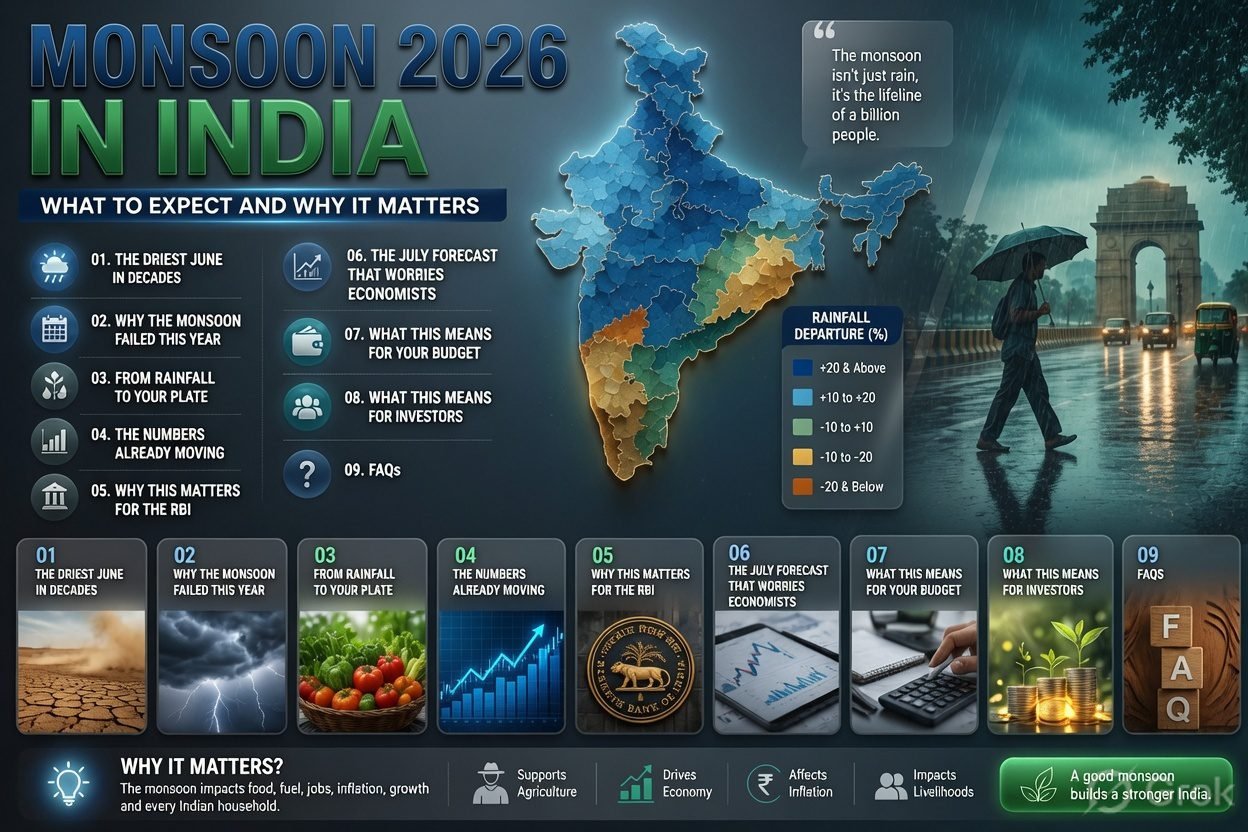

Monsoon 2026 India Inflation: Alarming Dry June Hits Grocery Bills
India just recorded its fifth-driest June since 1901. Food inflation is already climbing before the real damage even shows up. Here's the full, data-backed story of how a weak monsoon quietly rewrites your household budget.
Somewhere between a farmer checking the sky over a dry paddy field in central India and a shopper wincing at the price of tomatoes in a Mumbai market, there's a direct, almost mechanical line. That line is the monsoon. And this year, it's carrying a warning most households haven't noticed yet.
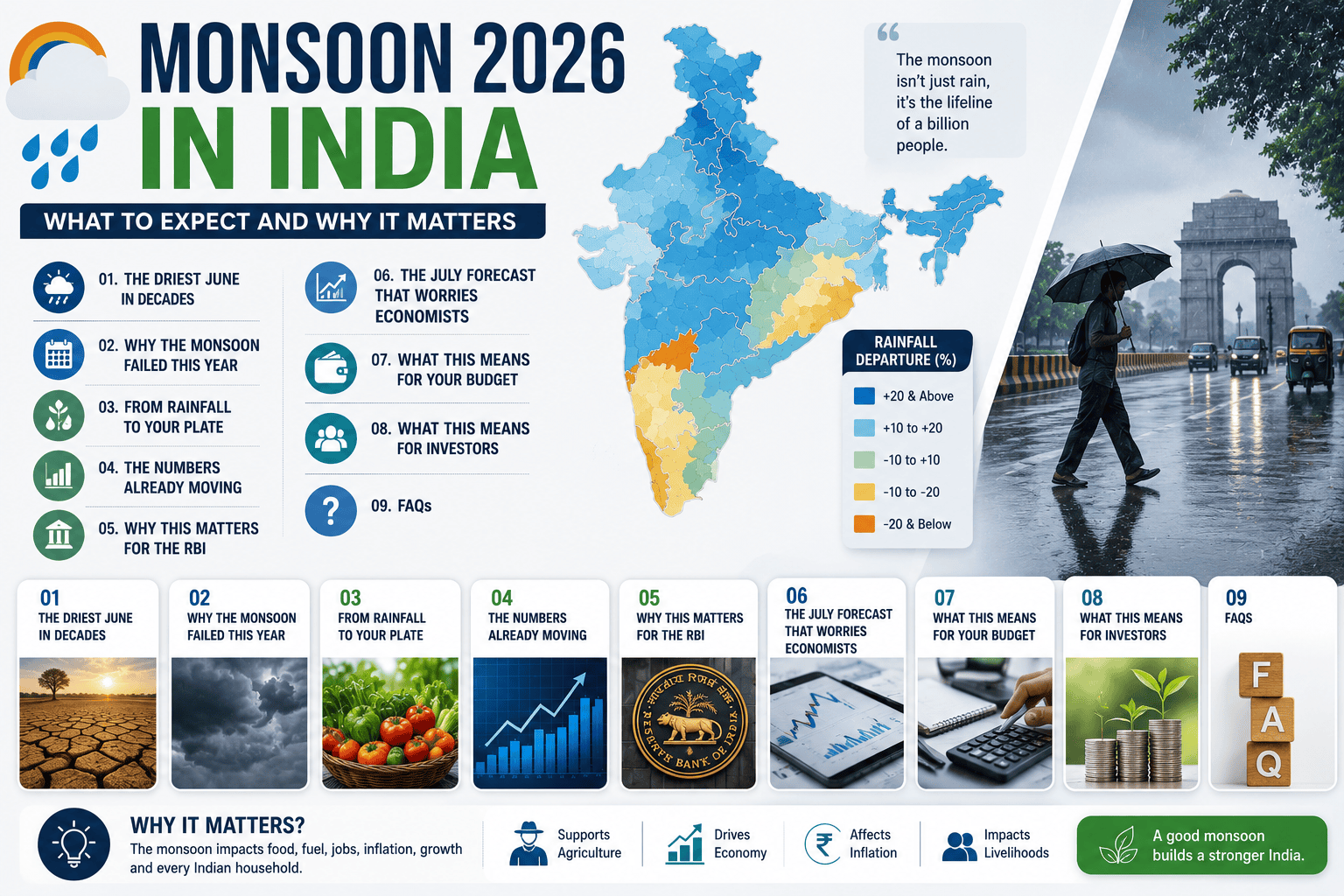
The Story, In Five Charts
Swipe / scroll →The Driest June in 5 Years
India received just 99.5mm rainfall in June — the 5th driest since records began in 1901.
Food Inflation Climbing
Food inflation (CFPI) rose 5 straight months — from 3.47% in Jan to 4.78% in May 2026.
Tomatoes React First
Tomato inflation jumped from 35.26% to 48.43% in a single month — vegetables move fastest.
Food's Outsized Weight
Food accounts for nearly 40% of India's CPI basket — the single biggest lever on headline inflation.
Testing the Comfort Zone
June CPI was polled at 4.3% by 37 economists — potentially breaking above the RBI's 4% target for the first time in 16 months.
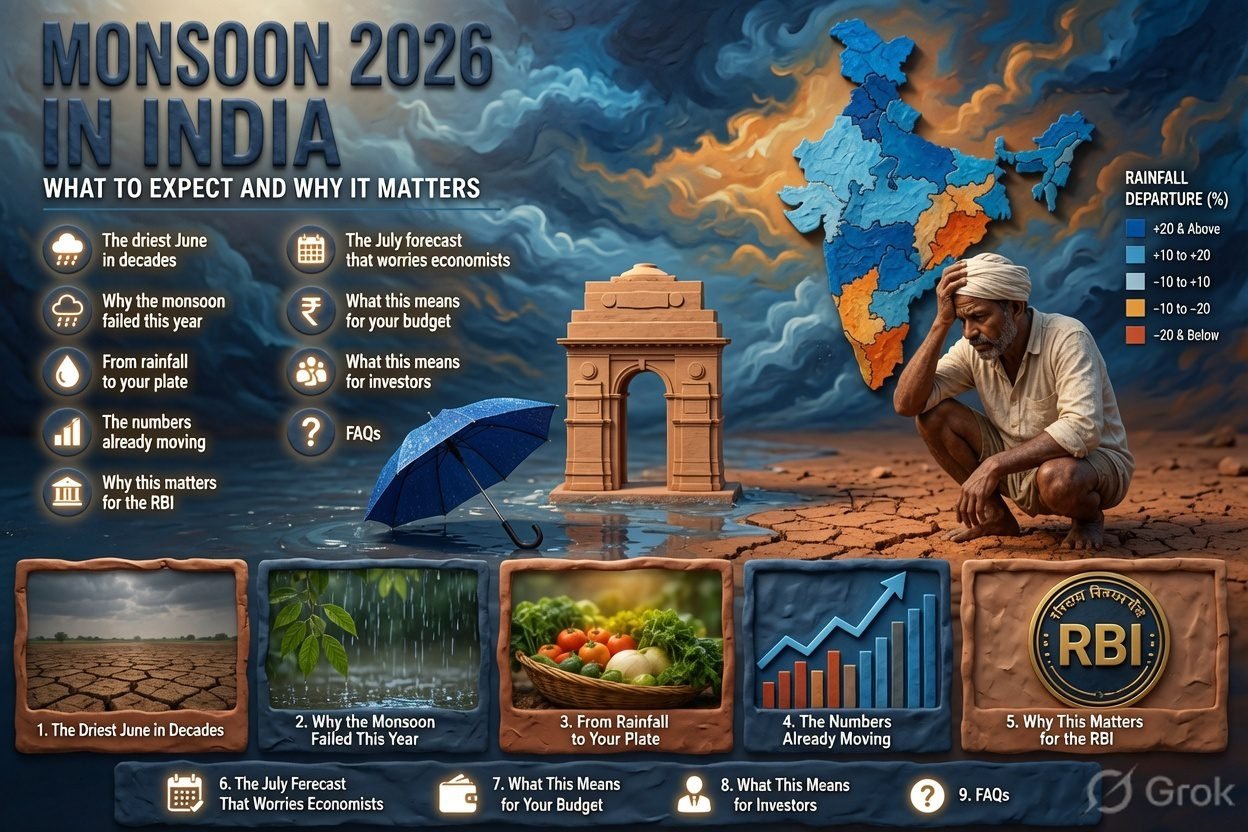
1. Monsoon 2026 India Inflation: The Driest June in Decades
Monsoon 2026 India inflation data is already showing warning signs, and it starts with the rainfall itself. June 2026 will be remembered by meteorologists for a while. India received just 99.5mm of rainfall for the month, roughly 40% below normal, making it the fifth-driest June since records began in 1901, according to Business Standard's coverage of the IMD's monthly outlook.
The regional breakdown is where the story gets uncomfortable for specific parts of the country. East and Northeast India recorded their lowest-ever June rainfall since 1901, at just 197.5mm. Central India, the country's kharif heartland, registered its seventh-driest June on record, with a rainfall deficit of 50.4%, according to official data from the India Meteorological Department.
Numbers like these aren't abstract. July typically contributes 32% of the entire seasonal monsoon total and is the critical sowing window for rain-fed kharif crops, particularly paddy, pulses, and oilseeds. A weak June already meant a lean start to sowing season across large parts of central India.
2. Why the Monsoon Failed This Year
IMD Director General Mrutyunjay Mohapatra pointed to a specific combination of factors behind June's shortfall, reported in detail by Down To Earth's climate coverage.
An unfavourable Madden-Julian Oscillation
The MJO is a moving system of wind, cloud, and pressure that circles the equator roughly every 30 to 60 days. In its favourable phase, it pushes extra cloud cover toward southern India, which the monsoon winds then carry northward. This year, the MJO sat in an unfavourable phase for much of June.
Missing low-pressure systems
Low-pressure systems act like magnets, pulling in moisture-laden winds and pushing the monsoon inland. June saw almost none of them, partly because most typhoons forming in the Pacific recurved north-northwest instead of feeding systems into the Indian Ocean.
El Niño's growing influence
El Niño conditions, characterized by warmer-than-usual sea temperatures in the central and eastern Pacific, are historically associated with weaker Indian monsoons. The IMD expects El Niño to strengthen through the rest of the season, while the Indian Ocean Dipole, which can sometimes counteract El Niño's drying effect, remains neutral, offering no offsetting boost.
3. From Rainfall to Your Plate: How a Weak Monsoon Becomes Food Inflation
Here's the part most people underestimate: the assumption that monsoon effects only show up after the harvest is, according to economists interviewed by Business Standard's detailed report on monsoon-inflation dynamics, simply wrong for two of the three major food categories.
Vegetables move within a week
Vegetables have short production cycles and almost no storage capacity. A rainfall disruption can reduce market arrivals and lift prices within days, not months.
Pulses react before the harvest even begins
Pulses respond in two stages. First, traders and markets price in weaker sowing acreage as soon as sowing data comes in, well before any crop reaches the ground. Second, actual arrivals confirm or correct that initial pricing once the harvest happens.
Cereals move the slowest
Government buffer stocks cushion cereal prices against short-term supply shocks, meaning cereals typically respond most gradually of the three categories, giving policymakers more room to manage the transition.
Vishrut Rana, Asia-Pacific senior economist at S&P Global Ratings, noted that disruptions have already hit oilseeds, groundnuts, cotton, and pulses like toor and moong, though India's foodgrain reserves could soften some of the immediate impact.
4. The Numbers Already Moving
This isn't a future risk. It's already visible in the data. India's headline CPI inflation has risen for five consecutive months in 2026, climbing from 2.74% in January to 3.93% by May, according to ChartForest's inflation tracking data.
| Item | April 2026 | May 2026 | Change |
|---|---|---|---|
| Headline CPI (YoY) | 3.48% | 3.93% | +45 bps |
| Food Inflation (CFPI) | 4.20% | 4.78% | +58 bps |
| Tomato Inflation | 35.26% | 48.43% | +13.2 pts |
| Ginger Inflation | 14.36% | 32.49% | +18.1 pts |
| Rural vs Urban Inflation | 4.25% (rural) vs 3.53% (urban) | ||
Not everything is rising. Potato prices are actually in deflation, down 23.71% year-on-year, a high-base effect from last year's bumper harvest. But the overall trend, according to Union Bank of India's economic research report, points firmly upward, with the bank revising its FY27 average inflation projection up to 5.1% from an earlier 4.50%.
5. Why This Matters for the RBI
The Reserve Bank of India operates within a 2% to 6% tolerance band, with a formal medium-term target of 4%. The monsoon 2026 India inflation story reached a new inflection point this week: a poll of 37 economists conducted between July 3 and July 9 put June's CPI reading at 4.3%, according to Prism News' economist survey coverage, which would mark the first time inflation has breached the RBI's 4% target in 16 months.
Importantly, a temporary food price bump alone doesn't automatically trigger a policy response. The RBI's real concern is persistence, whether elevated food prices start shaping broader inflation expectations across households and businesses. Official June inflation data is due for release on July 13, 2026, just two days from now, and will be the first hard confirmation of where this trend actually stands.
Rainfall distribution across key crop-producing regions, kharif acreage, reservoir storage, soil moisture, vegetable arrivals, and rural wage trends will all shape whether current inflation comfort holds or breaks down further into FY27.
6. The July Forecast That Worries Economists
July is the wettest month of the monsoon season, with a Long Period Average of 280.4mm based on 1971-2020 data. The IMD's outlook for this July projects rainfall below 94% of that average, according to a detailed IMD forecast analysis.
Some regions are expected to fare better than others. Northwest India, northeast India, east-central India, and the eastern peninsular region may see normal to above-normal rainfall. But most of the rest of the country, including large stretches of central India, where the kharif sowing damage from June is already visible, faces continued deficit conditions.
Above-normal daytime and nighttime temperatures are forecast across most of the country too, adding heat stress on top of water stress, a combination that tends to compound the pressure on both crop yields and reservoir levels feeding hydropower generation.
7. What This Means for Your Household Budget
For an average Indian household, the practical reality of monsoon 2026 India inflation shows up long before any economist's report reaches a headline. Food and beverages still represent a meaningful share of monthly spending, whether the official CPI weight is calculated at 36.75% under the new 2024-base series or the older 45.86% weighting. Either way, a sustained rise in vegetable and pulse prices shows up directly in a weekly grocery bill long before it appears in a quarterly GDP report.
Rural households are currently seeing the sharper edge of this, with rural inflation at 4.25% running noticeably above urban inflation at 3.53%. This matters because rural consumption also feeds into broader economic indicators, including FMCG sector demand and margins, where companies with heavy rural exposure are watching this exact monsoon story just as closely as any economist.
Building a dedicated buffer for predictable seasonal price swings, the same logic behind a sinking fund for festival expenses, can help absorb months where grocery costs run meaningfully above the household's usual budget line.
8. What This Means for Investors
A rising inflation trajectory changes the calculus for RBI rate decisions, which ripple through far more than just loan EMIs. Higher-than-expected inflation reduces the likelihood of near-term rate cuts, which affects everything from fixed deposit returns to how Nifty and Sensex price in future earnings expectations for rate-sensitive sectors like banking and real estate.
Currency dynamics matter here too. Persistent food inflation combined with global commodity pressures can influence rupee positioning, a theme covered in more depth in our Dollar Index explainer. Investors tracking how macro shocks ripple through equity markets more broadly may also find our piece on why markets react to macro news useful context for the weeks ahead.
Worth watching alongside this story
Gold has already had a dramatic 2026, partly on shifting global rate expectations. If India's own rate trajectory shifts in response to persistent food inflation, it's worth tracking against our coverage of gold's record run this year for the fuller macro picture.
9. FAQs
How bad was June 2026's monsoon rainfall in India?
India received 99.5mm of rainfall in June 2026, approximately 40% below normal, making it the fifth-driest June since nationwide records began in 1901. Central India was worst affected, with a 50.4% deficit.
Why does the monsoon affect India's inflation so much?
Food accounts for nearly 40% of India's CPI basket. Weak or delayed monsoon rainfall disrupts kharif crop sowing and vegetable supply, which pushes up food prices and, given food's large weight, directly lifts headline inflation.
What is India's current food inflation rate?
Food inflation (measured by the Consumer Food Price Index) stood at 4.78% year-on-year in May 2026, up from 4.20% in April, marking a fifth consecutive monthly increase in headline CPI overall.
Will the RBI raise interest rates because of this?
Not necessarily on food inflation alone. The RBI generally reacts when food inflation appears persistent or begins shaping broader inflation expectations, rather than responding to a single temporary spike. Official June CPI data, due July 13, 2026, will be a key data point. This is general information, not investment advice; consult a financial advisor for guidance specific to your situation.
What is the July 2026 monsoon forecast?
The IMD has forecast below-normal rainfall for July 2026, expected to come in below 94% of the Long Period Average, with above-normal temperatures across most of the country, following an already weak June.

- India Meteorological Department — Official monsoon information and forecasts
- Business Standard — Monsoon, food inflation and RBI policy analysis
- Trading Economics — India CPI inflation historical data
- ChartForest — India inflation rate breakdown and trends
- Focus Economics — India inflation historical context
- Down To Earth — Monsoon progress and July forecast analysis
- Prism News — Economist survey on June inflation expectations
- Union Bank of India — Economic research on food inflation trends

Pranab Barman is a Financial Educator and Personal Finance Researcher with over 10 years of hands-on experience in stock markets, trading, and investing. Currently enrolled in the CFA Program, he is committed to continuous learning and professional excellence in finance.
As the Founder of PlayWithStock, Pranab covers a wide range of topics including Mutual Funds, SIP, Taxation, Stock Market Basics, and Financial Calculators — with a focus on simplifying complex financial concepts for everyday all investors.
Email: support@playwithstock.com
Website: playwithstock.com
Related posts:
 What is the Dollar Index (DXY) and Why It Matters for India
 How Inflation Affects Your Stock Portfolio
 Record SIP Inflows June 2026: Indians Just Invested ₹31,781 Crore
 Fed Rate Hike 2026: Why the July 28-29 FOMC Meeting Could Change Everything
 Why Is the Stock Market Falling Today? US-Iran Tensions, Crude Oil Spike & FII Selling Explained
 India US Trade Deal 2026: Inside the Tariff Rollercoaster Before July 22
 Why Investors Lose Money: 7 Costly Mistakes to Avoid
 What is a Stock Split and Why Do Companies Do It