


What Are Life Cycle Funds? SEBI's Quiet New Mutual Fund Category
A brand-new mutual fund category just went live in India, and almost nobody's talking about it yet. Here's what a Life Cycle Fund actually is, how its glide path works, and why Zerodha already has one filed with SEBI.
Somewhere in a Zerodha compliance filing dated June 2026 sits a fund called "Life Cycle Fund 2041," waiting on final approvals nobody outside the industry has really noticed yet. That's usually how the most useful financial products arrive, quietly, buried in a circular, long before the marketing catches up. What are Life Cycle Funds, and why should you care before everyone else does? Here's the complete story.

The Glide Path, In Five Charts
Swipe / scroll →Equity Fades With Time
Equity exposure automatically glides down from up to 95% to as low as 5-20% as the target year nears.
Exit Load Ladder
Exit loads step down from 3% to zero over three years, enforcing genuine long-term holding.
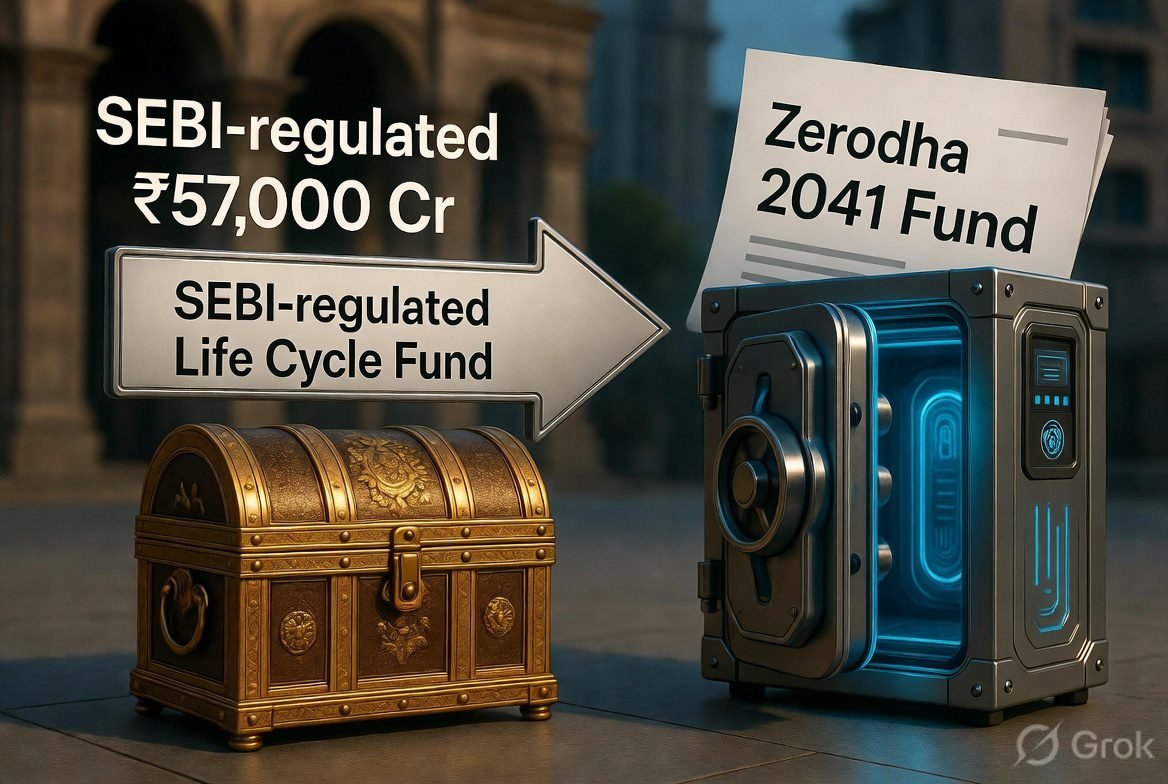
Zerodha's 2041 Fund
A real, filed Scheme Information Document already exists: Zerodha Life Cycle Fund 2041.
₹57,000 Cr Category Scrapped
Old "solution-oriented" retirement and children's funds are being retired in favor of this new category.
India's Target-Date Fund
Life Cycle Funds are India's regulated version of Target Date Funds, standard in US retirement accounts for decades.
1. What a Life Cycle Fund Actually Is
What are Life Cycle Funds in plain language? They're a new, open-ended mutual fund category, introduced through SEBI's circular on the Categorisation and Rationalisation of Mutual Fund Schemes, dated February 26, 2026. Each fund carries a fixed target maturity year, built directly into its name, like "Life Cycle Fund 2050," and follows a predefined glide path that automatically shifts the portfolio's equity-to-debt mix as that year approaches, according to Finnovate's detailed breakdown of the framework.
The core promise is genuinely simple: you pick a fund whose maturity year matches your goal, retirement, a child's education, a home purchase, twenty years out, and the fund handles every rebalancing decision from there. No manual switching, no timing calls, no remembering to shift from equity to debt as you age.
2. The Glide Path, Explained Simply
The glide path is the entire point of this product, and SEBI has been unusually specific about how it must work. Funds with 15 to 30 years remaining to maturity must hold roughly 65% to 95% in equity, prioritizing growth while there's still decades for compounding to smooth out volatility, according to Finplann's regulatory guide.
As the fund enters its middle years, roughly 5 to 15 years from maturity, equity exposure gradually narrows to a 35% to 65% range, with debt taking up more of the portfolio. In the final stretch, 1 to 5 years before maturity, equity drops sharply to 10% to 30%, with debt, restricted specifically to AA-rated or better instruments with residual maturity shorter than the fund's own target date, dominating at 65% to 85%. In the final year itself, equity can fall as low as 5% to 20%, prioritizing capital preservation above nearly everything else.
3. What It Replaces and Why
Life Cycle Funds aren't arriving in a vacuum. They directly replace the older "solution-oriented" mutual fund category, which covered retirement funds and children's funds, a segment SEBI discontinued as part of this same circular, according to Value Research's coverage, which pegged roughly ₹57,000 crore in existing assets across that old category.
The problem SEBI was solving is worth understanding. Those older solution-oriented schemes carried goal-based names, "retirement fund," "children's gift fund," that implied a structured, age-appropriate investment journey. In practice, many behaved almost identically to ordinary hybrid or balanced funds, with no genuine mechanism tying the portfolio's risk level to how close the investor actually was to their goal. Life Cycle Funds fix that gap by making the maturity-linked glide path mandatory and rule-based, not a marketing suggestion.
4. The Exit Load Rules
SEBI has built in a genuinely blunt financial discipline mechanism. Life Cycle Funds carry a graded exit load: 3% if you redeem within the first year, 2% within the second year, 1% within the third year, and nothing after that, according to ICICI Direct's regulatory summary.
| Time Since Investment | Exit Load |
|---|---|
| Within Year 1 | 3% |
| Within Year 2 | 2% |
| Within Year 3 | 1% |
| After Year 3 | Nil |
This is meaningful money on any sizeable investment, and it's designed that way deliberately. A fund built around a decades-long glide path only works if investors actually stay invested long enough for that glide path to matter. AMCs are also capped at a maximum of six Life Cycle Funds open for subscription at any given time, preventing the kind of product proliferation that partly motivated this entire regulatory overhaul in the first place.
5. A Real Example: Zerodha's 2041 Fund
Most explainers on this topic stay entirely theoretical. Here's something concrete: Zerodha Fund House has already filed a Scheme Information Document for a genuine, real "Zerodha Life Cycle Fund 2041," with its due diligence certificate submitted to SEBI on June 16, 2026, per the publicly available scheme documentation.
The fund's own risk disclosure describes its approach directly: the glide path itself is the primary risk management mechanism, with equity exposure reducing and debt exposure increasing as the scheme approaches its 2041 target date, diversifying across equity, debt, gold, silver, and InvITs along the way. This isn't a hypothetical product category anymore. Fund houses are actively building and filing real, specific schemes right now, well ahead of most retail investors even knowing this category exists.

6. How It Differs From Hybrid and Balanced Advantage Funds
It's easy to confuse Life Cycle Funds with existing hybrid or Balanced Advantage Funds, but the underlying logic is genuinely different. Balanced Advantage Funds shift their equity-debt mix based on market valuations, becoming more conservative when markets look expensive and more aggressive when they look cheap, regardless of any specific target date.
Life Cycle Funds shift purely based on the calendar, not market conditions. If you're retiring in 2050, the fund stays aggressive through market swings in 2035 and only begins its defensive shift as 2045, 2046, 2047 actually arrive, regardless of whether markets happen to look cheap or expensive at that moment. For genuinely goal-based, time-horizon-driven investing, this is arguably a cleaner mechanism than a valuation-based approach, since your actual proximity to a goal doesn't change based on where the market happens to be trading.
7. Who Should Actually Consider One
Life Cycle Funds make the most sense for long-horizon goal investors, retirement, a child's education, a home purchase five to thirty years out, who want a genuinely "set it and forget it" solution without having to manually manage the equity-to-debt transition themselves. First-time investors who feel overwhelmed by asset allocation decisions, or anyone who's watched their own emotions get in the way of rebalancing at the right time, are natural candidates too.
Readers newer to structuring long-term financial goals at all may find our beginner investing guide a useful starting point before evaluating a specific product like this one, and pairing any Life Cycle Fund allocation with a broader budgeting framework like our 50/30/20 rule can help ensure the contribution amount stays sustainable across decades, not just the first excited year.
Part of a bigger 2026 story
This launch sits inside the same SEBI overhaul that also reshaped expense ratios and portfolio overlap rules across the industry, arriving in the same season as India's largest-ever AMC listing, our coverage of the SBI Mutual Fund IPO, and a genuinely record month for retail participation covered in our piece on June's record SIP inflows.
8. The Honest Caveats
Life Cycle Funds carry zero performance track record, since the category is brand new. Different AMCs will execute their glide paths differently within SEBI's allowed bands, meaning two "2050" funds from different fund houses won't necessarily hold identical portfolios. They also don't qualify for Section 80C tax benefits, unlike ELSS funds, and expected direct-plan expense ratios in the 1.0% to 1.8% range may exceed what a hands-on investor could achieve building an equivalent DIY mix of flexi-cap, debt, and gold ETFs manually.
The exit load structure is also genuinely punishing for anyone whose timeline might shift. If there's real uncertainty about whether you'll need the money within three years, the 3-2-1% exit load ladder can cost meaningfully more than simply rebalancing a traditional portfolio yourself would. Given the total absence of live performance history, most thoughtful commentary, including from GoPocket's analysis, suggests waiting for two to three years of actual results before treating any single Life Cycle Fund as a proven, reliable long-term vehicle.
Real-World Example
Consider an investor in their early 30s planning for retirement around 2056. Under the old system, they might have bought a generic "retirement fund" whose actual portfolio behaved unpredictably, potentially remaining just as equity-heavy at 55 as it was at 30, with no rules forcing a genuine transition toward safety as retirement approached. Under a Life Cycle Fund 2055 structure, the same investor's portfolio is contractually required to glide from an aggressive 65-95% equity range in their 30s down toward a defensive 10-30% range in their mid-50s, entirely automatically, without a single manual switch or a moment of market-timing anxiety along the way. Whether that specific fund outperforms a hand-built DIY alternative over three decades remains genuinely unknown, since no Life Cycle Fund has existed long enough to prove it either way. That uncertainty is exactly why understanding the mechanism now, while the category is still new and largely uncovered, matters more than chasing any single fund's early marketing. Readers thinking about how this fits alongside other long-term, tax-advantaged products may find our comparison of term insurance versus endowment plans useful for rounding out a complete goal-based financial plan, and anyone managing IPO or fund applications alongside long-term SIPs should also keep the ITR filing deadline in mind each year. More coverage is available in our Personal Finance category and Stock Market category, and our piece on why investors lose money covers many of the same emotional rebalancing mistakes that Life Cycle Funds are specifically designed to remove from the equation entirely.
9. FAQs
What is a Life Cycle Fund in simple terms?
A Life Cycle Fund is a new SEBI-regulated mutual fund category with a fixed target maturity year and an automatic glide path that shifts the portfolio from equity-heavy to debt-heavy as that year approaches, similar to a Target Date Fund used in international retirement accounts.
When did SEBI introduce Life Cycle Funds?
SEBI introduced Life Cycle Funds through its Categorisation and Rationalisation of Mutual Fund Schemes circular dated February 26, 2026, replacing the older solution-oriented retirement and children's fund category.
What is the exit load on Life Cycle Funds?
Life Cycle Funds carry a graded exit load of 3% within the first year, 2% within the second year, 1% within the third year, and no exit load after three years.
Do Life Cycle Funds qualify for tax deductions under Section 80C?
No. Life Cycle Funds are a separate category without ELSS tax-saving status, unlike dedicated tax-saving mutual funds. This is not tax advice; consult a qualified financial advisor for guidance specific to your situation.
Are Life Cycle Funds a good investment right now?
Because the category is brand new with no live performance history, many analysts suggest waiting two to three years to see how different fund houses execute their glide paths before committing significant capital. This is not investment advice; consult a SEBI-registered financial advisor before investing.

- Finnovate — Life Cycle Funds rules, exit loads, and glide path
- ICICI Direct — Regulatory framework summary
- Value Research — Simple guide to the new category
- Finplann — Complete glide path and allocation rules
- Anand Rathi — Investor explainer on glide path mechanics
- GoPocket — Practical caveats and considerations
- SEBI — Official mutual fund regulatory framework
- AMFI — Indian mutual fund industry association

Pranab Barman is a Financial Educator and Personal Finance Researcher with over 10 years of hands-on experience in stock markets, trading, and investing. Currently enrolled in the CFA Program, he is committed to continuous learning and professional excellence in finance.
As the Founder of PlayWithStock, Pranab covers a wide range of topics including Mutual Funds, SIP, Taxation, Stock Market Basics, and Financial Calculators — with a focus on simplifying complex financial concepts for everyday all investors.
Email: support@playwithstock.com
Website: playwithstock.com
Related posts:
 SBI Mutual Fund IPO 2026: Dates, Price Band, GMP & Should You Apply
 SBI Mutual Fund IPO Opens Tomorrow: Everything Before You Apply
 Mutual Fund BER vs TER Calculator (2026): Compare BER vs TER Online
 How to Set Up a Sinking Fund for Festival Expenses
 Term Insurance vs Endowment Plan: Which is Better for Beginners in 2026
 Record SIP Inflows June 2026: Indians Just Invested ₹31,781 Crore
 ITR-4 Investment Disclosure Calculator: New 2026 Rule for Presumptive Taxpayers
 GST 2.0 for E-commerce Sellers (2026): Complete Guide