
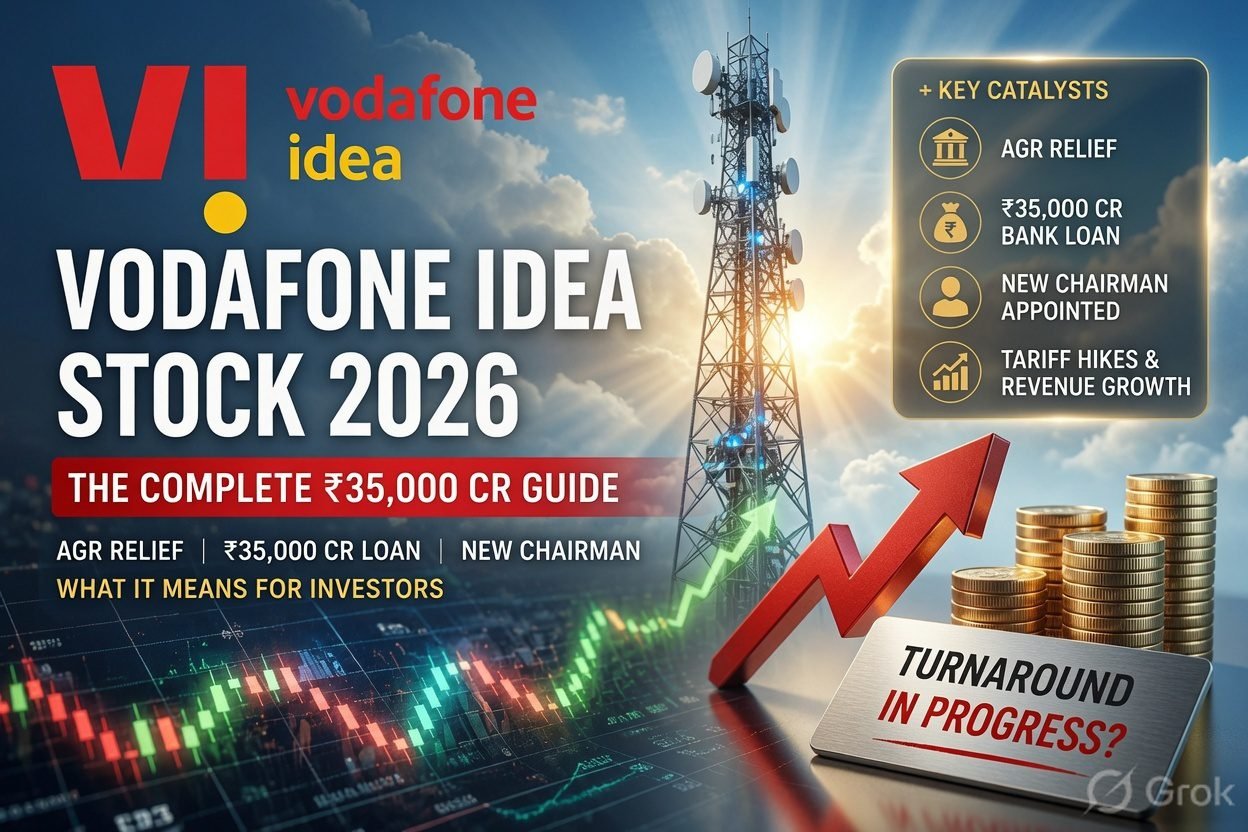

Vodafone Idea Stock 2026: The Complete ₹35,000 Crore Guide
A near-death telecom company just posted a ₹51,970 crore quarterly "profit," a Birla is chairman again, and banks are talking about a ₹35,000 crore loan. Here's what's real and what isn't.
A stock that traded below ₹7 a year ago is now the subject of serious ₹35,000 crore loan negotiations. That alone tells you something changed.
- What Actually Happened
- The AGR Relief That Changed Everything
- Breaking Down the ₹35,000 Crore Loan
- The Q4 Numbers, Decoded
- Is the Subscriber Bleeding Finally Stopping?
- Why Retail Traders Love This Stock
- Bull Case vs Bear Case
- What Analysts Are Actually Saying
- 2026 Catalyst Timeline
- The Risk Nobody Says Loud Enough
- Should You Buy Vodafone Idea Stock?
- FAQs
Vodafone Idea stock has done something almost no large-cap turnaround story manages: it went from being written off entirely to being one of the most actively traded names on the NSE, up over 91% in a year, while the underlying company still has a negative book value. That combination — a soaring share price sitting on top of a genuinely damaged balance sheet — is exactly why Vodafone Idea stock generates so much noise and so little agreement among analysts.
So let's cut through it. What actually happened in 2026, what the ₹35,000 crore loan really means, and whether any of this justifies the rally — or whether Vodafone Idea stock is simply doing what distressed telecom names have done before: running hard on hope, right before reality catches up.
What Actually Happened
Three things converged this year, and none of them happened by accident. First, the government finally reassessed Vodafone Idea's AGR dues and cut them by 27%. Second, Kumar Mangalam Birla returned as Non-Executive Chairman in May, sending a clear signal that the Aditya Birla Group hasn't walked away. Third, and most consequentially for the stock, an SBI-led consortium of banks started serious talks on a ₹35,000 crore funding package — the first real sign in years that lenders might actually be willing to bet on Vi's survival.
None of these events alone would have moved Vodafone Idea stock this much. Together, they rewrote the near-term survival story — even if the long-term profitability story remains genuinely unresolved.
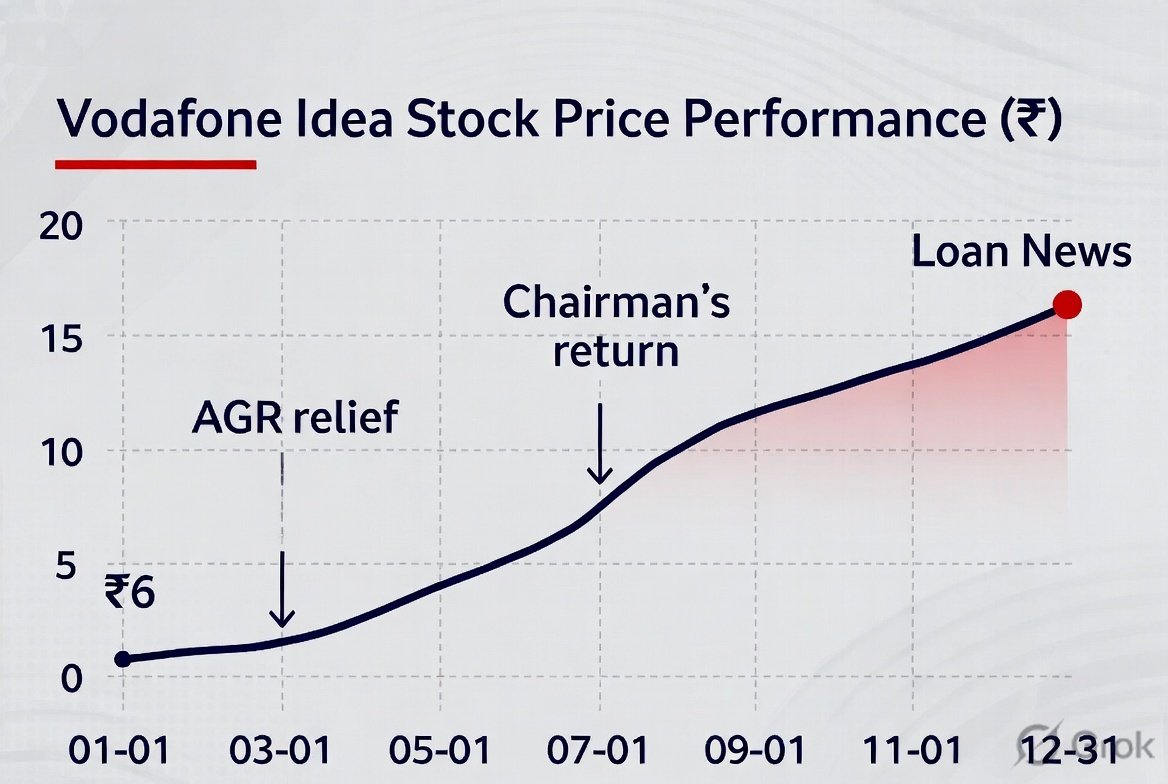
The 12-month chart tells a story of a stock that spent most of last year near delisting fears and most of this year rallying on relief news.
The AGR Relief That Changed Everything
AGR — Adjusted Gross Revenue — dues are the statutory licence and spectrum fees telecom companies owe the government. For years, this was the single biggest overhang on Vodafone Idea stock, a liability so large it threatened the company's very existence. In early May 2026, the Department of Telecommunications finally finalised a reassessment, cutting Vi's AGR liability from ₹87,695 crore to ₹64,046 crore — a 27% reduction — and, just as importantly, spreading repayment out with a moratorium stretching into FY32 through FY41.
The accounting impact was dramatic. Vodafone Idea derecognised a large chunk of the old liability and booked an exceptional gain of roughly ₹55,600 crore in Q4 FY26 alone. That's the source of the eye-popping ₹51,970 crore quarterly profit headline you may have seen — it's real in an accounting sense, but it's a one-time balance sheet adjustment, not operating cash flow, and it's important not to mistake the two.
Breaking Down the ₹35,000 Crore Loan
Here's the structure, as reported: Vodafone Idea is seeking roughly ₹25,000 crore as a term loan for capital expenditure, plus another ₹10,000 crore in short-term working capital and non-fund-based facilities. State Bank of India is expected to lead the consortium. For context, banks currently have only about ₹4,000 crore of exposure to Vi — so this would represent a massive expansion of lender risk appetite, not a modest top-up.
| Component | Amount | Purpose |
|---|---|---|
| Term Loan | ~₹25,000 crore | Network capex, 5G rollout |
| Working Capital / Non-Fund | ~₹10,000 crore | Short-term liquidity, guarantees |
| Total | ~₹35,000 crore | Combined funding ask |
Sources close to the negotiations say the money is earmarked strictly for capex — not for paying down AGR dues — and that approval could take three months or longer as lenders run detailed due diligence. That timeline matters for anyone tracking Vodafone Idea stock closely: this isn't a done deal yet, it's a deal in progress, and progress isn't the same as closure.

SBI's willingness to lead the consortium is being read by the market as the single biggest confidence signal of 2026.
The Q4 Numbers, Decoded
Strip out the accounting gain, and the operating story is genuinely improving, if slowly. Revenue for FY26 came in at ₹44,789 crore, up 3.1% year-on-year. ARPU — average revenue per user, the single most-watched metric in Indian telecom — rose to ₹190 in Q4 FY26 from ₹175 a year earlier, an 8.3% jump driven by customers upgrading their plans rather than a tariff hike.
For FY26 as a whole, Vodafone Idea reported a net profit of ₹34,552 crore, a sharp reversal from a ₹27,383 crore loss in FY25 — though, again, that swing is dominated by the AGR accounting adjustment rather than operations suddenly turning wildly profitable.
Is the Subscriber Bleeding Finally Stopping?
This is arguably the more important number for anyone evaluating Vodafone Idea stock on fundamentals rather than headlines. The company's subscriber base has been shrinking for years, losing ground steadily to Reliance Jio and Bharti Airtel. But something shifted in early 2026: monthly net subscriber additions turned positive in February, and between February and May, Vi added a cumulative 2,99,372 net subscribers.
It's a small number in absolute terms — total subscribers still sit around 192.8 million, down from over 400 million at the time of the 2018 merger — but the direction matters more than the magnitude right now. A company that stops losing customers is a fundamentally different investment case than one still bleeding market share every quarter.
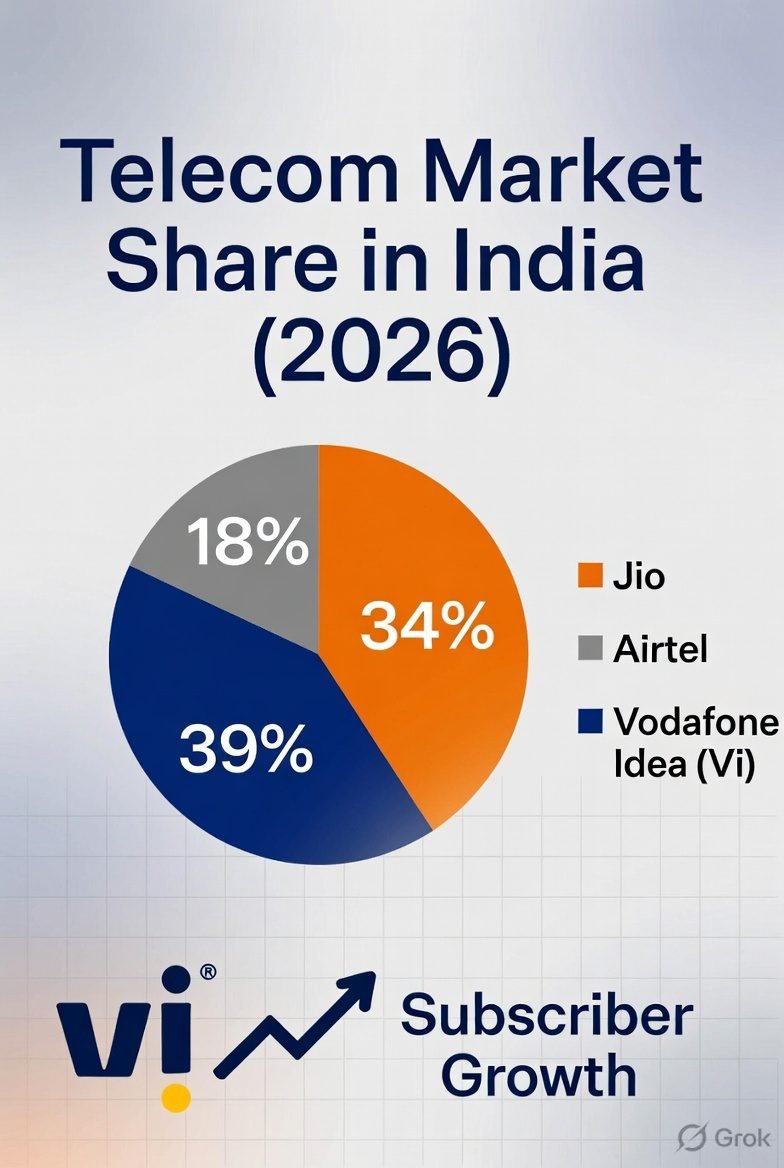
Vi's ~18% market share still trails Jio's ~39% and Airtel's ~34% by a wide margin.
Why Retail Traders Love This Stock
Part of the Vodafone Idea stock story has nothing to do with fundamentals at all. At roughly ₹14 a share, it's one of the few large, liquid names on the NSE that a retail trader with a modest account can buy in genuinely large quantities — thousands of shares for a few thousand rupees. That accessibility, combined with daily trading volumes routinely running into hundreds of millions of shares, has turned Vodafone Idea stock into a favourite for short-term traders chasing volatility rather than long-term investors chasing dividends.
That dynamic cuts both ways for Vodafone Idea stock. High retail participation can amplify rallies on good news, exactly what happened around the AGR relief and chairman announcement. It can just as easily amplify a sell-off if sentiment turns, since a large share of daily volume isn't anchored to any fundamental view of fair value in the first place.
Bull Case vs Bear Case
The Bull Case
- AGR overhang genuinely reduced, with repayments deferred over a decade
- ₹35,000 crore loan, if closed, funds a real 5G capex catch-up
- Subscriber additions turned positive for the first time in years
- ARPU rising on upgrades, ahead of any tariff hike
- Promoter (Birla Group) putting fresh capital in, not walking away
The Bear Case
- Book value remains negative — the company is still technically insolvent on paper
- Loan is not yet closed; approval could still take months and isn't guaranteed
- Spectrum dues of ₹7,000–28,000 crore due FY27–FY29, on top of everything else
- Government owns ~49%, meaning your upside is diluted by a non-commercial shareholder
- Market share gap to Jio and Airtel keeps widening even as losses slow
What Analysts Are Actually Saying
The brokerage view on Vodafone Idea stock is cautiously mixed, and it's worth reading the caution carefully rather than skipping to the target price. Citi and Morgan Stanley have both said Vodafone Idea stock is better placed to close the bank funding now that regulatory uncertainty has eased. ICICI Securities noted the company doesn't expect a cash-flow mismatch over the next three years, which is a meaningfully different statement than "the company is healthy" — it's a statement about near-term survival, not long-term value creation.
| Brokerage | View |
|---|---|
| Citi | Better placed to close ₹25,000 cr debt raise; flags 15% revenue CAGR assumption as aggressive |
| JM Financial | Modestly raised estimates on stronger ARPU, lower subscriber losses |
| ICICI Securities | No cash-flow mismatch expected over 3 years; trimmed FY27-28 EBITDA estimates 6-11% on delayed tariff hike |
| Nomura | Successful bank funding closure seen as key positive catalyst |
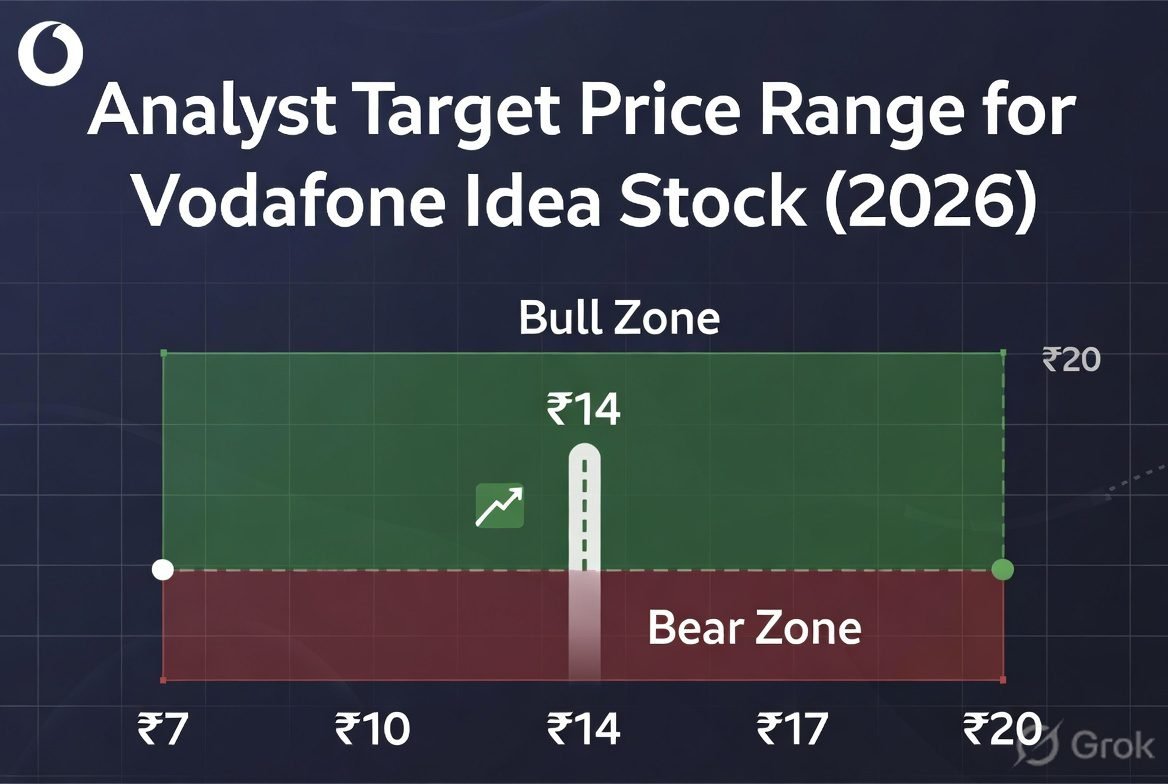
Most publicly cited target prices cluster in the ₹10–14 range — which, from a stock already trading near ₹14, implies limited near-term upside according to several brokerages, even among those turning more constructive. A minority of bullish scenarios point toward ₹12–14 sustaining or extending if tariff hikes and funding both land well; the more bearish downside case points back toward ₹7–8 if either of those pillars wobbles.
2026 Catalyst Timeline
Union Cabinet approves AGR relief package — freeze plus five-year moratorium framework announced.
DoT finalises reassessed AGR dues at ₹64,046 crore, down 27% from ₹87,695 crore.
Kumar Mangalam Birla takes over as Non-Executive Chairman.
Stock hits a fresh 52-week high of ₹13.64 on Q4 results and funding optimism.
EGM approves ₹4,730 crore warrant issue to Aditya Birla Group entity Suryaja Investments.
SBI-led consortium continues due diligence on the ₹35,000 crore loan package.
The Risk Nobody Says Loud Enough
Every bullish note on Vodafone Idea stock eventually gets to the same caveat, usually buried a few paragraphs in: the loan isn't closed yet. Banks have not agreed to a single lead lender structure, which means broad consortium participation is a precondition, not a formality. Due diligence timelines of three months or more can easily stretch further, and there's no contractual guarantee the full ₹35,000 crore materialises on the terms currently being discussed.
Layer on top of that: total funding needs over the next three years exceed ₹1 trillion once spectrum dues are included, according to ICICI Securities. The bank loan, even if it closes in full, covers a meaningful slice of that — not all of it. Anyone treating Vodafone Idea stock as a settled turnaround story rather than a story still very much in progress is skipping past the part that actually determines the outcome.
Should You Buy Vodafone Idea Stock?
Honestly? That depends entirely on what kind of investor you are, and this is genuinely not a stock where a generic answer serves you well. If you're looking for a stable, dividend-paying compounder, this isn't it — negative book value and an unresolved capital structure rule that out. If you understand distressed-turnaround investing, size positions accordingly, and can stomach the possibility of a total loss alongside the possibility of a further multi-bagger move, Vodafone Idea stock at least now has a coherent bull case behind it — which is more than could be said a year ago.
What it isn't, under any reading of the current situation, is a low-risk bet. Treat it as speculative, size it like something speculative, and don't mistake a quarter of accounting-driven profit for a company that has fully turned the corner.
FAQs: Vodafone Idea Stock
No, it's still under negotiation. An SBI-led consortium is conducting due diligence, and full approval is expected to take three months or longer from when talks gained momentum in May 2026.
The FY26 profit was driven overwhelmingly by a one-time accounting gain from the AGR dues reassessment, not from improved operating cash flow. The underlying business is improving but remains far from consistently profitable on an operating basis.
Most publicly cited targets cluster between ₹10 and ₹14, implying limited near-term upside from current levels around ₹14, with bearish scenarios pointing toward ₹7–8 if funding or tariff catalysts disappoint.
Monthly net subscriber additions turned positive starting February 2026, with roughly 2,99,372 net additions between February and May 2026 — a meaningful reversal after years of decline.
The Indian government holds roughly 49% currently, making it the largest shareholder. This could reduce slightly toward 47% if the Aditya Birla Group's warrants fully convert.
Yes. Negative book value, an unresolved multi-year funding requirement exceeding ₹1 trillion, and dependence on an unclosed bank loan make this a speculative, high-volatility stock rather than a stable long-term holding.
References: Multibagg AI: Vodafone Idea Funding & AGR Relief · Multibagg AI: SBI Debt Funding Talks · Business Standard: Brokerage Views on Vi · Goodreturns: ₹35,000 Crore Fundraise Plan · Upstox: AGR Dues Cut Details · Tickertape: Vodafone Idea Financials · Acumen: Vodafone Idea Share Price Outlook

Pranab Barman is a Financial Educator and Personal Finance Researcher with over 10 years of hands-on experience in stock markets, trading, and investing. Currently enrolled in the CFA Program, he is committed to continuous learning and professional excellence in finance.
As the Founder of PlayWithStock, Pranab covers a wide range of topics including Mutual Funds, SIP, Taxation, Stock Market Basics, and Financial Calculators — with a focus on simplifying complex financial concepts for everyday all investors.
Email: support@playwithstock.com
Website: playwithstock.com
Related posts:
 Record SIP Inflows June 2026: Indians Just Invested ₹31,781 Crore
 Trump Accounts Explained: The $1,000 Baby Bonus Already Reaching 6 Million Kids
 India Crypto Tax Notices: 44,000 Investors Just Got a Letter
 What is a Demat Account? A Complete Beginner’s Guide
 What Is Circuit Breaker Stock Market: Meaning, Limits & 2026 Update
 ITR Refund Status Kaise Check Kare 2026: The Complete Step-by-Step Guide
 SIP Compounding Calculator 2026: The Complete Guide
 SGB Redemption Tax Calculator 2026: The Complete Guide