
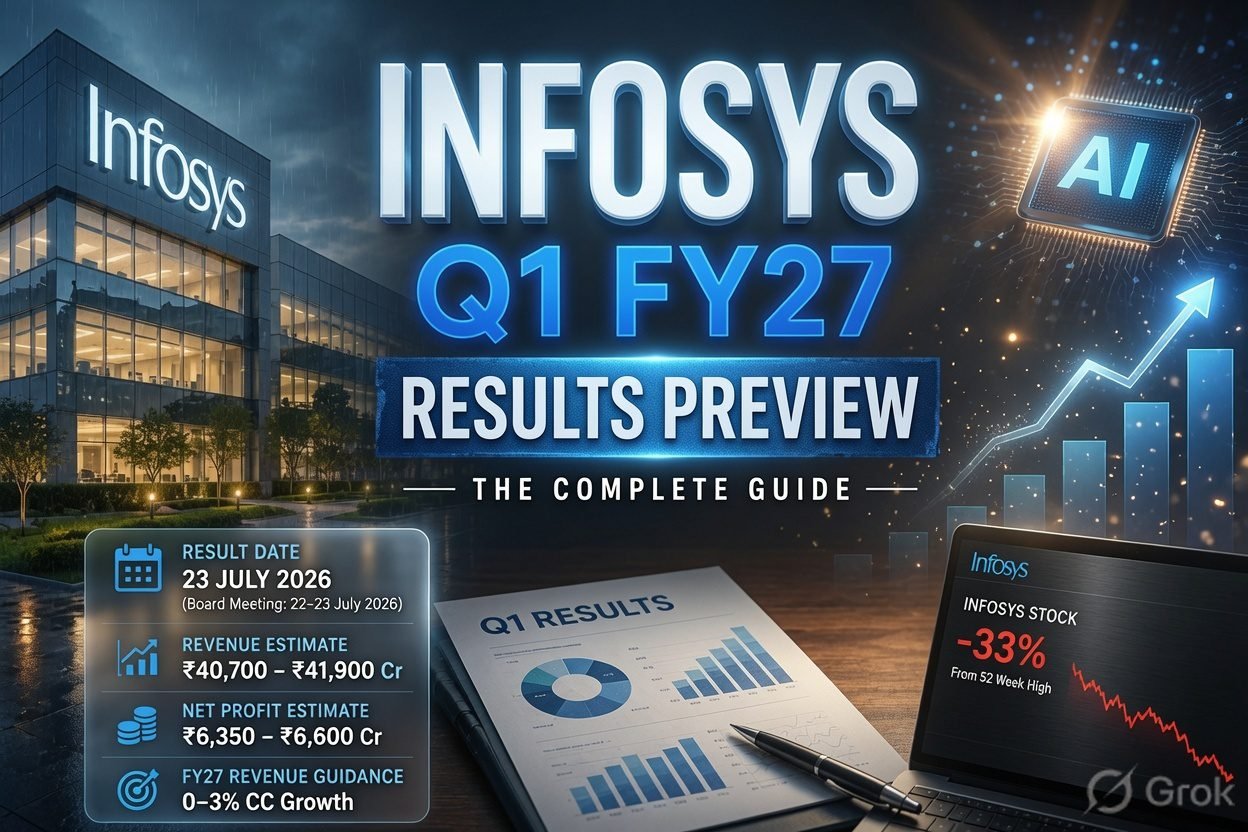

Infosys Q1 FY27 Results Preview: What to Watch on 23 July
Infosys is down roughly a third from its 52-week high, trading at its cheapest valuation in years, while profit keeps climbing. Here's exactly what the company needs to show on results day to change that story.
A ₹4.3 lakh crore company trading at its cheapest multiple in years — results day just got more interesting than usual.
- When and How Results Will Be Announced
- What Q4 FY26 Told Us: The Baseline
- FY27 Guidance: The Bar Infosys Set for Itself
- A Year of Gradually Improving Numbers
- Four Things Analysts Are Actually Watching
- The Numbers the Market Expects
- AI: From Pilots to Production Revenue
- How Infosys Compares to Peers Reporting This Week
- Why the Stock Is Down 33% Even as Profit Grows
- What Happens After 23 July: Three Scenarios
- FAQs
Infosys Q1 FY27 results land on 23 July 2026, and the setup this time is genuinely more interesting than a routine quarterly print. India's second-largest IT services company is sitting on a stock price down roughly a third from its 52-week high, a price-to-earnings ratio near 15 — cheap by its own historical standards — while its actual profit has kept growing double digits. That gap between "the business is fine" and "the stock hasn't been fine" is exactly what makes this particular results day worth watching closely, whether you already hold the stock or are deciding whether this is finally the entry point.
This isn't a results recap — Infosys hasn't reported yet at time of writing. This is what to actually watch for, built from the company's own guidance, analyst previews, and the specific numbers that will move the stock either way.
When and How Results Will Be Announced
Infosys's board meets on 22-23 July 2026 to approve the consolidated and standalone financial results for the quarter ended 30 June 2026, with the results typically released after Indian market hours on the 23rd, followed by an investor and analyst call the same day. The company's trading window for designated employees and insiders has been closed since 16 June 2026 and reopens on 27 July, standard practice ahead of a results announcement under SEBI's insider trading regulations.
Because Infosys reports after Indian hours, and given its NYSE-listed ADR, a meaningful chunk of the initial market reaction to the numbers plays out during the US trading session before Indian markets get to react the next morning — worth keeping in mind if you're tracking this in real time rather than waiting for the next day's opening bell.
What Q4 FY26 Told Us: The Baseline
To judge Q1 FY27 properly, you need the actual starting point. Infosys closed FY26 having crossed the $20 billion revenue mark for the first time, with full-year revenue of $20,158 million, up 3.1% in constant currency. Reported IFRS operating margin came in at 20.3%, with the adjusted figure at 21.0%. Free cash flow generation was healthy at $3,733 million, and the company signed large deals worth a combined $14.9 billion in total contract value across the year, with 55% of that representing genuinely new business rather than renewals.
| Metric | FY26 Full Year | Q4 FY26 (Latest Quarter) |
|---|---|---|
| Revenue | $20,158 million (+3.1% CC) | $5,040 million (+4.1% YoY CC) / ₹46,402 crore |
| Operating Margin | 20.3% reported / 21.0% adjusted | 20.9% |
| Net Profit | EPS +11.0% in INR terms | ₹8,501-8,509 crore (+20.9% YoY) |
| Large Deal TCV | $14.9 billion (55% net new) | — |
| Free Cash Flow | $3,733 million | — |
Notice that Q4 FY26 was actually the strongest quarter of the full year on a growth basis — 4.1% year-on-year constant currency growth, ahead of the 1.1% quarter-on-quarter pace analysts had modelled going into it. That "beat the trend" quarter is exactly why the bar for Q1 FY27 sits a little higher than a simple continuation would suggest.
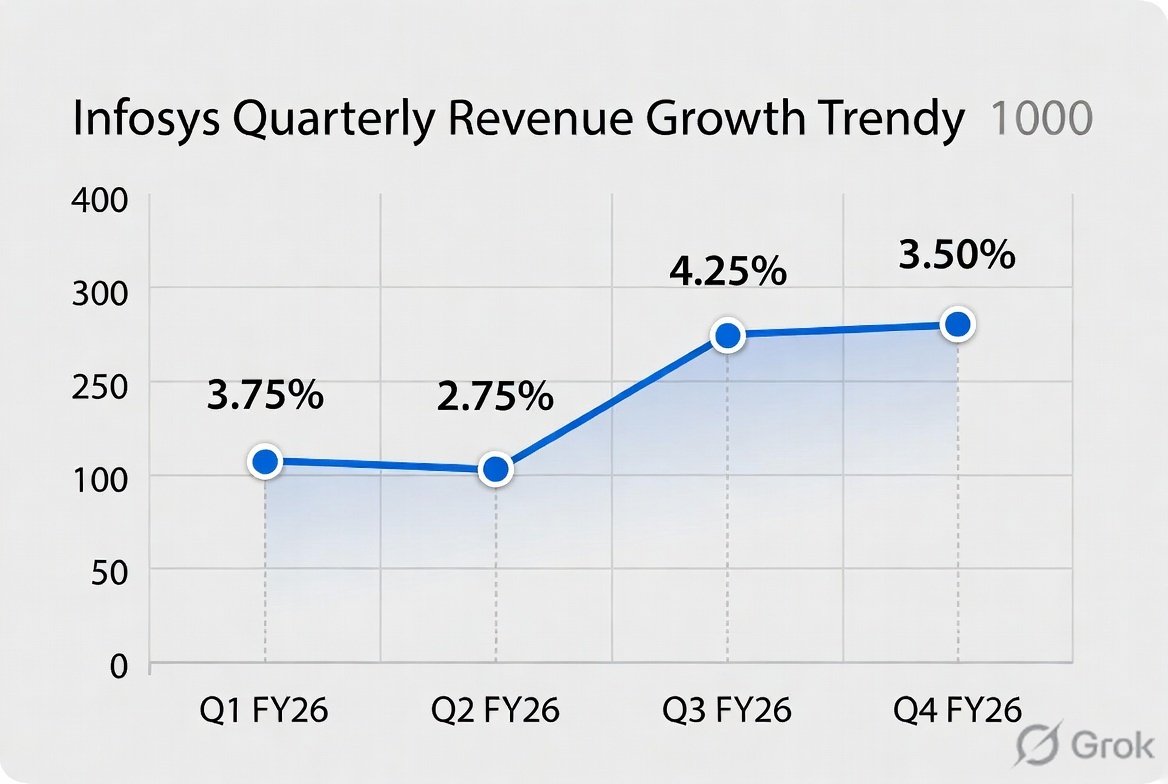
Growth accelerated through FY26 — the question is whether Q1 FY27 continues that trend or resets it.
FY27 Guidance: The Bar Infosys Set for Itself
Alongside its Q4 FY26 results on 23 April 2026, Infosys issued formal FY27 guidance of 1.5-3.5% revenue growth in constant currency, with an operating margin band of 20-22% on an IFRS basis. This is the company's own published outlook, not an analyst estimate — and it's a genuinely useful yardstick because it means every quarter through FY27 gets measured against a number management chose to commit to publicly.
A 1.5-3.5% full-year growth range is not, by historical Infosys standards, an aggressive target — it reflects a company still navigating a global IT spending environment where clients, particularly in the US and Europe, remain selective and cost-conscious rather than expanding budgets freely. The margin band of 20-22% suggests management expects to hold profitability roughly where it's been, rather than promising expansion — a reasonably conservative stance given persistent wage inflation and continued AI-related investment spending.
A Year of Gradually Improving Numbers
Context from the last four reported quarters helps frame why Q1 FY27 carries the weight it does. Through FY26, Infosys's quarter-on-quarter constant-currency growth rate actually trended upward across the year rather than staying flat — starting the year cautiously, then building toward that 4.1% year-on-year Q4 print, the strongest of the four quarters. That trajectory is part of why analysts modelled Q1 FY27 optimistically in the first place: a company whose growth rate has been quietly accelerating for several consecutive quarters has earned at least some benefit of the doubt heading into the next print.
Q3 FY26 specifically delivered $5,099 million in revenue, up 1.7% year-on-year and 0.6% sequentially in constant currency, alongside large deal wins worth $4.8 billion with 57% net new — a quarter management itself characterised as demonstrating resilience rather than dramatic acceleration. Reported operating margin that quarter came in at 18.4%, adjusted margin at 21.2%, illustrating how much the reported-versus-adjusted margin gap can move quarter to quarter depending on one-off items, a detail worth watching again in the Q1 FY27 print rather than reacting purely to whichever headline number gets quoted first.
Four Things Analysts Are Actually Watching
There's a fifth, quieter watchpoint too: headcount. Infosys reported a headcount reduction of 1,200 in the prior quarter, part of a continued push toward automation-driven efficiency. Whether that trend continues or reverses into net hiring says something concrete about how confident the company actually is in near-term demand, beyond whatever tone management strikes on the earnings call itself.
The Numbers the Market Expects
Market consensus is looking for Q1 FY27 revenue in the region of ₹41,000 crore, which would represent sequential growth broadly consistent with the FY27 guidance band once translated from constant-currency terms into rupee figures (itself affected by currency movements over the quarter). Analyst commentary published ahead of the results specifically frames this as a shift in narrative — from "macro headwinds," the dominant framing through much of FY26, toward "micro execution," meaning the story is now less about whether the industry environment is difficult (it clearly still is) and more about whether Infosys specifically can convert its record deal pipeline into recognised, reportable revenue.
The narrative has shifted from industry-wide headwinds to company-specific execution — a higher bar to clear.
AI: From Pilots to Production Revenue
The single most-watched qualitative theme heading into this print is whether Infosys can show its Generative AI initiatives moving from pilot projects into scaled, revenue-generating production deployments — a transition the company itself has been signalling since Q4 FY26. In May 2026, Infosys announced a five-year strategic partnership with a European logistics firm valued at ₹3,200 crore, alongside an expansion of its AI-focused "Topaz" platform to include industry-specific large language models rather than generic ones.
Whether this specific deal, and others like it, translate into a disclosed AI revenue percentage on the earnings call — rather than remaining a story told only through anecdote and individual deal announcements — is what one analyst research note ahead of results explicitly framed as "transitioning from AI experimentation to realisation." A concrete number here would be a meaningfully positive signal for the stock; continued vague, qualitative commentary would likely be read as a disappointment given how long the market has been waiting for this specific disclosure.
The stakes around this particular disclosure have grown across the sector, not just at Infosys. Every large IT services company now faces some version of the same question from investors: is Generative AI primarily a tool that helps you deliver existing projects more efficiently — which tends to compress billable hours and revenue per engagement — or is it also opening genuinely new categories of paid work that didn't exist before? Infosys's own answer, through its Topaz platform and the industry-specific LLM expansion, has been to position AI explicitly as a new revenue line rather than purely an internal efficiency tool. Q1 FY27 is the first quarter where the market will expect concrete evidence supporting that positioning, rather than product announcements alone.
How Infosys Compares to Peers Reporting This Week
Q1 FY27 results season is unusually clustered this year, which gives useful read-through context. Wipro reports on 16 July, Infosys and Mphasis both report on 23 July, and Coforge follows on 27 July — meaning the sector's overall tone will already be partially set by the time Infosys reports.
| Company | 12-Month Analyst Target | Implied Upside |
|---|---|---|
| Infosys | ₹1,332.83 (51 analysts) | Highest absolute consensus target in the sector |
| TCS | ₹2,408.75 (48 analysts) | ~9.5% |
| HCL Technologies | ₹1,283.66 | 8-9% |
| Coforge | ₹1,684.62 | 8-9% |
| Persistent Systems | ₹5,206 | Roughly flat from current levels |
Infosys carries the highest absolute consensus target in rupee terms among its large-cap IT peers, based on Bloomberg-compiled analyst data — a signal that the sell-side broadly views the current price as undervaluing the business, even amid an overall cautious sector-wide spending environment that's affected TCS, Wipro, and HCL Technologies similarly.
Why the Stock Is Down 33% Even as Profit Grows
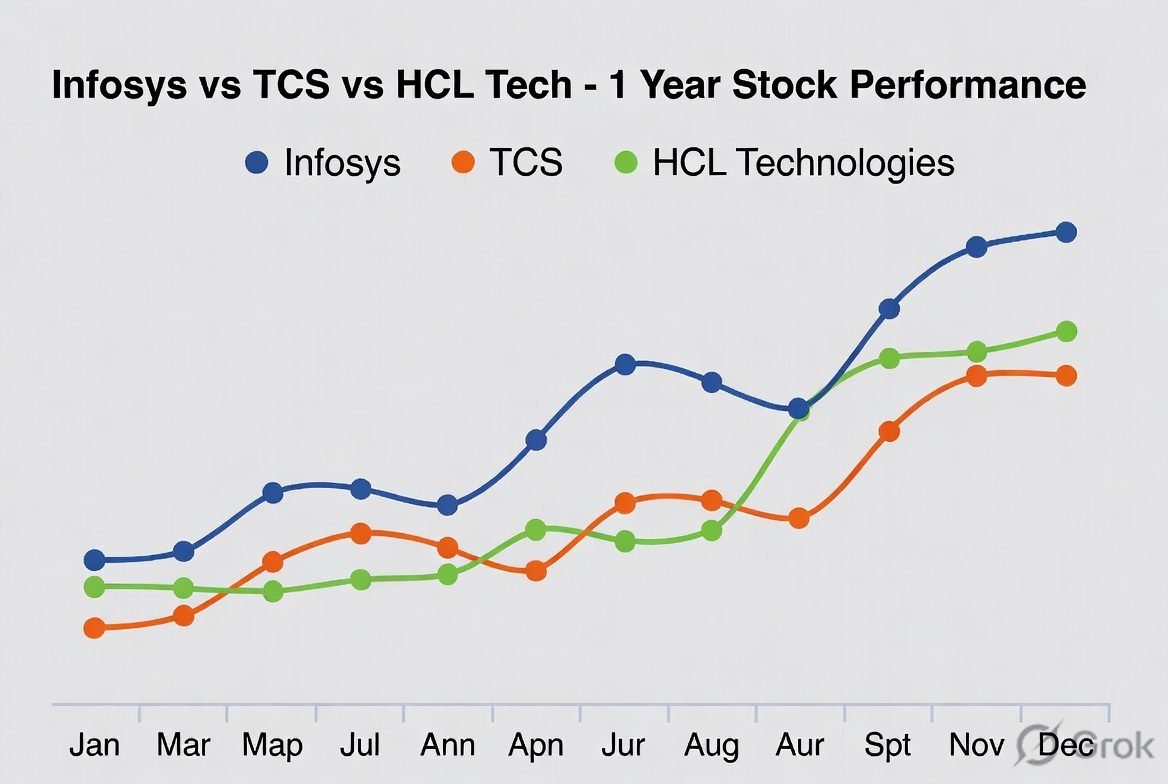
Here's the part that makes this results day genuinely interesting rather than routine: Infosys's Q4 FY26 net profit grew nearly 21% year-on-year, and full-year EPS grew 11% in rupee terms — by most conventional measures, a company executing reasonably well. And yet the stock has fallen roughly 33-35% over the past year, from a 52-week high of ₹1,728 to trading around ₹1,080, pushing its P/E ratio down to approximately 15.2 — meaningfully below where large-cap IT services names have historically traded.
This is precisely why the "micro execution" framing matters so much this quarter. A genuinely reassuring set of numbers — accelerating growth, a disclosed AI revenue contribution, stable margins — wouldn't just beat a single quarter's estimates; it would directly address the valuation question the market has been asking with its feet for the past year.
It's also worth noting Infosys hasn't stopped rewarding shareholders through this stretch, even as the stock price struggled. The company declared a dividend of ₹25 per share alongside its Q4 FY26 results, translating to a dividend yield of roughly 4.5% at current depressed prices — a yield that's arguably attractive in its own right for income-focused investors, largely because the falling share price has mechanically pushed the yield higher even as the absolute dividend payment itself reflects genuine, growing profitability rather than financial distress.
What Happens After 23 July: Three Scenarios
| Scenario | What It Looks Like | Likely Stock Reaction |
|---|---|---|
| Beat & Raise | QoQ growth above 2%, margin at or above 21%, concrete AI revenue disclosure | Meaningful re-rating toward analyst targets plausible |
| In-Line | Growth within the 1.5-2.2% modelled range, guidance reaffirmed unchanged | Muted reaction; stock likely range-bound pending more data |
| Miss | Growth below 1.5%, margin pressure, continued vague AI commentary | Renewed pressure on an already-depressed valuation |
Given how much of the past year's stock decline appears tied to structural, sector-wide AI-disruption concerns rather than company-specific execution failures, even a genuinely solid quarter may not immediately resolve the valuation gap in one print — but it would be the clearest evidence yet of which direction the underlying story is actually heading.
The Bottom Line
Infosys Q1 FY27 results carry more weight than a typical quarterly print because they arrive at a genuine inflection point in the market's narrative about the stock — from "the whole sector faces AI disruption headwinds" toward a company-specific test of whether Infosys can actually execute against its own guidance and convert a record deal pipeline into visible, reportable growth. Watch the sequential growth number against the 1.5-2.2% modelled range, listen for a concrete AI revenue disclosure rather than qualitative reassurance, and treat margin stability as seriously as the headline revenue figure. The stock's current valuation already reflects considerable skepticism — which means the bar for a genuinely positive surprise may be lower than the 52-week price chart alone would suggest.
FAQs: Infosys Q1 FY27 Results
The board meets on 22-23 July 2026, with results typically released after Indian market hours on 23 July, followed by an investor and analyst call the same day.
1.5-3.5% revenue growth in constant currency, with an operating margin band of 20-22% on an IFRS basis, issued alongside the Q4 FY26 results in April 2026.
The stock's roughly 33% decline over the past year is largely attributed to sector-wide concerns about AI-driven automation potentially shrinking demand for traditional IT services, a structural question the market is pricing independent of any single quarter's actual profit growth.
Consensus estimates centre around ₹41,000 crore, with quarter-on-quarter constant-currency growth expected in the 1.5-2.2% range, compared to 1.1% in the prior quarter.
Not disclosed as a specific percentage yet. Analysts are specifically watching whether Q1 FY27 commentary includes a concrete AI revenue figure or deal pipeline disclosure, rather than continued qualitative descriptions of AI adoption.
The 12-month consensus target based on 51 analyst estimates stands at approximately ₹1,332.83, the highest absolute rupee target among large-cap IT peers, according to Bloomberg-compiled data.
Wipro reports on 16 July, Mphasis reports the same day as Infosys on 23 July, and Coforge follows on 27 July, giving useful sector read-through context before and after the Infosys print.
References: Infosys Form 6-K: FY26 Results & FY27 Guidance · Upstox: Q1 FY27 Results Schedule · Univest: Infosys Q1 FY27 Results Preview · Sahi: Market Eyes ₹41,000 Crore Revenue · Business Today: Analyst Targets Across IT Sector · INDmoney: Infosys Share Price & Financials

Pranab Barman is a Financial Educator and Personal Finance Researcher with over 10 years of hands-on experience in stock markets, trading, and investing. Currently enrolled in the CFA Program, he is committed to continuous learning and professional excellence in finance.
As the Founder of PlayWithStock, Pranab covers a wide range of topics including Mutual Funds, SIP, Taxation, Stock Market Basics, and Financial Calculators — with a focus on simplifying complex financial concepts for everyday all investors.
Email: support@playwithstock.com
Website: playwithstock.com
Related posts:
 TCS Q1 FY27 Results Preview: Expected Revenue, Profit, Dividend & Key Things to Watch
 Reliance Industries Q1 FY27 Results Preview: What to Expect on July 17
 Big Bank Earnings July 14: Alarming Preview of JPMorgan, BofA & More
 Q1 FY27 Results Preview: What to Expect from Auto and FMCG Sectors This Quarter
 Bank of Maharashtra Q1 FY27 Results: QIP Update, Business Growth & Preview
 Indian Bank Q1 FY27 Results: Preview, Estimates & What to Expect Today
 Jio Financial Services Q1 FY27 Results Preview: Date, Estimates & Stock Analysis
 TCS Q1 FY27 Results: Profit Rises 5%, Sensex Jumps 828 Points