

Same Fund, Same Manager, Different NAV: Direct vs Regular Mutual Fund Explained With Real Numbers
Two versions of the exact same mutual fund can leave you lakhs of rupees apart after 20 years — and most investors have no idea which one they actually own.
- 1. Direct vs Regular Mutual Fund: What Actually Differs
- 2. The Expense Ratio Gap, By Fund Category
- 3. A Real 20-Year Example: The Actual Rupee Gap
- 4. Why This Split Even Exists
- 5. Why Direct Plan NAV Is Always Higher
- 6. Is a Regular Plan Ever Worth It
- 7. How to Check Which Plan You Currently Own
- 8. How to Switch From Regular to Direct
- 9. FAQs
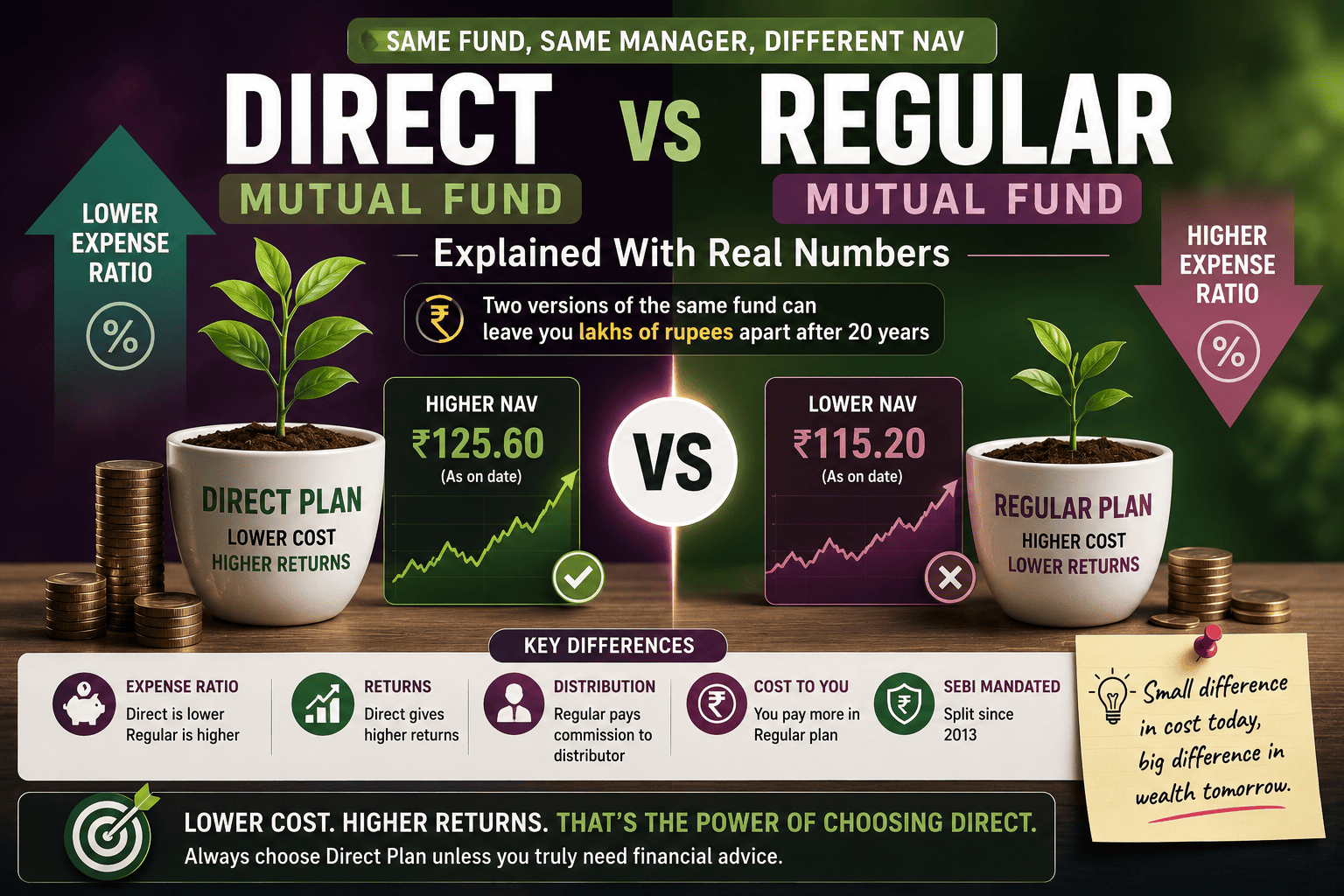
The Direct vs Regular Mutual Fund decision is one of the highest-leverage, lowest-effort choices in Indian investing, and yet a huge number of SIP investors have never actually checked which one they hold. Since SEBI mandated the split in 2013, every mutual fund scheme in India has come in two versions — direct and regular — that hold the exact same stocks, are run by the exact same fund manager, and follow the exact same strategy. The only thing that differs is what you pay, and that single difference can compound into a genuinely large gap over a long investment horizon — the same kind of compounding math covered in our SIP compounding calculator and how SIP works explainer.
⚡ Direct vs Regular Mutual Fund — Quick Reference
| Same Fund, Same Manager? | Yes, identical portfolio and strategy |
| What Differs | Expense ratio only |
| Avg Gap (Active Equity Funds) | 0.5% – 0.75% |
| Avg Gap (Index Funds) | 0.1% – 0.2% |
| Avg Gap (Debt Funds) | ~0.35% |
| Lowest Direct Index Fund ER | As low as 0.04% |
| ₹15,000/month, 20 yrs gap | ~₹12 lakh more with Direct |
1. Direct vs Regular Mutual Fund: What Actually Differs
A regular plan is purchased through a distributor — a bank, a financial advisor, or an online platform — who earns an upfront and ongoing "trail" commission for selling it to you. A direct plan is purchased straight from the Asset Management Company (AMC) itself, with no intermediary and therefore no commission built into the cost.
Everything else about the fund — the underlying stocks or bonds, the fund manager, the investment strategy, the risk profile — is completely identical between the two versions. The Direct vs Regular Mutual Fund choice is purely a question of distribution cost, not investment quality, which is exactly why the Direct vs Regular Mutual Fund decision deserves more attention than most investors give it. Our complete mutual fund guide and BER vs TER calculator are useful companion reads for understanding the broader cost structure mutual funds carry.
2. The Expense Ratio Gap, By Fund Category
The entire Direct vs Regular Mutual Fund gap comes down to one number: the Total Expense Ratio (TER), the annual fee a fund charges as a percentage of assets under management. In a regular plan, this fee includes the distributor's commission; in a direct plan, it doesn't.
| Fund Category | Direct Plan TER | Regular Plan TER | Typical Gap |
|---|---|---|---|
| Actively Managed Equity Funds | 0.55% – 0.70% | 1.20% – 1.80% | 0.5% – 0.75% |
| Index Funds (Nifty 50) | 0.04% – 0.20% | 0.20% – 0.40% | 0.1% – 0.2% |
| Debt Funds | Varies by category | Varies by category | ~0.35% |
| Small Cap Funds | ~0.70% | 1.40% – 2.00% | 0.6% – 0.9% |
Across more than 500 Indian mutual fund schemes tracked by independent data providers and cross-verified against AMFI factsheets, the average Direct vs Regular Mutual Fund gap works out to roughly 0.65% annually for equity funds and 0.35% for debt funds. Index funds show the smallest gap in absolute terms, since their base costs are already low, but the gap between the cheapest and priciest Nifty 50 index fund is itself only about 0.10% — making expense ratio the single most decisive selection factor for passive fund investors.
3. A Real 20-Year Example: The Actual Rupee Gap
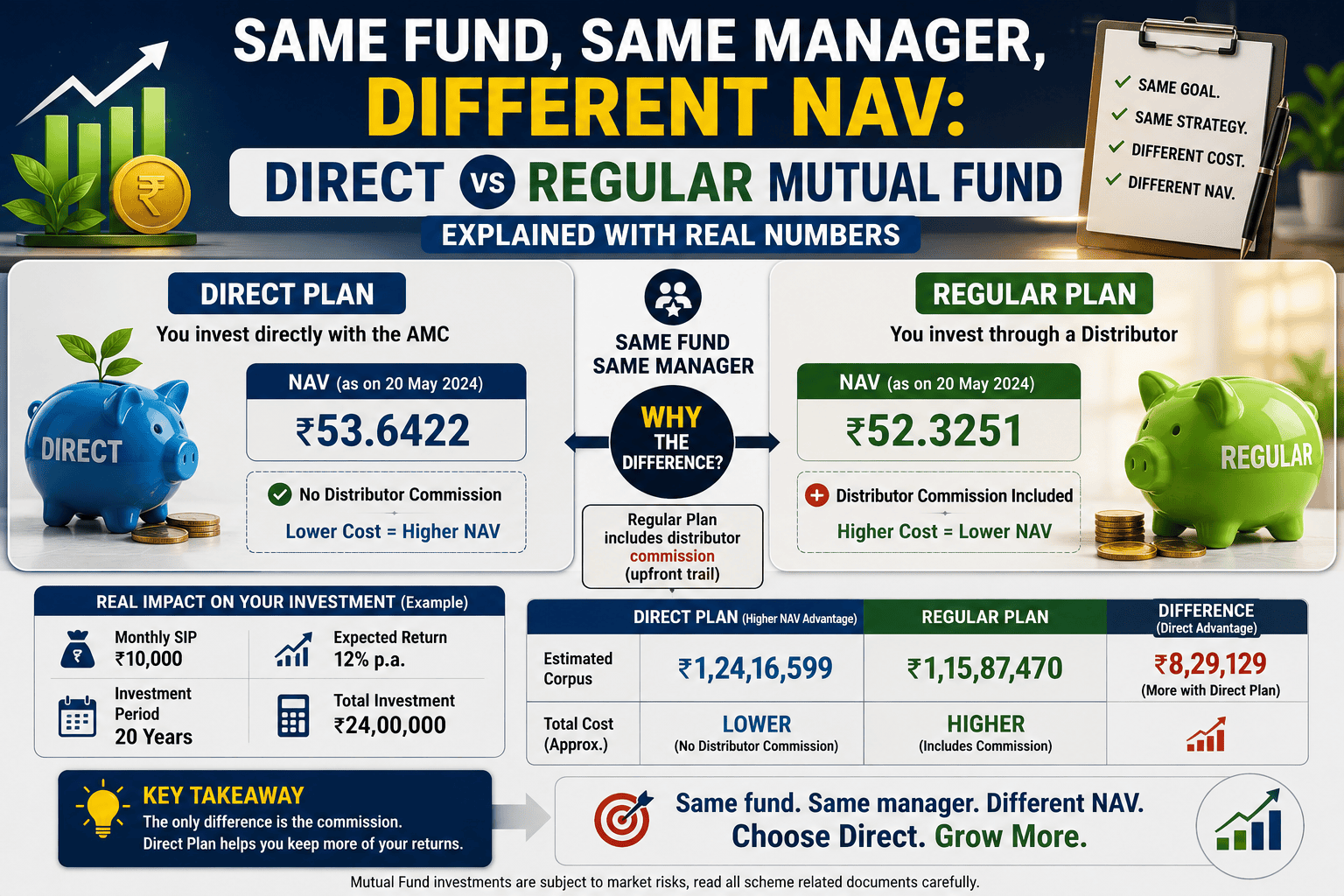
Numbers make the Direct vs Regular Mutual Fund decision concrete in a way percentages alone don't. Consider a ₹15,000 monthly SIP running for 20 years, assuming a 12% gross annual return before expenses — a reasonable long-term equity assumption.
| Plan Type | Expense Ratio | Net Annual Return | Final Corpus (20 yrs) |
|---|---|---|---|
| Direct Plan | 1.00% | 11.00% | ~₹1.31 crore |
| Regular Plan | 1.75% | 10.25% | ~₹1.19 crore |
Your total contribution over 20 years is identical either way — ₹36 lakh. The entire ₹12 lakh difference is purely the compounded cost of the distributor commission embedded in the regular plan's expense ratio. Our SIP compounding calculator lets you run this same comparison with your own monthly amount and time horizon.
4. Why This Split Even Exists
SEBI introduced the direct plan option in January 2013, specifically to give investors a route into mutual funds without paying for advice or distribution they might not need or want. Before that, every investor paid the same commission-loaded expense ratio regardless of whether they used an advisor or researched funds themselves.
Both direct and regular plans receive identical tax treatment under Indian income tax law — the same long-term and short-term capital gains rules apply to both, so there's no tax-based argument in favour of regular plans to offset their higher ongoing cost.
5. Why Direct Plan NAV Is Always Higher
Because the direct plan's lower expense ratio is deducted from returns before the NAV is calculated, direct plan NAV is always equal to or higher than regular plan NAV for the same scheme, and this gap widens progressively the longer both plans run. This isn't a sign of a "better performing" fund in the stock-picking sense — the underlying portfolio return is identical — it's purely the visible effect of the lower ongoing cost compounding in your favour over time, similar in principle to how bonus shares or other corporate actions mechanically move a stock's price without changing the company's actual value.
6. Is a Regular Plan Ever Worth It in the Direct vs Regular Mutual Fund Debate
The Direct vs Regular Mutual Fund debate isn't entirely one-sided. A regular plan can make sense if you genuinely need and use ongoing professional advice — portfolio rebalancing guidance, tax planning, or goal-based financial planning that you wouldn't otherwise do yourself, and that a fee-only advisor would charge separately for anyway. If you're comfortable researching funds, tracking your own asset allocation, and rebalancing periodically, a direct plan captures the full cost advantage with no meaningful trade-off.
For most SIP investors who've done the basic homework — picking a category, choosing 2-3 funds, and reviewing annually — a direct plan is the more capital-efficient choice. Our beginner investing guide, life cycle funds explainer, and record SIP inflows coverage can help you decide how much ongoing guidance you actually need and how this fits into the broader SIP growth story in India.
7. How to Check Which Plan You Currently Own
If you're not certain which version of a fund you hold, the scheme name itself usually tells you — look for the word "Direct" or "Regular" in the full fund name on your account statement or app. If it just says the fund name with no qualifier, or you invested through a bank, agent, or advisor without explicitly selecting "Direct," there's a strong chance you're in the regular plan.
- Check your Consolidated Account Statement (CAS), which lists the exact plan type for every holding — this is the same document worth reviewing alongside our mutual fund guide during any annual portfolio review.
- Look at your app or platform — most now clearly label "Direct" or "Regular" next to each fund, similar to how your demat account statement labels your equity holdings.
- Compare your NAV against the direct plan NAV published on the AMC's website — a lower number for the same fund on the same date confirms a regular plan.
8. How to Switch From Regular to Direct in the Direct vs Regular Mutual Fund Decision
Switching from a regular to a direct plan is technically a redemption from one plan and a fresh purchase into the other, which means it can trigger capital gains tax and, for equity funds, an exit load if done within the exit load period. You can verify current NAV and exit load details on NSE-linked mutual fund platforms or directly with the AMC before switching. Before switching, weigh the ongoing expense ratio savings against any one-time tax cost — for large, long-held holdings with significant unrealised gains, a gradual, staged switch across financial years is often more tax-efficient than switching everything at once. Our tax-loss harvesting guide and ITR filing guide cover related timing strategies for managing capital gains tax efficiently around your Direct vs Regular Mutual Fund switch.
9. Frequently Asked Questions About Direct vs Regular Mutual Fund Plans
What is the main difference between direct and regular mutual funds?
The underlying fund, manager, and strategy are identical. The only difference is the expense ratio — regular plans include a distributor commission, direct plans don't, resulting in a lower expense ratio and higher NAV for direct plans.
How much more money can a direct plan actually make you?
On a ₹15,000 monthly SIP over 20 years with a typical 0.75% expense ratio gap, a direct plan can result in roughly ₹12 lakh more than an equivalent regular plan, purely from the lower ongoing cost compounding over time.
Is the direct plan riskier than the regular plan?
No. Both plans hold the identical portfolio managed by the same fund manager under the same strategy. Risk is entirely determined by the fund's underlying holdings, not by which plan type you choose.
How do I know if I'm invested in a direct or regular mutual fund?
Check your Consolidated Account Statement (CAS) or your investment app, which typically labels each holding as "Direct" or "Regular." The full scheme name also usually includes this qualifier.
Does switching from regular to direct trigger tax?
Yes, switching is treated as a redemption and a fresh purchase, which can trigger capital gains tax and, for equity funds, an exit load if done within the exit load window. A staged switch across financial years is often more tax-efficient for large holdings.
Are index funds affected by the direct vs regular gap too?
Yes, though the absolute gap is smaller — typically 0.1% to 0.2% — since index funds already carry low base costs. The gap between the cheapest and most expensive direct-plan Nifty 50 index fund is itself only about 0.10%.

Pranab Barman is a Financial Educator and Personal Finance Researcher with over 10 years of hands-on experience in stock markets, trading, and investing. Currently enrolled in the CFA Program, he is committed to continuous learning and professional excellence in finance.
As the Founder of PlayWithStock, Pranab covers a wide range of topics including Mutual Funds, SIP, Taxation, Stock Market Basics, and Financial Calculators — with a focus on simplifying complex financial concepts for everyday all investors.
Email: support@playwithstock.com
Website: playwithstock.com
Related posts:
 Monthly SIP of ₹5,000 for 20 Years: Real Numbers, Real Story, and a Calculator
 Mutual Fund Guide India 2026: The Essential 7-Step Beginner Blueprint
 What Are Life Cycle Funds? SEBI’s Quiet New Mutual Fund Category
 SBI Mutual Fund IPO 2026: Dates, Price Band, GMP & Should You Apply
 SBI Mutual Fund IPO Opens Tomorrow: Everything Before You Apply
 Mutual Fund BER vs TER Calculator (2026): Compare BER vs TER Online
 SBI Mutual Fund IPO Listing: 7 Essential Facts to Know Before July 21 Debut
 Sensex Nifty Crash July 2026: 3 Real Reasons Behind the Fall