
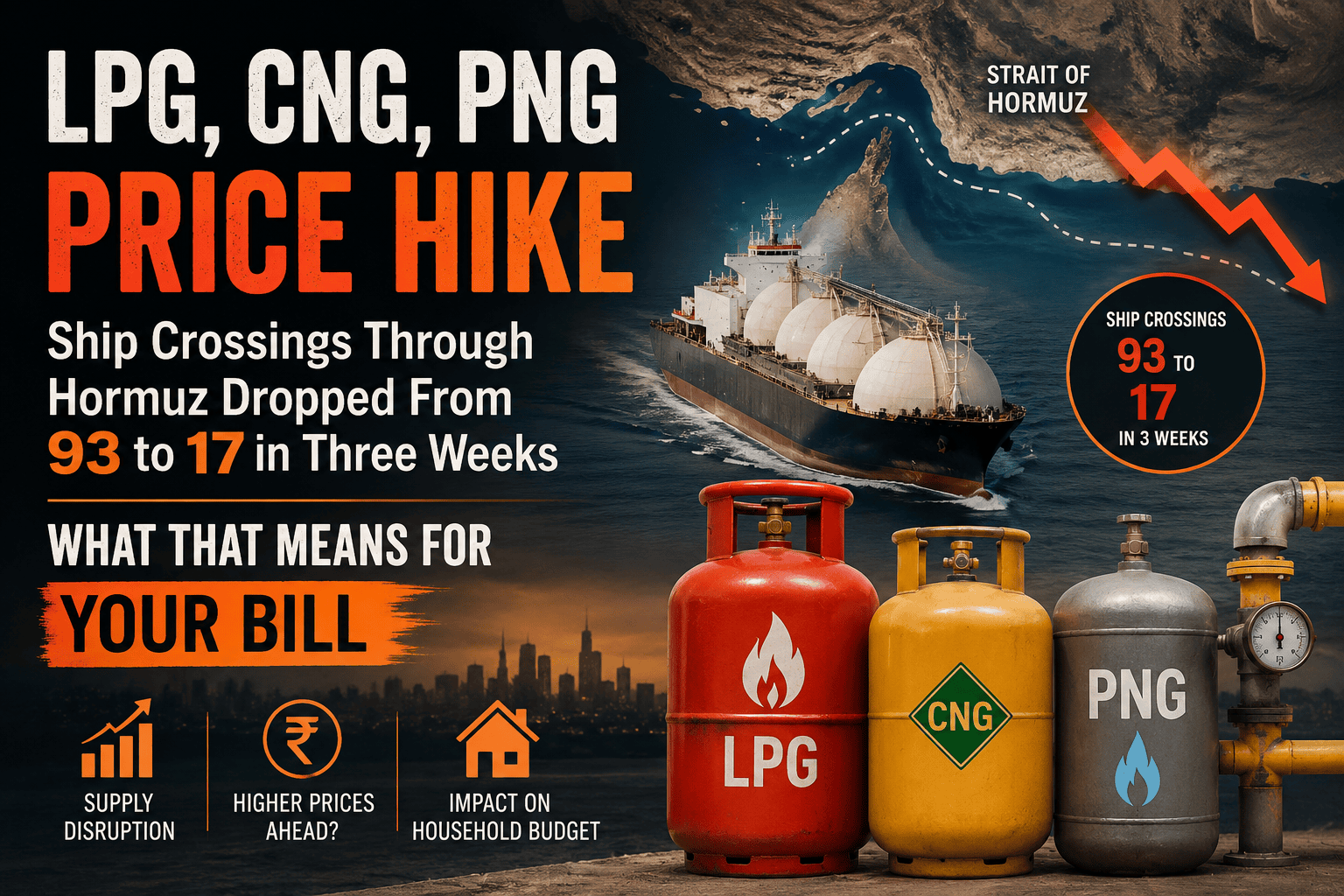

Ship Crossings Through Hormuz Dropped From 93 to 17 in Three Weeks — What That Means for Your LPG, CNG, and PNG Bill
India gets hit hardest among major economies when Hormuz traffic slows. Here's what's actually happening to cooking gas and fuel prices, and what history says comes next.
- 1. What's Actually Happening to LPG, CNG, and PNG Right Now
- 2. Why the Strait of Hormuz Controls Your Cooking Gas Bill
- 3. Current LPG, CNG, PNG Prices: What's Changed and What Hasn't
- 4. Why India Gets Hit Harder Than Most Countries
- 5. LPG Consumption Already Fell 8% This Year
- 6. What an LPG CNG PNG Price Hike Actually Does to a Household Budget
- 7. Which Stocks Move With This Story
- 8. What You Can Actually Do About It
- 9. FAQs
An LPG CNG PNG price hike risk has been building quietly through July 2026, and the numbers behind it are more serious than the "prices unchanged for now" headlines suggest. While your domestic 14.2 kg cylinder, CNG, and piped gas rates haven't actually moved yet, the underlying supply chain feeding those prices is under real strain — vessel crossings through the Strait of Hormuz have collapsed from 93 on June 24 to just 17 by July 13, according to S&P Global shipping data. This piece walks through exactly what's happening, why India specifically is more exposed than most economies, and what it could mean for your monthly budget if the situation doesn't ease.
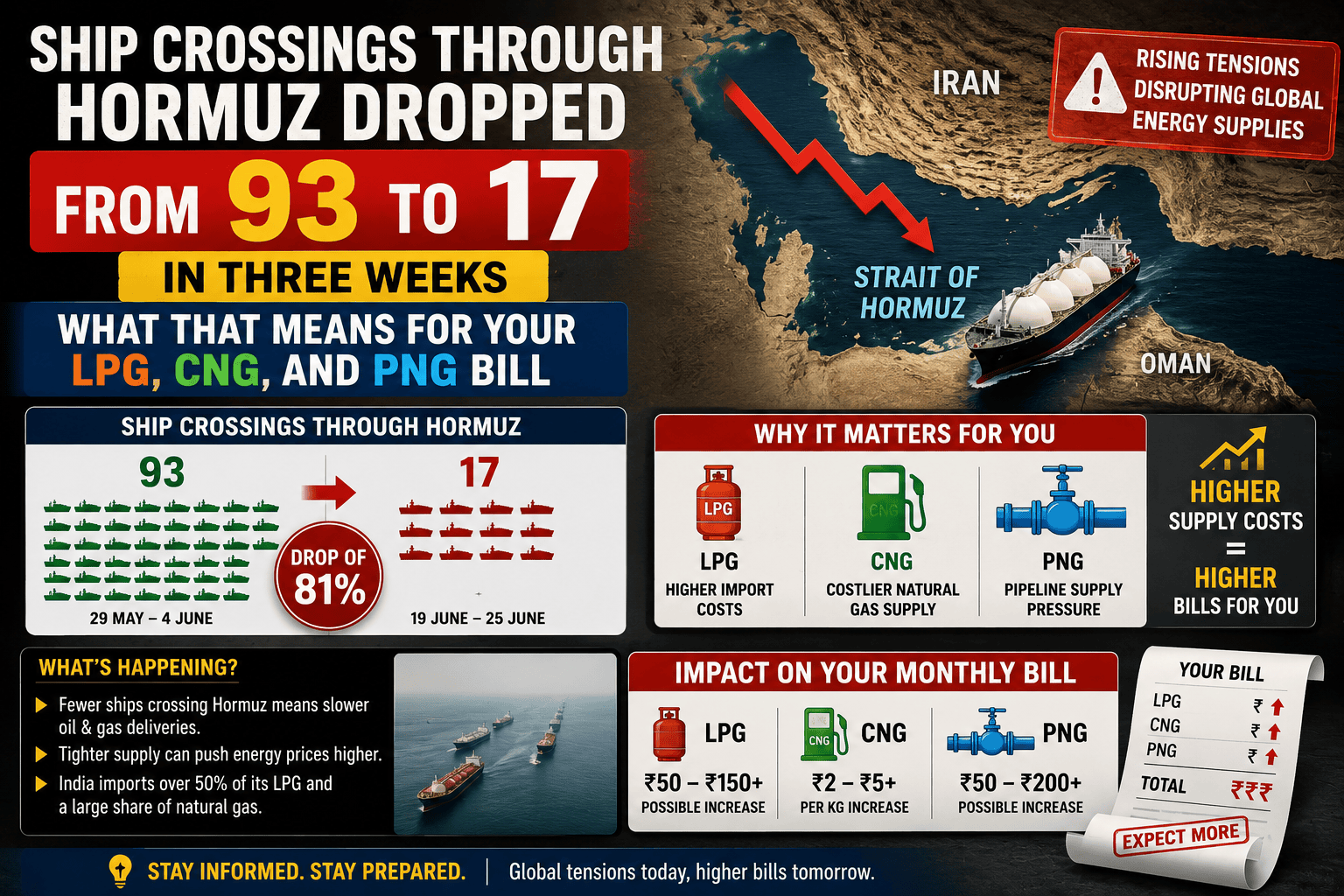
⚡ LPG CNG PNG Price Hike Risk — Quick Snapshot
| Hormuz Vessel Crossings (Jun 24 → Jul 13) | 93 → 17 |
| Brent Crude (as of Jul 20) | $90.79/barrel (highest since Jun 11) |
| Brent Weekly Gain | +15.9% (biggest since April) |
| India LPG Consumption Drop (H1 2026) | -8% YoY |
| Domestic 14.2kg / CNG / PNG | Unchanged for over a month |
| Commercial 19kg Cylinder (Jul 1 cut) | -₹173 to -₹183.50 |
1. What's Actually Happening to LPG, CNG, and PNG Right Now
As of July 21, 2026, domestic LPG, CNG, and piped natural gas prices in India have stayed technically unchanged for over a month, even as the underlying crisis has deepened. Oil Marketing Companies actually cut commercial 19kg cylinder prices on July 1 — the first reduction of 2026 — by ₹173 to ₹183.50 depending on the city, after supply concerns briefly eased and commercial LPG restrictions to hotels and restaurants were lifted.
That relief didn't last. Renewed US-Iran strikes since have reversed the improvement, and concerns about an LPG CNG PNG price hike have resurfaced sharply. For the full picture of how this connects to broader market movements, our US-Iran tension market impact coverage, oil price impact analysis, and Dollar Index explainer cover the equity-market and currency side of this same story.
2. Why the Strait of Hormuz Controls Your Cooking Gas Bill
The Strait of Hormuz is the narrow waterway at the mouth of the Persian Gulf that a large share of the world's LPG and crude oil physically passes through on its way to import-dependent countries like India. When military tension rises in the region, insurers and shipping companies become reluctant to send vessels through — not because the strait is technically closed, but because the risk of an attack makes war-risk insurance prohibitively expensive or unavailable altogether.
This is exactly what's driving the current LPG CNG PNG price hike concern: S&P Global data shows vessel crossings through Hormuz falling from 93 on June 24 to just 17 by July 13 — not because of an official blockade, but because ships and their insurers are choosing to avoid the risk. India's own LPG carrier, the Nanda Devi, was reportedly the only inbound LPG vessel at Hormuz during one recent stretch, headed to Qatar's Ras Laffan for loading — a striking illustration of how thin the shipping traffic has become.
3. Current LPG, CNG, PNG Prices: What's Changed and What Hasn't
Domestic 14.2kg cylinders, CNG, and piped natural gas have remained unchanged in price for more than a month as of this writing, which is genuinely reassuring for household budgets in the immediate term. Commercial LPG has been more volatile — cut on July 1 after supply improved, then placed back under scrutiny as the conflict deepened again through mid-July.
| Fuel Type | Status as of Jul 21, 2026 |
|---|---|
| Domestic LPG (14.2kg) | Unchanged for over a month |
| CNG | Unchanged for over a month |
| PNG (piped gas) | Unchanged for over a month |
| Commercial LPG (19kg) | Cut ₹173-183.50 on Jul 1; under renewed pressure since |
| FTL 5kg "Chhotu" cylinder | Cut ₹13 to ₹808.50 (Delhi, mid-July) |
| Aviation Turbine Fuel | Cut ₹5/litre on Jul 7 (Delhi: ₹110/litre); reversed as conflict resumed |
The key thing to understand about an LPG CNG PNG price hike risk in India specifically is that domestic cylinder prices are partly insulated by government subsidy and OMC pricing decisions, which don't move as mechanically or as fast as international crude benchmarks do — this buys time, but it doesn't remove the underlying cost pressure building up in the supply chain.
4. Why India Gets Hit Harder by This LPG CNG PNG Price Hike Risk
According to International Energy Agency Executive Director Fatih Birol, the current supply crisis has hit economies globally, but developing countries dependent on Hormuz-routed energy — India, Pakistan, and Bangladesh specifically — have suffered the most, more than even Japan and South Korea, which are also heavily import-dependent but have deeper financial buffers and diversified supply contracts.
Birol has also flagged a genuine public health dimension worth taking seriously: in the hardest-hit developing economies, some households have already begun shifting back to alternative cooking fuels like dung and wood as LPG becomes less affordable or less available — fuels that produce significantly more hazardous indoor emissions, with health risks that fall disproportionately on women, who typically do the household cooking. This is a reminder that an LPG CNG PNG price hike isn't just a line item on a monthly budget — for lower-income households, it can be a genuine health and safety issue.
5. LPG Consumption Already Fell 8% — The Price Hike Risk Is Already Showing Up
India's LPG consumption fell 8% year-on-year during the first half of 2026, according to data tracked by the Petroleum Planning and Analysis Cell (PPAC), directly attributable to disruptions in Hormuz-routed imports constraining available supply. This is a meaningful, already-realised impact of the broader LPG CNG PNG price hike risk — not a future possibility — and it shows the crisis has been building for longer than the recent headline spike in Brent crude suggests.
Brent crude itself rose to $90.79 a barrel by July 20, its highest level since June 11, gaining nearly 16% in a single week — its biggest weekly gain since April. Every dollar increase in crude filters through India's energy import bill with a lag, and that lag is exactly why domestic LPG CNG PNG prices haven't moved yet even though the underlying cost pressure clearly has.
6. What an LPG CNG PNG Price Hike Actually Does to a Household Budget
If domestic cylinder, CNG, or PNG prices do rise from here, the household-level math is fairly direct: a ₹50-100 increase per 14.2kg cylinder for a family refilling every 4-6 weeks adds up to a genuine, recurring monthly cost increase, not a one-time hit. For CNG-dependent households and vehicle owners, a per-kg price rise compounds against daily commuting costs in a way that's harder to defer or substitute away from quickly.
This is exactly the kind of imported-inflation pressure our inflation and stock portfolio guide and monsoon inflation coverage cover — energy costs feed into transport, packaged food, and manufacturing costs broadly, not just the direct fuel bill, which is why an LPG CNG PNG price hike tends to show up in headline inflation numbers with a delay even after households feel it directly.
7. Which Stocks Move With This Story
Oil Marketing Companies — BPCL, HPCL, and IOC — sit at the center of the LPG CNG PNG price hike story, since they absorb marketing losses if crude costs rise faster than retail prices are allowed to adjust. Upstream producers like ONGC and Oil India benefit from higher realisations on their own crude production, partially offsetting the pain elsewhere in the energy chain. Our sector rotation guide, Nifty and Sensex explainer, and gold price analysis cover how these sector-level effects and safe-haven flows typically show up across the broader index during an LPG CNG PNG price hike-driven risk-off period.
8. What You Can Actually Do About an LPG CNG PNG Price Hike
There's no way to hedge a household LPG bill directly, but a few practical steps genuinely help if an LPG CNG PNG price hike materialises over the coming weeks:
- Build or top up a sinking fund specifically for utility cost variability, the same principle covered in our sinking fund guide for predictable seasonal expenses.
- Review your overall budget buffer using our 50-30-20 budgeting rule to see how much room exists to absorb a genuine utility cost increase without disrupting savings or investing.
- Avoid panic bulk-buying cylinders ahead of an expected hike — this typically just shifts your own cash flow earlier without changing the total cost, and can strain local distributor supply for others.
- Track the actual Hormuz and crude data, not just headlines, since domestic price pass-through lags the underlying crisis by weeks, giving genuine advance notice before any official price revision.
9. Frequently Asked Questions
Have LPG, CNG, and PNG prices actually increased in India yet?
As of July 21, 2026, domestic 14.2kg LPG cylinders, CNG, and piped natural gas prices have remained unchanged for over a month, though commercial LPG prices have been more volatile amid the ongoing crisis.
Why does the Strait of Hormuz affect LPG prices in India?
A large share of India's LPG and crude oil imports physically transit the Strait of Hormuz. Rising conflict risk has caused vessel crossings to fall sharply as ships and insurers avoid the route, tightening supply even without a formal blockade.
How much has India's LPG consumption fallen due to this crisis?
India's LPG consumption fell 8% year-on-year during the first half of 2026, directly linked to Hormuz-related supply disruptions.
Which countries are most affected by the current energy supply crisis?
According to the IEA, developing countries dependent on Hormuz-routed energy — India, Pakistan, and Bangladesh — have been hit hardest, more than Japan or South Korea, which have deeper financial buffers despite similar import dependence.
Will petrol and diesel prices also rise because of this?
Petrol and diesel prices in India are updated by Oil Marketing Companies tracking Saudi Aramco's Official Selling Price, global market trends, and currency movements, and are influenced by but not automatically tied to short-term crude spikes.
How can I prepare for a possible LPG CNG PNG price hike?
Building a small utility-specific budget buffer, reviewing your overall savings rate, and avoiding panic bulk-buying are the most practical steps available at the household level, since domestic price pass-through typically lags the underlying crisis by several weeks.

Pranab Barman is a Financial Educator and Personal Finance Researcher with over 10 years of hands-on experience in stock markets, trading, and investing. Currently enrolled in the CFA Program, he is committed to continuous learning and professional excellence in finance.
As the Founder of PlayWithStock, Pranab covers a wide range of topics including Mutual Funds, SIP, Taxation, Stock Market Basics, and Financial Calculators — with a focus on simplifying complex financial concepts for everyday all investors.
Email: support@playwithstock.com
Website: playwithstock.com
Related posts:
 What is the Strait of Hormuz and Why Does It Affect India? Complete Guide 2026
 Circle National Trust Bank: What the OCC Approval Means for USDC and CRCL
 Gold Price Correction 2026: What It Means for Indian Investors
 Vedanta Demerger 2026: What It Means for Shareholders
 Trump Just Gave Indian Pharma a Two-Year Countdown Clock — Here’s What the US Generic Drug Tariff Actually Means
 Oil Price Crash 2026: How the End of a War Is Reshaping India’s Economy
 US-Iran Tension Impact: 7 Sectors Hit as Markets React
 India US Trade Deal 2026: Inside the Tariff Rollercoaster Before July 22