
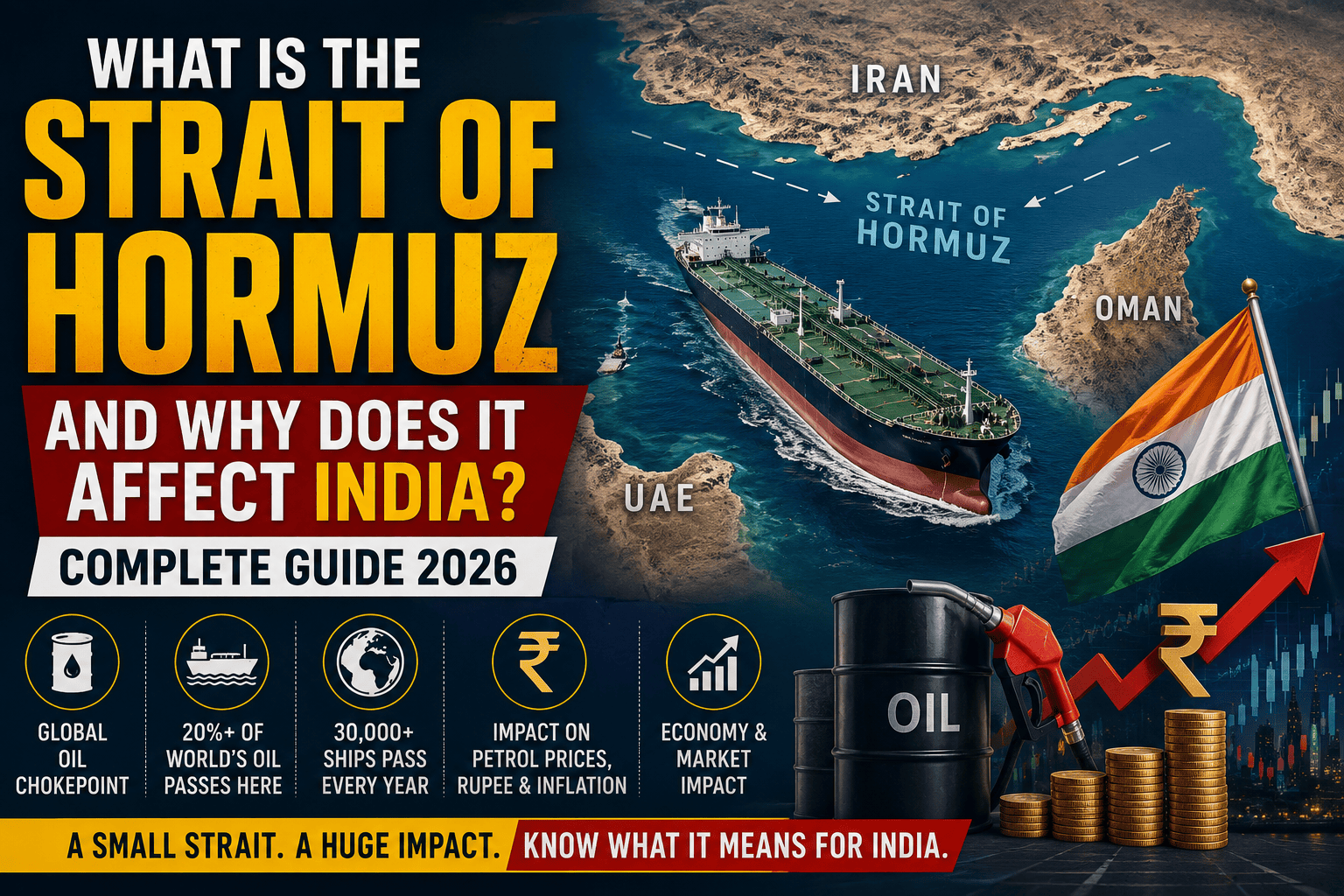

What is the Strait of Hormuz and Why Does It Affect India? Complete Guide 2026
The Strait of Hormuz is a 33-kilometre-wide strip of water that most Indians had never heard of — until early 2026, when the rupee started falling, LPG cylinder prices jumped, and petrol pump queues got longer. Suddenly, this narrow waterway sitting between Iran and Oman became the most important geography lesson in Indian households. This guide explains what it actually is, why the world's entire oil trade depends on it, and how a conflict thousands of kilometres away shows up directly in your monthly expenses.
What Exactly is the Strait of Hormuz?
Picture a bottleneck. A physical, geographic bottleneck through which a massive chunk of the world's oil has no choice but to pass.
The Strait of Hormuz is a narrow waterway connecting the Persian Gulf on one side with the Gulf of Oman and the Arabian Sea on the other. Iran sits on its northern coast. The UAE and Oman's Musandam Peninsula sit on its southern side. At its narrowest point, the strait is just 33 kilometres wide — roughly the distance between Delhi and Gurgaon.
Within that 33 km, the actual shipping lanes are even tighter. Two lanes of commercial traffic, each just 3 kilometres wide, one going in and one going out. Every single oil tanker leaving Saudi Arabia, Iraq, Kuwait, Qatar, or the UAE must pass through these lanes. There is no other exit from the Persian Gulf to the open ocean. None.
This is why geopolitical analysts have called it the most important 33 kilometres of water on Earth. According to Encyclopaedia Britannica, more than 20% of global oil and LNG exports travel through this strait every single day. On a normal day, anywhere between 80 to 130 ships pass through — that adds up to over 30,000 tankers a year.
It has been strategically important for centuries. Even Emperor Babur mentioned it in his memoirs as the gateway through which goods reached global markets. Today, it has become something far more consequential — a single geographic point where, if something goes wrong, the entire global energy system feels it within days.
To understand why India is so exposed, you first need to understand why global commodity prices and the dollar index are so closely linked — because oil is priced in dollars, and any shock to supply immediately hits both.
The Numbers That Make It So Critical
Raw numbers make the picture clearer than any explanation can.
Approximately 17 to 21 million barrels of oil pass through the Strait of Hormuz every single day. To put that in context, the entire world consumes around 100 million barrels per day. So one narrow strip of water, barely wider than a large river at its shipping lanes, carries roughly 20% of everything the world burns in oil. Some estimates push this to 25–27% when you include LNG.
Qatar — the world's largest exporter of liquefied natural gas — routes almost all of its LNG exports through this strait. There is no pipeline alternative that carries even a fraction of this volume. The UAE has the Habshan-Fujairah pipeline that can divert some of its oil around Hormuz, but it covers only a portion of regional volumes. Saudi Arabia has the East-West Pipeline, but again, its capacity is limited and has not been upgraded to handle a full Hormuz shutdown.
The countries sitting behind the strait — Saudi Arabia, Iran, Iraq, Kuwait, Qatar, Bahrain, UAE — together hold a massive share of global proven oil reserves. All of their exports to Asia go through Hormuz. Every drop of it.
This concentration of supply through one narrow point is what makes the strait so dangerous to global energy stability. It is what economists call a single point of failure — and it affects every oil-importing nation on Earth, with India among the most exposed.
How Dependent is India on This Waterway?
India imports roughly 88% of its crude oil needs. Domestic production simply cannot keep up with a fast-growing economy that consumes around 5.5 million barrels of crude per day.
Historically, between 40% and 50% of India's total crude oil imports transited through the Strait of Hormuz. The exposure for LPG is even higher — roughly 80–90% of India's LPG imports originate from Gulf nations, primarily Saudi Arabia, Qatar, and the UAE, all of which depend entirely on Hormuz for their export shipping routes.
This means the cooking gas in your kitchen, the petrol in your car, and a significant chunk of the aviation fuel powering every flight out of Indian airports all have a direct connection to a 33-kilometre waterway in the Middle East.
The connection flows through what economists call the Current Account Deficit. India's oil import bill is enormous. When oil prices rise sharply, India needs to spend more dollars buying oil. To get those dollars, the rupee has to be sold. More rupee selling means the rupee weakens. A weaker rupee means oil gets even more expensive because it is priced in dollars. You can see the feedback loop forming — and the Strait of Hormuz sits right at the beginning of that chain.
Every $10 per barrel rise in crude oil prices widens India's current account deficit by approximately $12–14 billion annually. That is not a small number. That directly feeds into inflation, fiscal pressure, and the overall health of the economy in ways that eventually reach the average household. Our article on how inflation affects your investment portfolio covers exactly this transmission mechanism in detail.
What Happens to India When the Strait Gets Disrupted?
The effects are not theoretical. They are mechanical and they follow a predictable sequence — almost like dominoes falling in a specific order.
First, oil prices spike globally. The moment traders perceive any serious threat to Hormuz shipping, crude oil futures jump. This is sometimes called the "fear tax" — markets price in risk even before actual supply is disrupted. Brent crude can move 5–10% in a single day on Hormuz news.
Second, India's oil import bill swells. Indian oil marketing companies — Indian Oil, BPCL, HPCL — are forced to buy crude at elevated international prices. If the government keeps retail prices of petrol and diesel fixed to protect consumers, these companies absorb the losses directly. In the 2026 crisis, those losses reportedly touched ₹1,000 crore per day across the sector.
Third, the rupee takes a hit. India needs more dollars to pay for the same oil. Forex outflows increase. The rupee weakens. This makes everything imported more expensive, not just oil. Electronics, machinery, chemicals, fertilisers — the cost of all of these rises when the rupee falls.
Fourth, inflation rises. Fuel is embedded in the cost of almost everything. Transport costs go up. Logistics get more expensive. Food prices follow because food is transported. Industrial inputs become costlier. The ripple spreads across the entire economy, reaching your monthly grocery bill, your auto-rickshaw fare, and your utility bills.
Fifth, the RBI faces a difficult choice. Raising interest rates can help defend the rupee and cool inflation, but it also slows economic growth and makes home loans more expensive. Keeping rates unchanged risks the rupee falling further. There is no clean option — only tradeoffs. This is why RBI repo rate decisions in 2026 have been so closely watched by markets.
Sixth, the fiscal deficit widens. If the government subsidises fuel prices to protect consumers, it spends more than it earns. This either means borrowing more or cutting spending elsewhere — both of which have their own economic consequences.
The 2026 Crisis — What Actually Happened
2026 turned the Strait of Hormuz from a geography textbook concept into a lived economic reality for hundreds of millions of Indians.
In late February and early March 2026, US and Israeli military action against Iran triggered what the International Energy Agency described as the largest supply disruption in the history of the global oil market. Iran's military effectively closed the strait to commercial shipping. Britannica confirmed that ship traffic dropped by more than 95% — from over 130 daily transits to fewer than 10.
India felt this almost immediately. The crude oil basket that India typically buys — a mix of different grades — was trading in the $62–70 per barrel range through most of FY2025–26. By March 11, 2026, it had reached $113.57 per barrel. It subsequently peaked at $157 per barrel — more than doubling in under a month.
The rupee hit a new all-time low, falling to approximately 92–93 per dollar in March 2026. By mid-July, even after some stabilisation, it was still sitting at around 95–96 per dollar, reflecting ongoing pressure from elevated oil prices and disrupted supply chains.
LPG cylinders in Delhi jumped by ₹60, reaching ₹913. Commercial cylinders saw even steeper increases. Some major cities reported irregular delivery schedules as LPG supply chains strained. The government issued a Natural Gas Control Order under the Essential Commodities Act to prioritise supply to households, hospitals, and fertiliser plants.
India's Petroleum Ministry moved quickly. By March 11, the government confirmed it had secured approximately 70% of its crude imports from outside the Strait — shifting purchases to Russia, West Africa (Nigeria, Angola), the US, and other non-Gulf sources. A 24x7 control room was set up to monitor petroleum stock levels nationally.
The broader market impact was significant too — IT stocks, banking, and consumer sectors all saw pressure as inflation expectations rose and the rupee weakened. Understanding how sector rotation works during macroeconomic stress helps explain why markets responded the way they did.
Can India Find Alternative Routes?
This is the question India's energy policymakers have been wrestling with for years — and the 2026 crisis forced an urgent answer.
The most-discussed alternative is the Cape of Good Hope route, going around the southern tip of Africa. The problem is distance. This route adds approximately 14–21 days to delivery schedules and increases per-barrel transportation costs by $2–4. For a country buying millions of barrels every day, that additional cost is not trivial.
Russia has emerged as India's most significant non-Hormuz supplier. Russian crude travels primarily through the Indian Ocean without touching the Persian Gulf, which means Hormuz disruptions do not directly affect those shipments. Since Western sanctions following Russia's 2022 military action in Ukraine, India has been buying discounted Russian crude in significant volumes — making Russia India's largest crude supplier in recent years.
West Africa — particularly Nigeria and Angola — is another genuine alternative. These countries export crude through routes entirely independent of the Persian Gulf. Indian state refiners already have established trading relationships with both, which means sourcing can be ramped up relatively quickly during disruptions.
The US and Latin America (Brazil, Argentina, Guyana) also provide crude through routes that bypass Hormuz entirely. However, longer shipping distances mean higher costs and longer lead times — not ideal for a country that needs predictable, just-in-time supply management.
The honest assessment from analysts is this: India has diversified its supply sources significantly, importing from around 40 countries by March 2026. But it has not fully diversified its shipping routes. A large share of imports still relies on either the Hormuz corridor or the Red Sea — which has its own vulnerability to conflict, as Houthi attacks demonstrated in 2024–25. The Cape of Good Hope remains the most resilient long-term alternative, but shifting a meaningful share of Indian crude imports to that route is a process measured in years, not weeks.
What Does This Mean for Indian Investors?
If you have money in Indian stocks, mutual funds, or bonds, Hormuz tension is not just geopolitics — it is a direct input into your portfolio's near-term performance.
Oil marketing companies (OMCs) like Indian Oil, BPCL, and HPCL suffer directly when crude prices spike and retail prices are held fixed. Their margins compress or turn negative. Stock prices follow. During the 2026 crisis, OMC stocks were among the worst performers in the Nifty for obvious reasons.
Airlines are similarly exposed. Aviation turbine fuel accounts for a large portion of airline operating costs, and there is no easy hedge when jet fuel prices double in a month. IndiGo, Air India, and SpiceJet all feel the pressure immediately in their cost structures.
Paints companies, chemicals, fertilisers, and plastics manufacturers are affected through their raw material costs, most of which are crude derivatives. When oil goes up sharply, input costs for these businesses rise before they can pass the increase on to customers.
On the flip side, some sectors benefit. Renewable energy companies — solar and wind — become relatively more attractive when fossil fuel prices spike. Domestic coal producers are also insulated. And IT companies, which earn in dollars and spend in rupees, actually see a short-term boost when the rupee weakens.
For long-term investors in index funds like the Nifty 50 or the Nifty Midcap 150, Hormuz-driven volatility is the kind of short-term noise that a 7–10 year investment horizon absorbs comfortably. But for traders and short-term investors, tracking oil prices and Hormuz developments is as important as tracking company earnings. The two are deeply connected.
Understanding how oil price movements affect Indian stocks in different sectors is essential reading if you are actively managing a portfolio through these periods.
India's Long-Term Plan to Reduce Dependence
The 2026 crisis has accelerated conversations that were already happening in India's energy policy circles. None of these are quick fixes — but they matter enormously over a 10–20 year horizon.
Strategic Petroleum Reserves (SPR) are a critical buffer. India currently has reserve capacity covering approximately 9.5 days of imports. The government has been planning to expand this significantly. The US maintains 90 days of reserve capacity. Japan maintains 90+ days. India's target is to eventually reach 30+ days, which would provide meaningful cushion during short-term supply disruptions.
Renewable energy is the structural answer. India already generates 75% of its electricity from domestic coal — which means the electricity grid is largely insulated from Hormuz shocks. The government is aggressively expanding solar and wind capacity. Every percentage point of electricity demand that shifts from diesel generators to renewables reduces India's oil exposure.
Electric vehicles, while still in early stages of adoption at scale, represent another long-term demand reduction for petroleum. As EV penetration grows in personal transport, two-wheelers, and eventually commercial vehicles, India's oil import dependence will gradually ease.
Supply diversification — buying from 40 countries instead of being heavily concentrated in the Gulf — is already underway and will continue. The Cape of Good Hope route, while expensive, is becoming more economically viable as freight markets adjust and as producers in Brazil, Guyana, and Africa expand output.
For Indian investors thinking about where energy security fits into their long-term view on the Indian economy, these structural shifts matter. The current vulnerability is real, but it is not permanent. Building a diversified portfolio that accounts for both the current risks and the long-term structural improvements is the sensible approach.
The Bottom Line
The Strait of Hormuz is 33 kilometres of water. India is 3,000 kilometres away from it. But the connection between them — through oil, through the rupee, through inflation, through your LPG cylinder and petrol pump — is direct and immediate.
What 2026 made clear is that India's energy security remains one of its most significant structural vulnerabilities. The country imports 88% of its crude oil. A large share of that has historically come through one narrow waterway that sits in one of the world's most geopolitically volatile regions. When that waterway is disrupted, the economic consequences arrive in Indian households within weeks.
The good news is that India is not passive about this. Import diversification is already happening. Strategic reserves are being expanded. Renewable energy is growing faster than almost anywhere else in the world. These are not overnight solutions, but they are real structural changes that will reduce India's Hormuz exposure over the coming decade.
For now, if you see news about US-Iran tensions, shipping disruptions in the Persian Gulf, or oil price spikes — know that it is not distant geopolitics. It is a direct input into India's inflation, its exchange rate, its fiscal deficit, and consequently, the value of your investments and your monthly household budget.
The Strait of Hormuz is 33 kilometres wide. And India cannot afford to ignore it.
Disclaimer: This article is for educational and informational purposes only. It does not constitute financial, investment, or policy advice. All economic data cited is based on publicly available sources and reporting as of July 2026.
Frequently Asked Questions
1. Where exactly is the Strait of Hormuz located?
The Strait of Hormuz sits between the Persian Gulf and the Gulf of Oman, with Iran on its northern coast and the UAE and Oman's Musandam Peninsula on its southern coast. At its narrowest point it is approximately 33 kilometres wide, with actual commercial shipping lanes occupying just two 3-kilometre-wide corridors — one for inbound and one for outbound traffic. It is the only sea passage connecting the oil-producing Persian Gulf nations to the open ocean.
2. Why is the Strait of Hormuz so important for global oil supply?
Roughly 20–25% of the world's entire oil and LNG trade passes through the Strait of Hormuz every single day — approximately 17 to 21 million barrels of crude oil. All oil exports from Saudi Arabia, Iraq, Kuwait, Qatar, Bahrain, UAE, and Iran must pass through this one waterway to reach global markets. There is no viable alternative route that can carry anywhere near this volume. This makes it the world's most critical energy chokepoint, and any serious disruption sends oil prices higher across the entire planet.
3. What percentage of India's oil imports pass through the Strait of Hormuz?
Historically, between 40% and 50% of India's total crude oil imports have transited the Strait of Hormuz. For LPG, the exposure is even higher — approximately 80–90% of India's LPG imports come from Gulf nations that depend on Hormuz for export routing. India imports roughly 88% of its total crude oil requirements, making any Hormuz disruption a significant direct economic event for the country.
4. How does the Strait of Hormuz affect petrol and LPG prices in India?
When the Strait is disrupted, global crude oil prices rise sharply. India's oil marketing companies must buy crude at these elevated prices. If the government holds retail petrol and diesel prices flat to protect consumers, the OMCs absorb massive losses. If prices are eventually passed on to consumers, petrol, diesel, and LPG prices rise at the pump. In the 2026 crisis, LPG cylinders in Delhi rose by ₹60 and crude oil prices more than doubled within a month of the disruption.
5. Why does the Strait of Hormuz cause the Indian rupee to fall?
Oil is priced in US dollars globally. When Hormuz is disrupted and oil prices rise, India needs significantly more dollars to pay for the same volume of oil imports. This increases demand for dollars in the foreign exchange market, which puts downward pressure on the rupee. A weaker rupee then makes oil even more expensive in rupee terms, creating a feedback loop. During the March 2026 crisis, the rupee fell to an all-time low of approximately 92–93 per dollar, and remained under pressure through mid-2026 at around 95–96 per dollar.
6. Can India avoid using the Strait of Hormuz for its oil imports?
India has been diversifying its oil sources significantly — importing from around 40 countries as of March 2026, with Russia, West Africa, the US, and Latin America all increasing as alternatives. However, fully avoiding Hormuz is difficult because some of the world's largest and most competitive oil producers sit behind it. The Cape of Good Hope route around Africa adds 14–21 days and significant cost per barrel. Over the long term, India can reduce Hormuz dependence through supply diversification, strategic reserves, renewable energy growth, and electric vehicle adoption — but there is no quick fix.
7. Which Indian industries are most affected when the Strait of Hormuz is disrupted?
Oil marketing companies (Indian Oil, BPCL, HPCL) are most directly affected. Airlines face sharply higher aviation fuel costs. Paints, plastics, chemicals, and fertiliser companies see input cost increases. The rupee weakness caused by oil shocks affects all importers. On the other side, renewable energy companies, domestic coal producers, and IT companies earning in dollars tend to be relatively insulated or may even benefit from Hormuz-driven rupee weakness in the short term.
8. What happened to India in 2026 because of the Strait of Hormuz?
The 2026 US-Iran conflict led to a near-total shutdown of commercial shipping through the Strait of Hormuz from late February 2026. India lost access to over 40% of its usual crude oil flows through that route. Crude oil prices rose from around $62–70 per barrel to a peak of $157 per barrel. The rupee fell to an all-time low near 92–93 per dollar. LPG prices in Delhi rose by ₹60. Oil marketing companies faced losses of approximately ₹1,000 crore per day. The government issued an emergency Natural Gas Control Order and activated alternative procurement from Russia, West Africa, and the US to manage the crisis.

Pranab Barman is a Financial Educator and Personal Finance Researcher with over 10 years of hands-on experience in stock markets, trading, and investing. Currently enrolled in the CFA Program, he is committed to continuous learning and professional excellence in finance.
As the Founder of PlayWithStock, Pranab covers a wide range of topics including Mutual Funds, SIP, Taxation, Stock Market Basics, and Financial Calculators — with a focus on simplifying complex financial concepts for everyday all investors.
Email: support@playwithstock.com
Website: playwithstock.com
Related posts:
 Dividend Aristocrats for Passive Income: Does India Have Its Own?
 Monsoon 2026 India Inflation: Why a Dry June Hits Grocery Bills
 What is the Dollar Index (DXY) and Why It Matters for India
 Oil Price Crash 2026: How the End of a War Is Reshaping India’s Economy
 Fed Rate Hike 2026: Why the July 28-29 FOMC Meeting Could Change Everything
 Why Is the Stock Market Falling Today? US-Iran Tensions, Crude Oil Spike & FII Selling Explained
 India Exports Q1 FY27: The Complete Growth Story (And the Part Most Headlines Skipped)
 AI Investing 2026: The Complete India-US Stock Guide