


EPF vs NPS vs PPF 2026: Which Retirement Option Actually Suits You
EPF vs NPS vs PPF is a question we get asked in some form almost every week, usually phrased as "which one should I actually put my money in?" The honest answer is that this framing itself is slightly off — for most salaried readers, the real question isn't which one to pick, it's how these three genuinely different tools work together. We covered NPS in full depth in our NPS National Pension System 2026 guide; this article puts all three side by side so you can see exactly where each one fits. Official rate and rule updates for all three schemes are published by their respective regulators — EPFO, PFRDA, and the National Savings Institute for PPF.
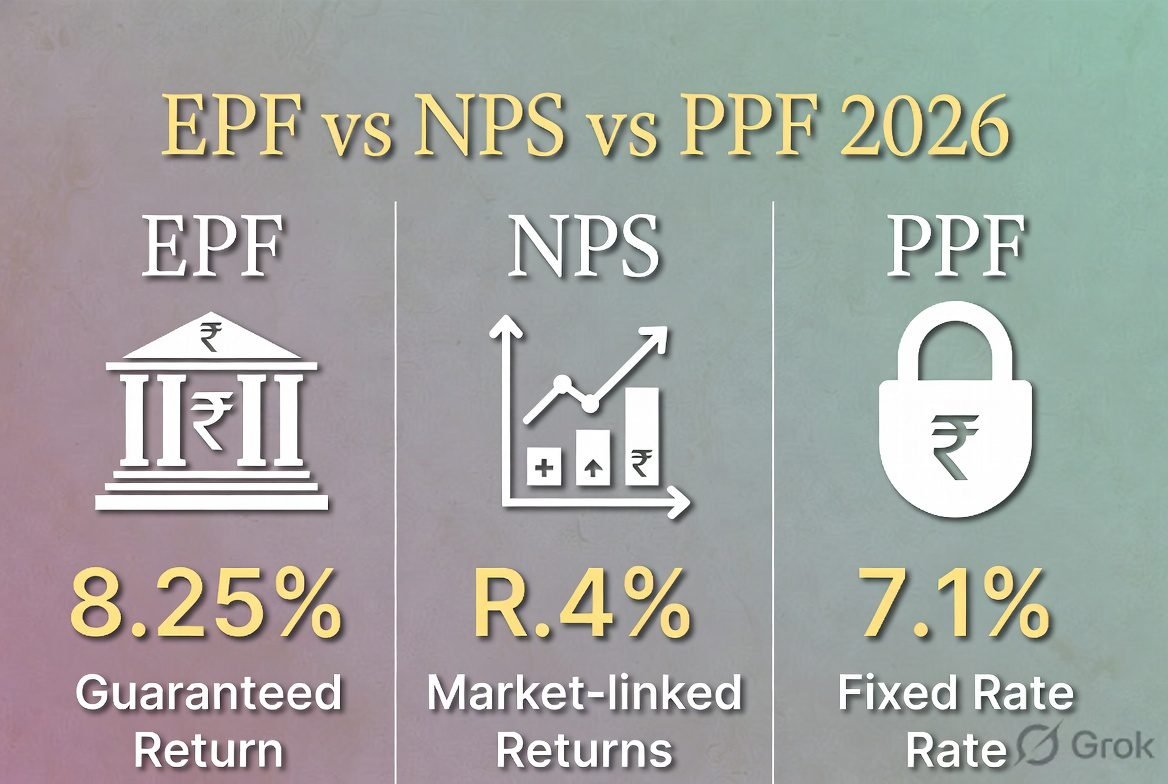
Table of Contents
- Quick Comparison Table
- EPF: The One You Probably Already Have
- PPF: The Conservative, Guaranteed Option
- NPS: The Growth Engine With Extra Tax Benefits
- Returns Comparison: What ₹1.5 Lakh a Year Actually Becomes
- Tax Treatment Side by Side
- Liquidity and Lock-in: The Underrated Factor
- Who Should Actually Prioritize What
- Why "All Three Together" Is Often the Right Answer
- Frequently Asked Questions
Quick Comparison Table
EPF vs NPS vs PPF — 2026 Snapshot
| EPF Interest Rate (FY 2025-26) | 8.25% |
| PPF Interest Rate (Q1 FY 2026-27) | 7.1% |
| NPS Historical Returns | 7.6% – 13.2% (market-linked) |
| PPF Lock-in | 15 years |
| NPS Lock-in | Till age 60 |
| EPF Lock-in | Till retirement / job change |
The EPF interest rate for FY 2025-26 is fixed at 8.25% per annum, applicable to all contributions made during the financial year, calculated monthly on the closing balance. The current PPF interest rate for Q1 FY 2026-27 stands at 7.1% per annum, compounded annually and credited on 31st March — a rate that has remained unchanged since April 2020, making it the longest stable period in recent PPF history. NPS, as we covered in detail in our NPS complete guide, doesn't offer a fixed rate at all — it's market-linked, ranging roughly 7.6% to 13.2% depending on your asset allocation.
EPF: The One You Probably Already Have
If you're a salaried employee at a company covered under the EPF Act, you're very likely already contributing to EPF without having made an active choice to do so — it's largely automatic through payroll. Under the EPF scheme, an employee makes a contribution, and the employer makes an equal matching contribution, with the employee receiving a lump sum on retirement that includes both contributions plus accumulated interest.
Contributions of up to ₹1.5 lakh are deductible under Section 80C, and withdrawals, contributions, and interest earned are all tax-free under normal circumstances. EPF withdrawals are permitted at retirement, after unemployment, or for specific financial needs like medical expenses or home loans, and anyone over the age of 54 can withdraw 90% of the accumulated amount early, while those unemployed for 60 days or more can withdraw the entire accrued amount.
One detail worth understanding clearly: Voluntary Provident Fund (VPF) contributions can be made up to 100% of basic salary plus Dearness Allowance, at the same EPF interest rate, giving salaried employees a way to boost their retirement savings at a guaranteed rate well above what most fixed deposits currently offer — we cover FD rate comparisons separately in our Amrit Vrishti FD calculator if you want a direct rate comparison. You can check your own EPF balance and passbook directly through the EPFO member portal.
PPF: The Conservative, Guaranteed Option
PPF is the option most Indian households have some familiarity with, often opened for children or as a standalone conservative investment even by people who aren't salaried and therefore don't have EPF access at all. The PPF interest rate is set quarterly by the Ministry of Finance, benchmarked to 10-year government security yields via the Shyamala Gopinath Committee formula, and is influenced by G-sec yields, RBI policy direction, and the government's broader fiscal calculus on small savings schemes.
The rate has fallen from 9.5% at the start of the millennium to today's 7.1%, and there's no separate, higher rate for senior citizens under PPF, unlike some other small savings schemes such as SCSS. What PPF trades away in rate, it makes up for in absolute predictability and a sovereign guarantee — there's no market risk whatsoever, unlike the equity-linked portion of NPS. PPF accounts can be opened at any nationalized bank, most private banks, or post offices, and the account can be managed and tracked through the National Savings Institute's official portal.
It's worth noting that PPF's 15-year term, while long, isn't as rigid as it first sounds. After the initial 15 years, the account can be extended in blocks of 5 years indefinitely, either with continued contributions or without — a flexibility that makes PPF genuinely useful as a multi-decade retirement vehicle rather than something you're forced to close and reinvest elsewhere the moment it matures.
NPS: The Growth Engine With Extra Tax Benefits
We've written the full breakdown of NPS separately, including the new December 2025 withdrawal rules, but the short version relevant to this comparison: NPS is the only one of the three with genuine equity market exposure, and it's the only one offering a dedicated ₹50,000 tax deduction under Section 80CCD(1B) that sits entirely outside the ₹1.5 lakh Section 80C limit shared by EPF and PPF.
That last point is genuinely significant for anyone who's already maxing out their 80C limit through EPF, life insurance, or ELSS funds — NPS is one of the few remaining ways to reduce taxable income further without needing to find room inside an already-full bucket. Read our full NPS National Pension System 2026 guide for the complete tax-section breakdown and the new withdrawal rules.
Returns Comparison: What ₹1.5 Lakh a Year Actually Becomes

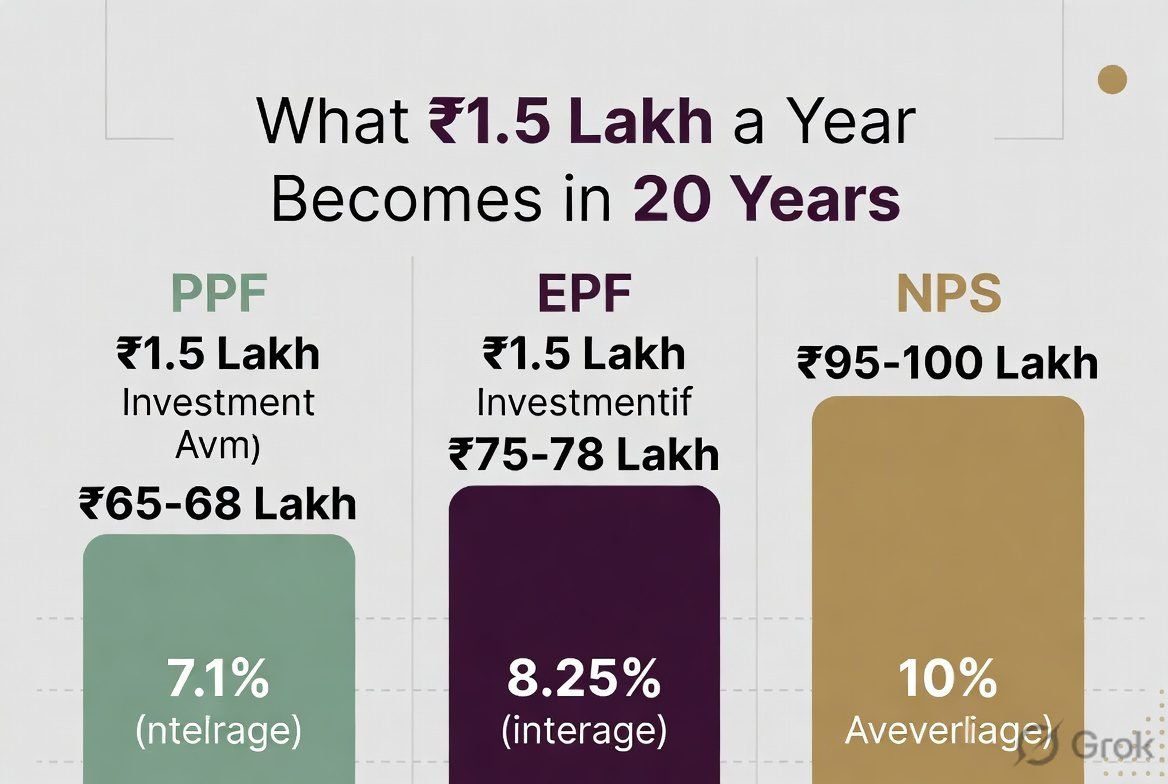
| Instrument | Rate Assumption | ₹1.5L/year for 20 years, approx. value |
|---|---|---|
| PPF | 7.1% fixed | ~₹65-68 lakh |
| EPF | 8.25% fixed | ~₹75-78 lakh |
| NPS (moderate, ~10%) | 10% average market-linked | ~₹95-100 lakh |
These figures are illustrative approximations assuming rates hold roughly steady over two decades, which is a genuinely large assumption for any market-linked instrument — NPS's actual outcome could land meaningfully higher or lower than this midpoint depending on market conditions in any given stretch of years. The point isn't the exact rupee figure; it's the directional relationship between guaranteed-but-lower and variable-but-potentially-higher returns. If you want to model your own numbers with your specific contribution amount, our SIP compounding calculator uses the same underlying compounding logic, just applied to mutual fund SIPs rather than these three retirement instruments specifically.
Tax Treatment Side by Side
| Instrument | Contribution Deduction | Maturity Tax Treatment |
|---|---|---|
| EPF | Up to ₹1.5L under 80C | Tax-free (if 5+ years continuous service) |
| PPF | Up to ₹1.5L under 80C | Fully tax-free (EEE status) |
| NPS | ₹1.5L (80CCD1) + ₹50K extra (80CCD1B) | 60% tax-free lump sum; annuity income taxable |
PPF holds the cleanest "Exempt-Exempt-Exempt" (EEE) status of the three — contribution, growth, and withdrawal are all tax-free with no conditions attached. EPF is effectively EEE too, provided you meet the continuous service requirement; leaving a job and withdrawing early can trigger tax consequences that catch some employees off guard. NPS is the most tax-efficient at the contribution stage because of that extra ₹50,000 deduction, but it's the only one of the three where a portion of eventual retirement income — the annuity payout — is fully taxable at your slab rate, a detail we explain in more depth in our NPS guide's withdrawal rules section.
Liquidity and Lock-in: The Underrated Factor
PPF: 15-Year Lock-in
Partial withdrawals allowed from year 7 onward. Extendable in 5-year blocks after maturity, with or without further contributions.
NPS: Till Age 60
Up to 25% of own contributions withdrawable early for specific purposes (education, medical, home purchase) under Section 10(12B).
EPF: Tied to Employment
Most flexible in practice — accessible on job change, unemployment beyond 60 days, or specific documented needs, without a fixed multi-year lock-in like PPF.
This is genuinely underrated when people compare these three purely on interest rate. A guaranteed 7.1% you can't touch for 15 years and a market-linked 10% average you can't touch till 60 serve very different roles in a financial plan than EPF, which most people can access relatively sooner if genuinely needed. We've written more broadly about matching investment choice to actual time horizon in our beginner investing guide.
Who Should Actually Prioritize What
If you're salaried with EPF already deducted automatically — you likely don't need to actively "choose" EPF; it's already working for you. Consider VPF if you want to voluntarily increase this guaranteed-rate allocation.
If you're self-employed or a freelancer without EPF access — PPF becomes your primary guaranteed-return retirement anchor, since you won't have an automatic EPF contribution happening in the background. Our behavioral mistakes guide touches on why self-employed savers specifically need more deliberate, self-imposed discipline than salaried employees who save automatically through payroll.
If you've already maxed your 80C limit — NPS's extra ₹50,000 deduction under 80CCD(1B) becomes the most tax-efficient next rupee to allocate, regardless of your employment type.
If you're within 5-10 years of retirement — the case for PPF's guaranteed, zero-volatility return strengthens relative to NPS's equity-linked component, since there's less time to recover from a market downturn close to when you'll actually need the money — the same time-horizon logic we cover in our index funds vs active funds comparison.
If you're just starting your career in your 20s — you have the longest possible runway for NPS's equity-linked component to compound and recover from any short-term volatility, which is exactly the scenario where a higher equity allocation within NPS tends to make the most sense, similar to the age-based risk tolerance logic in our sector rotation and broader asset allocation content.
Read Our Full NPS Guide →Why "All Three Together" Is Often the Right Answer
For self-employed readers without EPF, the equivalent combination might lean more heavily on PPF plus NPS, since mutual fund SIPs can fill some of the additional growth-oriented role that EPF's guaranteed contribution plays for salaried employees.
Frequently Asked Questions
What is the EPF interest rate for 2026?
The EPF interest rate for FY 2025-26 is fixed at 8.25% per annum, applicable to contributions made during that financial year and calculated monthly on the closing balance.
What is the current PPF interest rate?
The PPF interest rate for Q1 FY 2026-27 is 7.1% per annum, compounded annually and credited on March 31st — a rate that has remained unchanged since April 2020.
Which gives better returns: EPF, NPS, or PPF?
EPF's fixed 8.25% currently beats PPF's fixed 7.1%. NPS has the highest potential returns (historically 11-20% annualized for equity-heavy allocations) but carries market risk that neither EPF nor PPF has.
Can I invest in EPF, NPS, and PPF all at the same time?
Yes. There's no restriction preventing you from holding all three simultaneously, and for many salaried investors, using all three for their different strengths — EPF's automatic discipline, PPF's guarantee, and NPS's extra tax deduction and growth potential — is a reasonable approach.
Which is more tax-efficient: EPF, PPF, or NPS?
PPF and EPF both offer EEE (Exempt-Exempt-Exempt) tax treatment. NPS offers an additional ₹50,000 deduction outside the 80C limit, making it the most tax-efficient at the contribution stage, though part of its eventual payout (the annuity) is taxable, unlike PPF's fully tax-free maturity.
What is the lock-in period for each option?
PPF has a 15-year lock-in with partial withdrawals allowed from year 7. NPS is locked until age 60, with limited early withdrawal for specific purposes. EPF is generally accessible on job change or after 60 days of unemployment, without a fixed multi-year lock-in.
Our Bottom Line
We'd rather you walk away from this comparison understanding that EPF, NPS, and PPF are solving three different problems than picking a single "best" option and putting everything into it. If you're building a genuinely complete retirement plan, our NPS guide is the natural next read for the deduction and withdrawal mechanics we've only summarized here, and our 50-30-20 budgeting rule article can help you work out how much monthly savings capacity you actually have to split across all three.

Pranab Barman is a Financial Educator and Personal Finance Researcher with over 10 years of hands-on experience in stock markets, trading, and investing. Currently enrolled in the CFA Program, he is committed to continuous learning and professional excellence in finance.
As the Founder of PlayWithStock, Pranab covers a wide range of topics including Mutual Funds, SIP, Taxation, Stock Market Basics, and Financial Calculators — with a focus on simplifying complex financial concepts for everyday all investors.
Email: support@playwithstock.com
Website: playwithstock.com
Related posts:
 NPS National Pension System 2026: Complete Guide to Rules, Tax Benefits and Withdrawal
 How Does SIP Actually Work? 7-Point Breakdown for All Investors
 What Happens to Your EPF When You Change Jobs
 Best AI Stocks India 2026: 7 Picks That Are Actually Worth Watching
 Trump Just Gave Indian Pharma a Two-Year Countdown Clock — Here’s What the US Generic Drug Tariff Actually Means
 Term Insurance vs Endowment Plan: Which is Better for Beginners in 2026
 ITR Refund Status Kaise Check Kare 2026: The Complete Step-by-Step Guide
 Silver Price Surge 2026: Why Silver Is Beating Gold This Year