

PM-SYM vs APY vs NPS-Traders: Which Pension Scheme Is Actually Yours
PM-SYM vs APY vs NPS-Traders is a question we genuinely didn't expect to write about until a reader messaged us confused about why she couldn't enrol in both PM-SYM and NPS-Traders at once — turns out the schemes deliberately block each other, and almost nothing online explains why. All three promise the same headline number, a ₹3,000 to ₹5,000 monthly pension after 60, aimed broadly at people without a formal employer-run retirement plan. But they're not the same scheme wearing three names — they're built for three genuinely different groups of people, run by two different regulators, and you can only ever be enrolled in one.
We've already covered Atal Pension Yojana in full detail. This article puts it next to its two lesser-known siblings so you can actually tell which one, if any, is meant for you.
Table of Contents
- The Quick Answer: Who Is Each Scheme Actually For
- PM-SYM: For Workers Earning Under ₹15,000 a Month
- NPS-Traders: For Shopkeepers and the Self-Employed
- APY: The One We've Already Covered, Recapped
- The Structural Difference Nobody Explains: LIC vs PFRDA
- Why You Can't Join More Than One
- Side-by-Side Comparison Table
- How to Actually Figure Out Which One Applies to You
- Frequently Asked Questions
The Quick Answer: Who Is Each Scheme Actually For
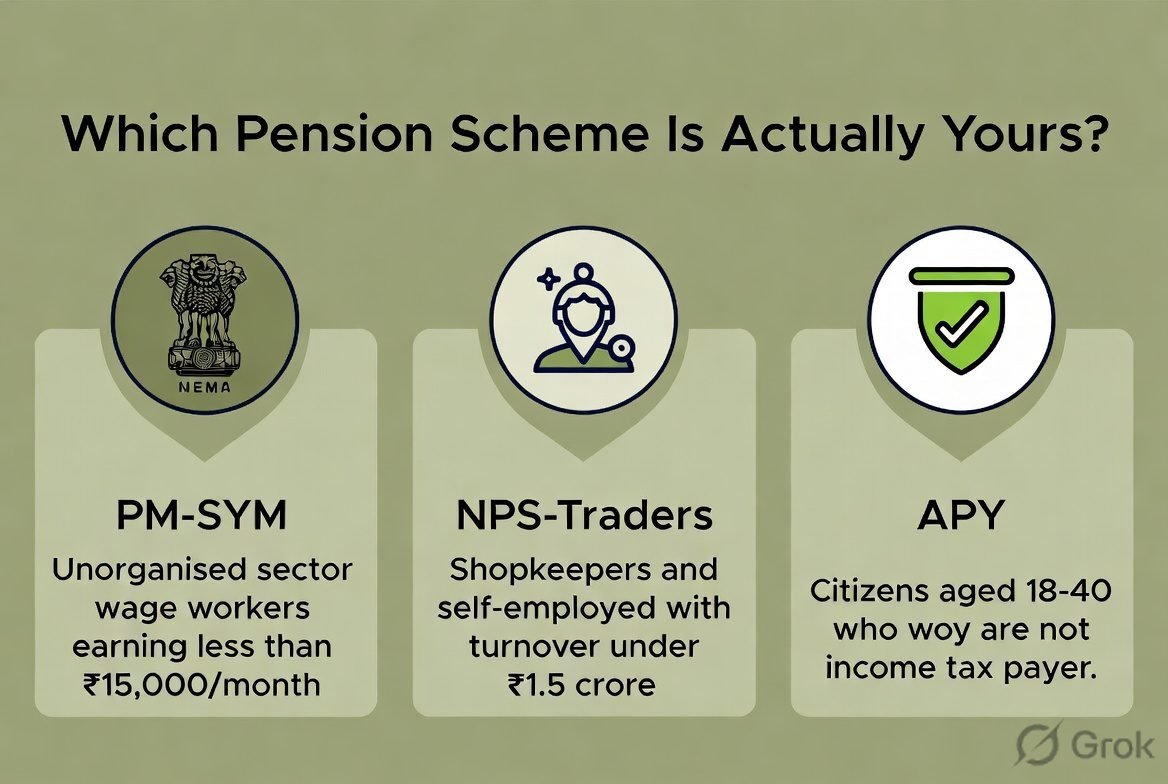
PM-SYM
Unorganised sector wage workers earning ₹15,000/month or less — daily wage labourers, domestic workers, street vendors.
NPS-Traders
Shopkeepers, retail traders, and self-employed business owners with annual turnover under ₹1.5 crore.
APY
Any Indian citizen aged 18-40 with a savings account, as long as they've never been an income tax payer — broadest eligibility of the three.
If you're genuinely unsure which bucket you fall into, the honest starting point is your income source: are you paid a wage by someone else (PM-SYM), do you run your own small business (NPS-Traders), or does neither apply cleanly and you just want a general-purpose guaranteed pension (APY)?
PM-SYM: For Workers Earning Under ₹15,000 a Month
Pradhan Mantri Shram Yogi Maandhan (PM-SYM) is a voluntary, contributory pension scheme launched by the Government of India to provide financial security to workers in the unorganised sector, guaranteeing a minimum monthly pension of ₹3,000 after age 60 to workers earning up to ₹15,000 per month. It's aimed at the roughly 50% of India's GDP contributed by unorganised workers — home-based workers, street vendors, mid-day meal workers, domestic workers, construction labourers, agricultural labourers, beedi workers, handloom workers, rag pickers, cobblers, and similar occupations.
Applicants must be between 18 and 40 years old, not employed in the organised sector, and not covered under EPFO, NPS, or ESIC. The scheme is also only available to those who are not income taxpayers. Monthly contributions range from ₹55 to ₹200, based on entry age — structurally identical to APY's contribution logic, where joining younger costs meaningfully less. Official enrollment and scheme details are maintained on the Maandhan portal, the government's unified platform for these unorganised-sector pension schemes.
Exit provisions are genuinely flexible for a workforce with unpredictable income: if a subscriber exits before completing 10 years, the contributed amount is refunded with savings bank interest. If they exit after 10 years but before 60, they receive their contribution along with accrued interest. PM-SYM is administered by the Ministry of Labour and Employment in collaboration with the Life Insurance Corporation of India (LIC) and Common Service Centres, with LIC serving as the Pension Fund Manager responsible for actual payouts. The scheme's official press releases are archived on the Press Information Bureau's website.
NPS-Traders: For Shopkeepers and the Self-Employed
The National Pension Scheme for Traders and Self-Employed Persons bridges a genuine gap for shopkeepers, small traders, and self-employed professionals who don't have access to salaried retirement benefits. Eligible occupations include retail traders, shop owners, rice mill owners, commission agents, and similar self-employed individuals, with an annual turnover not exceeding ₹1.5 crore, aged 18 to 40.
The scheme is regulated by the Ministry of Labour and Employment, with LIC again serving as the fund manager responsible for pension payouts, and Common Service Centres handling enrolment. Beneficiaries contribute 50% of the monthly premium, and the central government contributes the remaining 50% — doubling the effective pension fund accumulation compared to a purely self-funded scheme. Enrollment locations and step-by-step guidance are available through the Common Service Centre network's official site.
Explicitly excluded: members of EPFO, NPS, or ESIC, income taxpayers, and individuals already enrolled under other Maandhan-family schemes like PM-SYM or PM Kisan Maandhan Yojana — the same mutual-exclusivity rule we'll unpack shortly.
APY: The One We've Already Covered, Recapped
We wrote the complete deep-dive on Atal Pension Yojana separately, but for this comparison, the short version: APY offers a guaranteed monthly pension of ₹1,000 to ₹5,000 from age 60, open to any Indian citizen aged 18-40 with a savings bank account, provided they haven't been an income tax payer since October 2022 and aren't already enrolled in a similar scheme like EPF or PPF. Unlike PM-SYM and NPS-Traders, APY has no occupation or turnover-based eligibility test — it's the most broadly accessible of the three, as long as the tax-payer exclusion doesn't rule you out. Full details, including the exact contribution chart by age, are in our complete APY guide.
The Structural Difference Nobody Explains: LIC vs PFRDA
This is genuinely the detail most comparison articles skip entirely, and it matters for understanding how each scheme is actually run behind the scenes. PM-SYM and NPS-Traders are both regulated by the Ministry of Labour and Employment, with LIC acting as the pension fund manager. APY, by contrast, is managed by PFRDA — the same regulator behind NPS itself.
| Feature | PM-SYM | NPS-Traders | APY |
|---|---|---|---|
| Regulator | Min. of Labour | Min. of Labour | PFRDA |
| Fund Manager | LIC | LIC | PFRDA-appointed PFs |
| Govt. Contribution Style | Matches equally | Matches equally | No ongoing match |
This isn't just administrative trivia — it affects how the pension corpus is actually invested and managed, and which government body you'd approach with a grievance or a claim issue. Both PM-SYM and NPS-Traders benefit from an equal government contribution matching the subscriber's own, effectively doubling the accumulation compared to a self-funded-only structure, which is a meaningfully different value proposition from APY's model.
Why You Can't Join More Than One
Individuals already enrolled under other pension schemes like PM-SYM or PM Kisan Maandhan Yojana are explicitly excluded from NPS-Traders, and the same cross-exclusion logic applies in reverse. The underlying reason is straightforward: all three schemes exist to give unorganised and self-employed Indians access to formal, government-backed pension coverage — not to let the same person stack multiple subsidized, government-co-funded accounts simultaneously.
Side-by-Side Comparison Table
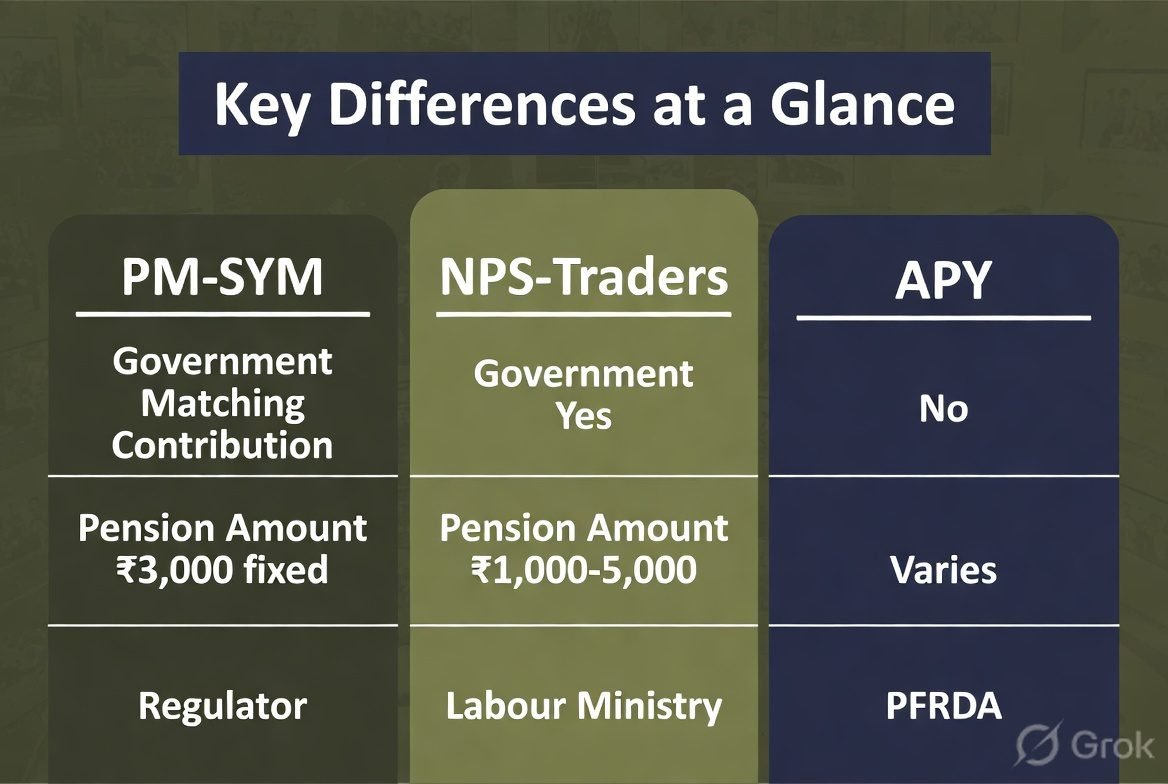
Full Comparison — 2026
| Target Audience | PM-SYM: Wage workers | NPS-Traders: Traders | APY: Anyone eligible |
| Age Range | 18–40 (all three) |
| Monthly Pension | PM-SYM/NPS-Traders: ₹3,000 fixed | APY: ₹1,000–5,000 (chosen) |
| Contribution Range | PM-SYM/NPS-Traders: ₹55–200 | APY: ₹42–1,454 |
| Government Match | PM-SYM/NPS-Traders: Yes, equal | APY: No ongoing match |
| Income/Turnover Cap | PM-SYM: ₹15,000/mo income | NPS-Traders: ₹1.5cr turnover | APY: None specified beyond tax status |
One genuinely important limitation applies across all three: the pension amount is fixed and does not automatically increase with inflation. A ₹3,000 monthly pension decades from now will have meaningfully less purchasing power than ₹3,000 today, which is exactly why financial planners consistently frame these schemes as a guaranteed floor to build on, not a complete retirement solution on their own. We've made the same point about APY in our retirement calculator article, where inflation-adjusted planning is central to the entire methodology.
Read Our Full Atal Pension Yojana Guide →How to Actually Figure Out Which One Applies to You
You're paid wages by an employer, informally, earning under ₹15,000/month — PM-SYM is built specifically for this situation, and the government contribution match makes it genuinely more cost-effective than APY if you qualify.
You run your own shop, stall, or small business with turnover under ₹1.5 crore — NPS-Traders is the closer fit, again with the added benefit of a matching government contribution that APY doesn't offer.
Neither fits cleanly, or you want more control over your pension amount — APY remains the most flexible option, letting you choose your target pension from ₹1,000 to ₹5,000 rather than accepting a fixed ₹3,000, though without the contribution-matching benefit of the other two.
You're already a taxpayer or covered under EPF/NPS through formal employment — none of these three schemes apply to you; our NPS guide and EPF vs NPS vs PPF comparison are the more relevant reads.
Frequently Asked Questions
Can I join both PM-SYM and NPS-Traders?
No, the schemes are mutually exclusive. Beneficiaries of PM-SYM are explicitly excluded from NPS-Traders eligibility, and vice versa.
What is the difference between PM-SYM and NPS-Traders?
PM-SYM is for unorganised sector wage workers earning under ₹15,000/month, while NPS-Traders is for shopkeepers and self-employed individuals with annual turnover under ₹1.5 crore. Both offer a fixed ₹3,000 monthly pension with equal government contribution matching.
Which scheme has the highest possible pension: PM-SYM, NPS-Traders, or APY?
APY allows choosing a pension amount up to ₹5,000/month, higher than the fixed ₹3,000 offered by both PM-SYM and NPS-Traders, though APY does not include an ongoing government contribution match.
Does the government match contributions in all three schemes?
No. PM-SYM and NPS-Traders both include an equal government contribution matching the subscriber's own payment. APY does not have this ongoing matching structure.
Are PM-SYM and NPS-Traders pensions adjusted for inflation?
No, the ₹3,000 monthly pension under both schemes is fixed and does not automatically increase with inflation over time.
Who manages PM-SYM and NPS-Traders funds?
Both schemes are regulated by the Ministry of Labour and Employment, with the Life Insurance Corporation of India (LIC) serving as the pension fund manager, unlike APY, which is managed by PFRDA.
Our Bottom Line
We'd rather you leave this article knowing exactly which of the three genuinely applies to your situation than vaguely remembering "there's some ₹3,000 pension scheme somewhere." The eligibility rules are specific enough, and the mutual exclusivity strict enough, that guessing isn't a great strategy here — if you're helping a family member figure this out, walking through their actual occupation and income against the three eligibility profiles above is the fastest path to the right answer.
For salaried taxpayers, none of these three schemes apply, and our NPS guide, EPF vs NPS vs PPF comparison, and SCSS guide cover the retirement instruments genuinely relevant to that audience instead.

Pranab Barman is a Financial Educator and Personal Finance Researcher with over 10 years of hands-on experience in stock markets, trading, and investing. Currently enrolled in the CFA Program, he is committed to continuous learning and professional excellence in finance.
As the Founder of PlayWithStock, Pranab covers a wide range of topics including Mutual Funds, SIP, Taxation, Stock Market Basics, and Financial Calculators — with a focus on simplifying complex financial concepts for everyday all investors.
Email: support@playwithstock.com
Website: playwithstock.com
Related posts:
 NPS National Pension System 2026: Complete Guide to Rules, Tax Benefits and Withdrawal
 EPF vs NPS vs PPF 2026: Which Retirement Option Actually Suits You
 Senior Citizens Savings Scheme 2026: Interest Rate, Limits and Tax Rules Explained
 EPS Explained 2026: The Hidden Pension Inside Your EPF Account
 119 Years Old and Still Beating Every Major Private Bank on FD Rates — Inside the Bank of Baroda FD Scheme Lineup
 Atal Pension Yojana 2026: Complete Guide to Rules, Contribution and Eligibility
 Retirement Calculator India 2026: How Much You Actually Need to Save
 UPS Pension Calculator 2026: The Complete Guide