


EPS Explained 2026: The Hidden Pension Inside Your EPF Account
EPS Explained 2026 is honestly overdue on this blog, because it's genuinely one of the most misunderstood parts of Indian retirement planning — not because it's complicated, but because almost nobody realizes it's happening at all. Every month, a slice of your employer's PF contribution quietly gets diverted away from your EPF balance and into a completely separate pension account. Most salaried employees we talk to have never once looked at this number, and a lot of them don't even know it exists as a distinct thing from their EPF corpus.
We've covered EPF itself in our EPF vs NPS vs PPF comparison, but EPS deserves its own dedicated explanation, because confusing the two is exactly how people accidentally forfeit a lifelong pension without realizing what they gave up. Our beginner investing guide is a useful starting point if retirement account terminology in general still feels unfamiliar. Official EPS scheme documentation is maintained by the EPFO's official website.
Table of Contents
- What Is EPS, and How Is It Different From EPF
- The EPS 2026 Update: What Actually Changed
- The Pension Formula, Explained Simply
- Eligibility: The 10-Year Rule That Trips Everyone Up
- A Real Number: What Does This Actually Pay
- Early Pension From Age 50: The Trade-off
- Why Withdrawing at Every Job Change Destroys This Benefit
- Family Pension: What Happens After You're Gone
- Frequently Asked Questions
What Is EPS, and How Is It Different From EPF
The Employees' Pension Scheme, established under Section 6A of the EPF & MP Act, 1952, is a social security pension scheme that operates alongside EPF. It's one of the largest pension schemes in the world by membership, covering over 6 crore employees across India, and yet remains one of the least understood components of the entire EPF ecosystem. The full legal text and scheme rules are available through the Ministry of Labour & Employment's official website.
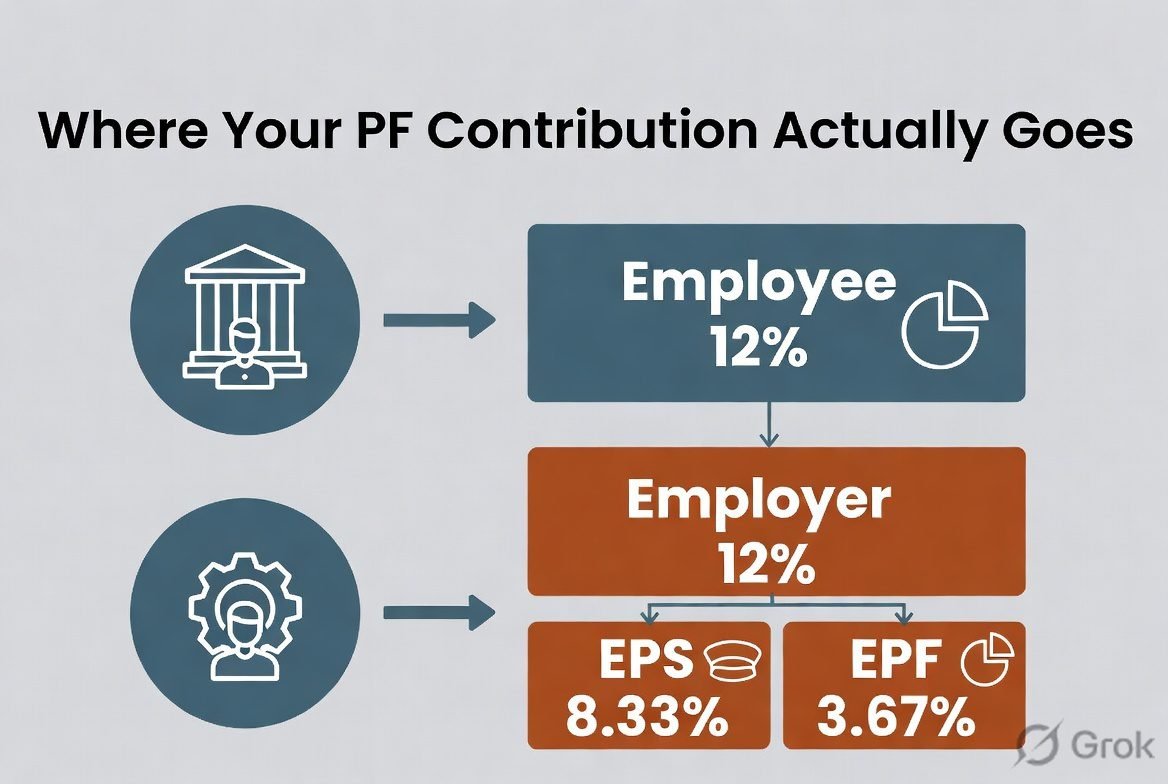
Here's the part that genuinely surprises people: EPF receives 12% from the employee plus 3.67% from the employer, while EPS separately receives 8.33% from the employer's contribution, capped at ₹1,250 per month, providing a monthly pension rather than a lump sum. Your own 12% contribution never touches EPS at all — it's entirely an employer-side diversion, which is exactly why so few employees notice it happening.
EPF vs EPS — Where Your Contribution Actually Goes
| Your Contribution | 12% → EPF only |
| Employer's Contribution | 12% total |
| — Of Which, to EPS | 8.33% (capped ~₹1,250/mo) |
| — Of Which, to EPF | Remaining 3.67% |
| EPS Payout Type | Monthly pension for life |
| EPF Payout Type | Lump sum |
The EPS 2026 Update: What Actually Changed
On June 29, 2026, the Ministry of Labour & Employment launched the Employees' Pension Scheme 2026, replacing the earlier EPS-1995 and the 1971 Family Pension Scheme under the Code on Social Security, 2020. If that sounds like it should mean sweeping changes, the more useful headline is actually the opposite: while the new framework replaces the previous scheme by name, the core eligibility criteria and pension calculation formula remain unchanged, and around 6 crore existing EPFO subscribers continue receiving pension benefits under the same methodology. Official notifications and press releases on this transition are archived on the Press Information Bureau's website.
The pension calculation, contribution rates, minimum pension amount, and broader eligibility criteria all remain unchanged under EPS 2026 — this is genuinely a consolidation and modernization of the legal framework rather than a reset of how much anyone's pension is actually worth. If you were expecting your EPS number to change because of this relaunch, it hasn't.
The Pension Formula, Explained Simply
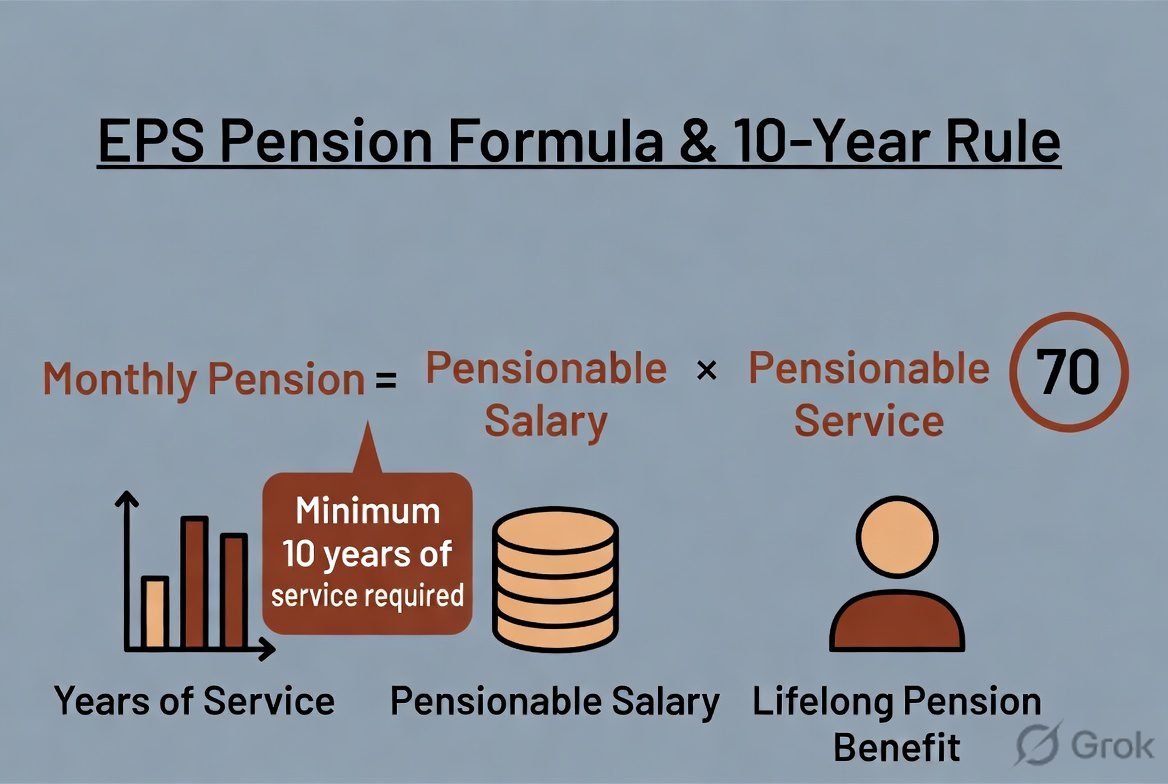
The monthly EPS pension is calculated using the formula prescribed under Paragraph 12 of the EPS Scheme: Monthly Pension = (Pensionable Salary × Pensionable Service) ÷ 70.
Pensionable Salary is the average of the last 60 months' salary (basic pay plus DA) preceding your date of exit from employment. However, for the purpose of EPS contribution, this salary is capped at ₹15,000 per month, meaning the maximum pensionable salary considered is ₹15,000 regardless of your actual salary.
This wage ceiling is genuinely the single most important detail in understanding why EPS pensions look modest compared to what people expect. Even a senior employee earning ₹1,50,000 a month has their EPS pension calculated as though they earn ₹15,000 — the scheme was designed as a baseline social security floor, not a proportional retirement replacement for higher earners.
Eligibility: The 10-Year Rule That Trips Everyone Up
To receive pension benefits under EPS, an employee must complete at least 10 years of pensionable service. If the service period is less than 10 years, the employee may withdraw the accumulated pension amount but will not receive a monthly pension. The standard retirement age for EPS pension is 58 years.
10+ Years of Service
Qualifies for a guaranteed monthly pension for life, calculated using the standard formula, starting at age 58.
Under 10 Years of Service
No monthly pension — instead, a one-time withdrawal benefit is paid out, and the lifelong pension entitlement is lost entirely.
This is genuinely the biggest risk in the entire system: if you withdraw PF at every job change, you will never accumulate 10 years of pensionable service and will lose entitlement to a lifelong pension forever. Always transfer PF when changing jobs instead of withdrawing it — a detail we cover in more depth in our EPF transfer when changing jobs guide.
A Real Number: What Does This Actually Pay
Based on the current formula, an employee completing exactly 10 years of eligible service can expect an estimated monthly pension of approximately ₹2,143, subject to the prevailing wage ceiling. The minimum pension payable under EPS continues to remain at ₹1,000 per month.
There have been discussions about increasing the minimum pension to somewhere between ₹5,000 and ₹7,500 per month, but no official notification approving such a revision has been issued so far — worth watching for future policy updates, but not something to plan around until it's formally confirmed.
Early Pension From Age 50: The Trade-off
Employees who have completed the 10-year service requirement can choose an early pension starting from age 50, rather than waiting until 58. However, if you start your pension early, the monthly pension amount is permanently reduced by 4% for every year your age is below 58 at the time you begin drawing it.
That reduction compounds quickly — starting at exactly age 50 instead of 58 means an 8-year gap, which at 4% per year works out to a roughly 32% permanent cut to the monthly pension amount for the rest of your life. This is genuinely a decision worth thinking through carefully rather than defaulting into, especially if you have other income sources that could bridge the gap between 50 and 58 without needing to draw EPS early.
Why Withdrawing at Every Job Change Destroys This Benefit
We've touched on this already, but it deserves its own section because it's genuinely the most common, avoidable mistake in the entire EPF/EPS system. Withdrawing EPF at every job change is the most common and damaging retirement planning mistake made by Indians, and it also has a direct tax cost — EPF withdrawn before 5 continuous years of employment is fully taxable as income, on top of resetting your pensionable service clock back to zero for EPS purposes.
Maintaining the same EPF account across job changes, or carrying forward pensionable service through a Scheme Certificate when a transfer genuinely isn't possible, helps preserve accumulated service toward the 10-year EPS eligibility requirement. Practically, this means the single best financial decision most job-switchers can make is a UAN-based transfer rather than a withdrawal — a process that takes a few minutes online but protects a benefit that can be worth a guaranteed monthly income for decades.
Read: EPF When You Change Jobs →Family Pension: What Happens After You're Gone
EPS isn't purely an individual benefit that ends with the subscriber. The EPS 2026 framework continues to offer family pension as one of its core benefit types, alongside monthly superannuation pension, early pension, disability pension, and withdrawal benefits. If an EPS member passes away, eligible family members — typically a spouse and, in many cases, children up to a certain age — continue to receive a pension under defined rules, which is part of why maintaining continuous, transferred EPF/EPS accounts matters even beyond the subscriber's own retirement planning.
Frequently Asked Questions
What is EPS and how is it different from EPF?
EPS (Employees' Pension Scheme) is a separate pension account funded by 8.33% of your employer's contribution (capped at ~₹1,250/month), providing a monthly pension for life after retirement. EPF is your own 12% contribution plus the remaining employer share, paid out as a lump sum.
What is the EPS pension formula?
Monthly Pension = (Pensionable Salary × Pensionable Service) ÷ 70, where Pensionable Salary is your average basic salary plus DA over the last 60 months, capped at ₹15,000 per month regardless of actual salary.
How many years of service do I need for an EPS pension?
A minimum of 10 years of pensionable service is required to receive a monthly pension. Less than 10 years results in a one-time withdrawal benefit instead of a lifelong pension.
What is the minimum EPS pension amount?
The minimum pension payable under EPS is ₹1,000 per month. There have been discussions about raising this to ₹5,000-7,500, but no official notification has been issued as of 2026.
Can I get my EPS pension before age 58?
Yes, employees who've completed 10 years of service can opt for early pension from age 50, but the monthly amount is permanently reduced by 4% for each year below 58 at the time pension begins.
What happens to my EPS if I change jobs?
If you withdraw your EPF at a job change instead of transferring it, you lose accumulated pensionable service, which can prevent you from ever reaching the 10-year EPS eligibility threshold. Always transfer your EPF/EPS account when switching jobs.
Our Bottom Line
EPS is genuinely one of those benefits that's easy to overlook precisely because it requires no active decision-making from most employees — it just quietly accumulates in the background of a salary structure most people never examine closely. The one decision that genuinely matters is what you do at every job change: transfer, don't withdraw, and that single habit preserves a benefit that can be worth a guaranteed monthly income for the rest of your life.
If you're mapping out your complete retirement picture, our retirement calculator and NPS guide cover the pieces that need to fill the gap EPS alone won't cover.

Pranab Barman is a Financial Educator and Personal Finance Researcher with over 10 years of hands-on experience in stock markets, trading, and investing. Currently enrolled in the CFA Program, he is committed to continuous learning and professional excellence in finance.
As the Founder of PlayWithStock, Pranab covers a wide range of topics including Mutual Funds, SIP, Taxation, Stock Market Basics, and Financial Calculators — with a focus on simplifying complex financial concepts for everyday all investors.
Email: support@playwithstock.com
Website: playwithstock.com
Related posts:
 EPF vs NPS vs PPF 2026: Which Retirement Option Actually Suits You
 NPS National Pension System 2026: Complete Guide to Rules, Tax Benefits and Withdrawal
 What is a Demat Account? A Complete Beginner’s Guide
 119 Years Old and Still Beating Every Major Private Bank on FD Rates — Inside the Bank of Baroda FD Scheme Lineup
 What Happens to Your EPF When You Change Jobs
 Atal Pension Yojana 2026: Complete Guide to Rules, Contribution and Eligibility
 Senior Citizens Savings Scheme 2026: Interest Rate, Limits and Tax Rules Explained
 India US Trade Deal 2026: Inside the Tariff Rollercoaster Before July 22