

Ayushman Bharat for Senior Citizens 70+: The ₹5 Lakh Cover Most Families Still Don't Know About
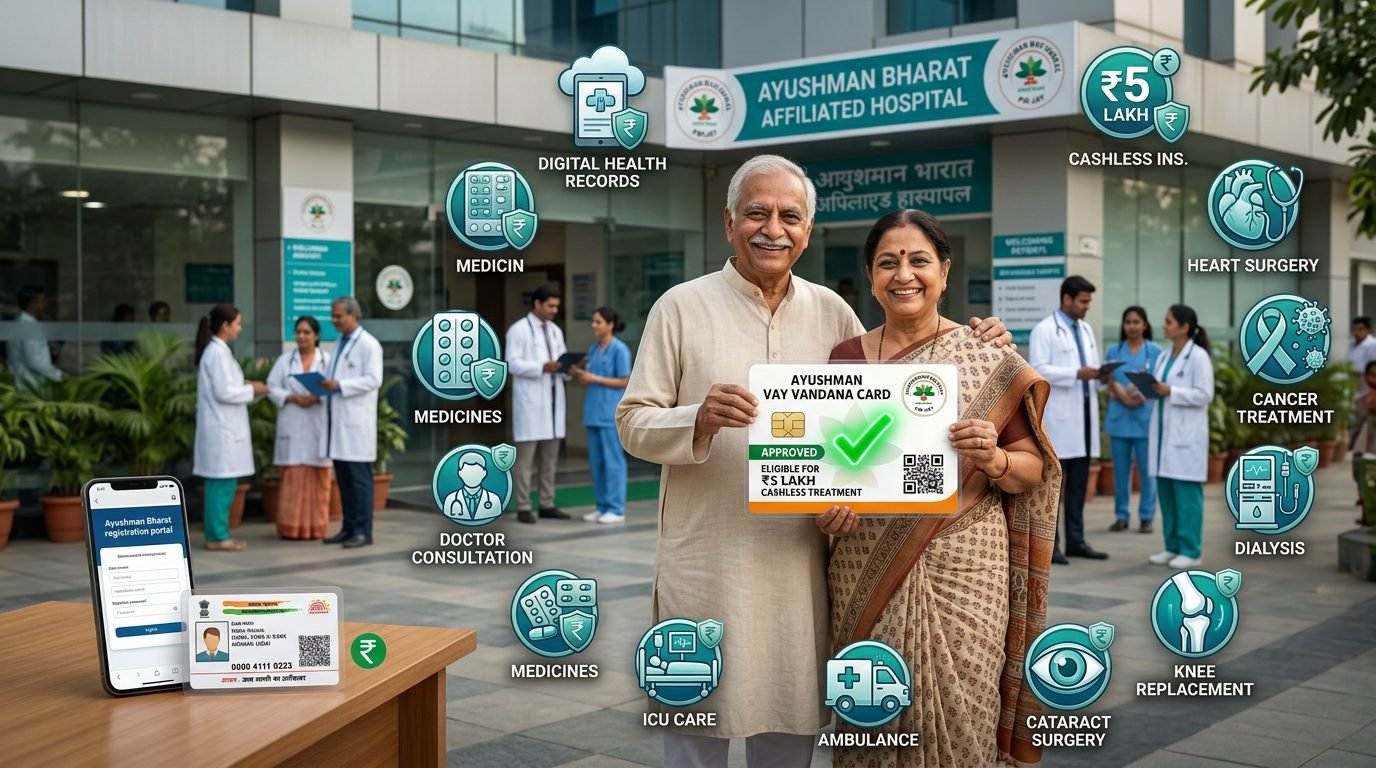
Ayushman Bharat for Senior Citizens 70+ is genuinely one of those schemes we assumed most readers already knew about, until we actually asked around. A relative in her seventies, comfortably middle-class, had never heard that she qualified for ₹5 lakh in free hospital cover — she'd always assumed Ayushman Bharat was strictly a scheme for below-poverty-line families, which used to be true, and hasn't been true for every senior citizen since October 2024. That gap between what changed and what people still believe is exactly why we're writing this.
This continues our Government Schemes coverage alongside SCSS and Atal Pension Yojana — both financial schemes for the same broad audience this health cover is built for. Healthcare costs are genuinely one of the biggest threats to a retirement plan, and this scheme addresses that directly, at zero cost, for anyone who qualifies. We've also touched on retirement healthcare planning more broadly in our retirement calculator article, where medical cost inflation is flagged as one of the harder variables to plan around — this scheme is genuinely one of the few tools that removes a large chunk of that uncertainty outright, for those who actually claim it.
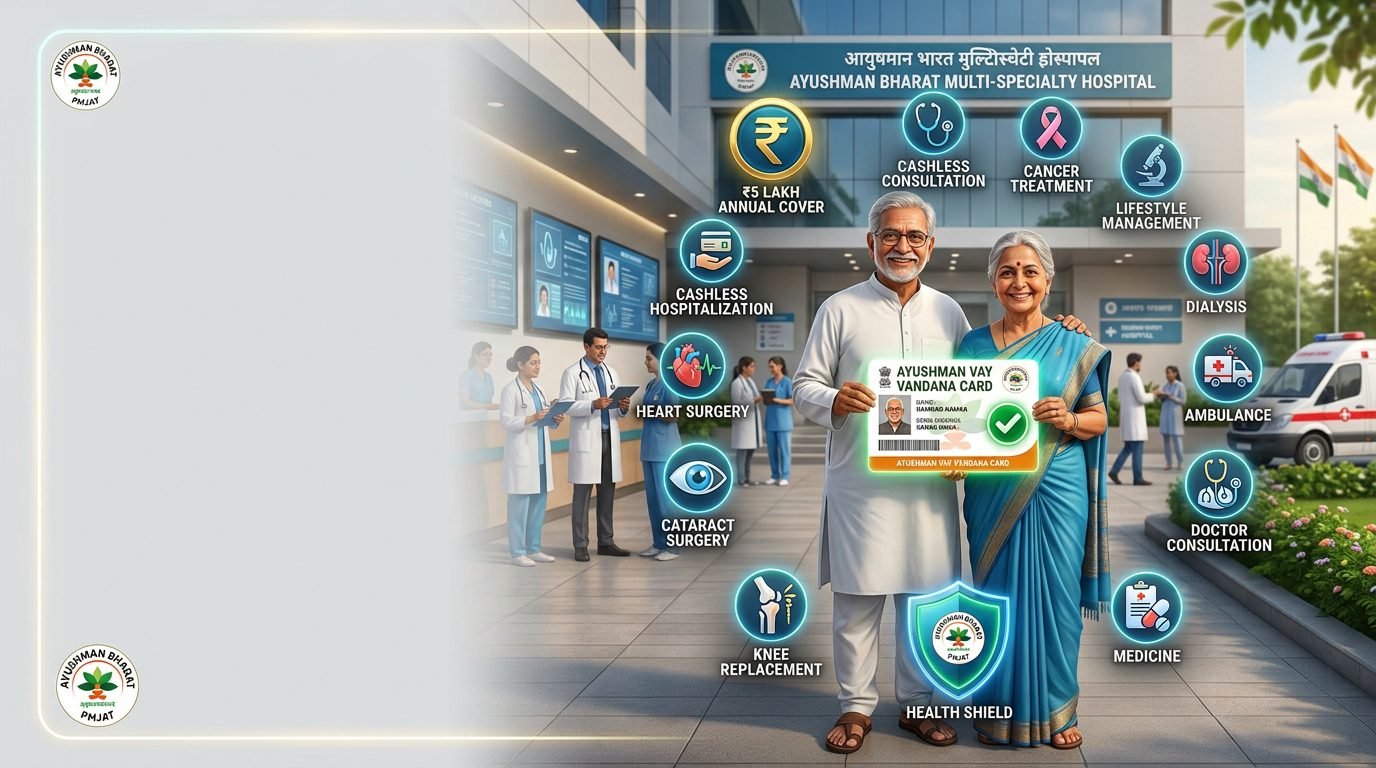
Table of Contents
- What Actually Changed in October 2024
- Who Qualifies — and Why Income Doesn't Matter Anymore
- What the ₹5 Lakh Actually Covers
- The Top-Up Detail Families Genuinely Miss
- How to Apply: The Actual Steps
- If You Already Have CGHS, ECHS, or Private Insurance
- The Real Numbers So Far
- Mistakes Families Make When Applying
- Frequently Asked Questions
What Actually Changed in October 2024
The Ayushman Vay Vandana Card, launched on October 29, 2024, under the Ayushman Bharat Pradhan Mantri Jan Arogya Yojana (AB PM-JAY), offers ₹5 lakh in free health coverage annually to all seniors above 70, regardless of their financial background. Before this, Ayushman Bharat coverage depended on where you fell in the SECC 2011 economic survey data — genuinely restrictive for a scheme trying to reach India's elderly population broadly. Full details on the scheme's history and structure are maintained by the National Health Authority, the body responsible for implementing PM-JAY nationwide.
Ayushman Bharat 70+ — 2026 Snapshot
| Annual Cover | ₹5 lakh per senior |
| Income Requirement | None |
| Empanelled Hospitals | 36,229 nationwide |
| Procedures Covered | 1,961+ |
| Pre-Existing Conditions | Covered from Day 1 |
| Cards Issued (as of Mar 2026) | 3.4+ crore |
"Every Indian citizen aged 70 years or above is eligible for Ayushman Bharat, regardless of income, economic category, or existing insurance — no proof of poverty required." This is genuinely the single most important expansion of Ayushman Bharat in recent years, and it's the specific provision that a lot of otherwise well-informed families still haven't caught up with.
Who Qualifies — and Why Income Doesn't Matter Anymore
You must be 70 or older, verified by your Aadhaar card. If only the birth year is listed, January 1 of the next year is taken as your date of birth for age verification purposes — a detail worth checking on your own Aadhaar record before applying, since a mismatch here is one of the more common causes of application delays.
Eligibility requires being 70 years or older, an Indian citizen, and meeting the AB-PMJAY beneficiary criteria under this specific senior citizen provision. Whether a family is rich or poor, if there is a member aged 70 or above, they are now eligible — the scheme deliberately removed the economic means-testing that governs the rest of Ayushman Bharat's regular coverage for younger beneficiaries.
What the ₹5 Lakh Actually Covers
The scheme provides cashless treatment at over 29,870 empanelled hospitals, including thousands of private facilities, covering approximately 2,000 medical procedures, from diagnostics to complex surgeries, with no waiting period for pre-existing conditions. More recent counts put empanelment at 36,229 hospitals — 19,483 government and 16,746 private — with 1,961 procedures covered across 27 medical specialties.
Genuinely Covered From Day 1
Pre-existing conditions — diabetes, heart disease, kidney failure — are covered immediately on enrolment, no waiting period.
Common Claim Categories
The bulk of claims so far have gone toward cataract surgery, knee replacement, cardiac angioplasty and CABG, and dialysis.
This "no waiting period on pre-existing conditions" detail is genuinely the part that separates this from private senior citizen health insurance, where pre-existing condition exclusions and waiting periods are almost universal, and often the exact reason families struggle to get elderly parents covered privately at all.
The specialty range covered is also genuinely broader than most people assume from the headline "₹5 lakh hospital cover" framing. Beyond the high-volume categories like cataract and knee replacement, the scheme's package includes cancer treatment, cardiac surgery, neurosurgery, and dialysis — the exact categories of care that tend to be both medically urgent and financially devastating without insurance, particularly for a family relying on fixed retirement income to cover an unplanned hospitalization.
The Top-Up Detail Families Genuinely Miss
This ₹5 lakh senior citizen cover is in addition to — not instead of — any existing family PM-JAY coverage. A household that is already PM-JAY eligible gets the regular family cover plus an additional ₹5 lakh top-up specifically for the 70-plus member. For families already under AB PM-JAY, seniors get an additional ₹5 lakh top-up cover exclusively for themselves.
This stacking detail is genuinely easy to miss if you only skim the headline. A family that assumes they're "already covered" under regular PM-JAY and don't bother applying for the senior-specific card is leaving an entire separate ₹5 lakh cover unclaimed for their eldest members — the two covers are additive, not overlapping.
How to Apply: The Actual Steps
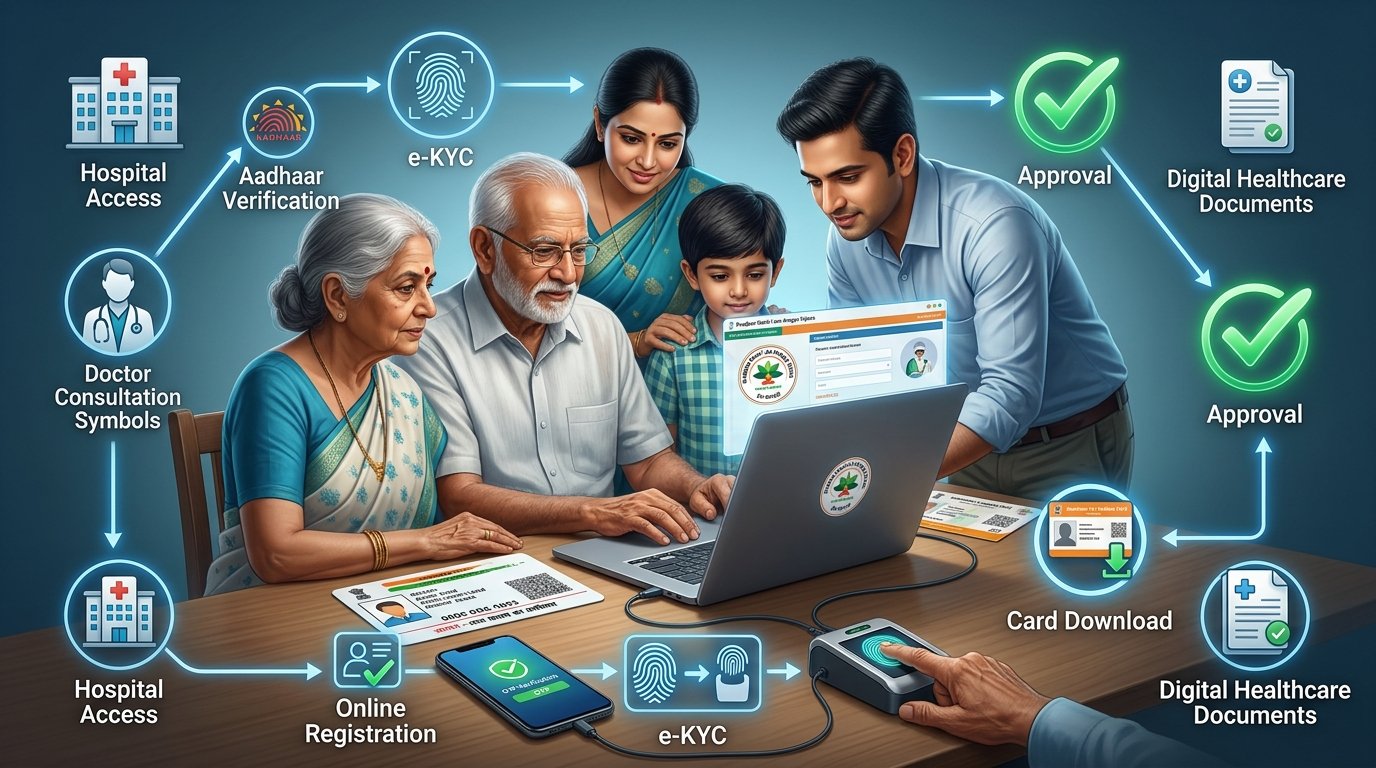
- Visit the official portal at beneficiary.nha.gov.in, which now redirects to the BIS Portal (bis.pmjay.gov.in) for registration, card download, and e-KYC.
- Choose "Beneficiary" login and enter the Aadhaar-linked mobile number.
- Verify with the OTP sent by UIDAI to that mobile number.
- Under "Scheme," specifically select "Ayushman Vay Vandana Yojana" — not the regular PMJAY option, since this is a distinct scheme track within the portal.
- Enter State, District, Block, and Village or Urban Ward details.
- Complete e-KYC — this typically requires a live photo of the senior citizen along with Aadhaar OTP verification.
- Once approved, usually within 15-30 minutes, download the Ayushman Vay Vandana Card directly.
Caregivers can apply for senior citizen parents or grandparents online at beneficiary.nha.gov.in or through the Ayushman App, which is genuinely useful given that many eligible seniors aren't comfortable navigating a government portal independently — the application is explicitly designed to be completed by a family member on their behalf.
Read Our SCSS Guide for Retirement Income →If You Already Have CGHS, ECHS, or Private Insurance
Seniors currently on CGHS, ECHS, or ESI can choose to switch to AB-PMJAY or continue their existing scheme — whichever benefits them more. This is genuinely worth an honest comparison rather than an automatic decision either way. CGHS and ECHS typically offer broader network access for government employees and their families with different reimbursement structures, while Ayushman Bharat's senior cover is genuinely cashless with no premium and no income test, which can make it a meaningful supplement even for those with other coverage, provided the specific hospital and procedure needed falls within its empanelled network.
Private health insurance holders aren't excluded either — nothing about holding a private policy disqualifies a 70+ citizen from also applying for this government cover, and having both genuinely gives a family more total coverage and more hospital choice than either alone. Live hospital network searches, filterable by state, district, and specialty, are available directly through the official PM-JAY hospital search portal.
The Real Numbers So Far
| Metric | Figure (as of early-mid 2026) |
|---|---|
| Eligible Senior Citizens (70+) | ~6 crore estimated |
| Cards Enrolled | 3.4+ crore |
| Total Claims Authorised | ₹4,200+ crore |
| Claim Period Covered | First 17 months of the scheme |
National Health Authority data shows over 3.4 crore senior citizens have enrolled for the card against an estimated eligible base of 6 crore — meaning genuinely more than 2.5 crore eligible seniors likely still haven't applied. That's a substantial gap, and it's a large part of why we felt this article was worth writing now rather than assuming the scheme has already reached everyone it's meant for.
The scheme has authorised over ₹4,200 crore in claims in its first 17 months, with the bulk going toward cataract surgery, knee replacement, cardiac angioplasty and CABG, and dialysis — a concentration that makes sense given how common these specific conditions are in the 70+ age group, and how expensive they'd otherwise be to manage without coverage. A single cardiac procedure or a course of dialysis can easily run into lakhs of rupees privately, so the aggregate claims figure represents genuinely meaningful savings spread across millions of families rather than an abstract budget number.
Mistakes Families Make When Applying
Assuming existing family PM-JAY coverage already includes the senior member's top-up — as covered above, this is a separate, additive cover that requires its own application under the specific "Ayushman Vay Vandana Yojana" scheme selection.
Not checking the birth year listed on Aadhaar — since age verification defaults to January 1 of the following year when only a birth year is recorded, a senior citizen who's actually 70 by their real birthday might show as 69 in the system until that default date passes, delaying eligibility confirmation.
Assuming income or existing insurance disqualifies them — genuinely the most common misconception, and the one that likely explains a meaningful share of the enrollment gap between the 6 crore eligible and 3.4 crore enrolled figures.
Not verifying hospital empanelment before a planned procedure — checking the hospital list through pmjay.gov.in's Hospital Search feature before scheduling a non-emergency procedure avoids the scenario of arriving at a preferred hospital only to find it isn't part of the cashless network.
Delaying application until a health issue actually arises — while the scheme does cover pre-existing conditions from day one, the enrollment and e-KYC process itself takes time to complete, and doing it during a medical emergency adds unnecessary stress to an already difficult situation. Completing the application while a senior citizen is in good health, purely as a precaution, avoids that scramble entirely.
Not checking state-specific top-up schemes — several states run their own supplementary health coverage that stacks on top of the central Ayushman Bharat cover. Depending on where a senior citizen resides, the effective total coverage can meaningfully exceed the base ₹5 lakh once state-level programs are factored in, something families rarely check unless they specifically ask at their local Common Service Centre.
Frequently Asked Questions
Who is eligible for the Ayushman Bharat 70+ health cover?
Any Indian citizen aged 70 or above, verified through Aadhaar, regardless of income, economic category, or existing insurance coverage.
How much health coverage does the scheme provide?
₹5 lakh per year per eligible senior citizen, and this is separate from and additional to any existing family PM-JAY coverage the household may already have.
Are pre-existing conditions covered under this scheme?
Yes, pre-existing conditions such as diabetes, heart disease, and kidney failure are covered from day one, with no waiting period, unlike most private health insurance policies.
How do I apply for the Ayushman Vay Vandana Card?
Visit beneficiary.nha.gov.in (now redirecting to bis.pmjay.gov.in), log in with an Aadhaar-linked mobile number and OTP, select "Ayushman Vay Vandana Yojana" as the scheme, complete e-KYC, and download the card once approved, usually within 15-30 minutes.
Can seniors with private health insurance still apply?
Yes, having private insurance or other government health schemes like CGHS or ECHS does not disqualify a senior citizen from also enrolling in this scheme.
How many hospitals accept this card?
Over 36,000 hospitals nationwide, including both government and private facilities, covering more than 1,900 medical procedures across various specialties.
Our Bottom Line
This is genuinely one of the more consequential government schemes we've covered on this blog, precisely because it addresses a risk — major healthcare costs late in life — that can undo years of otherwise careful financial planning in a single hospitalization. The eligibility gap between roughly 6 crore qualified seniors and 3.4 crore actually enrolled suggests a real awareness problem rather than an access problem, which makes this exactly the kind of information worth sharing directly with parents, grandparents, or elderly neighbours rather than assuming they already know.
If you're building a complete financial picture for a senior citizen in your family, our SCSS guide and Atal Pension Yojana article cover the income side of retirement planning that pairs naturally with this health coverage.

Pranab Barman is a Financial Educator and Personal Finance Researcher with over 10 years of hands-on experience in stock markets, trading, and investing. Currently enrolled in the CFA Program, he is committed to continuous learning and professional excellence in finance.
As the Founder of PlayWithStock, Pranab covers a wide range of topics including Mutual Funds, SIP, Taxation, Stock Market Basics, and Financial Calculators — with a focus on simplifying complex financial concepts for everyday all investors.
Email: support@playwithstock.com
Website: playwithstock.com
Related posts:
 Senior Citizens Savings Scheme 2026: Interest Rate, Limits and Tax Rules Explained
 Passive Investing in India Just Crossed ₹14 Lakh Crore — Here’s the Index Funds vs Active Funds Math Behind It
 Silver Shortage 2026: Why Prices Crossed ₹2.25 Lakh and Keep Climbing
 Reliance Q1 FY27 Results: Revenue Hits Record ₹3.12 Lakh Crore, Profit Slips 22%
 India IPO Boom 2026: ₹2.65 Lakh Crore Pipeline Explained in Simple Terms
 Gold Price Rally 2026: Why It Jumped 44% and Nears ₹1.45 Lakh
 RBI MPC August 2026: 5 Key Things to Watch Before the Repo Rate Decision
 Term Insurance vs Endowment Plan: Which is Better for Beginners in 2026