


India IPO Boom 2026: ₹2.65 Lakh Crore Pipeline Explained in Simple Terms
India IPO Boom 2026 is a phrase we've been typing into a lot of headlines lately, and honestly the numbers behind it are big enough that we wanted to sit down and actually break them apart properly instead of just repeating a crore figure without context. Somewhere between ₹44,000 crore, ₹265,000 crore, and Kotak's ₹6 lakh crore projection, most readers lose the thread of what's actually happening — and that confusion is exactly why we're writing this.
We track IPOs individually on this blog — you've probably read our pieces on the Reliance Jio IPO, the SBI Mutual Fund IPO, or the Zepto IPO — but nobody had connected the dots on why so many companies are rushing to list in the same three-month window. You can browse the raw list of live and upcoming issues yourself on broker platforms like Upstox's IPO page, Groww's IPO dashboard, or Angel One's upcoming IPO tracker, and Zerodha maintains its own summary on Zerodha's IPO page. Turns out there's a very specific regulatory reason behind the rush, and once you understand it, the whole "IPO boom" headline stops feeling random.
What's Actually Driving the 2026 IPO Boom
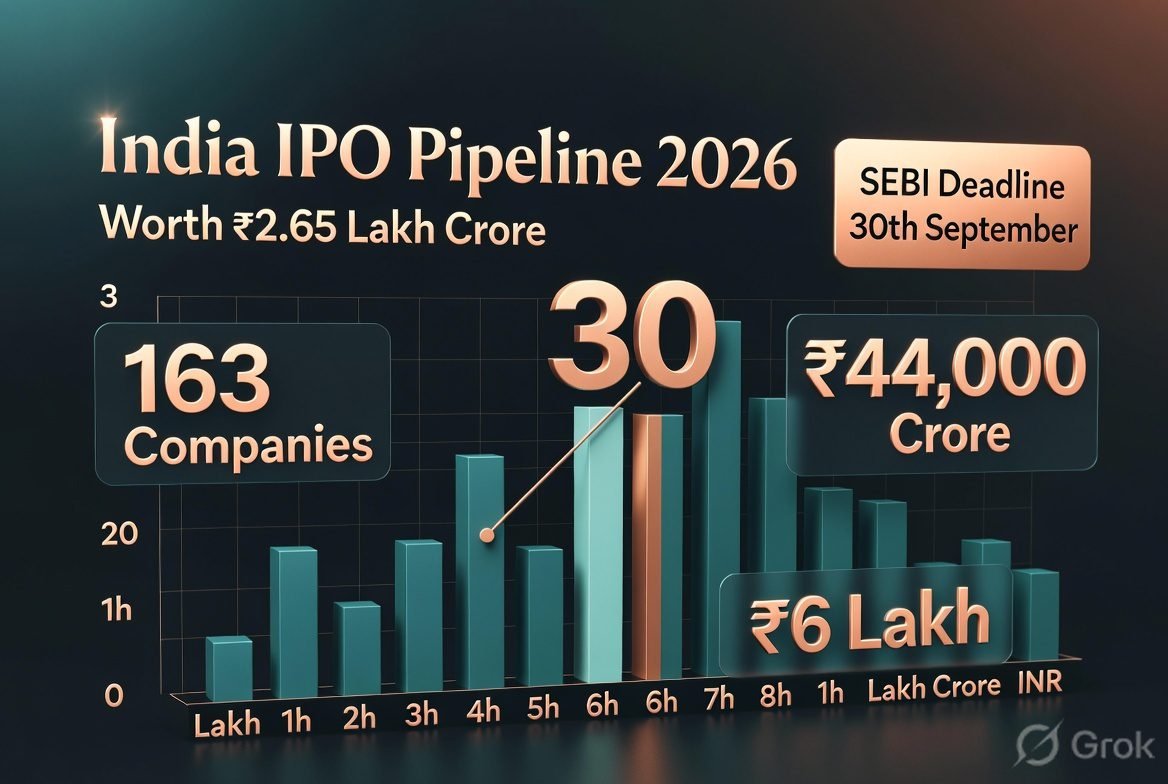
The short answer is a deadline. SEBI has granted a one-time extension for IPO approval letters to 37 companies, valid until September 30, 2026, protecting plans to raise close to ₹44,000 crore amid global geopolitical tensions and market volatility. In plain English: these companies already got the regulator's green light, but if they don't actually launch before that date, the approval expires and they have to refile the whole thing from scratch.
Nobody wants to redo months of paperwork, so what you get instead is a genuine rush — dozens of merchant bankers trying to squeeze roadshows, price band announcements, and listings into the same narrow window. Merchant banking activity of this kind is typically led by firms like Kotak Investment Banking, Axis Capital, and ICICI Securities, all of whom publish their own IPO pipeline research notes periodically. We've seen this pattern before with our own SBI Mutual Fund IPO subscription coverage and the eventual listing day article — a single deadline can genuinely reshape an entire quarter's market calendar.

The September 30 SEBI Deadline Explained
An IPO approval from SEBI, officially called an observation letter, is valid for exactly 12 months from the date it's issued. If a company hasn't opened its issue within that window, the clock runs out and it has to start the entire draft prospectus process over again — new disclosures, new scrutiny, new cost.
Given that a lot of approvals were issued in late 2025, September 2026 is where a genuine bunch of them expire together. SEBI's own regulatory framework and IPO guidelines are publicly available on the SEBI official website, and the observation letter mechanism specifically is explained in SEBI's ICDR regulations section if you want to read the actual rulebook rather than take our word for it.
We'd genuinely caution against treating "IPO before September 30" as a quality signal on its own. A company rushing to beat a clock isn't automatically better or worse than one that isn't — the timing tells you about the calendar, not about the balance sheet. If you're new to reading these fundamentals at all, our beginner investing guide and demat account explainer are good starting points before you jump into any single IPO application.
Real Numbers: Breaking Down the ₹2.65 Lakh Crore Figure
India IPO Pipeline — July 2026 Snapshot
| Companies with valid SEBI approval | ~163 |
| Companies awaiting SEBI clearance | ~62 |
| 37 firms racing the Sept 30 deadline | ₹44,000 crore |
| Wider approved/awaiting pipeline | ₹2,65,000 crore |
| Kotak's full-year 2026 issuance forecast | ₹6,00,000+ crore |
| Founders' lock-up shares eligible to sell soon | ₹80,000+ crore |
Let's actually unpack this rather than just listing it. According to data cited from Prime Database, about 163 companies currently hold SEBI approval and another 62 are awaiting clearance, with wider estimates putting the total issue size closer to ₹3,00,000 crore. That's the broad pipeline. Separately, Kotak Investment Banking expects total issuance volumes to exceed ₹6,00,000 crore across the whole of calendar 2026, with IPO issuance alone projected around ₹2,50,000 crore of that figure.
Close to 50 firms are expected to launch IPOs in the coming three months alone, and within that group, ten companies are projected to raise over ₹33,000 crore combined. You can verify the live, constantly-updated version of this pipeline yourself on trackers like IPO Central's SEBI approval tracker, Chittorgarh's IPO database, or IPO Gyani's calendar, all of which update daily as new observation letters get issued.
Prime Database itself, run by veteran market researcher Pranav Haldea, is generally considered the most cited primary source for this kind of aggregate IPO data in Indian financial media — you can browse their own published reports on Prime Database's official site, and you'll find their numbers quoted across Moneycontrol's IPO section, Economic Times' IPO tracker, LiveMint's market desk, and Business Standard's IPO section.
Companies Leading This IPO Wave
The pipeline spans a genuinely wide mix of sectors. Financials, chemicals, and renewable energy names are among the lead contenders racing the extension deadline, with Credila Financial Services and Dorf-Ketal Chemicals India each targeting roughly ₹5,000 crore. Separately, the primary market calendar spans quick commerce, fintech, data centres, manufacturing, and hospitality — a genuinely broad cross-section of the Indian economy, not just one hot sector riding a trend.
Some of the bigger names already on our radar and covered separately on this blog:
Reliance Jio
Still widely expected to be one of the largest listings in Indian market history once it launches. We've covered the mechanics in our Jio IPO explainer and the more detailed Reliance Jio IPO 2026 breakdown.
SBI Mutual Fund
Already listed and tracked start to finish on this blog — from the initial IPO announcement through subscription day to the actual listing, useful as a template for how a large financial-sector IPO typically plays out.
Zepto
Representing the quick-commerce sector in this pipeline — see our dedicated Zepto IPO 2026 article for the specifics on valuation and business model.
NSDL
Market updates have flagged a Draft Red Herring Prospectus filing tied to an IPO expected to be worth around ₹30,000 crore in the data infrastructure space — a reminder that not every large IPO gets equal media attention despite the size of the raise.
There's also a genuinely long tail of mid-sized names most retail investors haven't heard of yet — companies like International Gemmological Institute, Kalpataru, Unimech Aerospace, Sanathan Textiles, and Rubicon Research have moved through the SEBI approval process over the past year, alongside firms like Saatvik Green Energy, Atlanta Electricals, GK Energy, and CIEL HR Services expected to announce price bands in the weeks approaching the deadline.
The Part Nobody Puts in the Headline: Discount Trap Risk
Here's what most "IPO boom" coverage conveniently skips. As of April 2026, 66% of newly listed companies were trading below their IPO price — what analysts have started calling a "discount trap." A busy pipeline and a profitable pipeline are two completely different things, and conflating them is one of the most common ways new investors lose money on primary market allotments.
We've written before about exactly this pattern in our piece on why investors lose money in the stock market, and the specific behavioural mistake of chasing hype without checking fundamentals is covered in more depth in our behavioral mistakes in stock trading guide. Independent listing-day performance data for recent issues is tracked publicly on Chittorgarh's IPO listing gains tracker and InvestorGain's live GMP report, both worth checking before you assume every new listing pops on day one.
There's a second risk sitting quietly behind the listing-day excitement: lock-up expiries. Shares worth over ₹80,000 crore could become eligible for sale by early promoters and investors in the near term once existing lock-up restrictions lift. When that much stock becomes sellable at once across multiple companies, it can genuinely pressure prices even for businesses that are otherwise performing fine — supply simply outpaces demand for a few weeks.
Reasonable Approach
Read the actual DRHP, check revenue growth and debt levels, compare valuation to listed peers, and size your investment as you would any other equity position — not as a lottery ticket.
Risky Approach
Applying to every IPO in the pipeline purely because "the market is hot right now," without reading a single page of the offer document or checking listing-day performance of comparable recent issues.
Which Sectors Are Leading This Pipeline
| Sector | Notable Pipeline Activity |
|---|---|
| Quick Commerce / Fintech | Zepto and several digital-first platforms moving through SEBI observation |
| Financial Services | Credila Financial Services, SBI Mutual Fund (listed), NSDL data infrastructure |
| Chemicals | Dorf-Ketal Chemicals India among the larger raises |
| Renewable Energy | Saatvik Green Energy, GK Energy, SolarWorld Energy Solutions |
| Telecom / Digital | Reliance Jio expected as one of the largest listings in Indian history |
| Manufacturing & Industrials | Atlanta Electricals, Epack Prefab Technologies, Transline Technologies |
This spread matters for a reason we keep coming back to on this blog: it's genuinely hard to build a diversified portfolio if every new listing comes from the same two or three sectors. Sector-wise IPO allocation data of this kind is tracked by CRISIL Research and ICRA's rating rationale reports, both of which publish sector outlook notes ahead of major listings. A pipeline this wide actually gives retail investors more room to pick names that fit their existing allocation rather than piling into whatever happens to be trending that week — a concept we explore further in our sector rotation guide.
How Retail Investors Should Actually Approach This Boom
We're not going to tell you to apply for every IPO on this list, because that's genuinely bad advice dressed up as enthusiasm. What we'd suggest instead:
Check the demat and application basics first. If you haven't applied for an IPO before, our demat account guide and NSE vs BSE explainer cover the mechanics of where these shares actually get listed and traded. The application process itself runs through the ASBA system detailed on NSE's website, and every listed prospectus is publicly filed on SEBI's public issues filing page if you want to read the source document yourself rather than a summary.
Read past the price band. A low price band doesn't mean cheap, and a high one doesn't mean expensive — what matters is valuation relative to earnings and comparable listed companies, the same logic we apply in our bonus share and stock split explainers when readers ask about corporate actions.
Watch institutional participation, not just retail hype. FII and DII subscription numbers on the institutional portion of an IPO often tell you more than retail oversubscription headlines — our FII vs DII explained article breaks down why that distinction matters, and day-by-day subscription figures for live issues are published live on NSE's issue information page and BSE's public issue tracker.
Don't let macro noise distract you from company-specific homework. Yes, the India-US trade deal, the India-UK CETA agreement, and even the RBI's August 2026 rate decision all shape the broader mood the market is in when these IPOs launch — but none of that replaces reading the actual prospectus of the specific company you're applying to.
How This Works: NSE vs BSE Listing Explained →Don't Forget the Boring Admin Side
If an IPO allotment actually lands in your demat account and you sell for a gain, that's a taxable event, and short-term listing-day profits are taxed differently from long-term holdings — the exact capital gains tax slabs and holding period rules are laid out on the Income Tax Department's official portal, and explained in simpler language by ClearTax's capital gains guide. Our tax planning guide and the broader ITR filing deadline 2026 article are both worth bookmarking well before the actual filing season arrives. And if F&O-style speculative trading around listing day is tempting you, it's worth first reading up on SEBI's 2026 F&O position limit rules and the 50-50 cash margin rule, since listing-day volatility in F&O contracts on newly listed stocks can catch inexperienced traders off guard.

What Happens to This Pipeline After September 30
A reasonable question we've been asked directly by readers: does the IPO market simply go quiet in October once the deadline passes? Not necessarily. If the 37 SEBI-approved issuers move before September 30, it can set the tempo for a larger pipeline that multiple trackers describe as extending well into 2026 — meaning a strong pre-deadline run tends to build momentum and investor appetite for the names still waiting in the queue afterward, rather than exhausting it.
We'll keep updating our individual IPO trackers — including our AI stocks India 2026 and AI investing guide if any of these newer listings fall into that theme — as fresh observation letters and price bands get announced through August and September. For the most current status of any single company, the SEBI ICDR filings page remains the single most reliable primary source, ahead of any secondary news aggregator, including this one.
Frequently Asked Questions
Why are so many IPOs launching in India in 2026?
A major driver is a SEBI-granted one-time extension for 37 companies' IPO approval letters, valid until September 30, 2026 — after that date, expired approvals require companies to refile, which is pushing many issuers to launch before the deadline.
How big is India's IPO pipeline in 2026?
Estimates vary by source, but roughly 163 companies hold valid SEBI approval and another 62 are awaiting clearance, with the wider pipeline estimated between ₹2,65,000 crore and ₹3,00,000 crore, and Kotak Investment Banking projecting over ₹6,00,000 crore in total 2026 issuance across IPOs and other offerings.
Is it safe to apply for every upcoming IPO in this pipeline?
No. As of April 2026, roughly 66% of newly listed companies were trading below their IPO price, sometimes called a "discount trap" — a busy IPO pipeline doesn't automatically mean profitable listings, and each company still needs individual research.
What is the SEBI September 30, 2026 deadline?
It's the expiry date for a one-time extension SEBI granted to 37 companies whose IPO observation letters (approvals) would otherwise have lapsed, giving them until this date to actually launch their public offerings.
Which sectors dominate the 2026 IPO pipeline?
The pipeline spans quick commerce, fintech, financial services, chemicals, renewable energy, data infrastructure, manufacturing, and hospitality — a genuinely broad mix rather than concentration in one theme.
What are lock-up expiries and why do they matter for this IPO boom?
A lock-up period restricts founders and early investors from selling shares immediately after listing. Once it expires, over ₹80,000 crore worth of shares could become eligible for sale across recently listed companies, which can add selling pressure even on fundamentally sound stocks.
Do I need a demat account to apply for these IPOs?
Yes, a demat account is mandatory to apply for any mainboard or SME IPO in India, since allotted shares are credited electronically and cannot be issued in physical form.
Will this IPO boom continue after September 2026?
Market trackers generally expect a strong pre-deadline run to build momentum for the wider pipeline extending into the rest of 2026, rather than the market going quiet immediately after September 30.
Our Bottom Line on the 2026 IPO Boom
We'd rather you walk away from this article understanding the mechanics — a regulatory deadline compressing a normal 12-month pipeline into a three-month rush — than just remembering a big crore figure from a headline. The size of the pipeline tells you the market is active. It doesn't tell you which specific company deserves your money, and that homework doesn't get shorter just because September 30 is approaching fast.
If you're newer to investing altogether and this is your first time watching an IPO season this closely, start with our foundational pieces on beginner investing and how Nifty and Sensex work before applying to anything in this pipeline — the index-level basics make the individual company research make a lot more sense.

Pranab Barman is a Financial Educator and Personal Finance Researcher with over 10 years of hands-on experience in stock markets, trading, and investing. Currently enrolled in the CFA Program, he is committed to continuous learning and professional excellence in finance.
As the Founder of PlayWithStock, Pranab covers a wide range of topics including Mutual Funds, SIP, Taxation, Stock Market Basics, and Financial Calculators — with a focus on simplifying complex financial concepts for everyday all investors.
Email: support@playwithstock.com
Website: playwithstock.com
Related posts:
 Reliance Q1 FY27 Results: Revenue Hits Record ₹3.12 Lakh Crore, Profit Slips 22%
 Passive Investing in India Just Crossed ₹14 Lakh Crore — Here’s the Index Funds vs Active Funds Math Behind It
 Reliance Jio IPO 2026: India’s Biggest-Ever Listing, Explained
 What Is Sector Rotation? A Simple Guide for Indian Investors
 Vodafone Idea Stock 2026: The Complete ₹35,000 Crore Guide
 SBI Mutual Fund IPO Listing: 7 Essential Facts to Know Before July 21 Debut
 Zepto IPO 2026: Complete Guide — Date, Valuation, Financials, and Should You Apply?
 Record SIP Inflows June 2026: Indians Just Invested ₹31,781 Crore