


STP (Systematic Transfer Plan) 2026: Lumpsum Investing Without Timing Risk
Systematic Transfer Plan (STP) solves a very specific problem: you have a lumpsum — a bonus, an FD maturity, a property sale, an annual increment payout — and you want it in equity, but you don't want to bet the whole amount on today's market level. An STP parks that money in a low-risk fund first, then automatically moves a fixed amount into an equity fund at regular intervals, so your idle cash keeps earning a return while it gradually averages into the market.
We've had readers ask us this exact question after our ₹1 crore SIP calculator article — what do you do if you already have a large lumpsum sitting in a savings account rather than building it up monthly? A Systematic Transfer Plan is the direct answer to that question, and it's genuinely underused compared to how often it should come up.
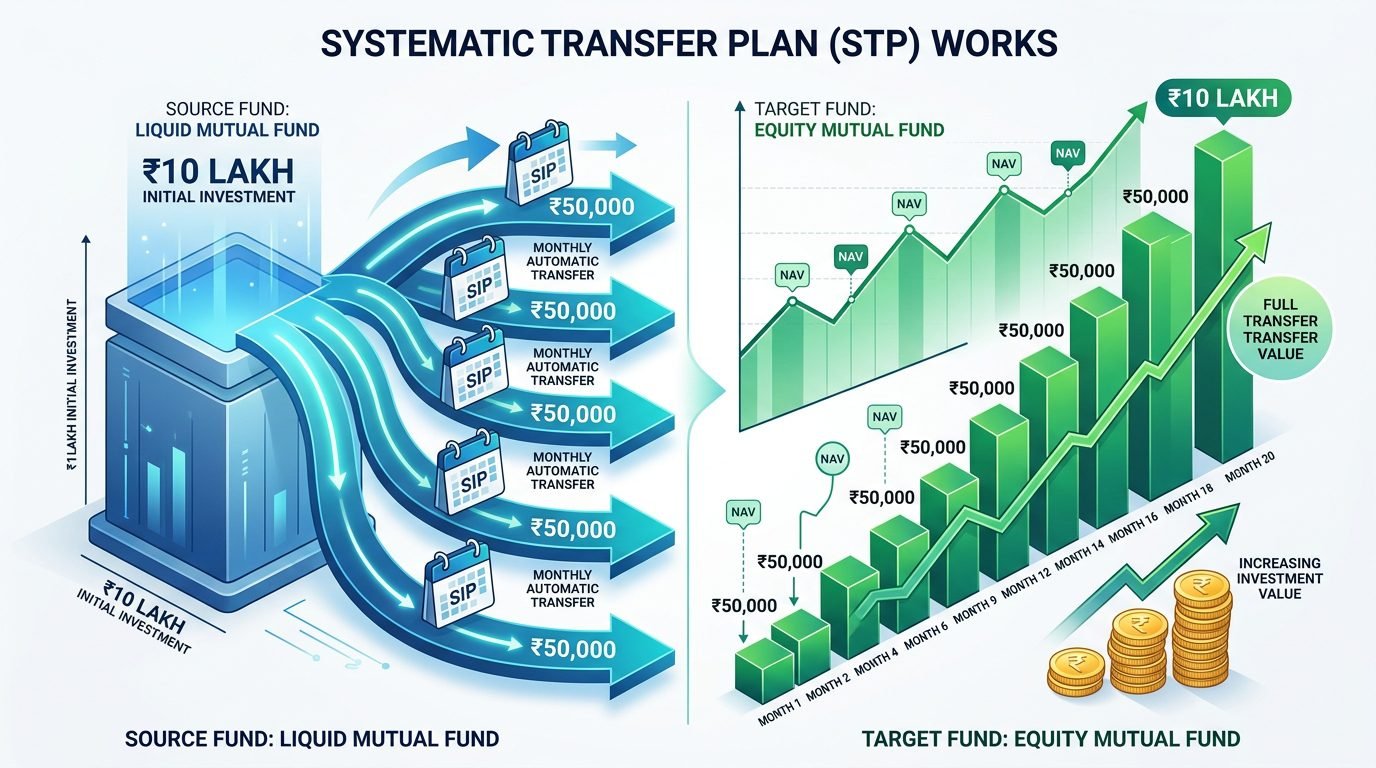
Table of Contents
What Is an STP, Exactly?
An STP moves a fixed amount of money from one mutual fund scheme to another at regular intervals, typically from a liquid or debt fund (the source) into an equity fund (the target). Your balance in the source fund reduces with each transfer, and your balance in the target fund grows — the process runs automatically once set up, requiring no manual action from you each month.
Crucially, an STP can only move money between two schemes of the same Asset Management Company. You cannot set up an STP from, say, an Axis Liquid Fund into an HDFC Bluechip Fund — moving money across AMCs would require a manual redemption and reinvestment, which is a separate taxable transaction with its own exit load considerations.
How an STP Actually Works, Step by Step
The mechanics are simpler than the tax treatment, which we'll get to shortly. In practice, setting up an STP looks like this:
Real Example: Deploying a ₹10 Lakh Bonus
We walked a reader through this exact scenario after she received a ₹10 lakh annual bonus and didn't want to put it all into equity in one shot given how volatile markets had been. She invested the full ₹10 lakh into a liquid fund from the same AMC as her chosen equity fund, then set up a monthly STP of ₹50,000 running over 20 months. Each month, ₹50,000 moved automatically from the liquid fund into the equity fund, buying more units when the equity fund's NAV was low and fewer when it was high — the same rupee-cost-averaging principle behind a regular SIP, just funded from an already-invested lumpsum instead of fresh monthly income.
The liquid fund portion earns a modest but real return (commonly in the 6-7% range) while it waits its turn to be transferred, which is meaningfully better than letting the same money sit in a zero-interest savings account for a year and a half. This is the same logic behind keeping short-term money in a sinking fund rather than idle cash — money that isn't needed immediately should still be working.
The Three Types of STP
STP Variants
| Type | What Transfers | Best Suited For |
|---|---|---|
| Fixed STP | A fixed rupee amount every interval | Most common — disciplined, predictable deployment of a lumpsum |
| Capital Appreciation STP | Only the gains/appreciation portion | Investors who want to keep their original principal untouched in the source fund |
| Flexi STP | A variable amount based on market conditions or a formula | More active investors comfortable adjusting transfer size around volatility |
Fixed STP is by far the most commonly used variant and the one most AMC platforms default to when you set one up — it's also the easiest to plan around, since you know exactly how much moves and when, similar in spirit to how a regular SIP works on the equity side.
STP vs Lumpsum: When Each Wins
A one-shot lumpsum investment can outperform an STP if markets rise steadily and continuously from the day you invest — you'd have been fully invested from day one instead of averaging in gradually. But that outcome depends entirely on timing your entry well, which is exactly the risk an STP is designed to reduce. For most investors deploying a genuine windfall over a 6-18 month window, the disciplined, gradual approach tends to be the more comfortable choice, both financially and psychologically.
This mirrors a debate we've covered before in the context of why investors lose money in the stock market — trying to perfectly time a large lumpsum entry is a form of market timing, and market timing is one of the most consistently costly behavioral mistakes retail investors make. An STP removes that decision entirely by spreading it across a fixed schedule.
STP vs SIP: They're Not the Same Thing
It's easy to confuse the two since both involve regular, fixed transfers into an equity fund, but the source of the money is fundamentally different. A SIP pulls fresh money from your bank account each month — money you haven't invested yet. An STP moves money that's already invested in a mutual fund, just shifting it from one scheme to another within the same fund house.
STP vs SIP — Key Differences
| Factor | SIP | STP |
|---|---|---|
| Money source | Fresh funds from bank account | Already-invested lumpsum in another scheme |
| Tax event on each transfer | No — only on final redemption | Yes — each transfer is a redemption from the source fund |
| Best for | Regular monthly savings/income | Deploying an existing lumpsum gradually |
| Idle money return while waiting | N/A (no idle money) | Source fund (liquid/debt) return, typically 6-7% |
That tax difference in the table above is the single most important thing to understand before starting an STP, and it's the part we see skipped over most often in casual explanations.
The Tax Catch Most Investors Miss
Every single STP transfer is treated as a redemption from the source fund, which means capital gains tax applies on the gain in the units moved — every month, not just once at the very end. This is genuinely the part most investors overlook when they picture an STP as one smooth, tax-neutral internal movement of money.
STP Taxation — Source Fund Type
| Source Fund | Held Under 3 Years | Held Over 3 Years |
|---|---|---|
| Liquid/Debt Fund | Taxed at your income slab rate (STCG) | Taxed at 20% with indexation (LTCG) |
| Equity Fund (reverse STP) | 15% STCG (under 1 year) | 10% LTCG above ₹1 lakh/year (over 1 year) |
Because most STPs start from a liquid fund with a fairly short holding period, transfers are usually taxed at your income tax slab rate rather than a flat capital gains rate — but liquid fund returns are typically modest (6-8%), so the actual tax payable on each monthly transfer tends to be small in absolute terms, even though it is technically due. Our ITR filing last date coverage is worth bookmarking if you're running an active STP, since these smaller gains still need to be reported.
What This Means in Practice
A 12-month STP moving ₹1 lakh a month out of a liquid fund technically creates 12 separate taxable redemption events across the year, not one. Most investors don't realize this until they see their capital gains statement and find a dozen small line items instead of one. This isn't a reason to avoid STP — the tax on liquid fund gains is usually modest — but it is a reason to keep records and not be surprised at tax filing time.
How to Actually Set Up an STP
The process is straightforward on most AMC platforms or through your existing broker/RTA account, provided your basic investing setup — like a working demat account and completed KYC — is already in place.
Setup Checklist
1. Invest your lumpsum into a liquid or debt fund from an AMC that also offers the equity fund you eventually want exposure to.
2. Choose your STP type (Fixed is the standard default).
3. Set the transfer amount and frequency — monthly is most common, though weekly and quarterly options exist.
4. Set the duration — commonly anywhere from 6 to 24 months depending on the size of the lumpsum and your comfort with market volatility.
5. Check the exit load window on both the source and target schemes before confirming, since early exits from either side can carry a small penalty.
If you'd rather not choose the target equity fund yourself, our comparisons of large cap vs mid cap vs small cap funds and index funds vs active funds are good starting points, and checking direct vs regular mutual fund plans before you commit the full lumpsum schedule can meaningfully reduce the long-term expense drag on the target fund.
Common Mistakes Investors Make
Watch Out For These
1. Assuming STP transfers are tax-free because the money "stays invested." Each transfer is a redemption from the source scheme and is taxed accordingly, as covered above.
2. Trying to run an STP across two different AMCs. This isn't possible directly — it requires a manual redemption and reinvestment instead.
3. Ignoring exit loads on the source fund. Some funds carry a small graded exit load in the very first few days, which can eat into returns if triggered accidentally.
4. Setting an STP duration too short for genuinely large lumpsums. A 3-month STP on a very large amount barely reduces timing risk compared to a lumpsum — 12-24 months is more typical for meaningfully averaging entry.
5. Not tracking each monthly transfer for tax filing. Twelve small taxable events are easy to lose track of without a simple running log.
Want to see how a monthly amount compounds once it lands in the equity side of your STP?
How This Calculator Works →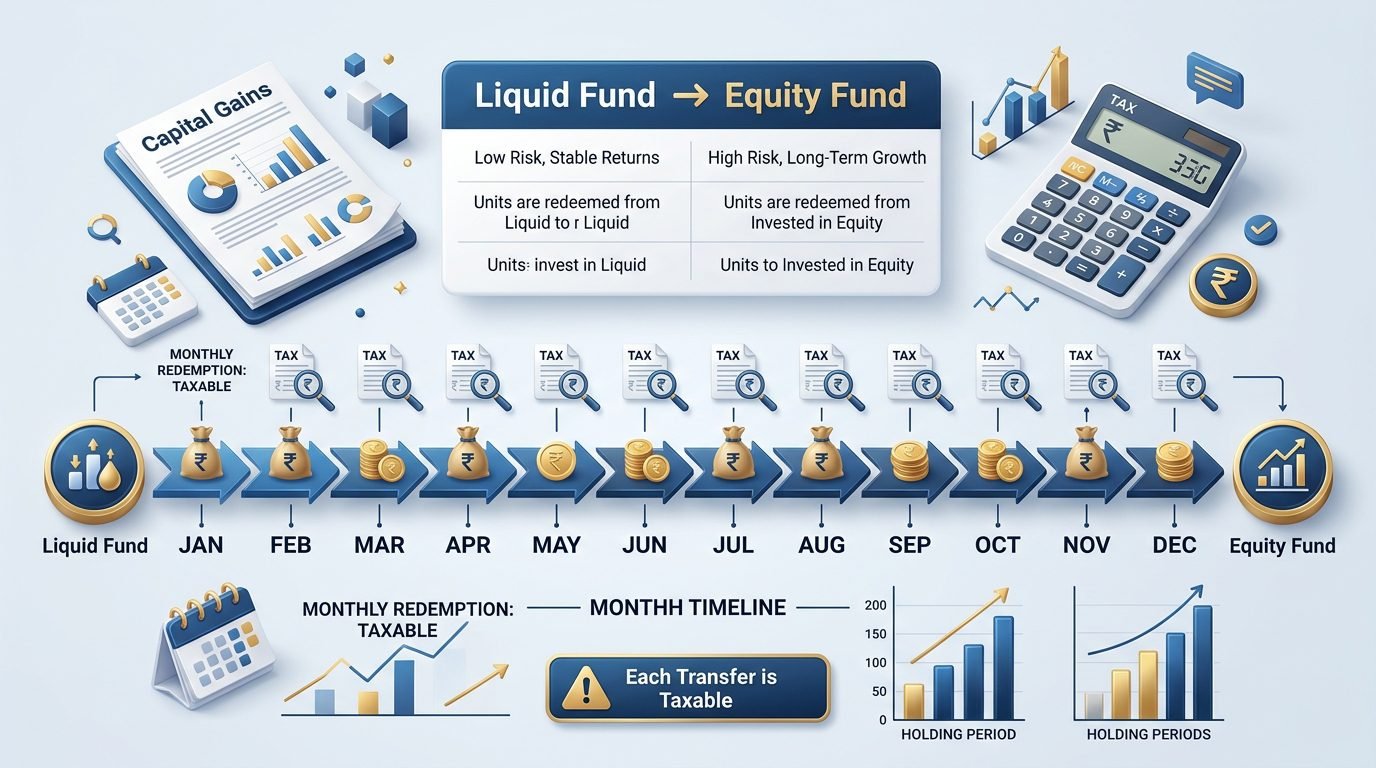
STPs are also commonly used the other way around — moving money from equity back into a debt fund to lock in gains during a market high, or to rebalance a portfolio that's drifted from its target allocation. This reverse use case pairs naturally with our coverage of tax-loss harvesting in India, since both strategies involve deliberately triggering a capital gains event for a specific portfolio-management reason rather than simply reacting to the market.
Frequently Asked Questions
Can I set up an STP between funds from two different AMCs?
No. An STP can only transfer money between two schemes of the same Asset Management Company. Moving money across AMCs requires a manual redemption from one and reinvestment into the other, which is a separate taxable transaction.
Is an STP better than investing a lumpsum all at once?
It depends on market direction after your entry point. A lumpsum can outperform if markets rise steadily and continuously. An STP reduces timing risk by averaging your entry gradually, which tends to be the more comfortable choice for most investors deploying a large windfall over 6-18 months.
Do I pay tax on every single STP transfer?
Yes. Each transfer is treated as a redemption from the source fund and is taxed based on the fund type and holding period — typically at your income slab rate for liquid/debt fund transfers held under 3 years, or 20% with indexation if held longer.
What is the difference between STP and SIP?
A SIP invests fresh money from your bank account each month. An STP moves money that is already invested in one mutual fund scheme into another scheme of the same AMC, and each transfer is a taxable redemption event, unlike a SIP.
Which fund should I use as the source for an STP?
A liquid fund or ultra-short-term debt fund from the same AMC as your intended target equity fund is most common, since these offer relative stability and modest returns while the lumpsum waits to be transferred.
How long should an STP run for?
Commonly 6 to 24 months, depending on the size of the lumpsum and how much timing risk you want to average out. Very short durations barely reduce the risk a lumpsum carries, while very long durations delay full equity exposure.

Pranab Barman is a Financial Educator and Personal Finance Researcher with over 10 years of hands-on experience in stock markets, trading, and investing. Currently enrolled in the CFA Program, he is committed to continuous learning and professional excellence in finance.
As the Founder of PlayWithStock, Pranab covers a wide range of topics including Mutual Funds, SIP, Taxation, Stock Market Basics, and Financial Calculators — with a focus on simplifying complex financial concepts for everyday all investors.
Email: support@playwithstock.com
Website: playwithstock.com
Related posts:
 Term Insurance vs Endowment Plan: Which is Better for Beginners in 2026
 Passive Investing in India Just Crossed ₹14 Lakh Crore — Here’s the Index Funds vs Active Funds Math Behind It
 AI Investing 2026: The Complete India-US Stock Guide
 Beginner Investing: 7 Proven Steps to Start the Right Way
 Micro-Investing Apps for Beginners: A Complete Comparison
 Mutual Fund Guide India 2026: The Essential 7-Step Beginner Blueprint
 ELSS Tax Saving Mutual Funds 2026: The Complete 80C Guide
 Large Cap vs Mid Cap vs Small Cap Funds: What SEBI’s Rules Actually Mean for You