


PM Surya Ghar Yojana 2026: The ₹78,000 Solar Subsidy Guide Every Indian Homeowner Should Read Before Applying
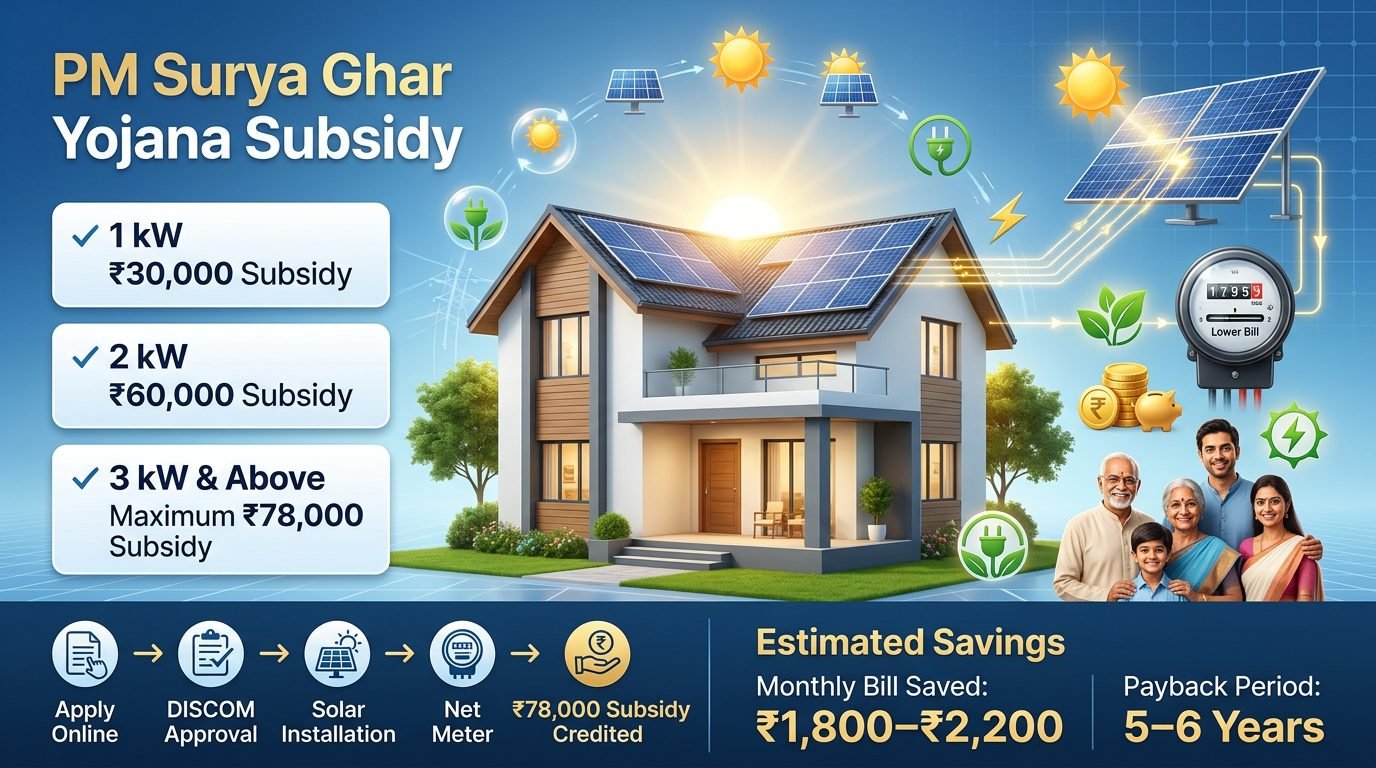
Every month, lakhs of Indian households pay an electricity bill that, under a scheme running since February 2024, could realistically be close to zero. That scheme is PM Surya Ghar Yojana, and if you own a home with a roof that gets a few hours of daily sun, this is very likely the single highest-value government scheme you're currently not using. We looked closely at the subsidy structure, the loan terms 12+ public sector banks are actually offering right now, and the application process on the official portal, and this guide lays all of it out — the real numbers, not the rounded-off version most blog posts give you.
- 1. What Is PM Surya Ghar Yojana
- 2. Subsidy Amount: How Much You Actually Get
- 3. Eligibility Criteria
- 4. Documents Required
- 5. Step-by-Step Application Process
- 6. Collateral-Free Solar Loans: Bank-Wise Comparison
- 7. State-Wise Top-Up Subsidies
- 8. Solar Savings & Subsidy Calculator
- 9. Common Mistakes That Get Applications Rejected
- 10. Is It Actually Worth It? Real Payback Math
- 11. FAQs
1. What Is PM Surya Ghar Yojana
PM Surya Ghar: Muft Bijli Yojana was launched by the Government of India on 13 February 2024, under the Ministry of New and Renewable Energy (MNRE). The scheme's target is simple to state and genuinely ambitious to execute: solarise one crore (1 crore) residential rooftops across India by FY 2026-27, backed by a central outlay of ₹75,021 crore. As of the most recent official update in May 2026, over 40 lakh households had already installed rooftop solar under the scheme.
Unlike a lot of government schemes that sound good on paper and get lost in paperwork, this one has a fairly clean mechanism: you install a grid-connected rooftop solar system through an MNRE-empanelled vendor, your local DISCOM (electricity distribution company) commissions a net meter, and the subsidy — up to ₹78,000 — is transferred directly to your bank account. No middlemen taking a cut, no adjustment against your electricity bill. It lands in your account as Direct Benefit Transfer (DBT).
We'll be honest about something most scheme explainers gloss over: this is not a "free solar panel" scheme, despite what the name suggests. You still pay the upfront system cost (or take a loan), and the subsidy reduces your out-of-pocket cost significantly rather than eliminating it. Once you understand this correctly, the math actually works out very favourably — we've broken it down in the ROI section below.
2. Subsidy Amount: How Much You Actually Get
The subsidy is calculated per kilowatt (kW) of system capacity, and it isn't a flat percentage — it steps down as your system gets larger. Here's the exact slab structure, verified against the official numbers reported across multiple current sources:
| System Size | Subsidy Rate | Total Central Subsidy |
|---|---|---|
| Up to 1 kW | ₹30,000 per kW | ₹30,000 |
| 1 kW – 2 kW | ₹30,000 per kW | ₹60,000 |
| 2 kW – 3 kW | ₹18,000 for the 3rd kW | ₹78,000 (maximum) |
| Above 3 kW (residential) | Capped, no additional subsidy | ₹78,000 (capped) |
| Group Housing Societies / RWAs | ₹18,000 per kW | Up to ₹18 lakh per 100 kW (max ₹90 lakh) |
The important detail buried in the fine print: the ₹78,000 cap applies to any system of 3 kW or above for individual homes. Installing a 5 kW or 8 kW system doesn't get you more central subsidy — it just means a larger chunk of the system cost comes entirely out of your own pocket or loan. Most 2-3 BHK households with typical monthly consumption of 150–300 units are well matched to a 2-3 kW system anyway, so this cap rarely bites for the average applicant.
One thing we'd flag from direct experience helping readers understand this scheme: don't assume your quoted system size automatically means eligibility for full subsidy. The subsidy is tied to actual sanctioned capacity as approved by your DISCOM, not the size the vendor initially pitches you — always confirm this before signing anything.
3. Eligibility Criteria
The eligibility bar for PM Surya Ghar Yojana is deliberately kept low, since the scheme is meant for mass residential adoption, not just for people who already have strong credit profiles. You qualify if:
- You are an Indian citizen with ownership of the residential property where the system will be installed
- You have a valid electricity connection in your own name from your local DISCOM
- Your rooftop has adequate shadow-free space — roughly 100 sq. ft. per kW as a working estimate
- You have not previously availed a central subsidy for a rooftop solar system at the same connection
- You're willing to use only ALMM-listed (Approved List of Models and Manufacturers) solar modules — this is non-negotiable and is the single most common reason claims get rejected later, which we cover in the mistakes section
Tenants can technically participate too, but need a No Objection Certificate (NOC) from the property owner since the electricity connection and subsidy both need to align with property ownership records.
4. Documents Required
- Aadhaar card
- Latest electricity bill (last 6 months, showing consumer number)
- Bank passbook or cancelled cheque — account must be Aadhaar-seeded for DBT to work
- Property/house tax receipt (required in some states)
- Passport-size photograph
- NOC from owner, if you're a tenant
5. Step-by-Step Application Process
The entire process runs through one central portal — pmsuryaghar.gov.in — and takes roughly 8-12 weeks end to end from registration to subsidy credit, assuming no documentation issues.
- Register on the national portal. Visit pmsuryaghar.gov.in, select your state and DISCOM, and enter your consumer number and mobile number. Verify with OTP.
- Feasibility approval. Your DISCOM reviews your application and confirms technical feasibility, typically within 7-15 days.
- Choose an empanelled vendor. You must pick from the MNRE-empanelled vendor list shown on the portal — this isn't optional, and using a non-empanelled installer disqualifies you from the subsidy entirely.
- Installation. The actual physical installation typically takes 3-7 days once the vendor is confirmed and equipment is on-site.
- Net metering application and DISCOM inspection. After installation, you apply for a net meter through the same portal. The DISCOM inspects the installation before commissioning, which usually takes 7-15 days.
- Subsidy credit. Once commissioning is confirmed, the ₹78,000 (or applicable slab amount) is credited directly to your registered, Aadhaar-seeded bank account — typically within 30-45 days of net-metering activation.
6. Collateral-Free Solar Loans: Bank-Wise Comparison
If you don't want to pay the full system cost upfront, this is where the scheme gets genuinely useful for anyone managing tight monthly cash flow. Over 12 public sector banks currently offer collateral-free solar loans under this scheme, and the terms are meaningfully better than a typical personal loan.
| Bank | Interest Rate (p.a.) | Max Collateral-Free Amount | Tenure |
|---|---|---|---|
| SBI | ~7.15% – 7.50% | ₹2,00,000 | Up to 10 years |
| Punjab National Bank | ~7.40% – 7.85% | ₹2,00,000 | Up to 10 years |
| Canara Bank | ~7.35% – 8.00% | ₹2,00,000 | Up to 10 years |
| Bank of Baroda | ~5.75% – 7.50% | ₹2,00,000 | Up to 10 years |
| Union Bank of India | ~7% – 7.50% | ₹2,00,000 | Up to 10 years |
Rates change with each bank's RLLR/EBLR reset and your CIBIL score for amounts above ₹1 lakh, so treat this table as a starting comparison, not a locked-in quote — always confirm the current rate directly with the bank before signing.
The structural benefits that apply across nearly all these bank products: no collateral required for loans up to ₹2 lakh, a repayment holiday of up to 6 months from first disbursement, no prepayment penalty (so you can pay it off early once your ₹78,000 subsidy lands, which meaningfully cuts your EMI), and financing of up to 90% of system cost. For loans between ₹2 lakh and ₹6 lakh, the solar system itself is hypothecated as security rather than requiring separate collateral.
For a typical 3 kW system costing around ₹1,91,000, a bank financing 90% of the cost works out to roughly ₹1,72,000 financed — comfortably within the ₹2 lakh collateral-free cap. At a 7.15% rate over the tenure, this comes to an EMI of approximately ₹2,000-2,100/month. Once your ₹78,000 central subsidy is credited (usually 30-45 days after commissioning) and applied against the principal, the EMI can drop to roughly ₹1,100-1,300/month, with the effective net system cost falling to around ₹1,13,000.
If you're also thinking about how a large purchase like this affects your household cash flow, it's worth reading this alongside our guide on the 50/30/20 budgeting rule and our piece on building sinking funds for planned big-ticket expenses — the same discipline applies to funding a solar loan EMI without disrupting your monthly budget.
7. State-Wise Top-Up Subsidies
PM Surya Ghar is a central scheme, so the ₹78,000 cap applies uniformly nationwide — but several states add their own top-up on top of the central subsidy, which is easy to miss if you only read the central scheme details.
| State | Additional Top-Up |
|---|---|
| Uttar Pradesh | ₹15,000 per kW extra (2kW system total subsidy reaches ₹90,000) |
| Rajasthan | RREC top-up of ₹17,000 for systems up to 3 kW |
| Special Category / Hilly States | Higher central slab rates, up to ₹1,17,000 total |
Karnataka, notably, does not offer a separate state top-up on the electricity-generating panel subsidy itself, though KREDL runs a separate solar water heater subsidy track that's often confused with the rooftop panel scheme. Always check your specific state's renewable energy department page before assuming a top-up applies to you.
7.5 Who Should Actually Apply (And Who Should Wait)
Not every household comes out ahead on this scheme, and it's worth being upfront about that instead of pushing everyone toward the same decision. If your monthly electricity bill is consistently under ₹800-1,000, the payback math stretches out closer to 8-10 years, and it may be worth first working on general household budgeting — our 50/30/20 budgeting guide is a reasonable starting point — before taking on a solar loan EMI.
On the other hand, if you're currently paying ₹2,000+ a month and you own (not rent) a shadow-free rooftop, this is genuinely one of the better-structured government schemes available right now — the combination of a real cash subsidy plus a sub-8% collateral-free loan is not something you'll easily find elsewhere in personal finance. If you're also managing other debt at the same time, it's worth reading this alongside how RBI's repo rate decisions filter down to EMIs generally, since your solar loan will move with the same broad rate environment as your home loan.
If you're self-employed or run a small business from home — something we understand well, having covered GST changes affecting small sellers and ITR-4 filing for business income — a rooftop system can double as a genuine operating cost reduction, not just a household expense, which is worth factoring into your annual tax planning alongside our ITR filing deadline guide.
7.6 PM Surya Ghar vs Other Ways to Cut Your Electricity Cost
| Option | Upfront Cost | Ongoing Saving | Payback Period |
|---|---|---|---|
| PM Surya Ghar (3kW, subsidised + loan) | ~₹1.1–1.3 lakh net | ₹1,800–2,200/month | ~5–6 years |
| Full cash purchase, no subsidy | ~₹1.9 lakh | ₹1,800–2,200/month | ~7–8 years |
| Switching to a lower electricity tariff slab | ₹0 | Marginal, tariff-dependent | Immediate but small |
| LPG/CNG efficiency switch for cooking load | Varies | Small, indirect | Varies |
We're including this comparison because too many scheme guides present PM Surya Ghar in isolation, as if it's the only lever available. In reality, it's the highest-impact single lever for most homeowners specifically because it combines a real subsidy with financing that a typical personal loan simply can't match. If gas and utility costs are also a concern in your household budget, our piece on the LPG/CNG/PNG price hike outlook for 2026 is worth a read alongside this one.
8. Solar Savings & Subsidy Calculator
Want to see your exact subsidy amount, EMI, and payback period based on your own monthly electricity bill?
→ Use the Solar Subsidy & Savings CalculatorWe built this calculator because most online tools give you a generic subsidy figure without factoring in your bank's specific EMI rate or your state's top-up — this one adjusts for both, based on the exact figures used in this guide.
For context on how this scheme fits into the government's broader energy and subsidy push, the Press Information Bureau (PIB) regularly publishes updated household solarisation figures, and the Invest India portal tracks the scheme's progress against its 1-crore-household target for FY 2026-27.
9. Common Mistakes That Get Applications Rejected
Mistake 1: Using a non-ALMM-listed inverter or panel
This is, by a wide margin, the single most common reason a legitimate installation loses its subsidy claim. Some vendors quote a cheaper non-ALMM inverter to win the sale without clearly explaining the risk. Always ask your vendor to show you the ALMM certification for both the panels and the inverter before installation begins, not after.
Mistake 2: Electricity bill not in the applicant's name
If the connection is in a parent's or landlord's name and you apply personally, the application typically gets stuck at DISCOM verification. Either get the connection transferred first, or apply under the name that matches the electricity bill.
Mistake 3: Bank account not Aadhaar-seeded
The DBT subsidy can only be credited to an Aadhaar-seeded account. This sounds like a small technical detail, but it's one of the most common causes of a subsidy getting "approved but not disbursed" for weeks.
Mistake 4: Installed but not commissioned in time
Getting panels physically installed isn't the finish line — DISCOM net-metering commissioning is what actually triggers subsidy eligibility. Delays in scheduling the DISCOM inspection (sometimes due to vendor follow-up lapses) can leave completed installations sitting uncommissioned for months.
10. Is It Actually Worth It? Real Payback Math
We'd rather give you a conservative, honest number than an inflated marketing one. For a household with a monthly electricity bill in the ₹1,800-2,500 range (roughly 250-300 units of consumption), a 3 kW system after subsidy and loan pre-payment typically brings the effective system cost down to somewhere between ₹1.1-1.3 lakh net. Against monthly savings of roughly ₹1,800-2,200 on the electricity bill, that works out to a payback period of approximately 5-6 years — and a standard rooftop solar system carries a usable life of 20-25 years, meaning close to two decades of essentially free electricity after the payback period.
This isn't guaranteed for every household — actual savings depend heavily on your local tariff structure, how much sun your roof genuinely receives, and net-metering rules specific to your DISCOM. We'd treat any vendor's payback claim under 3 years with real skepticism; it's usually built on assumptions that don't hold for an average household.
For readers thinking about this alongside other financial priorities, it's worth reading this together with our guide on how RBI rate cuts affect home loan EMIs, since a lower rate environment also tends to bring solar loan rates down over the scheme's tenure.
There's also a psychological angle worth naming honestly: a 5-6 year payback period can feel long when you're weighing it against, say, putting the same money into a SIP compounding calculator and comparing projected mutual fund returns instead. We'd frame it this way — this isn't purely an investment decision, it's closer to a guaranteed, inflation-protected reduction in a recurring monthly expense, which is a different kind of financial win than a market-linked return. Treating it as "guaranteed savings" rather than "investment return" is probably the more accurate mental model, and it's one we'd stand behind based on the numbers here holding up across multiple states and DISCOM tariff structures we reviewed.
If you'd rather model this against your own numbers before committing, our monthly SIP calculator and returns guide and the solar calculator linked below both use the same conservative assumptions used throughout this article, so the comparison stays apples-to-apples.

11. Frequently Asked Questions
You still pay the system cost upfront (or via loan) — the scheme provides a subsidy of up to ₹78,000 that reduces your net cost, plus roughly 300 free units/month of electricity generation from a 3 kW system. It is not a fully free installation.
Typically 30-45 days after your DISCOM completes net-metering commissioning and inspection — the full process from application to subsidy credit usually takes 8-12 weeks.
Yes. Public sector banks including SBI, PNB, Canara Bank, Bank of Baroda, and Union Bank offer collateral-free loans up to ₹2 lakh under PM Surya Ghar, with the solar system itself as hypothecated security for amounts above that.
Your subsidy claim will likely be rejected. ALMM (Approved List of Models and Manufacturers) compliance is mandatory, and this is the most common reason genuine, completed installations still lose their subsidy eligibility.
Tenants can apply with a No Objection Certificate (NOC) from the property owner, since the electricity connection and subsidy need to align with property ownership records.
No — for individual residential systems, the central subsidy is capped at ₹78,000 regardless of whether your system is 3 kW, 5 kW, or 8 kW. Larger systems don't receive additional central subsidy.
The central subsidy of up to ₹78,000 is uniform nationwide, but some states add a top-up — Uttar Pradesh adds ₹15,000/kW extra, and Rajasthan adds ₹17,000 for systems up to 3 kW, for example.
Applications are made only through the official national portal at pmsuryaghar.gov.in — there is no other official channel, and third-party sites offering to "process" your application on your behalf should be treated with caution.
Related Reading on Play With Stock
- RBI Repo Rate Cut 2026: Impact on Home Loan EMI
- The 50/30/20 Budgeting Rule Explained
- Sinking Funds: Planning for Big Expenses
- The 20-30-40 Rule for Home Loans
- How Monsoon 2026 Is Affecting India's Inflation
- What Happens to Your EPF When You Change Jobs
Official & External Sources

Pranab Barman is a Financial Educator and Personal Finance Researcher with over 10 years of hands-on experience in stock markets, trading, and investing. Currently enrolled in the CFA Program, he is committed to continuous learning and professional excellence in finance.
As the Founder of PlayWithStock, Pranab covers a wide range of topics including Mutual Funds, SIP, Taxation, Stock Market Basics, and Financial Calculators — with a focus on simplifying complex financial concepts for everyday all investors.
Email: support@playwithstock.com
Website: playwithstock.com
Related posts:
 Sukanya Samriddhi Yojana 2026: Complete Guide to Rules, Rate and Maturity
 How to Read Stock Charts: A Complete Candlestick Guide for Beginners
 Atal Pension Yojana 2026: Complete Guide to Rules, Contribution and Eligibility
 RBI MPC August 2026: 5 Key Things to Watch Before the Repo Rate Decision
 Renewable Energy Sector India: Solar, Wind & Green Hydrogen
 Monthly SIP of ₹5,000 for 20 Years: Real Numbers, Real Story, and a Calculator
 Vodafone Idea Stock 2026: The Complete ₹35,000 Crore Guide
 India US Trade Deal 2026: Inside the Tariff Rollercoaster Before July 22