

Sukanya Samriddhi Yojana 2026: Complete Guide to Rules, Rate and Maturity
Sukanya Samriddhi Yojana 2026 comes up constantly in our inbox from parents who've just had a daughter and heard from a relative that "you should open an SSY account immediately." That advice is usually right, but almost nobody explains why, or what the actual numbers look like over the full 21-year life of the account. We wanted to write the version of this guide that walks through the real mechanics — not just the headline 8.2% rate everyone repeats.
This is genuinely the first article we're publishing in a new Government Schemes section on this blog, alongside the retirement-focused pieces we've already written on NPS and SCSS. SSY is a different kind of scheme entirely — it's not about your own retirement, it's about building a fund for a daughter's education or marriage over two decades.
Table of Contents
- What Is Sukanya Samriddhi Yojana
- Eligibility: Who Can Open an Account, and When
- Deposit Rules: The 15-Year Window Most People Miss
- Current Interest Rate and How It's Calculated
- Tax Benefits: The Full EEE Status
- What ₹1.5 Lakh a Year Actually Grows To
- Withdrawal Rules: What You Can Actually Take Out, and When
- How to Open an Account
- Frequently Asked Questions
What Is Sukanya Samriddhi Yojana
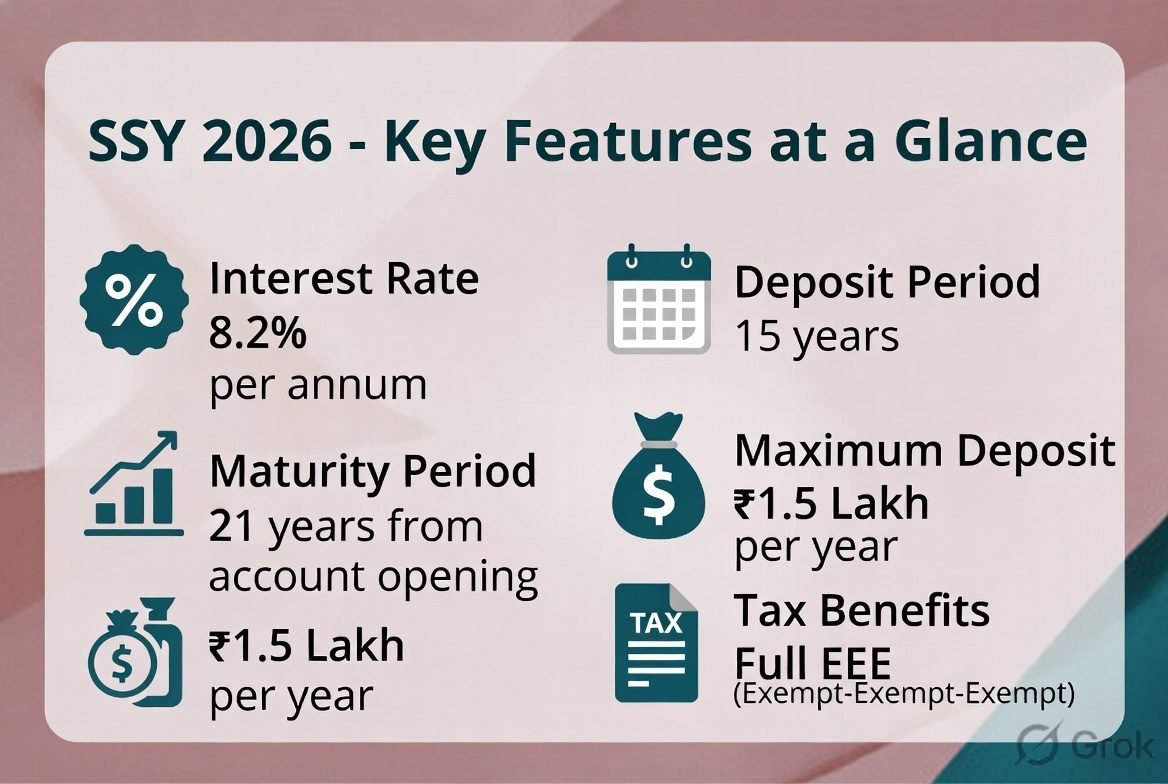
Sukanya Samriddhi Yojana is a small savings scheme introduced by the Government of India exclusively for girl children. Parents or legal guardians can open an SSY account in the name of a girl child before she turns 10 years of age. Deposits can be made for 15 years, while the account matures after 21 years from the date of opening.
That gap between year 15 and year 21 genuinely confuses a lot of parents when they first read the rules, so it's worth stating plainly upfront: you only need to deposit for the first 15 years from account opening. After year 15, no new deposits are required or accepted — the account simply earns interest on the accumulated balance for the remaining 6 years and matures at the end of year 21.
SSY at a Glance — 2026
| Interest Rate (Q1 FY 2026-27) | 8.2% |
| Account Opening Age | Before girl turns 10 |
| Deposit Period | 15 years |
| Maturity | 21 years from opening |
| Minimum Annual Deposit | ₹250 |
| Maximum Annual Deposit | ₹1.5 lakh |
Eligibility: Who Can Open an Account, and When
The girl child must be an Indian resident, and the account must be opened before she turns 10 years old. Only one account is allowed per girl child, and normally a family can open accounts for up to two girl children, though exceptions apply for twins or triplets, allowing a third account.
Grandparents can open an SSY account only if they are the legal guardian of the girl child — otherwise, only a parent or legal guardian is eligible to open the account. The account is managed by the parent or guardian until the girl turns 18, after which she can operate it herself.
Deposit Rules: The 15-Year Window Most People Miss
The minimum annual deposit is ₹250, and the maximum is ₹1.5 lakh, with no change to these limits in the recent 2026 updates. If you deposit more than the ₹1.5 lakh annual maximum, no interest is generated on the excess amount, and the excess can be withdrawn at any time — a detail worth knowing before you accidentally over-deposit in a single year.
Years 1–15
Active deposit period. You contribute anywhere from ₹250 to ₹1.5 lakh per year, and the account compounds interest annually on the growing balance.
Years 16–21
No further deposits needed or accepted. The account simply continues earning interest on the accumulated balance until it matures.
This structure is genuinely different from something like PPF, which requires contributions for its full tenure to keep earning the headline rate. SSY front-loads the commitment into 15 years and then lets compounding do the remaining work for six more — worth factoring into your own household budgeting, since the financial pressure of the scheme eases noticeably once you cross year 15.
Current Interest Rate and How It's Calculated
The latest Sukanya Samriddhi Yojana interest rate is 8.2% for Q2 of FY 2026-27 (July-September), compounded annually. The Ministry of Finance confirmed on March 30, 2026 that the SSY interest rate for Q1 FY2026-27 remained unchanged at 8.2% per annum — a rate that has genuinely held steady across several consecutive quarters now.
The interest for an SSY account is calculated on the lowest balance in the account for the calendar month, and is credited once, at the end of each financial year. The interest earned is then further compounded within the scheme until maturity. The rate is reviewed and notified every quarter, so while 8.2% is current, it's genuinely worth checking the latest notification periodically rather than assuming it's fixed for the full 21-year tenure.
Tax Benefits: The Full EEE Status
SSY enjoys EEE — Exempt-Exempt-Exempt — status, meaning eligible contributions, the interest earned, and the final maturity amount are all tax-free under the applicable provisions of the Income-tax Act. Contributions qualify for a tax deduction of up to ₹1.5 lakh annually under Section 80C.
This puts SSY in genuinely rare company — it shares this full EEE status with PPF, which we've compared against other retirement instruments in our EPF vs NPS vs PPF article. Unlike SCSS, which we've also covered and where interest is fully taxable, every rupee that comes out of an SSY account — principal, interest, and maturity value alike — is yours without any tax deduction at any stage, provided you follow the scheme's rules through to maturity.
What ₹1.5 Lakh a Year Actually Grows To
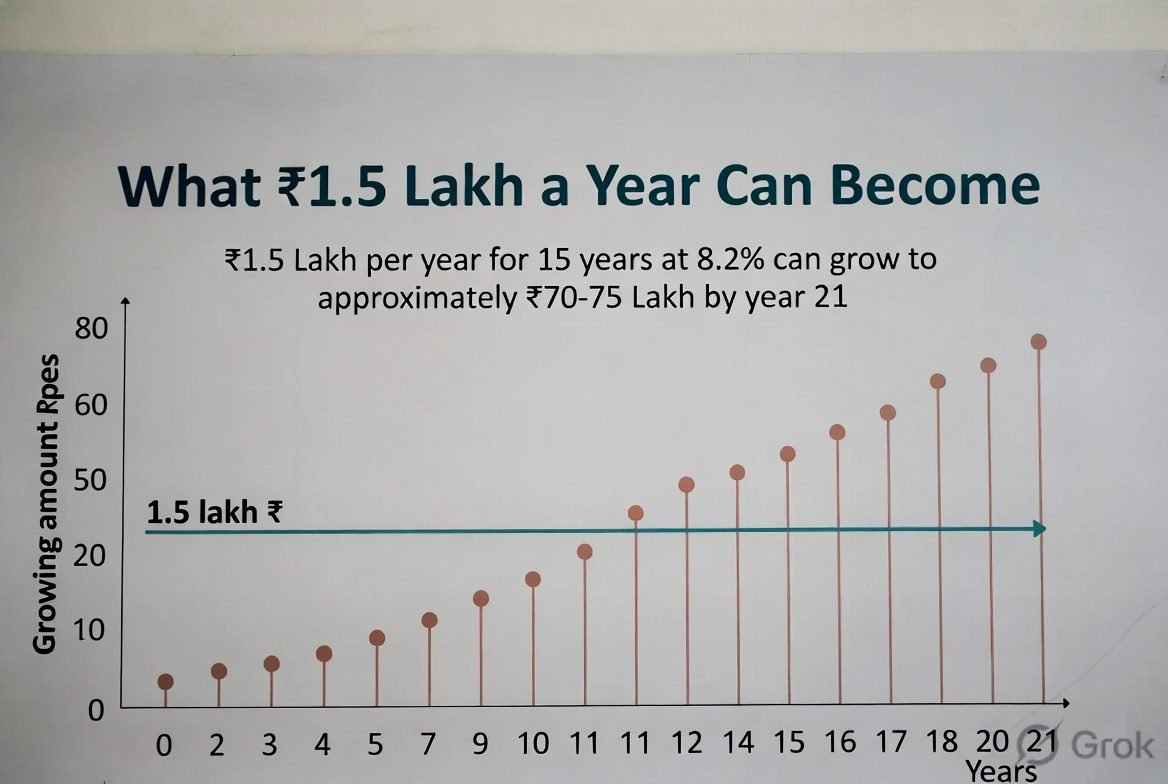
Depositing ₹1.5 lakh per year for 15 years at 8.2% can grow to roughly ₹70 lakh or more by the time the girl turns 21. A deposit of ₹1.5 lakh per year for 15 years at 8.2% interest can grow to approximately ₹70-75 lakh by the time the girl turns 21, though the exact figure depends on how the rate moves across the full tenure.
Withdrawal Rules: What You Can Actually Take Out, and When
| Situation | What's Allowed |
|---|---|
| Higher Education (after age 18) | Up to 50% of preceding year's balance |
| Marriage (after age 18) | Full premature closure permitted |
| Death of Account Holder | Full premature closure permitted |
| Extreme Hardship (medical, etc.) | Full premature closure, government approval required |
| Maturity (21 years) | Full withdrawal, entirely tax-free |
Partial withdrawal after age 18 is specifically for higher education expenses — admission fees, tuition, hostel costs. It cannot be used for marriage, personal expenses, or any other purpose without closing the account entirely. Partial withdrawal of up to 50% of the balance is allowed once the girl child turns 18, calculated against the balance at the end of the preceding financial year.
If the account isn't closed at maturity, it doesn't continue earning the SSY rate indefinitely — it instead earns the much lower post-office savings rate, currently around 4%, which is a genuinely important detail: there's no financial upside to leaving the money in past maturity, and a real cost to doing so.
Read Our SCSS Guide for Comparison →How to Open an Account
SSY accounts can be opened at any post office or authorised bank branch offering the scheme. You'll need to fill the account opening form with details of the girl child and guardian, submit KYC and birth documents, and make an initial deposit of at least ₹250.
Required documents typically include the girl child's birth certificate, the guardian's Aadhaar card, the guardian's bank passbook or a cancelled cheque, passport-size photographs of both guardian and child, and proof of address. Official account details and the government's own maturity calculator are available through the National Savings Institute's website and India Post's official portal, since SSY remains primarily a post office scheme even though many banks now offer it too.
Frequently Asked Questions
What is the current Sukanya Samriddhi Yojana interest rate?
The SSY interest rate for Q2 FY 2026-27 is 8.2% per annum, compounded annually, and has remained stable at this level across several consecutive quarters.
Until what age can I open an SSY account for my daughter?
The account must be opened before the girl child turns 10 years old, and can be opened any time from birth up to that age.
Do I need to keep depositing for the full 21 years?
No. Deposits are only required for the first 15 years. The account then earns interest on the accumulated balance for the remaining 6 years until maturity at year 21.
Is Sukanya Samriddhi Yojana tax-free?
Yes, SSY has full EEE (Exempt-Exempt-Exempt) status — contributions up to ₹1.5 lakh qualify for Section 80C deduction, interest earned is tax-free, and the maturity amount is entirely tax-free.
Can I withdraw money from SSY before my daughter turns 21?
Partial withdrawal of up to 50% of the previous year's balance is allowed after she turns 18, specifically for higher education. Full premature closure is allowed for marriage after 18, death, or approved extreme hardship cases.
What happens if I don't withdraw the money at maturity?
The account stops earning the SSY interest rate and instead earns the much lower post-office savings rate, around 4%, so there's no financial benefit to delaying withdrawal past maturity.
Our Bottom Line
SSY genuinely earns its reputation as one of the best available options for a daughter's long-term fund — the combination of a high, government-backed guaranteed rate and full EEE tax treatment is hard to match elsewhere in Indian small savings schemes. The two things worth getting right from day one: open the account as early as possible to maximize the compounding runway, and plan your annual contribution around what you can realistically sustain for 15 straight years, not the headline maximum-deposit example most articles use.
If you're building a broader family savings plan alongside SSY, our 50-30-20 budgeting rule guide and sinking fund planning article cover complementary pieces of household financial planning.

Pranab Barman is a Financial Educator and Personal Finance Researcher with over 10 years of hands-on experience in stock markets, trading, and investing. Currently enrolled in the CFA Program, he is committed to continuous learning and professional excellence in finance.
As the Founder of PlayWithStock, Pranab covers a wide range of topics including Mutual Funds, SIP, Taxation, Stock Market Basics, and Financial Calculators — with a focus on simplifying complex financial concepts for everyday all investors.
Email: support@playwithstock.com
Website: playwithstock.com
Related posts:
 Atal Pension Yojana 2026: Complete Guide to Rules, Contribution and Eligibility
 SSY Maturity Calculator 2026: The Complete Guide
 Senior Citizens Savings Scheme 2026: Interest Rate, Limits and Tax Rules Explained
 RBI Repo Rate Cut 2026: The Complete Home Loan EMI Guide
 NPS National Pension System 2026: Complete Guide to Rules, Tax Benefits and Withdrawal
 RBI MPC August 2026: 5 Key Things to Watch Before the Repo Rate Decision
 New Gratuity Rules 2026: How the 50% Wage Floor Changes Your Payout
 Large Cap vs Mid Cap vs Small Cap Funds: What SEBI’s Rules Actually Mean for You