
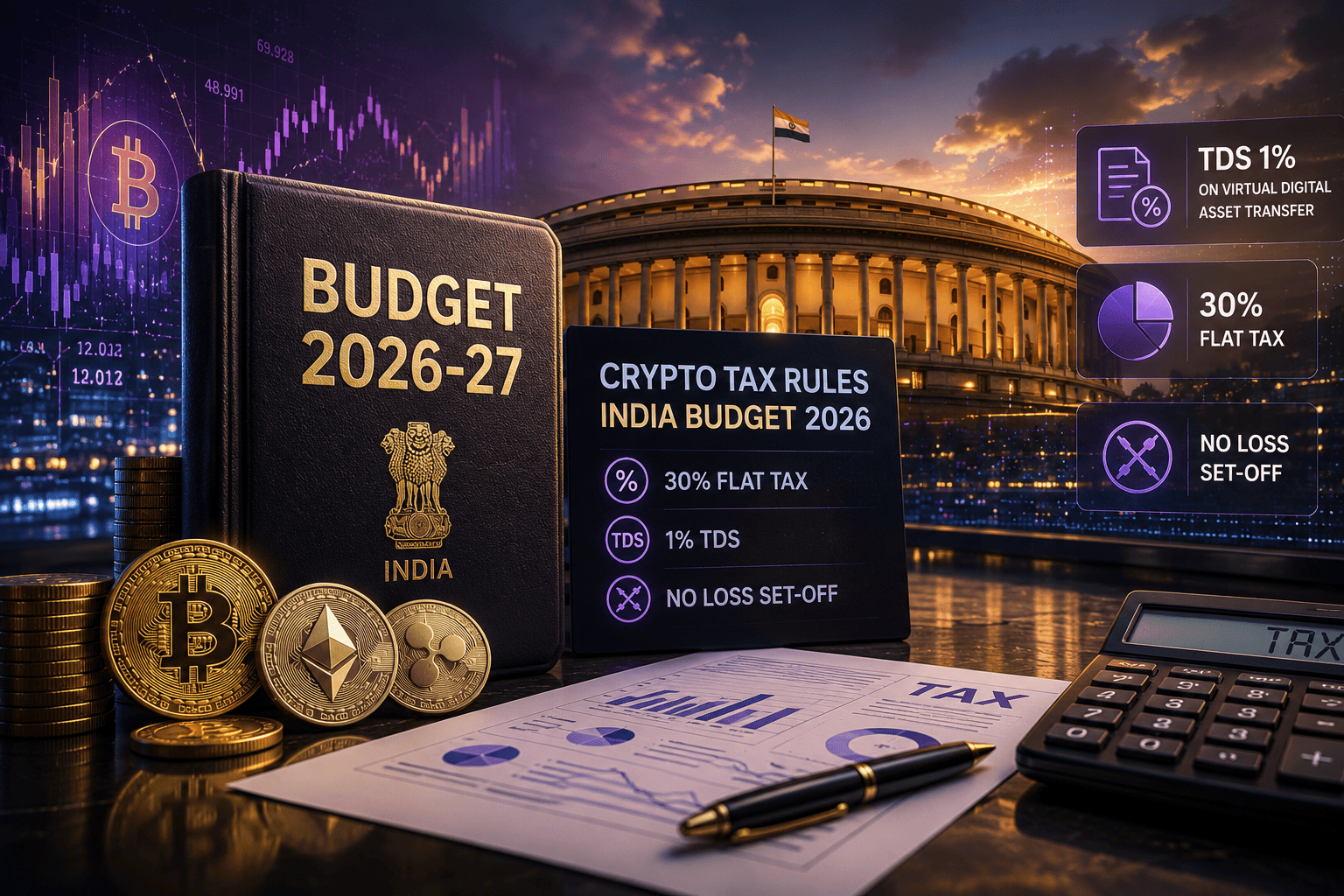

Crypto Tax Rules India Budget 2026: TDS, Loss Set-Off & What Actually Changed
Crypto tax rules in India going into Budget 2026 carried real hope for reform among traders and investors — a lower TDS rate, finally allowing loss set-offs, some genuine relief after years of the harshest digital asset tax regime among major economies. The actual outcome: Budget 2026-27 retained the existing framework almost entirely — the flat 30% tax, the 1% TDS, and the no-loss-set-off rule all stayed exactly as they were, while a new, stricter reporting penalty structure was added on top.
We've tracked this topic closely because it's one of the more consequential "nothing changed, except it got stricter" stories in this year's tax overhaul. If you're holding or trading crypto, this is worth reading in full rather than assuming last year's rules simply carried over unchanged, since the reporting penalties genuinely are new. This sits alongside our broader coverage of the Income-tax Act, 2025 terminology changes and revised ITR deadline extension, both part of the same compliance overhaul.

Table of Contents
- What Stayed Exactly the Same
- What Actually Changed in Budget 2026
- How the 1% TDS Actually Works
- Why You Still Can't Offset Crypto Losses
- Real Example: Gains, Losses, and the 30% Rate
- New Reporting Penalties: The Real 2026 Change
- Global Reporting: CARF and Cross-Border Data Sharing
- Filing Checklist for Crypto Investors
- Common Mistakes to Avoid
- Frequently Asked Questions
What Stayed Exactly the Same
Let's be direct about the headline: Budget 2026-27 made no change to the three pillars of India's crypto tax framework that traders have been asking to reform since 2022.
Core Crypto Tax Framework — Unchanged in 2026
| Rule | Rate/Detail | Legal Basis |
|---|---|---|
| Tax on VDA gains | Flat 30% + 4% cess (no slab benefit) | Section 115BBH |
| TDS on transfers | 1% on transactions above ₹10,000 (₹50,000 for specified persons) | Section 194S |
| Loss set-off | Not allowed against any income, including other crypto gains | Section 115BBH |
| Loss carry-forward | Not permitted to future years | Section 115BBH |
| Allowed deductions | Only cost of acquisition | Section 115BBH |
What Actually Changed in Budget 2026
The genuine changes this year are narrower but real: the Income-tax Act, 2025 explicitly expanded the legal definition of Virtual Digital Assets to include the term "crypto-asset," closing some ambiguity around edge-case tokens. More significantly, a new penalty framework specifically targets exchanges and reporting entities, not just individual taxpayers.
New From Budget 2026 / IT Act 2025
| Change | Detail | Effective |
|---|---|---|
| VDA definition expanded | Explicitly includes "crypto-asset" terminology | April 1, 2026 |
| Non-reporting penalty | ₹200/day for exchanges failing to report accurately | April 2026 |
| Inaccurate reporting penalty | ₹50,000 flat penalty | April 2026 |
| Financial account reporting | Crypto-assets, CBDCs, e-money included in reporting framework | January 1, 2026 |
The financial account reporting inclusion is the change that deserves more attention than it's currently getting — crypto assets, central bank digital currencies, and electronic money are now formally part of India's financial account reporting framework, aligning with international standards. This connects to a much bigger story we cover separately in our piece on crypto tax notices in India, since better data reporting is precisely what's driving increased notice volume.
How the 1% TDS Actually Works
Under Section 194S, a 1% TDS applies to crypto transfers exceeding ₹10,000 in a financial year for most individuals, or ₹50,000 for "specified persons" (broadly, those with business/professional income above certain thresholds). This applies even to barter-style crypto-to-crypto swaps, not just crypto-to-INR sales.
Important: TDS Is Not an Extra Tax
A common misunderstanding worth correcting directly: the 1% TDS is not an additional tax on top of the 30% — it's an advance payment that gets credited against your final tax liability when you file your return. You claim this credit by checking Form 26AS or the AIS (Annual Information Statement) and reporting it in the TDS schedule of your ITR. If your actual tax liability ends up lower than the TDS deducted across the year, you can claim the difference as a refund.
Exchanges like domestic platforms deduct this automatically and share periodic reports with users, but P2P transactions carry an important trap: if the buyer fails to deduct the required TDS on a peer-to-peer transfer, the buyer themselves becomes liable for the TDS amount, plus interest at 1.5% per month and a penalty equal to the TDS amount — a liability many casual P2P traders don't realize they're carrying.
Why You Still Can't Offset Crypto Losses
This remains the single most criticized aspect of India's crypto tax framework, and it stayed completely unchanged in Budget 2026. Losses from one VDA cannot be set off against gains from another VDA, against any other income category, and cannot be carried forward to future years — each transaction is effectively taxed in isolation.
Real Example: The No-Set-Off Rule in Practice
Consider a trader who lost ₹2,00,000 on an Ethereum position and gained ₹3,00,000 on a Bitcoin position in the same financial year. Under standard capital gains rules for stocks (as covered in our tax-loss harvesting India guide), that loss would offset the gain, leaving only ₹1,00,000 taxable. Under crypto's specific rules, the trader pays 30% tax on the full ₹3,00,000 gain, with the ₹2,00,000 loss providing zero tax benefit whatsoever — not this year, not in any future year.
This structural difference is exactly why we'd caution readers against treating crypto and equity investments as interchangeable for tax planning purposes — strategies that work well for a diversified equity portfolio simply don't apply the same way to VDA holdings.
Real Example: Gains, Losses, and the 30% Rate
Worked Example — Single Crypto Transaction
| Detail | Amount |
|---|---|
| Purchase price (Bitcoin, Aug 2025) | ₹12,00,000 |
| Sale price (Jan 2026) | ₹18,00,000 |
| Gain | ₹6,00,000 |
| Tax rate applied | 30% flat (regardless of income slab) |
| Tax owed (before cess) | ₹1,80,000 |
| Effective tax + 4% cess | ₹1,87,200 |
Notice that even if this trader had zero other income and would otherwise fall into the lowest tax slab, the crypto gain is still taxed at the full flat 30% — there's no benefit from a lower personal income bracket, which is a meaningful structural difference from how capital gains on other asset classes are typically taxed in India.
New Reporting Penalties: The Real 2026 Change
Penalty Structure Effective April 2026
₹200 per day — charged to exchanges and reporting entities that fail to report crypto transactions accurately or on time.
₹50,000 flat penalty — for materially inaccurate reporting by exchanges or platforms.
Section 271FA penalty (up to ₹10 lakh) — for non-disclosure of foreign crypto holdings, alongside prosecution risk under existing provisions.
While these penalties primarily target exchanges rather than individual investors directly, the practical effect is a much stronger incentive for platforms to report every transaction accurately and promptly — which in turn means individual investors should expect their transaction history to be more completely and accurately reflected in their AIS and Form 26AS than in previous years, leaving less room for unreported income to go unnoticed.
Global Reporting: CARF and Cross-Border Data Sharing
Perhaps the most consequential long-term change isn't in this year's budget language at all — it's the OECD's Crypto-Asset Reporting Framework (CARF), which will require Indian exchanges to share crypto transaction data globally starting in 2027. Combined with India's own new financial account reporting inclusion for crypto-assets from January 1, 2026, this represents a genuine tightening of the net around cross-border and offshore crypto activity that was previously harder for tax authorities to trace.
For NRIs and anyone holding crypto on international exchanges, this significantly raises the stakes of accurate crypto bookkeeping and record-keeping — Schedule FA (Foreign Assets) disclosure requirements already carry steep penalties for non-disclosure, and that risk only grows as international data-sharing agreements mature.
Filing Checklist for Crypto Investors
Before You File Your ITR This Year
1. Aggregate all crypto transactions for the financial year and report totals in Schedule VDA of ITR-2 (capital gains treatment) or ITR-3 (business income treatment), depending on your trading pattern.
2. Verify the 1% TDS credits appearing in your Form 26AS or AIS match your actual transaction records — discrepancies should be flagged before filing.
3. Report transaction-wise details: date of acquisition, date of transfer, INR cost, and full sale consideration for each VDA transaction.
4. If you hold crypto on foreign exchanges, ensure Schedule FA disclosure is complete and accurate given the steep non-disclosure penalties.
5. Remember the filing deadline: July 31 for ITR-1/ITR-2, or August 31 for ITR-3/ITR-4 non-audit cases under the revised 2026 deadline structure.

Common Mistakes to Avoid
Watch Out For These
1. Assuming crypto losses offset stock market gains. They don't — crypto losses cannot offset any other income category, including gains from equities, mutual funds, or other crypto assets.
2. Treating the 1% TDS as your total tax liability. It's an advance credit, not the final tax owed — the full 30% liability still applies and gets reconciled at filing time.
3. Ignoring P2P transaction TDS obligations. Buyers in P2P trades who fail to deduct required TDS can become personally liable for the TDS amount, interest, and penalty.
4. Underreporting foreign exchange holdings. With CARF data-sharing starting in 2027 and India's own reporting framework already active, offshore crypto activity is increasingly visible to tax authorities.
5. Missing that deductions beyond cost of acquisition aren't allowed. Gas fees, exchange fees, and advisory charges cannot be deducted from crypto gains under the current framework.
Readers building a broader diversified portfolio alongside crypto holdings may find our index funds vs active funds comparison and life cycle funds coverage useful context for how differently traditional asset classes are taxed compared to VDAs. For readers specifically tracking crypto market movements, our coverage of the Bitcoin crash 2026 and cold wallet vs hot wallet security remain relevant companion reads, and our FATF anti-fraud rules 2026 piece covers the broader regulatory direction crypto compliance is heading in globally.
It's worth stepping back and considering why the reform push failed to move the needle this year. Tax officials have repeatedly signaled they view crypto's harsh treatment as intentional — a deliberate policy choice to discourage speculative retail trading in an asset class the government still doesn't recognize as legal tender, rather than an oversight waiting to be corrected. That framing matters for anyone hoping next year's budget brings relief: the current structure appears to reflect settled policy rather than a temporary compliance gap. Readers comparing crypto's tax treatment against more conventional options may find our silver and gold market coverage and direct vs regular mutual fund guide useful for weighing where new investment capital might be better allocated given this structural tax disadvantage.
Frequently Asked Questions
Did Budget 2026 change the 30% crypto tax rate?
No. Budget 2026-27 retained the flat 30% tax rate under Section 115BBH, plus 4% cess, unchanged from previous years. Industry calls for a rate reduction were not addressed.
Can I now offset crypto losses against gains in Budget 2026?
No. The no-loss-set-off rule remains unchanged. Losses from one VDA still cannot offset gains from another VDA, other income, or be carried forward to future years.
What new crypto tax rules were actually introduced in 2026?
The main genuine changes are a new penalty structure for exchanges (₹200/day for non-reporting, ₹50,000 for inaccurate reporting), an explicitly expanded VDA definition including "crypto-asset," and inclusion of crypto-assets in India's financial account reporting framework from January 1, 2026.
Is the 1% TDS an additional tax on top of the 30%?
No. The 1% TDS under Section 194S is an advance tax credit, not an additional tax. It gets adjusted against your final 30% tax liability when you file your ITR, and any excess can be claimed as a refund.
What happens if I don't report foreign crypto exchange holdings?
Non-disclosure of foreign assets, including crypto held on international exchanges, can attract penalties up to ₹10 lakh under Section 271FA, plus prosecution risk. Reporting requirements are tightening further with global data-sharing frameworks like CARF starting in 2027.
Which ITR form should I use to report crypto income?
Report crypto transactions in Schedule VDA within ITR-2 (if treated as capital gains) or ITR-3 (if treated as business income), depending on the frequency and nature of your trading activity.
For readers weighing crypto's regulatory trajectory against India's broader macro environment, our coverage of the Dollar Index (DXY), RBI repo rate decisions, and inflation trends all feed into the same risk-appetite conversation that shapes how retail capital moves between crypto, equities, and safer instruments each year.

Pranab Barman is a Financial Educator and Personal Finance Researcher with over 10 years of hands-on experience in stock markets, trading, and investing. Currently enrolled in the CFA Program, he is committed to continuous learning and professional excellence in finance.
As the Founder of PlayWithStock, Pranab covers a wide range of topics including Mutual Funds, SIP, Taxation, Stock Market Basics, and Financial Calculators — with a focus on simplifying complex financial concepts for everyday all investors.
Email: support@playwithstock.com
Website: playwithstock.com
Related posts:
 Tax Year vs Financial Year vs Assessment Year: What Actually Changed in 2026
 Tax-Loss Harvesting: How It Works in India
 Free STT Hike Breakeven Calculator 2026 — see exactly how much extra STT the Budget 2026 hike adds to your F&O trades and how many points you now need to break even.
 Large Cap vs Mid Cap vs Small Cap Funds: What SEBI’s Rules Actually Mean for You
 Crypto Bookkeeping for Tax in India: The Complete 2026 Guide
 NPS National Pension System 2026: Complete Guide to Rules, Tax Benefits and Withdrawal
 Senior Citizens Savings Scheme 2026: Interest Rate, Limits and Tax Rules Explained
 India Crypto Tax Notices: 44,000 Investors Just Got a Letter