
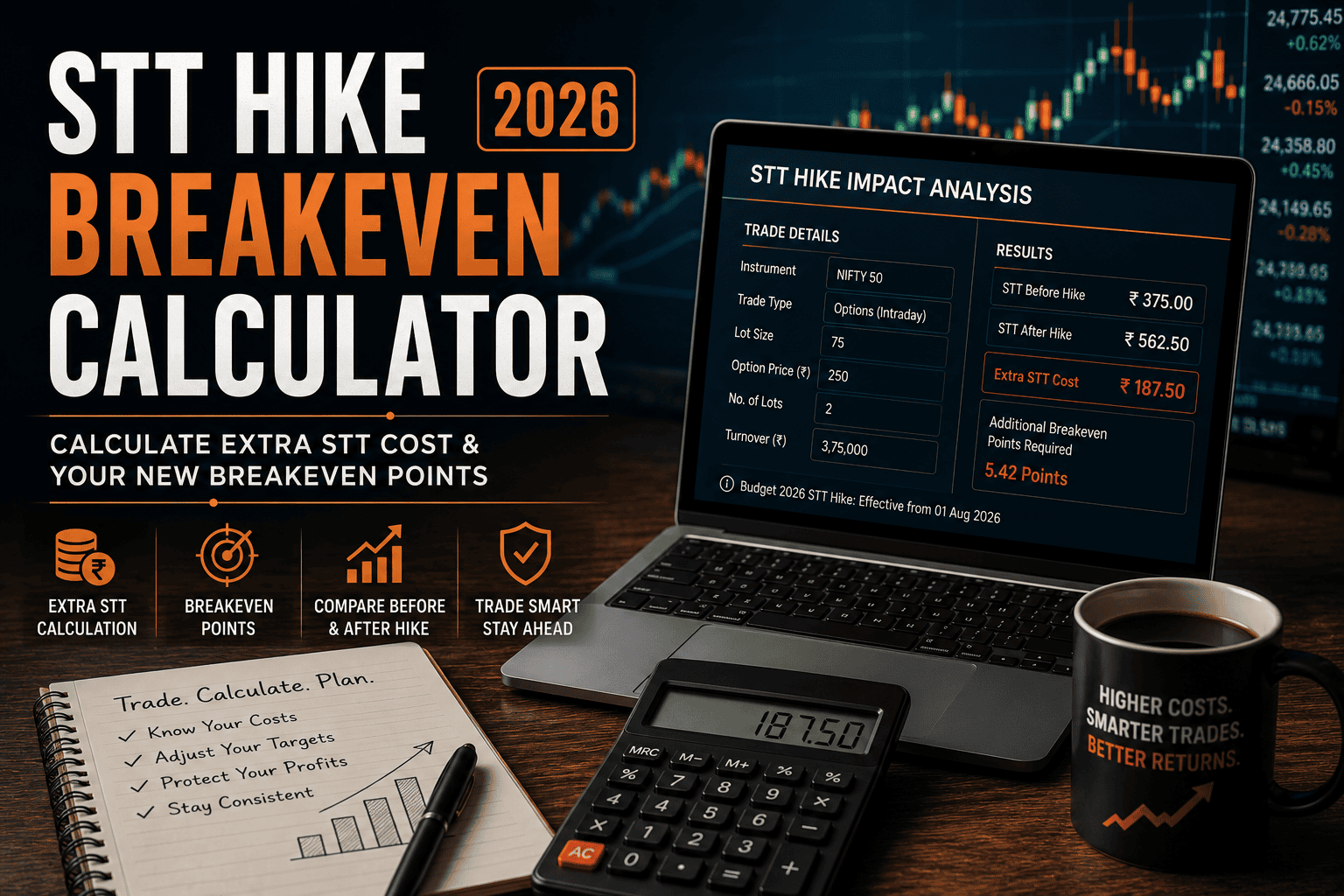

STT Hike Breakeven Calculator 2026: The Complete Guide
See exactly how much extra STT the Budget 2026 hike adds to your F&O trades, and how many extra points you now need just to break even.
STT Hike Breakeven Calculator
Enter your trade details below to see the exact extra cost from the STT hike. This is an educational estimate only.
Introduction
Most traders felt the Budget 2026 STT hike as a vague sense that trading got more expensive, without ever calculating the exact number. This calculator converts the headline percentage change — futures STT up 150%, options STT up 50% — into the actual rupee cost per trade and the extra price movement you now need just to reach the breakeven point you were hitting before.
Complete Guide: The Budget 2026 STT Hike
Finance Minister Nirmala Sitharaman announced a significant hike in Securities Transaction Tax on derivatives in the Budget 2026 speech on 1 February 2026, effective from 1 April 2026. Futures STT rose from 0.02% to 0.05% of traded value — a 150% increase — while options STT on premium rose from 0.10% to 0.15%, a 50% increase. STT on exercised options also rose, from 0.125% to 0.15% of intrinsic value.
Crucially, only equity and index derivatives were affected. Delivery-based equity trades, intraday cash trading, and equity mutual funds saw no change. Commodity derivatives traded on MCX also remain untouched at the old 0.01% rate — a detail many traders miss when assuming the hike applies market-wide.
The government's stated rationale, echoed in post-Budget commentary, centred on SEBI data showing that roughly 90-93% of individual F&O traders incur net losses, with many continuing to trade despite repeated losses. The hike is explicitly framed as a measure to curb speculative, high-frequency trading rather than as a revenue-generation move, though it does both simultaneously given the scale of derivatives turnover in Indian markets.
How to Use This Calculator
The Breakeven Formula
| Instrument | Old Rate | New Rate | Change |
|---|---|---|---|
| Futures (sell side) | 0.02% | 0.05% | +150% |
| Options premium (sold) | 0.10% | 0.15% | +50% |
| Options exercised | 0.125% | 0.15% | +20% |
| Commodity derivatives (MCX) | 0.01% | 0.01% (unchanged) | No change |
Common Mistakes to Avoid
- Assuming the hike applies to equity delivery or intraday. Only F&O derivatives saw a rate increase — cash market STT is unchanged.
- Forgetting commodity derivatives are exempt. MCX commodity contracts continue at the old 0.01% rate; only equity and index derivatives are affected.
- Ignoring STT when planning intraday options strategies. High-frequency weekly options strategies accumulate the extra STT cost far faster than positional trades, since STT applies on every leg of every trade.
- Not treating STT as a deductible business expense. If F&O income is declared as business income, STT paid is deductible under Section 36 — many traders miss this in their tax filing.
Worked Example
Example — Futures. Selling 1 lot of a futures contract worth ₹7,50,000 (price × lot size), the old STT (0.02%) was ₹150. Under the new 0.05% rate, STT is ₹375 — an extra ₹225 per lot purely from the rate hike.
Example — Options. Selling 1 lot of options with a total premium value of ₹50,000 (premium × lot size), old STT (0.10%) was ₹50. Under the new 0.15% rate, STT is ₹75 — an extra ₹25 per lot. For a trader executing 20 similar lots a day, that's an extra ₹500 daily, or roughly ₹12,500 over a 25-day trading month, purely from the STT hike.
Conclusion
The Budget 2026 STT hike doesn't change your strategy's edge, but it does raise the floor every trade needs to clear before it becomes profitable — and that floor matters most for high-frequency, thin-margin trading rather than occasional positional trades. Running your actual lot size and frequency through this calculator gives you the real number to weigh against your strategy's historical win rate, rather than reacting to the headline percentage alone.
FAQs
1 April 2026, as announced in the Budget 2026 speech on 1 February 2026 and implemented through the Finance Act amendments.
No. Only futures and options STT rates were changed. Delivery equity, intraday cash trading, and equity mutual fund STT remain unchanged.
No. Commodity derivatives traded on MCX continue at the unchanged 0.01% rate. The hike applies only to equity and index derivatives.
Yes, if F&O income is declared as business income, STT paid is deductible as a business expense under Section 36 of the Income Tax Act.
Related Reading on Play With Stock

Pranab Barman is a Financial Educator and Personal Finance Researcher with over 10 years of hands-on experience in stock markets, trading, and investing. Currently enrolled in the CFA Program, he is committed to continuous learning and professional excellence in finance.
As the Founder of PlayWithStock, Pranab covers a wide range of topics including Mutual Funds, SIP, Taxation, Stock Market Basics, and Financial Calculators — with a focus on simplifying complex financial concepts for everyday all investors.
Email: support@playwithstock.com
Website: playwithstock.com
Related posts:
 F&O STT Hike Breakeven Calculator: 2026 New Rates
 TCS Q1 FY27 Results: Profit Rises 5%, Sensex Jumps 828 Points
 Fed Rate Hike 2026: Why the July 28-29 FOMC Meeting Could Change Everything
 UPS Pension Calculator 2026: The Complete Guide
 SSY Maturity Calculator 2026: The Complete Guide
 Amrit Vrishti FD Calculator 2026: The Complete Guide
 SIP Compounding Calculator 2026: The Complete Guide
 8th Pay Commission Fitment Factor Calculator 2026