

GST Registration for Small Business 2026: When It's Actually Mandatory
GST Registration for Small Business is a question we've genuinely heard get answered wrong more often than any other compliance topic on this blog — usually because business owners assume turnover is the only trigger, check their revenue, see it's below the threshold, and stop thinking about GST entirely. That assumption is exactly what catches people off guard, because several categories of business have to register regardless of how much they've actually earned, sometimes at the very first rupee of sales.
This sits slightly outside our usual Government Schemes territory — we've written about savings schemes and post office instruments so far — but GST registration is genuinely one of the most consequential government compliance decisions a small business owner makes, and it deserves the same level of actual detail. We've also touched on GST from the e-commerce seller's angle in our earlier coverage of GST 2.0 changes for e-commerce sellers; this article steps back to the more fundamental question of registration itself, which applies well beyond just online sellers.
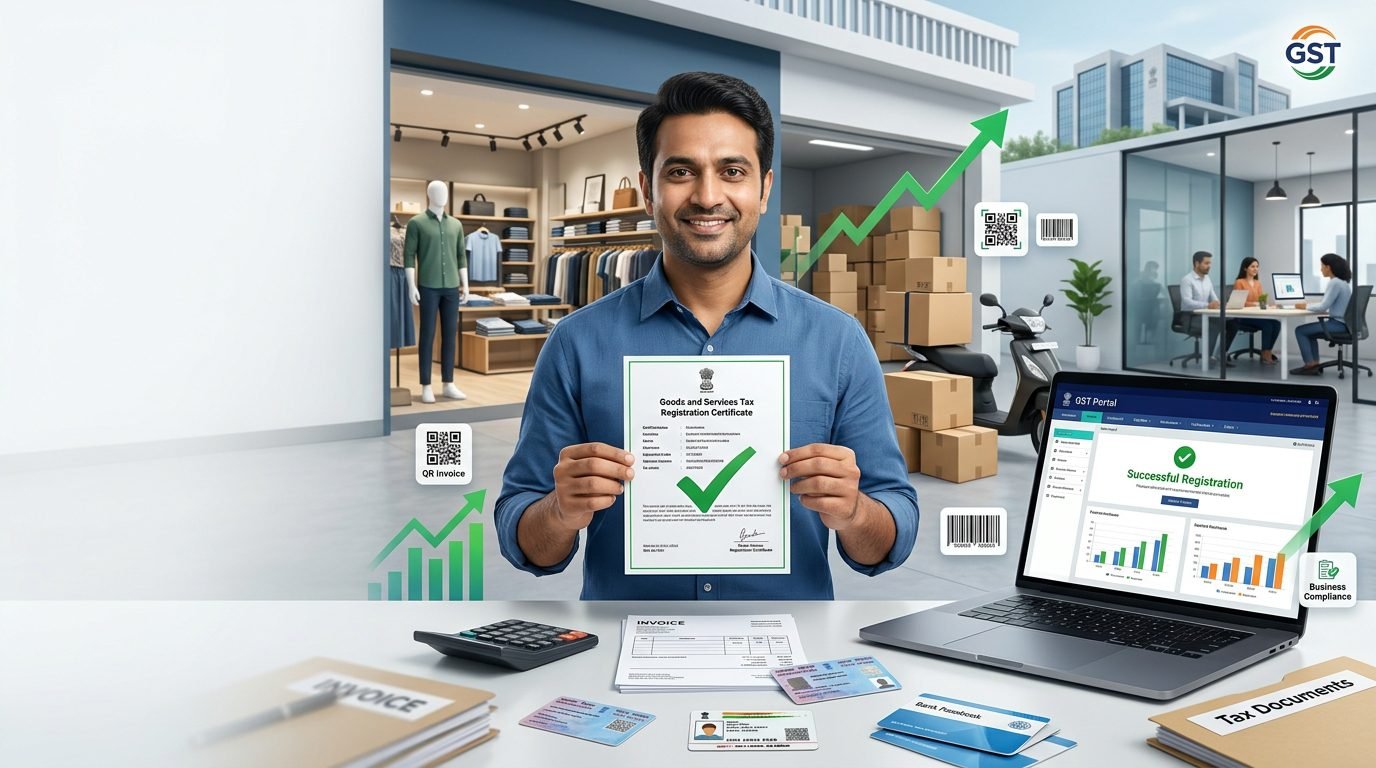
Table of Contents
- The Turnover Thresholds, State by State
- Registered Regardless of Turnover: The Part Everyone Misses
- The Composition Scheme Alternative
- Documents You'll Actually Need
- The Registration Process, Step by Step
- The 30-Day Bank Account Rule Nobody Warns You About
- What Happens If You Register Too Late
- Should You Register Voluntarily, Below the Threshold
- Frequently Asked Questions
The Turnover Thresholds, State by State
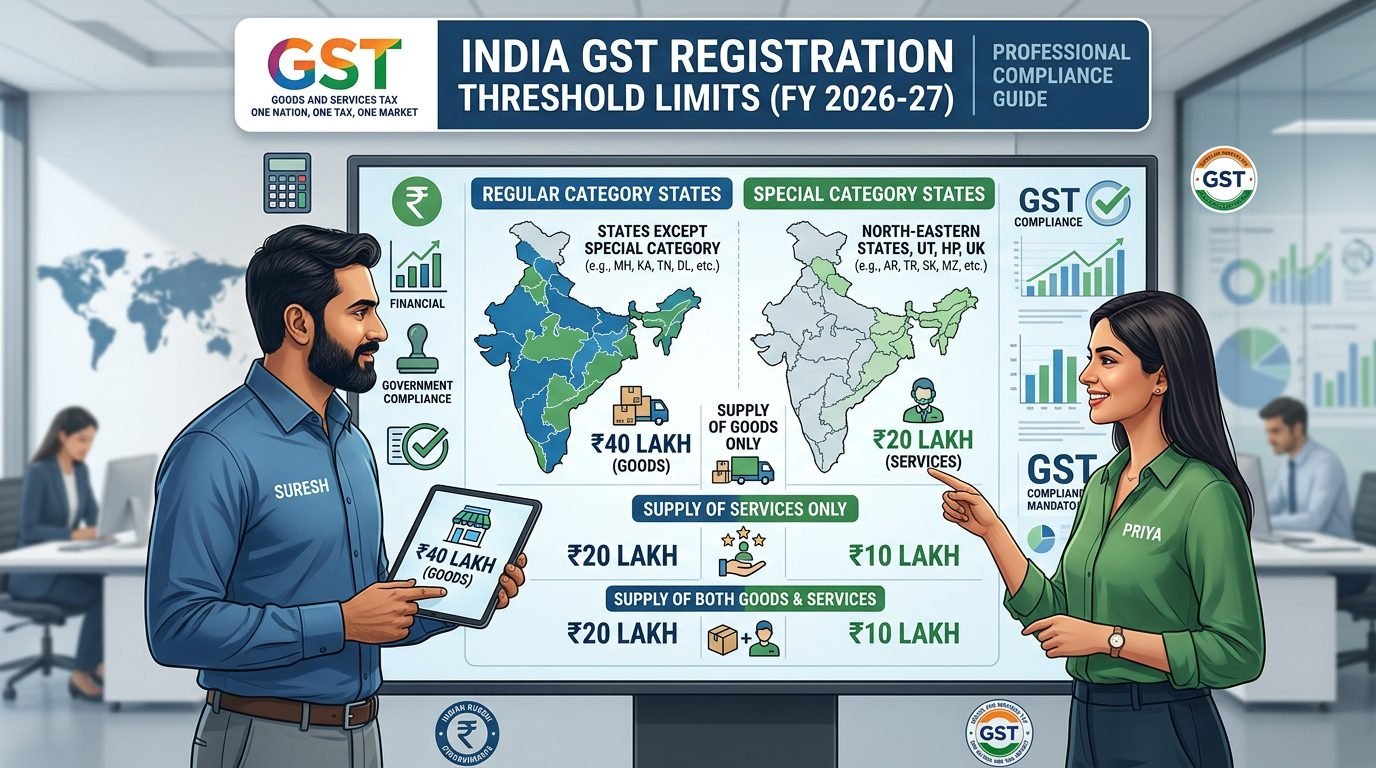
The GST registration threshold is ₹40 lakh in aggregate annual turnover for suppliers of goods, and ₹20 lakh for services, across most Indian states. This drops to ₹20 lakh and ₹10 lakh respectively in special-category states — the North-Eastern states along with a few hill states.
GST Threshold Limits — 2026
| Goods, Regular States | ₹40 lakh |
| Services, Regular States | ₹20 lakh |
| Goods, Special Category States | ₹20 lakh |
| Services, Special Category States | ₹10 lakh |
| Government Registration Fee | ₹0 (free on the portal) |
Aggregate turnover means all-India turnover under the same PAN, counting taxable, exempt, and export supplies together, but excluding GST itself. That "same PAN" detail matters more than most business owners realize — the aggregate turnover is calculated on an all-India basis, not just for a single state or location, so someone running a small operation in two states can't treat each location's revenue as separate for threshold purposes. Both get added together against the same PAN.
Registered Regardless of Turnover: The Part Everyone Misses
Under Section 24 of the CGST Act, several categories must register at any turnover, even at ₹1 of sales. This includes businesses making inter-state supplies, with an exception for inter-state service providers who remain exempt from compulsory registration up to the ₹20 lakh threshold, or ₹10 lakh in special category states.
Genuinely Mandatory at Any Turnover
Interstate suppliers of goods, casual taxable persons, those required to pay tax under reverse charge, and non-resident taxable persons — none of these get to wait for a threshold.
E-commerce Sellers Specifically
A person who supplies via an e-commerce aggregator, other than supplies specified under CGST Section 9(5), generally must register regardless of turnover.
That e-commerce trigger genuinely matters given how many small sellers now operate through platforms rather than their own storefronts — someone selling handmade goods through an online marketplace can be legally required to register for GST well before they'd ever cross the ₹40 lakh goods threshold on their own, purely because of how they're selling, not how much they're selling.
Casual taxable persons — someone who occasionally supplies goods or services in a state where they don't have a fixed place of business, like a vendor at a seasonal trade fair or exhibition — also fall into this mandatory bucket, typically needing to register before the event even begins rather than waiting to see how much they actually sell. The common thread across all these Section 24 categories is that the law treats the nature of the business activity itself as the risk factor, not the revenue it happens to generate. The full list of mandatory categories is set out directly in the official GST portal's registration guidance, worth checking directly if your business model doesn't fit neatly into the examples above.
The Composition Scheme Alternative
For small businesses that do need to register but want to avoid the full compliance burden of standard GST — monthly returns, detailed invoice-level reporting, input tax credit reconciliation — the Composition Scheme offers a genuinely simpler path. It's built specifically for small taxpayers, trading a lower, fixed tax rate on turnover for giving up the ability to claim input tax credit and charge GST separately to customers.
This isn't automatically the right choice for every eligible business — it suits businesses selling mainly to end consumers who don't need input tax credit themselves, and tends to work less well for businesses selling to other GST-registered businesses that expect to claim credit on their purchases. Whether composition or regular registration makes more sense genuinely depends on who your customers are, not just your turnover.
A small restaurant or retail shop selling directly to walk-in customers, for instance, often finds the composition scheme genuinely easier to manage — quarterly returns instead of monthly, a flat tax rate applied to turnover, and no need to track input tax credit across every purchase invoice. A wholesaler or manufacturer supplying primarily to other GST-registered businesses usually finds the opposite is true, since their business customers will actively prefer a supplier who can pass on input tax credit, something composition scheme registrants can't offer.

Documents You'll Actually Need
Before starting the online application, having these ready genuinely speeds things up considerably: PAN card of the business or proprietor, Aadhaar card, proof of business registration or incorporation certificate (for partnerships, companies, or LLPs), address proof for the principal place of business (utility bill, rent agreement, or property tax receipt), bank account details along with a cancelled cheque or bank statement, and digital signature (mandatory for companies and LLPs, optional for proprietorships).
Registration also involves Aadhaar and biometric authentication requirements per a GSTN advisory, with timely biometric verification genuinely critical for smooth ARN generation — meaning delays in completing this step are one of the more common reasons applications stall partway through rather than completing cleanly.
The Registration Process, Step by Step
- Visit the official GST portal at gst.gov.in and select "New Registration" under the Services tab.
- Fill in Part A with basic details — PAN, mobile number, and email — and verify with the OTP sent to both.
- Note down the Temporary Reference Number (TRN) generated after Part A verification.
- Log back in using the TRN to complete Part B — business details, promoter/partner information, principal place of business, and bank account details.
- Upload the required documents in the specified formats and file sizes.
- Complete Aadhaar authentication and any required biometric verification.
- Submit the application using either a Digital Signature Certificate or an Electronic Verification Code.
- Receive an Application Reference Number (ARN) to track the application status.
- Once approved, receive your GSTIN and registration certificate, typically within a few working days if all documentation is in order.
There is no government fee for GST registration — the entire process on gst.gov.in is free, and charges only apply if you choose to hire a professional or agent to handle the process on your behalf, which many first-time registrants do to avoid the documentation back-and-forth that comes with an incomplete or incorrectly filed application.
The 30-Day Bank Account Rule Nobody Warns You About
This is genuinely a recent addition that catches new registrants off guard, since it's easy to complete the initial registration and assume you're fully done. As per a GSTN advisory dated November 20, 2025, a registered business must furnish valid bank account details within 30 days of registration, or before filing its first GSTR-1, whichever comes first, to avoid automatic suspension.
What Happens If You Register Too Late
| Situation | Consequence |
|---|---|
| Crossed threshold, didn't register | Backdated tax demand from the date liability arose |
| Backdated tax owed | Interest charges on the unpaid amount |
| Continued non-compliance | Penalties and formal notices from the GST department |
The consequences of registering too late range from backdated tax demands and interest charges to penalties and notices from the GST department — genuinely more expensive and disruptive than simply registering on time would have been, since the backdated demand applies from the date the liability actually arose, not from whenever the department happens to notice.
The practical trap here is that many small business owners don't discover they've crossed the threshold until well after the fact, sometimes only when preparing annual accounts or during a routine tax filing. By that point, months of unregistered, GST-liable turnover may have already accumulated, and the backdated demand covers that entire period, not just going forward from discovery. Keeping a running, updated total of turnover throughout the year — rather than only checking it once annually — is a genuinely simple habit that prevents this specific problem. Official penalty provisions under the CGST Act are detailed on the Central Board of Indirect Taxes and Customs website.
Read: All Post Office Savings Schemes Compared →Should You Register Voluntarily, Below the Threshold
Not every business below the threshold should wait to be forced into registration. Businesses with turnover below the threshold aren't required to register, but they can do so voluntarily to receive input tax credits and other benefits.
Voluntary registration genuinely makes sense in a few specific situations: if your customers are primarily other GST-registered businesses who'd rather deal with a registered supplier for their own input tax credit purposes, if you're planning to scale past the threshold within the next year and want the systems in place early, or if you're regularly buying inputs on which GST is charged and want to claim that credit back rather than absorbing it as a cost. For a business selling mainly to individual consumers with no immediate growth plans, staying unregistered below the threshold and avoiding the compliance overhead is often the more practical choice.
There's also a credibility angle worth mentioning, even though it's less quantifiable than the tax mechanics. A registered GSTIN on an invoice signals a certain level of formality to business customers and larger clients, some of whom may simply prefer, or even require, working with GST-registered vendors as part of their own procurement policy. For a small business actively trying to win larger corporate clients, voluntary registration can function as a credibility signal independent of the actual tax benefit.
Frequently Asked Questions
What is the GST registration threshold for small businesses in 2026?
₹40 lakh annual turnover for suppliers of goods and ₹20 lakh for services in most states, dropping to ₹20 lakh and ₹10 lakh respectively in special category states.
Do I need to register for GST even if my turnover is below the threshold?
Yes, in certain cases. Interstate suppliers of goods, e-commerce sellers, casual taxable persons, and a few other categories under Section 24 of the CGST Act must register regardless of turnover.
Is there a government fee for GST registration?
No, GST registration on the official gst.gov.in portal is free. Fees only apply if you hire a professional or agent to handle the process for you.
What happens if I don't provide bank account details after registering?
As per a November 2025 GSTN advisory, failing to furnish valid bank account details within 30 days of registration, or before filing your first GSTR-1, can result in automatic suspension of your GST registration.
What documents are required for GST registration?
PAN card, Aadhaar card, business registration proof, address proof for the business location, bank account details with a cancelled cheque, and a digital signature certificate for companies and LLPs.
What happens if I register for GST late, after crossing the threshold?
You may face a backdated tax demand from the date your liability actually arose, along with interest charges and potential penalties or notices from the GST department.
Our Bottom Line
The genuinely important takeaway here isn't the threshold number itself — most small business owners already have a rough sense of that. It's the categories that bypass the threshold entirely, especially the e-commerce and interstate supply triggers that catch sellers who assumed their revenue alone determined their obligation. Checking which category your business actually falls into, before assuming turnover is the only test that matters, is the single most useful five minutes you can spend on this topic.
For other government compliance and savings topics relevant to small business owners and freelancers, our post office savings schemes comparison and NSC guide cover complementary financial planning ground.

Pranab Barman is a Financial Educator and Personal Finance Researcher with over 10 years of hands-on experience in stock markets, trading, and investing. Currently enrolled in the CFA Program, he is committed to continuous learning and professional excellence in finance.
As the Founder of PlayWithStock, Pranab covers a wide range of topics including Mutual Funds, SIP, Taxation, Stock Market Basics, and Financial Calculators — with a focus on simplifying complex financial concepts for everyday all investors.
Email: support@playwithstock.com
Website: playwithstock.com
Related posts:
 GST 2.0 for E-commerce Sellers (2026): Complete Guide
 Kisan Vikas Patra 2026: How Your Money Actually Doubles, and What It Costs You
 Post Office Time Deposit vs Bank FD 2026: Which Actually Wins
 Silver Crash 2026: What Happened After Its All-Time High of $121
 Dividend Aristocrats for Passive Income: Does India Have Its Own?
 Bank of Maharashtra Q1 FY27 Results: QIP Update, Business Growth & Preview
 Ethanol Stocks India: The Complete Guide to the Business, the E20 Controversy, and Every Listed Company
 EPF vs NPS vs PPF 2026: Which Retirement Option Actually Suits You