


Kisan Vikas Patra 2026: How Your Money Actually Doubles, and What It Costs You
Kisan Vikas Patra 2026 gets recommended to us constantly with the same pitch: "put in money, it doubles, guaranteed." That's technically true, and it's exactly why the scheme has stayed popular at post office counters for decades. But "doubling" is doing a lot of quiet work in that sentence — it takes nearly nine and a half years, the interest is fully taxable, and there's no Section 80C benefit at all, three details that rarely make it into the pitch from whoever's recommending it to you.
We've already covered Sukanya Samriddhi Yojana, the first article in this Government Schemes section, as well as SCSS on the retirement side. KVP sits at almost the opposite end of the small savings spectrum — no tax break, no restriction to a specific beneficiary, just a straightforward, government-guaranteed doubling of whatever you put in. Official scheme rules are published by India Post, the primary administrator of the scheme.
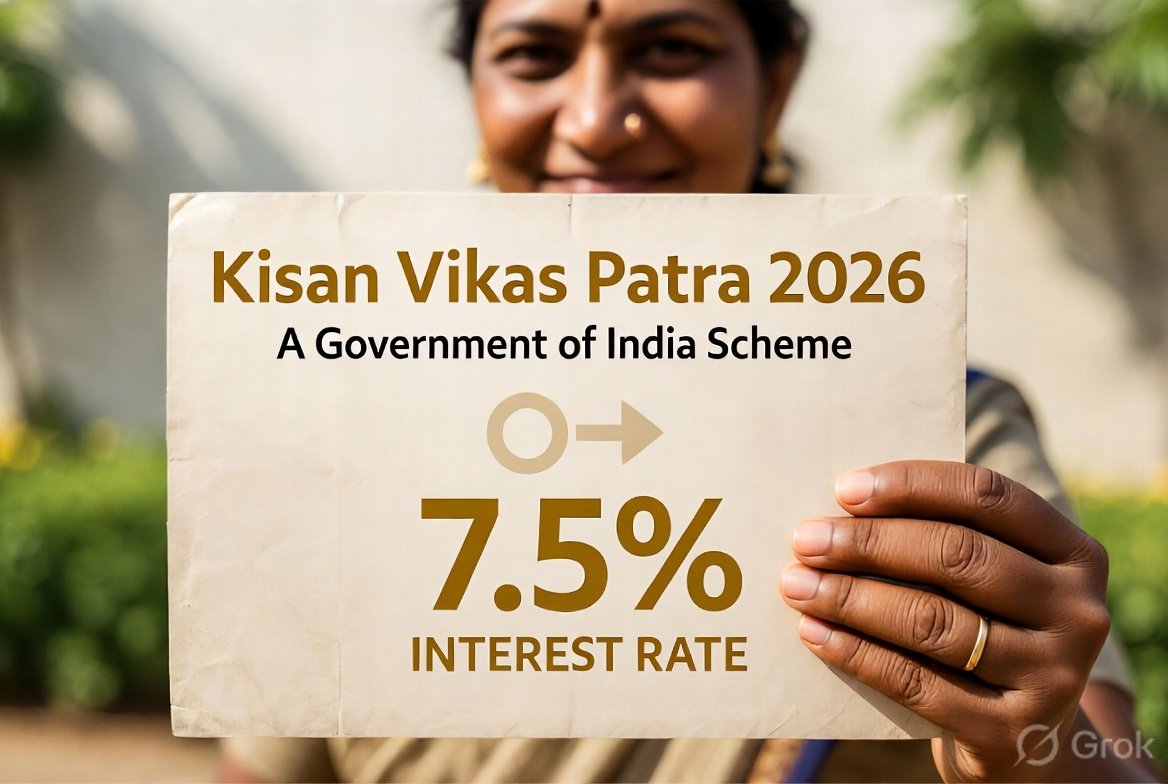
Table of Contents
- What Is Kisan Vikas Patra
- Current Interest Rate and Doubling Period
- Who Can Actually Invest — Not Just Farmers
- The Tax Catch Nobody Mentions Upfront
- The 30-Month Lock-in and Premature Withdrawal
- Using KVP as Loan Collateral
- KVP vs PPF vs NSC: Where It Actually Fits
- How to Buy a KVP Certificate
- Frequently Asked Questions
What Is Kisan Vikas Patra
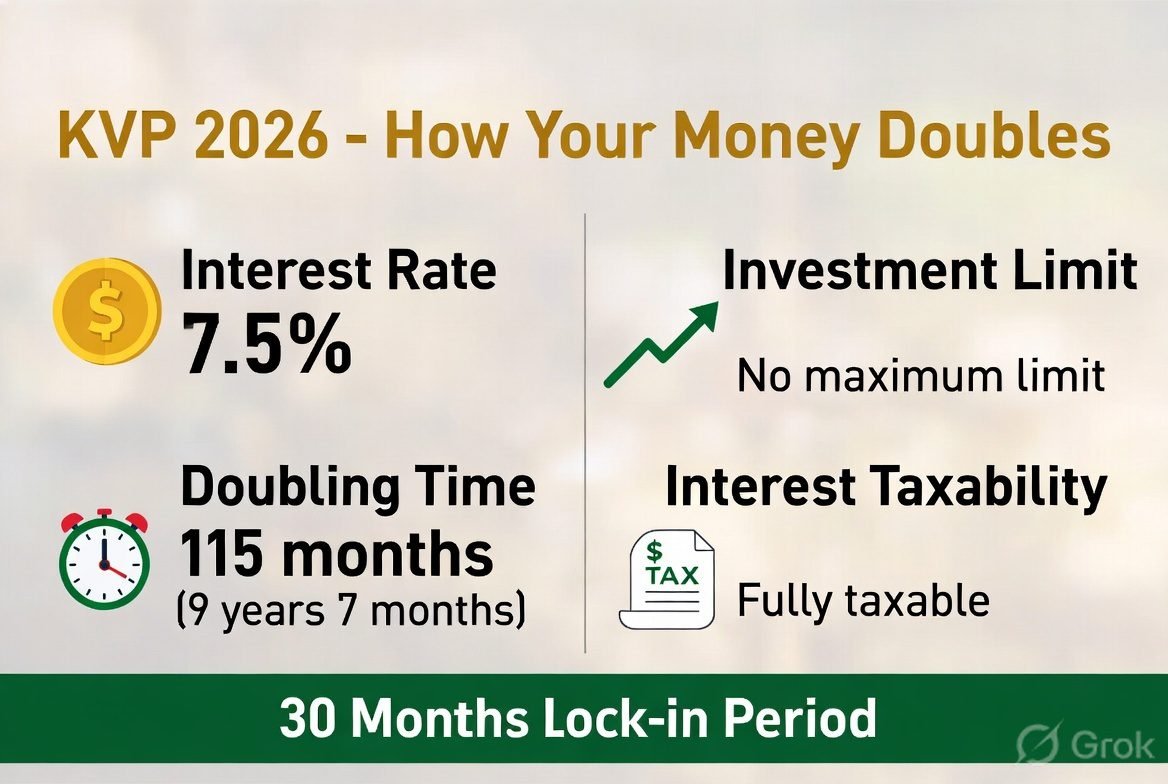
Kisan Vikas Patra is a government-guaranteed certificate that doubles a one-time deposit. It pays 7.5% for April-June 2026 and doubles the money in 115 months — 9 years and 7 months. Though the account matures after 115 months, the maturity proceeds continue to accrue interest even after that point, until you actually withdraw the amount.
The name suggests it's built for farmers specifically — "Kisan" literally means farmer — but that's genuinely a historical naming choice rather than an actual eligibility restriction, which we'll get to shortly.
KVP at a Glance — 2026
| Interest Rate (Apr-Jun 2026) | 7.5% |
| Doubling Period | 115 months (~9 yrs 7 mo) |
| Lock-in Before Withdrawal | 30 months |
| Minimum Investment | ₹1,000 |
| Maximum Investment | No limit |
| Section 80C Deduction | None |
Current Interest Rate and Doubling Period
The rate and maturity date are locked in at the time of purchase, which insulates the saver from later rate cuts — a genuinely useful feature if you're buying during a period of relatively high rates, since your certificate keeps earning that original rate for its full term even if the government revises the rate downward for new buyers afterward.
The maturity period of KVP depends on the interest rate changes notified by the Ministry of Finance each quarter, though the final maturity value is always pre-printed directly on the certificate — so whatever rate applies on the day you buy determines your exact doubling timeline, and you know it upfront rather than needing to track quarterly rate changes yourself.
Who Can Actually Invest — Not Just Farmers
Despite the name, any Indian resident adult can purchase a Kisan Vikas Patra certificate — for themselves, on behalf of a minor, jointly with another adult, or through a Trust. There's genuinely no occupational restriction tying it to agriculture; the name is a legacy of the scheme's original 1988 launch by India Post rather than a current eligibility rule.
KVP is available in denominations of ₹1,000, ₹5,000, ₹10,000, and ₹50,000, with the ₹50,000 denomination only available at head post offices in a city. Larger investments exceeding ₹50,000 require PAN details, and there is no maximum limit on how much you can invest, in a single certificate or across multiple certificates combined.
The Tax Catch Nobody Mentions Upfront
This is genuinely the detail that surprises the most people, precisely because KVP gets recommended in the same breath as PPF and NSC, both of which do carry tax benefits. KVP interest is fully taxable and earns no Section 80C deduction, unlike NSC or PPF. Withdrawals post-maturity are exempt from TDS, but that only means tax isn't deducted at source — you're still required to declare the interest as income and pay tax on it at your applicable slab rate.
The 30-Month Lock-in and Premature Withdrawal
| Timing | What's Allowed |
|---|---|
| Before 30 months | Only death, court order, or pledgee forfeiture |
| After 30 months, before maturity | Premature encashment allowed, at a reduced interest rate |
| At 115-month maturity | Full doubled amount, or continued accrual if left untouched |
During the initial 30-month lock-in, premature encashment is generally not allowed except in specific circumstances — death of the certificate holder, forfeiture by a Gazetted Officer, or a court order directing encashment. If encashed after the lock-in but before full maturity, the holder receives the principal amount along with interest, but at a reduced rate compared to the full scheme rate — meaning early exit genuinely costs you part of the return you'd have earned by holding to maturity, without wiping out your principal.
Using KVP as Loan Collateral
One feature that doesn't get enough attention: a KVP certificate can be used as collateral or security to avail secured loans, often at lower interest rates compared to unsecured borrowing, since it's backed by a guaranteed government instrument. This lets a holder borrow against the certificate in a genuine emergency without breaking it, preserving the doubling on the underlying investment.
This is genuinely a meaningful advantage over locking money into something like a fixed deposit with a hard early-withdrawal penalty — a KVP holder facing a sudden cash need has a middle path between full premature encashment and simply not having access to funds at all.
KVP vs PPF vs NSC: Where It Actually Fits
| Feature | KVP | PPF | NSC |
|---|---|---|---|
| Current Rate | 7.5% | 7.1% | ~7.7% |
| Section 80C Benefit | No | Yes | Yes |
| Interest Tax Treatment | Fully taxable | Tax-free (EEE) | Taxable, but reinvested interest qualifies for 80C |
| Tenure | ~115 months | 15 years | 5 years |
| Investment Cap | None | ₹1.5L/year | None |
KVP's real advantage over PPF and NSC is genuinely the absence of an investment ceiling — someone with a large lump sum to park safely can put the entire amount into KVP in a single certificate, something PPF's ₹1.5 lakh annual cap simply doesn't allow. For readers who've already maxed out their 80C-eligible options for the year and still have surplus cash they want in a zero-risk, government-guaranteed instrument, KVP genuinely fills that specific gap, tax treatment aside.
Read Our EPF vs NPS vs PPF Comparison →How to Buy a KVP Certificate
To invest in Kisan Vikas Patra, you'll need to obtain and fill Form A with the required information, along with identity proof such as Aadhaar, Voter ID, PAN, or Passport. Certificates are available at post offices and select banks, with several major banks now facilitating the purchase directly, making the investment process straightforward.
A KVP certificate can also be transferred between people or between post offices, and nomination facilities are available, including the ability to nominate a minor as beneficiary. Official scheme details and the current quarterly rate notification are published on the India Post official website and the National Savings Institute's portal.
Frequently Asked Questions
How long does it take for Kisan Vikas Patra to double?
At the current 7.5% interest rate for April-June 2026, KVP doubles your investment in 115 months, approximately 9 years and 7 months. The exact doubling period depends on the interest rate at the time of purchase and is locked in for that certificate.
Is only a farmer eligible to invest in Kisan Vikas Patra?
No, despite the name, any Indian resident adult can invest in KVP, regardless of occupation. It can be purchased individually, jointly, on behalf of a minor, or through a Trust.
Does KVP offer any tax deduction?
No, KVP does not qualify for Section 80C deduction, unlike PPF or NSC, and the interest earned is fully taxable at your income tax slab rate.
Can I withdraw my KVP investment before maturity?
Premature encashment before 30 months is only allowed for death, forfeiture by a pledgee, or a court order. After 30 months, premature withdrawal is permitted but at a reduced interest rate compared to holding to full maturity.
Is there a maximum limit on how much I can invest in KVP?
No, there is no maximum investment limit, though investments above ₹50,000 require PAN details, and the ₹50,000 denomination certificate is only available at head post offices.
Can I use my KVP certificate to get a loan?
Yes, a KVP certificate can be pledged as collateral for a secured loan, often at a lower interest rate than unsecured borrowing, without needing to break the certificate.
Our Bottom Line
KVP genuinely does one thing well: a simple, government-guaranteed doubling of whatever you put in, with no investment ceiling and no restriction on who can buy it. Where it falls short of PPF or NSC is entirely on the tax side — no 80C deduction going in, and full taxation on the interest coming out. It's a genuinely reasonable place to park a large lump sum you want completely safe and don't need tax efficiency on, but it shouldn't be the first stop for anyone still building out their 80C-eligible investments for the year.
For a fuller picture of how KVP compares against tax-advantaged alternatives, our EPF vs NPS vs PPF comparison and Sukanya Samriddhi Yojana guide cover the tax-free side of India's small savings landscape.

Pranab Barman is a Financial Educator and Personal Finance Researcher with over 10 years of hands-on experience in stock markets, trading, and investing. Currently enrolled in the CFA Program, he is committed to continuous learning and professional excellence in finance.
As the Founder of PlayWithStock, Pranab covers a wide range of topics including Mutual Funds, SIP, Taxation, Stock Market Basics, and Financial Calculators — with a focus on simplifying complex financial concepts for everyday all investors.
Email: support@playwithstock.com
Website: playwithstock.com
Related posts:
 Post Office Time Deposit vs Bank FD 2026: Which Actually Wins
 Why Investors Lose Money: 7 Costly Mistakes to Avoid
 Bitcoin’s back above $65K. This time, it’s not retail chasing a candle — it’s ETF money.
 EPF vs NPS vs PPF 2026: Which Retirement Option Actually Suits You
 Retirement Calculator India 2026: How Much You Actually Need to Save
 How Does SIP Actually Work? 7-Point Breakdown for All Investors
 Large Cap vs Mid Cap vs Small Cap Funds: What SEBI’s Rules Actually Mean for You
 Best AI Stocks India 2026: 7 Picks That Are Actually Worth Watching