


National Savings Certificate 2026: The 80C Trick Most Investors Never Use
National Savings Certificate 2026 tends to get filed away by readers as "the boring post-office one" — the scheme people default to only after they've already maxed out PPF or ELSS, without giving it a proper look on its own. That's genuinely a mistake, because NSC has one feature almost nobody uses correctly: the interest it earns every year doesn't just sit there, it counts toward your 80C deduction all over again. We'll walk through exactly how that works below, because most explainers mention it in passing and move on.
This continues the Government Schemes series we started with Sukanya Samriddhi Yojana and Kisan Vikas Patra. NSC sits somewhere between the two — it has a real tax benefit like SSY, but a fixed lock-in and guaranteed-doubling style structure closer to KVP. Official scheme details are maintained by India Post, the primary channel through which NSC is sold.
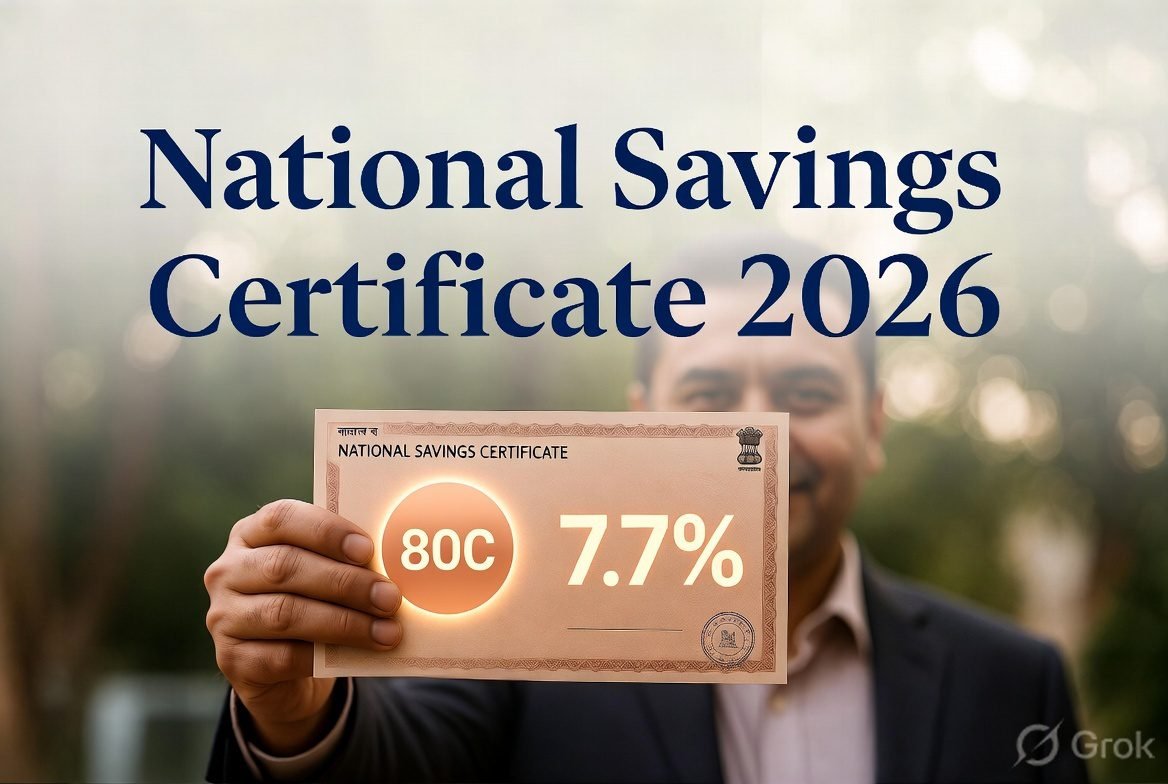
Table of Contents
- What Is NSC, in Plain Terms
- Current Interest Rate, and Why It's Locked for 5 Years
- The Reinvestment Trick: Getting 80C Twice From One Deposit
- Who Can Actually Buy an NSC Certificate
- Premature Withdrawal: Genuinely Restricted, Not Just Discouraged
- Using NSC as Collateral for a Loan
- NSC vs PPF vs KVP: The Real Difference
- How to Actually Buy One
- Frequently Asked Questions
What Is NSC, in Plain Terms
The National Savings Certificate is a fixed-income investment scheme offered through post offices, run by the Government of India, aimed mainly at small and mid-income investors who want a genuinely low-risk return. It used to come in two variants based on maturity period — NSC Issue VIII and Issue IX — but currently only one is open for subscription, which simplifies the decision considerably compared to a few years ago.
NSC at a Glance — 2026
| Interest Rate (Q1 FY 2026-27) | 7.7% |
| Lock-in / Maturity | 5 years, fixed |
| Minimum Investment | ₹1,000 |
| Maximum Investment | No upper limit |
| Section 80C Deduction | Up to ₹1.5 lakh/year |
| Interest Payout | Paid only at maturity |
Current Interest Rate, and Why It's Locked for 5 Years
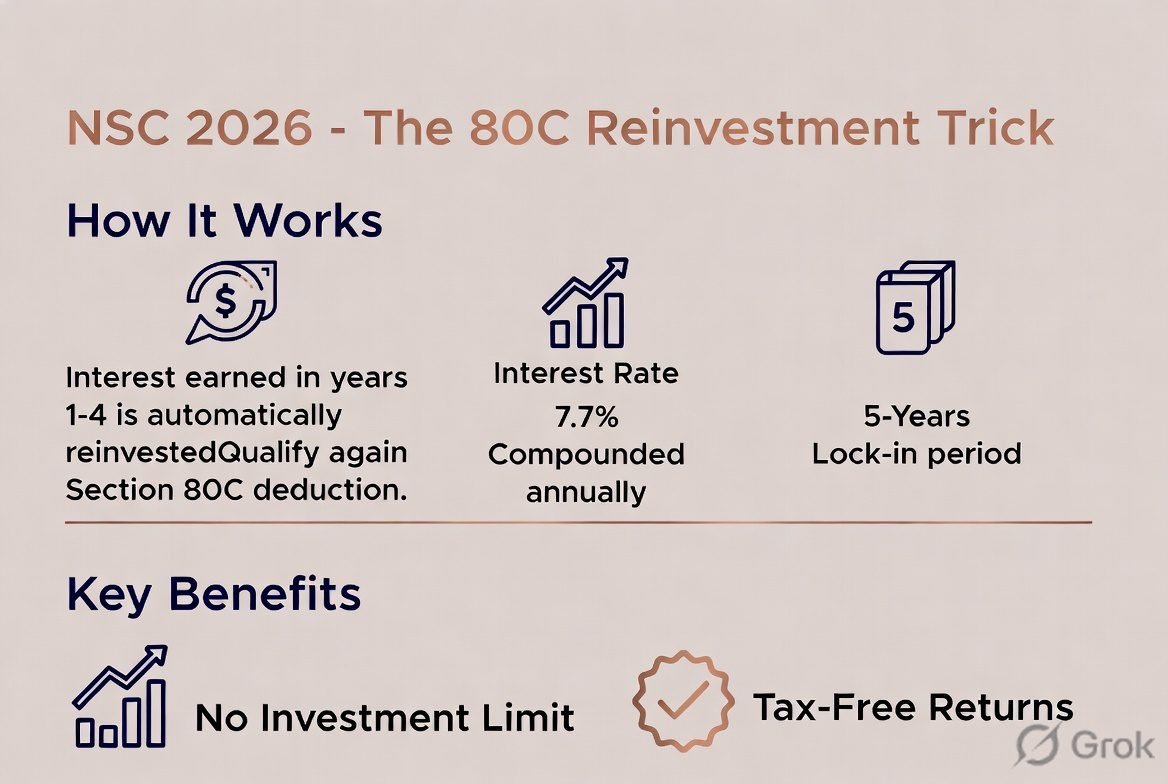
This rate is locked in at the time of purchase — if you invest in 2026 at 7.7%, that rate remains applicable for the full five-year term, regardless of any future changes to NSC rates announced afterward. The rate has remained unchanged for a couple of consecutive quarters now, which is genuinely a useful signal if you're deciding whether to buy now or wait for a possible increase — historically, NSC rates don't move dramatically quarter to quarter.
Interest compounds annually but is paid only at maturity, with no periodic payout along the way — a genuinely different structure from something like SCSS, which pays quarterly. NSC is built for people who want to set the money aside and not think about it again until year five.
The Reinvestment Trick: Getting 80C Twice From One Deposit
Interest earned during the first four years is automatically reinvested rather than paid out, and this reinvested interest is itself eligible for an additional 80C deduction, subject to the overall ₹1.5 lakh annual limit. This is the "reinvestment hack" that makes NSC's tax treatment genuinely stronger than a simple one-time deduction.
Year 1
You invest ₹1 lakh and claim the full ₹1 lakh under 80C. Interest earned this year is reinvested automatically — you never see the cash.
Years 2, 3, 4
Each year's accrued interest is again reinvested, and each year's reinvested amount is itself separately eligible for an 80C claim, up to your overall ₹1.5 lakh limit.
The catch, and it's a real one: no TDS is applicable on the maturity payout, but investors are still legally obligated to report the annual interest accrual in their Income Tax Return every year, not just in the year you receive the cash. Skipping that annual disclosure is a genuine compliance gap we'd flag clearly — the tax-free feeling of "I don't touch this money for 5 years" doesn't extend to your reporting obligation. Our ITR filing deadline article is worth reviewing alongside this, since NSC interest needs to appear on your return every single year, not just at maturity.
Worth noting: this reinvestment benefit only applies to the first four years' interest — the fifth and final year's interest, paid out at maturity, doesn't get reinvested and isn't eligible for a fresh 80C claim, since the certificate has already matured by then. It's a genuinely powerful feature for years one through four, not a permanent, indefinite tax shelter.
Who Can Actually Buy an NSC Certificate
Any resident Indian citizen can invest, including single adults, joint account holders up to three adults, and guardians investing on behalf of minors. Minors above the age of 10 can also open and operate an account in their own name.
Non-Resident Indians, Hindu Undivided Families, and corporate trusts are not permitted to purchase new NSC certificates — the same NRI exclusion we've seen across most of these post office schemes, worth remembering if you're helping a family member abroad plan their India-based savings.
Premature Withdrawal: Genuinely Restricted, Not Just Discouraged
| Situation | What Happens |
|---|---|
| Withdrawn before 1 year | No interest paid at all |
| Withdrawn after 1 year, before maturity | Interest paid at post office savings account rate (much lower) |
| Death, court order, or pledgee forfeiture | Premature closure genuinely permitted |
| Full 5-year maturity | Full principal + compounded interest |
Premature withdrawal outside these specific circumstances — death of the certificate holder or joint holder, forfeiture by a pledgee if the NSC was used as loan collateral, or a court order — is not permitted. This is genuinely stricter than KVP, which allows premature encashment after 30 months for any reason, just at a reduced rate. NSC's restriction is closer to "these specific situations only," which is worth factoring in before you commit a large sum you might need access to within the five years.
Using NSC as Collateral for a Loan
Due to their sovereign government backing, NSCs are widely accepted as collateral by banks for secured loans — the same collateral flexibility we discussed with KVP. This is genuinely one of the more underappreciated features of these post office instruments: money that's technically locked away for years can still function as leverage for a loan if a real need comes up, without breaking the certificate itself.
Compare: Read Our Kisan Vikas Patra Guide →NSC vs PPF vs KVP: The Real Difference
| Feature | NSC | PPF | KVP |
|---|---|---|---|
| Current Rate | 7.7% | 7.1% | 7.5% |
| Tenure | 5 years | 15 years | ~9.6 years |
| Section 80C | Yes, plus reinvested interest | Yes | No |
| Interest Tax Treatment | Taxable (except reinvested portion's deduction) | Fully tax-free | Fully taxable |
| Investment Ceiling | None | ₹1.5L/year | None |
NSC's genuine sweet spot is the middle ground it occupies: a shorter commitment than PPF's 15 years, a real 80C benefit that KVP simply doesn't offer, and no investment ceiling if you have a larger lump sum to place. For someone who's already maxing out PPF's ₹1.5 lakh annual cap and still has 80C room or surplus cash, NSC is often the next logical stop — our EPF vs NPS vs PPF comparison covers the broader tax-advantaged landscape this fits into.
How to Actually Buy One
NSC can be purchased at any post office branch, in your own name, for a minor, or jointly with another adult. You'll need standard KYC documents — PAN, Aadhaar, and address proof — along with the initial deposit amount. Several banks now also facilitate NSC purchase directly, alongside the traditional post office route.
Official rate notifications and scheme rules are published by the National Savings Institute and India Post, both worth checking directly before a large purchase, since quarterly rate revisions are announced there first.
Frequently Asked Questions
What is the current NSC interest rate?
The NSC interest rate for Q1 FY 2026-27 (April-June 2026) is 7.7% per annum, compounded annually and paid at maturity after 5 years.
How does the NSC reinvestment tax benefit actually work?
Interest earned in years 1 through 4 is automatically reinvested rather than paid out, and this reinvested interest each year is itself eligible for an additional Section 80C deduction, within your overall ₹1.5 lakh annual limit.
Can I withdraw my NSC investment before 5 years?
Generally no, except in specific circumstances: death of the certificate holder, forfeiture by a pledgee, or a court order. Outside these situations, premature withdrawal is not permitted.
Is there a maximum investment limit for NSC?
No, there is no upper limit on total investment, though only up to ₹1.5 lakh per year qualifies for the Section 80C deduction.
Can NRIs invest in NSC?
No, Non-Resident Indians, Hindu Undivided Families, and corporate trusts are not eligible to purchase new NSC certificates.
Can NSC be used as collateral for a loan?
Yes, due to its sovereign government backing, NSC is widely accepted by banks as collateral for secured loans.
Our Bottom Line
NSC genuinely deserves more attention than the "fallback after PPF" reputation it usually gets. The reinvestment mechanism is the real differentiator — a 5-year, government-guaranteed instrument that keeps handing you a fresh 80C deduction on interest you never actually withdraw is a genuinely efficient use of tax-saving space, provided you remember to report the annual accrual on your returns even though you won't see the cash until maturity.
For the broader picture of how NSC fits alongside other government-backed options, our Kisan Vikas Patra guide and Sukanya Samriddhi Yojana article cover the rest of this Government Schemes series.

Pranab Barman is a Financial Educator and Personal Finance Researcher with over 10 years of hands-on experience in stock markets, trading, and investing. Currently enrolled in the CFA Program, he is committed to continuous learning and professional excellence in finance.
As the Founder of PlayWithStock, Pranab covers a wide range of topics including Mutual Funds, SIP, Taxation, Stock Market Basics, and Financial Calculators — with a focus on simplifying complex financial concepts for everyday all investors.
Email: support@playwithstock.com
Website: playwithstock.com
Related posts:
 All Post Office Savings Schemes Compared 2026: The Full Picture
 ELSS Tax Saving Mutual Funds 2026: The Complete 80C Guide
 Senior Citizens Savings Scheme 2026: Interest Rate, Limits and Tax Rules Explained
 NPS National Pension System 2026: Complete Guide to Rules, Tax Benefits and Withdrawal
 Circle National Trust Bank: What the OCC Approval Means for USDC and CRCL
 How Does SIP Actually Work? 7-Point Breakdown for All Investors
 FATF Anti-Fraud Rules 2026: What They Mean for Indian Investors
 HDFC Bank Bonus Share: The Essential Guide for Investors 2026