
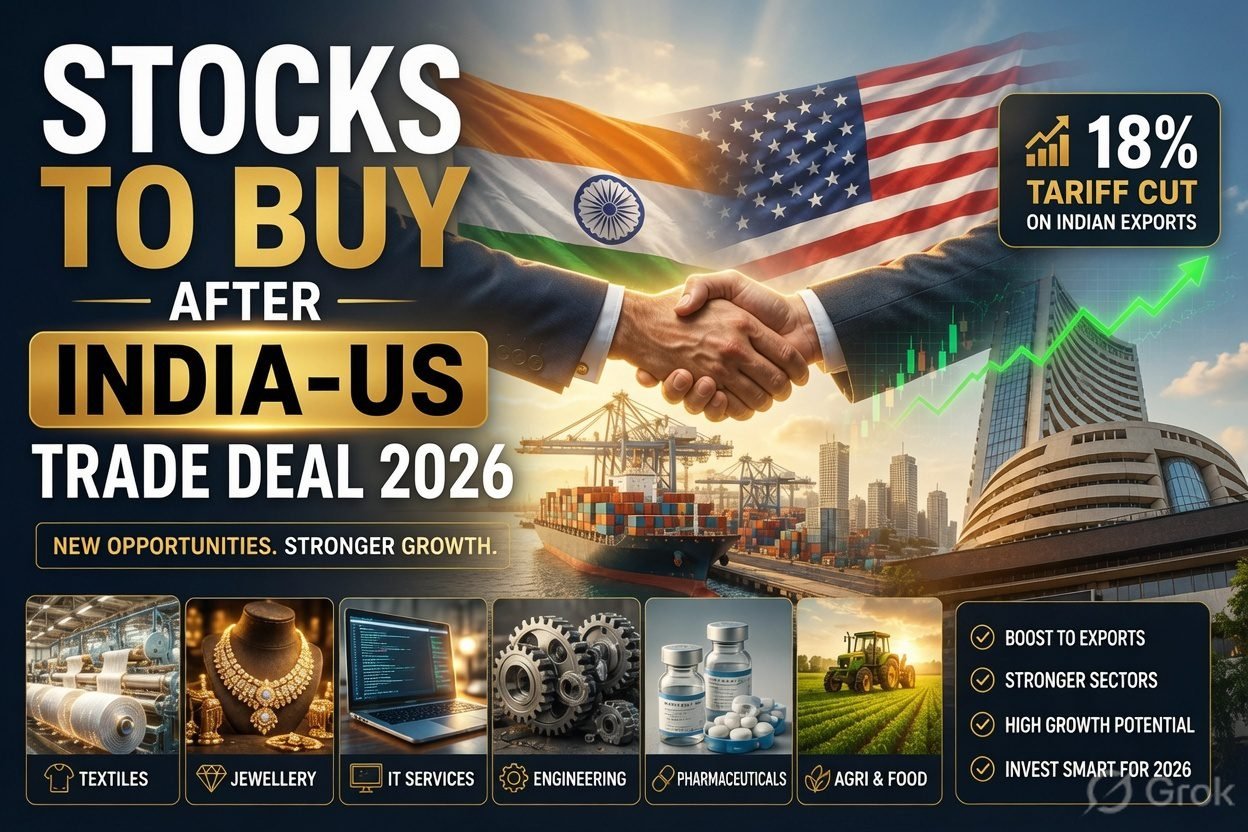

Stocks to Buy After India-US Trade Deal 2026: A Sector-by-Sector Breakdown
The tariff cut from roughly 50% to 18% changes the math for entire export sectors. Here's where analysts see the biggest opportunity — and where the enthusiasm may be running ahead of the fundamentals.
A single tariff number changed the earnings outlook for several Indian export sectors overnight.
- What Actually Changed in the Trade Deal
- Old Tariffs vs New: The Numbers That Matter
- Sector-by-Sector: Stocks to Buy After India-US Trade Deal
- Textiles and Apparel
- Gems and Jewellery
- Engineering Goods and Auto Ancillaries
- Chemicals
- IT Services: The Indirect Beneficiary
- Company Names Analysts Are Watching
- How the Market Has Reacted So Far
- Risks Worth Weighing Before You Act
- How Retail Investors Should Approach This
- FAQs
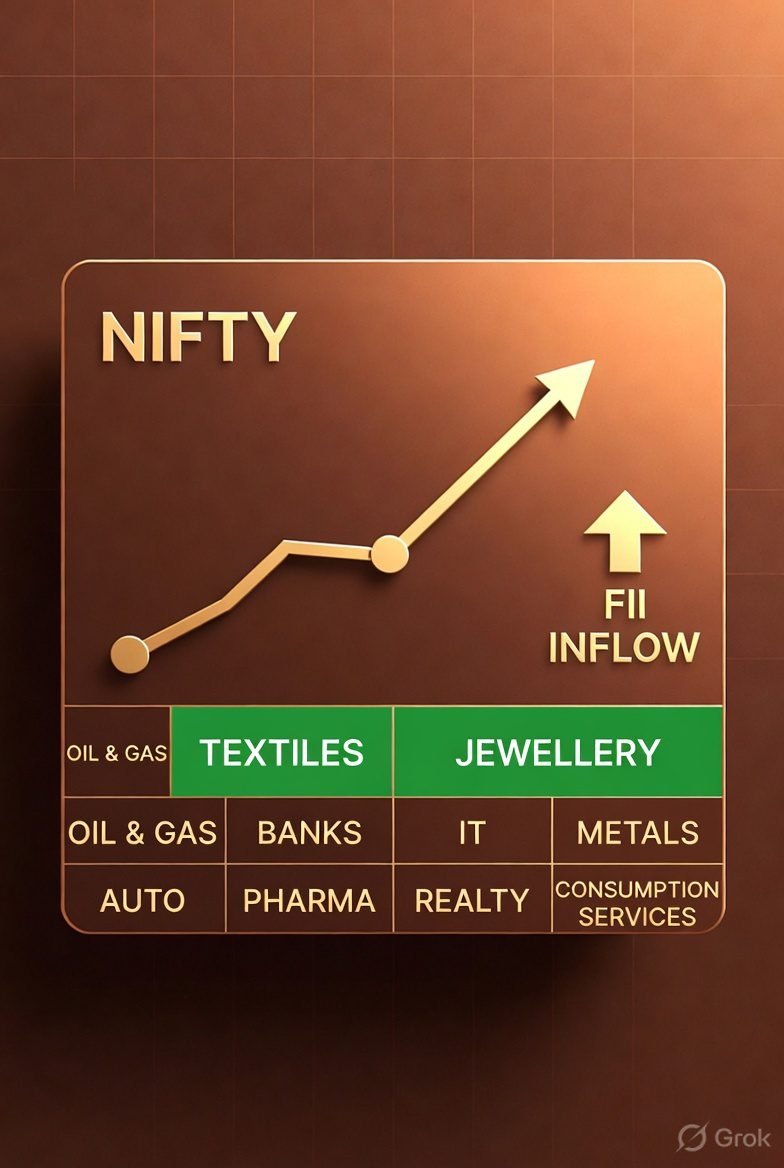
Stocks to Buy After India-US Trade Deal has become one of the most searched phrases on Indian trading platforms since the tariff agreement was finalised, and the reaction makes sense — a cut from tariffs that had touched roughly 50% down to around 18% doesn't just remove uncertainty, it mechanically changes the profit math for every rupee of goods India ships to the United States. Nifty jumped nearly 2.8% on the day sentiment around the deal became clear, and the rally wasn't spread evenly across the index — export-linked sectors led, while domestic-focused names barely moved.
This piece isn't a list of guaranteed winners — no tariff deal works that cleanly, and anyone promising certainty about which stocks to buy after the India-US trade deal is skipping past a lot of real execution risk. What follows instead is a structured look at which sectors have genuine, mechanical exposure to the tariff cut, which company names keep showing up in analyst coverage, and — just as importantly — where the excitement may already be ahead of what the deal can realistically deliver. If you haven't read the full policy explainer yet, our India-US Trade Deal 2026 guide covers the negotiation timeline and broader economic terms in detail.
What Actually Changed in the Trade Deal
India and the United States finalised a bilateral trade agreement earlier in 2026 that sharply lowers tariffs on a wide range of Indian exports. Before the deal, US tariffs on many Indian goods had, at various points, touched as high as roughly 50% — a level that made Indian exporters genuinely uncompetitive against regional rivals. Under the new arrangement, that rate has come down to approximately 18%, a number that matters as much for what it does to India's relative position as for the absolute reduction itself.
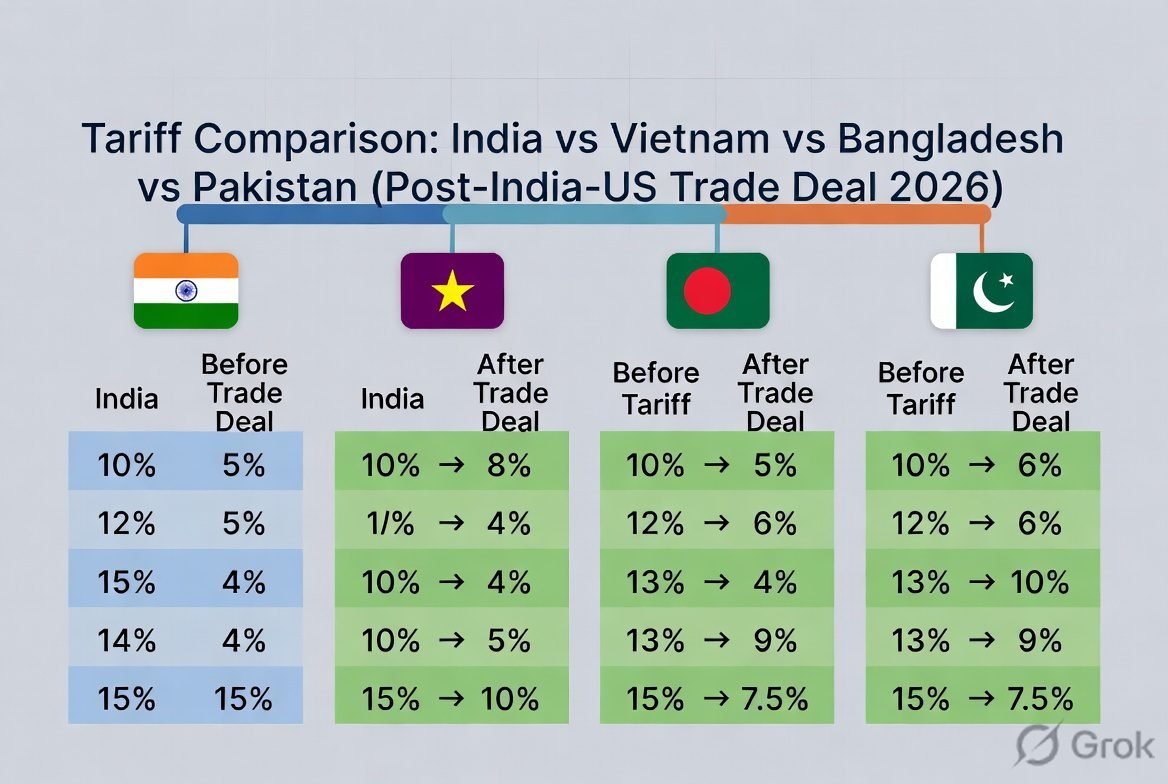
That relative positioning is really the heart of the stocks-to-buy-after-India-US-trade-deal thesis. At 18%, Indian exporters now sit below competing manufacturing hubs like Vietnam and Bangladesh, both still facing tariffs closer to 19–20%, and below Pakistan's roughly 19% rate as well. A few percentage points may not sound dramatic, but on thin-margin, high-volume export categories like textiles, that gap is often the difference between winning and losing a large US buyer's order.
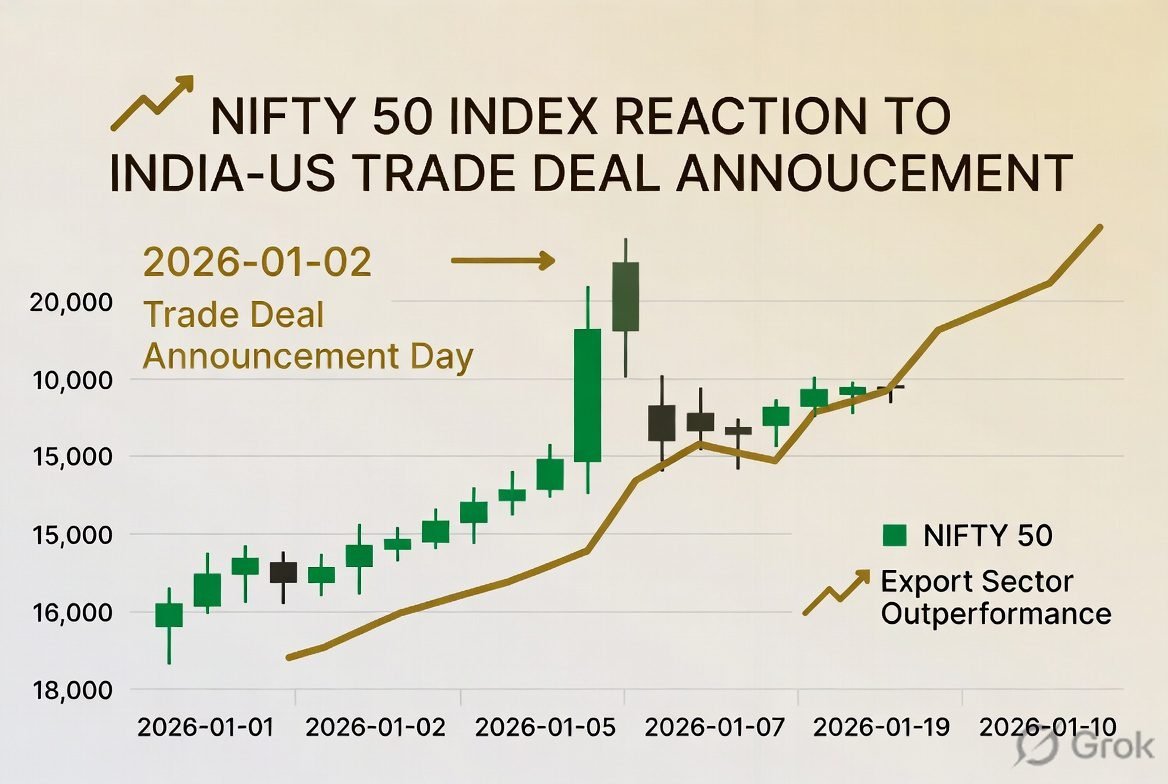
Nifty's move on the announcement day reflected how much of the rally was concentrated in export-heavy names.
Old Tariffs vs New: The Numbers That Matter
| Country | Approx. US Tariff Rate | Position vs India |
|---|---|---|
| India (before deal) | Up to ~50% | — |
| India (after deal) | ~18% | Baseline |
| Vietnam | ~20% | India now cheaper |
| Bangladesh | ~20% | India now cheaper |
| Pakistan | ~19% | India now marginally cheaper |
Figures reflect widely reported approximations from market commentary following the deal's announcement; final, product-specific tariff schedules may vary by category.
Sector-by-Sector: Stocks to Buy After India-US Trade Deal
Not every export sector benefits equally, and understanding why matters more than memorising a stock list. The sectors below are ranked roughly by how directly and immediately the tariff cut flows through to their US revenue.
Textiles and Apparel
This is where the "stocks to buy after India-US trade deal" conversation started, and for good reason. India already holds a meaningful and growing share of US textile imports, having gained ground as China's share has declined in recent years. With tariffs now undercutting Vietnam and Bangladesh, orders that had gone elsewhere during the uncertainty of the tariff dispute have a genuine reason to return. Home textiles — bedding, towels, furnishings — are a specific sub-category where Indian manufacturers already have deep, established US retail relationships, making the switching cost for buyers to come back lower than in categories where new supplier relationships would need to be built from scratch.

Textile exporters have some of the most direct, mechanical exposure to the tariff cut.
Gems and Jewellery
Lower tariffs and improved market access should help jewellers and contract manufacturers selling into US retail and wholesale chains improve realisations. This sector combines both a branded consumer angle — companies with visible consumer jewellery businesses — and a pure contract-manufacturing angle for firms that supply US jewellery chains without their own retail brand. The two respond somewhat differently to a tariff cut: branded players benefit from improved margins on existing volumes, while contract manufacturers are more likely to see actual volume growth as US buyers place larger orders now that landed costs are more predictable.
Engineering Goods and Auto Ancillaries
Engineering goods and speciality manufacturing are classic export categories where a clearer, lower tariff makes it easier to win bigger contracts and justify capacity investment. Auto ancillary exporters supplying components — particularly those that had faced reciprocal tariffs as steep as 50% on specific categories — see some of the sharpest relative relief among all affected sectors, since the starting tariff burden was unusually high. Full auto OEMs (vehicle manufacturers themselves) see a more muted, indirect benefit, since most of their US-bound business runs through different trade mechanisms than component exports do.
Chemicals
India's chemical exports to the US run into several billion dollars annually, and pricing pressure from competing exporters has been a persistent headwind. A lower tariff rate improves order conversion and pricing flexibility for Indian chemical manufacturers competing for the same US buyers, though this sector is also more sensitive than most to currency movements and raw-material costs, which can offset some of the tariff benefit if they move unfavourably.
IT Services: The Indirect Beneficiary
IT services companies aren't directly affected by goods tariffs, since software and services exports work through an entirely different trade mechanism. But several analysts covering the sector have pointed to a secondary effect: improved US-India relations reduce the near-term risk of additional scrutiny, visa tightening, or punitive measures aimed at the services trade relationship specifically. Given that IT has the largest single-sector exposure to the US of any major Indian industry, even a modest reduction in policy risk can matter for sentiment, even where it doesn't show up directly in revenue the way it does for goods exporters.
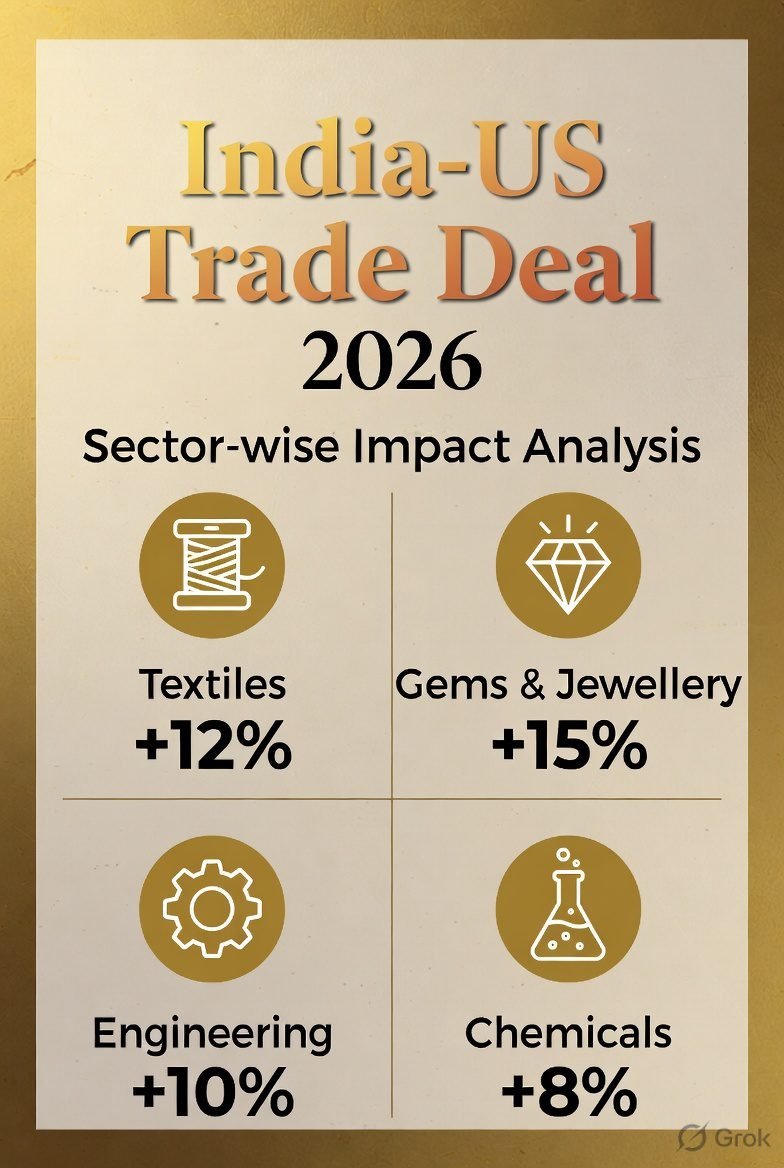
Six sectors, six different transmission mechanisms — not all tariff-linked, not all equally direct.
Company Names Analysts Are Watching
The names below have appeared repeatedly across market commentary discussing stocks to buy after India-US trade deal news broke — they are cited here as examples of where analyst attention has concentrated, not as recommendations or a model portfolio.
| Sector | Names Frequently Cited | Why They Come Up |
|---|---|---|
| Textiles / Home Textiles | Trident Limited, Welspun India, KPR Mills | Established US retail relationships, direct export exposure |
| Jewellery / Apparel | Titan Company, Gokaldas Exports | Consumer jewellery exposure and apparel export contracts respectively |
| IT Services | Large-cap IT exporters generally | Sentiment tailwind from reduced bilateral policy risk |
| Engineering / Chemicals | Sector broadly, rather than specific single names in most coverage | Improved landed-cost competitiveness on large contracts |
How the Market Has Reacted So Far
The initial reaction was sharp and concentrated. On the day sentiment around the deal solidified, the Nifty moved up roughly 2.8%, with export-oriented heavyweights leading the gains and broader, domestically-focused sectors participating far less. Some analysts framed this as a potential inflection point for foreign portfolio investor (FPI) flows into Indian equities, which had been a drag on the market through parts of 2025 — the reasoning being that reduced trade-policy uncertainty removes one specific reason global investors had been cautious on India. Whether that translates into sustained FPI inflows, rather than a one-time repricing, is something that will only become clear over the following quarters as actual export order data comes through.
Risks Worth Weighing Before You Act
Every version of the stocks-to-buy-after-India-US-trade-deal thesis carries real risks that are easy to skip past in the excitement of a rally.
It's also worth remembering that trade agreements of this scale are rarely static. Officials on both sides have indicated a more comprehensive India-US trade agreement — covering services, investment rules, and further tariff refinement — remains under discussion, which means today's 18% figure could itself be revised in either direction as negotiations continue through the rest of 2026.
How Retail Investors Should Approach This
For most retail investors, chasing individual stocks to buy after India-US trade deal headlines is a riskier approach than gaining diversified exposure to the sectors that genuinely benefit. Sector-focused mutual funds or ETFs covering export-oriented industries offer a way to participate in the theme without betting the outcome on a single company's execution. If you do want direct stock exposure, treating this as one input among several — alongside valuation, balance sheet quality, and management track record — rather than the sole reason to buy, is the more defensible approach. Our beginner investing guide and demat account explainer are useful starting points if you're setting up to invest in this theme for the first time.
The Bottom Line
The India-US trade deal genuinely changes the competitive math for several export sectors, and the sectors and company names covered here reflect where that mechanical benefit is most direct. But "stocks to buy after India-US trade deal" is a theme, not a formula — sector tailwinds help, they don't guarantee outcomes, and a meaningful part of the initial re-rating may already be priced into the stocks that led the rally. Treat this as a starting point for further research, not a finish line.
FAQs: Stocks to Buy After India-US Trade Deal
Textiles and home textiles are widely seen as the most direct beneficiary, given high US exposure and a tariff gap versus Vietnam and Bangladesh that meaningfully affects competitiveness in a thin-margin category.
The initial re-rating has already happened for many export-linked names, so part of the easy gain may be priced in. Whether further upside exists depends on actual order growth and earnings delivery over coming quarters, not just the tariff announcement itself.
Not directly — IT services trade isn't covered by goods tariffs. The benefit is indirect, coming from reduced bilateral policy risk and improved sentiment rather than a mechanical cost change.
Approximately 18%, down from levels that had touched roughly 50% at points during the earlier tariff dispute.
Diversified exposure through a sector-focused mutual fund or ETF spreads execution risk across multiple companies. Individual stock selection requires additional company-level research beyond the sector tailwind alone.
A more comprehensive India-US trade agreement remains under discussion as of mid-2026, meaning the current tariff terms could still be refined or revised as negotiations continue.
References: INDmoney: Trade Deal Impact on Stock Market · ICICI Direct: US-India Trade Agreement Explained · Definedge Securities: Trade Deal Market Impact · StockYaari: India-US Trade Deal 2026 · Grip Invest: India-US Trade Deal Explained · CNBC: India-US and EU Trade Deals · Dailyhunt: Trade Deal Nears Completion

Pranab Barman is a Financial Educator and Personal Finance Researcher with over 10 years of hands-on experience in stock markets, trading, and investing. Currently enrolled in the CFA Program, he is committed to continuous learning and professional excellence in finance.
As the Founder of PlayWithStock, Pranab covers a wide range of topics including Mutual Funds, SIP, Taxation, Stock Market Basics, and Financial Calculators — with a focus on simplifying complex financial concepts for everyday all investors.
Email: support@playwithstock.com
Website: playwithstock.com
Related posts:
 India US Trade Deal 2026: Inside the Tariff Rollercoaster Before July 22
 Gold Price All Time High India: Should You Buy Now or Wait in 2026
 H-1B $100K Visa Fee — Indian IT Stocks Pe Impact (2026 Update)
 Dividend Aristocrats for Passive Income: Does India Have Its Own?
 Tax-Loss Harvesting: How It Works in India
 Monsoon 2026 India Inflation: Why a Dry June Hits Grocery Bills
 Crypto Bookkeeping for Tax in India: The Complete 2026 Guide
 F&O STT Hike Breakeven Calculator: 2026 New Rates