


India UK Trade Deal 2026: What Gets Cheaper, and Which Stocks Just Won
It went live at midnight. Scotch just got 75% cheaper to import, JLR's India-bound cars got a haircut on duty, and a specific list of Indian companies woke up this morning with a real, measurable tailwind. Here's exactly what changed and who it actually helps.
Six years of negotiation, signed a year ago in London, and finally live from midnight today.
- What Actually Went Live Today
- The Full Tariff Glide Path, Visualised
- Six Years in the Making: How We Got Here
- What Gets Cheaper for Indian Consumers
- What Gets Cheaper for UK Buyers of Indian Goods
- Which Indian Stocks Actually Win
- The One Sector Losing Ground: Steel
- The Bigger Trade Picture
- Rules of Origin: The Fine Print That Decides Everything
- What's Deliberately Left Out
- How This Stacks Up Against India's Other Five FTAs
- The Skeptic's Case: Will This Actually Move the Needle?
- What Retail Investors Should Actually Do
- Key Dates to Watch From Here
- FAQs
India UK Trade Deal negotiations dragged on for six years, survived a near-collapse over a UK steel dispute, and finally crossed the finish line at midnight last night. The Comprehensive Economic and Trade Agreement — CETA, if you want the acronym everyone's throwing around today — is now live. Not "signed." Not "announced." Live, as of this morning, with real tariff schedules kicking in on real shipments.
You've probably already seen the headline numbers floating around: Scotch whisky duty cut from 150% to 75%, UK luxury cars getting cheaper to import, textile stocks jumping. What most of the coverage skips is the actual mechanics — who benefits immediately versus over ten years, which specific companies are positioned to capture this, and where the real risk sits. That's what this piece is for.
What Actually Went Live Today Under the India UK Trade Deal
CETA was signed in London on 24 July 2025, after negotiations that started back in 2022 and got repeatedly delayed — most recently by a dispute over UK steel safeguards that pushed the original April-May 2026 target back by weeks. It's now in force from 15 July 2026, alongside a companion Double Contribution Convention covering social security. This is India's sixth FTA under the current government, following pacts with Mauritius, the UAE, Australia, EFTA, and Oman — but it's the first with a major Western, developed economy, which is why it's being treated as a bigger milestone than the others.
The headline number everyone's repeating is real: nearly 99% of tariff lines — covering close to the entire value of India's goods exports to the UK — will eventually become duty-free. Key word there is "eventually." Some of this is immediate. A lot of it phases in over five to ten years. Understanding which is which matters enormously if you're trying to figure out what actually changes this quarter versus what's a 2031 story.
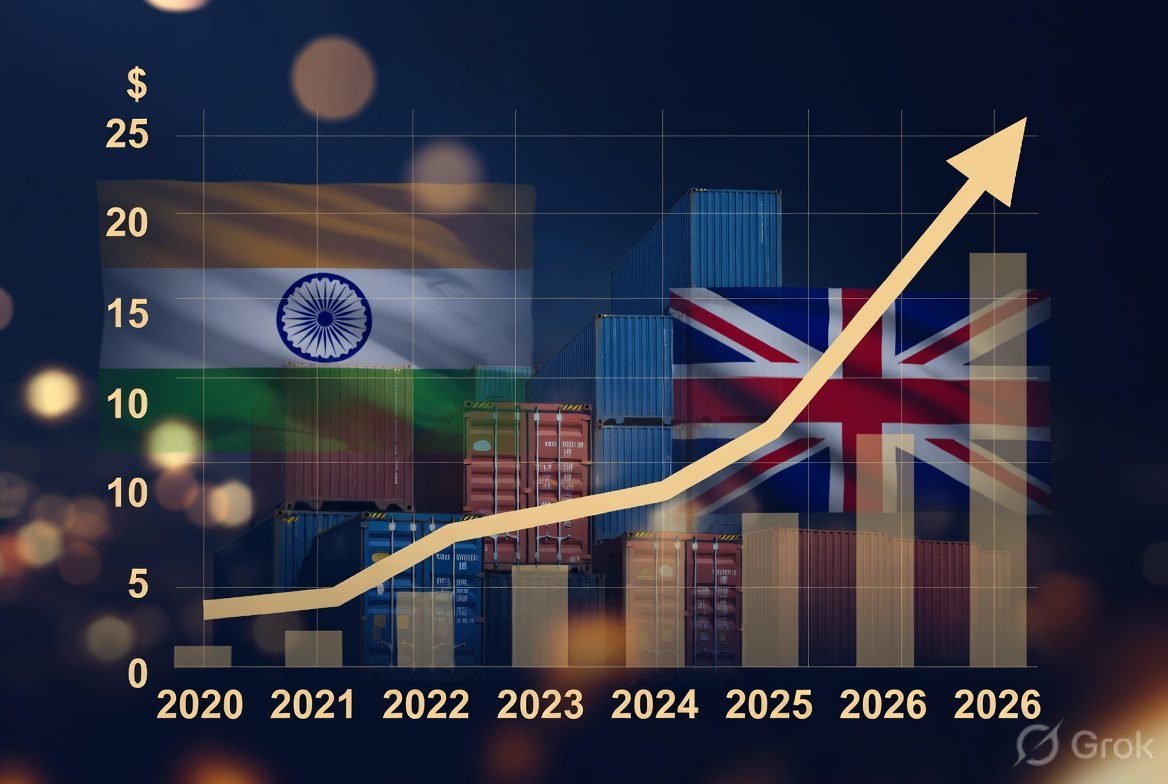
Bilateral trade crossed $25 billion in 2025-26 — and this deal is designed to accelerate that curve.
The Full Tariff Glide Path, Visualised
Here's where most coverage gets lazy — they quote the "150% to 75%" headline and move on, without showing that this isn't a single overnight jump. It's a staged reduction, and the pace matters for anyone modelling out actual price impact.
Scotch duty steps down from 150% to 110% immediately, then glides toward 40% by year ten — not a single 75% cut on day one, despite how headlines phrased it.
The India UK Trade Deal's alcohol provisions apply this same staged logic across cider, mead, sake, brandy, bourbon, rum, gin, vodka, liqueurs, and tequila — not just Scotch, though Scotch gets the most attention because it's the single largest UK spirits export to India by value. There's also a minimum import price threshold, generally around $5 a litre (roughly $3.75-6 per 750ml bottle depending on the product), below which the concession doesn't apply — a detail aimed at protecting the mass-market end of the domestic spirits industry from being undercut.
Cars follow a similar staged path. India's duty on fully built UK cars and trucks drops from 110% toward 10% "over time" — official language that specifically avoids committing to a fixed annual schedule for every vehicle category. Petrol and diesel vehicles get concessional treatment immediately; electric and hybrid vehicles only get preferential access starting in year six. That's a meaningful gap if you were expecting an immediate flood of cheaper imported EVs — it isn't happening this year.
Six Years in the Making: How We Got Here
It's worth understanding why the India UK Trade Deal took as long as it did, because the delays themselves tell you something about how contested certain provisions were. Formal negotiations opened in January 2022, under a different UK government, with an original ambition of wrapping up within a year. That timeline slipped repeatedly — through a change in UK prime ministers, disagreements over visa provisions for Indian professionals, disputes over the automobile tariff schedule, and, most recently, a UK steel safeguard dispute that pushed the original April-May 2026 implementation target back by several weeks.
The deal was finally signed in London on 24 July 2025, a ceremonial milestone that still left roughly a year of technical work — legal scrubbing, domestic ratification processes in both countries, and system readiness at customs authorities — before the India UK Trade Deal could actually enter into force. That gap between "signed" and "in force" is standard for agreements this complex, but it's also why so much of the stock market reaction happened well before today's technical go-live date, once implementation became a near-certainty rather than a possibility.
What Gets Cheaper for Indian Consumers
Strip away the acronyms and here's what an ordinary Indian buyer actually notices, and when.
| Product Category | Old Duty | New Starting Duty | Realistic Timeline |
|---|---|---|---|
| Scotch whisky (premium) | 150% | 110% now, 75% by year 3 | Gradual price softening over 3-10 years |
| Gin, vodka, rum, other spirits | 150% | Same staged path, subject to minimum import price | Multi-year |
| UK petrol/diesel cars (JLR, Aston Martin, etc.) | 110% | ~30% within a defined annual quota | Immediate for quota vehicles, wider access phases in |
| UK electric/hybrid/hydrogen cars | 110% | Preferential access begins year 6 | Not this year |
| Cosmetics, medical devices | ~15% | Toward 3% | Phased |
Notice what's conspicuously absent from that table: everyday consumer goods. This isn't a deal that makes UK groceries or fast fashion cheaper at your local store. It's concentrated almost entirely in premium categories — spirits and cars, overwhelmingly — which tells you exactly who the intended beneficiary of the "cheaper imports" side of this deal actually is: a fairly narrow, upper-income consumer segment, not the mass market.
What Gets Cheaper for UK Buyers of Indian Goods
This is the side of the India UK Trade Deal that matters far more for Indian exporters and, by extension, Indian stock prices. The UK is eliminating tariffs — not reducing, eliminating — across a genuinely wide swath of Indian exports, immediately or on a much faster timeline than India's own concessions to the UK.
India's own auto sector gets a specific, easy-to-miss benefit here: the UK's standard 10% tariff on passenger cars disappears entirely for eligible Indian electric, hybrid, and hydrogen vehicles within the quota — a full 10-percentage-point edge that pure-combustion Indian exporters don't get.
Which Indian Stocks Actually Win From the India UK Trade Deal
Markets didn't wait for the ink to dry on the implementation date. Textile stocks specifically began rallying in mid-June once the 15 July effective date was confirmed, well ahead of today's actual go-live — a reminder that by the time a "fresh" news event technically happens, a chunk of the obvious reaction has often already been priced in.
Textiles: The Biggest, Most Direct Beneficiary
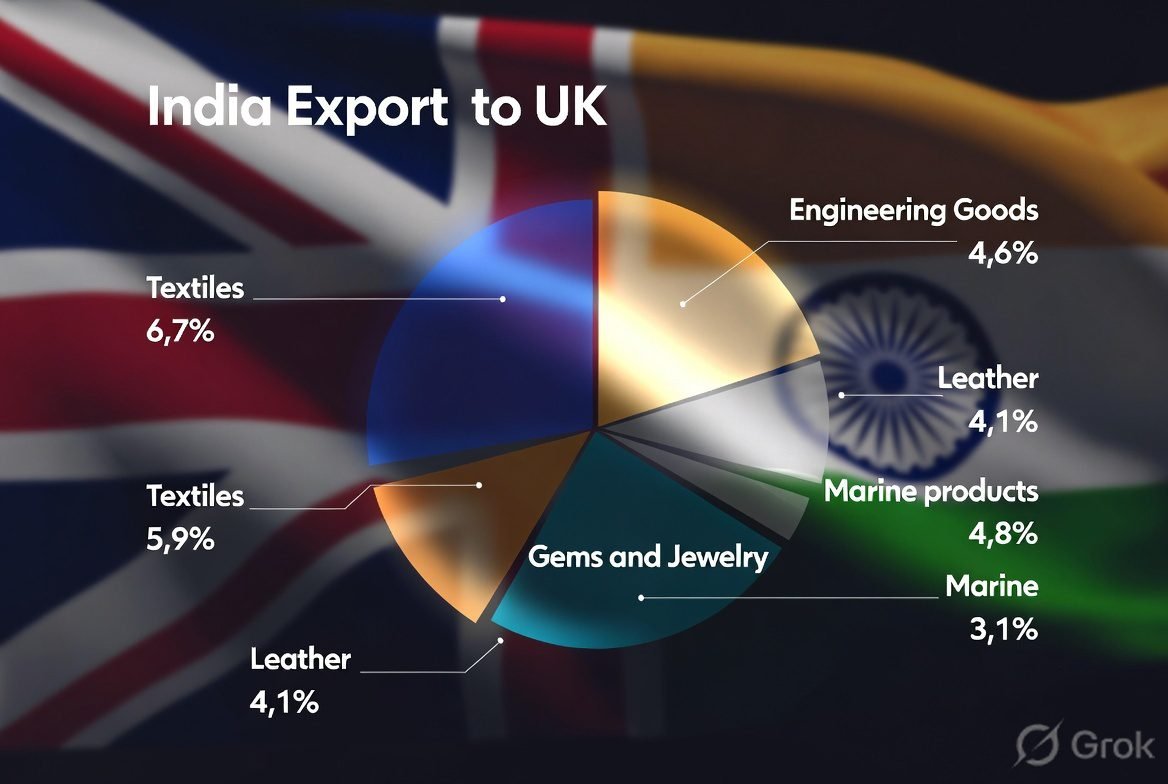
This is where the India UK Trade Deal reaction has been sharpest. Reports from mid-June already showed a "sharp uptrend" across major textile exporters on confirmation of the implementation date, with some names surging as much as 20% intraday on the news.
Why these names specifically? All five have meaningful, established export relationships with UK retail buyers already in place — the switching cost for a British buyer to actually route more volume their way is low, since the relationship and the supply chain already exist. That's a genuinely different setup from a company that would need to build a new UK client relationship from scratch to capture any benefit.
IT Services: The Quiet, Non-Tariff Winner
IT services aren't touched by goods tariffs at all — services trade runs through an entirely separate mechanism. But the India UK Trade Deal includes something specifically valuable to Indian IT majors: a five-year exemption from social security contributions for employees India-based companies send to the UK. For firms like Tata Consultancy Services and Infosys, which routinely deploy consultants and engineers onsite for UK client projects, this directly reduces the cost of every seconded employee, improving project margins on UK engagements without a single line of new revenue.
Auto: A Genuinely Two-Sided Story
Tata Motors sits in an unusually interesting spot here, and most coverage misses the nuance entirely. As an Indian company, Tata Motors' domestic operations don't directly export mass volumes to the UK in a way that benefits hugely from the UK's tariff cuts. But Tata Motors also owns Jaguar Land Rover — a UK-based, UK-manufacturing subsidiary — and JLR's vehicles exported into India now face a lower Indian import duty under the same agreement. It's the same corporate parent benefiting from two different sides of one trade deal, through two different subsidiaries, which is a genuinely unusual structural position among Indian large-caps.
Engineering, Chemicals, and Pharma: The Broader, Less Flashy Wins
Engineering goods, auto components, and pharmaceutical exports all gain duty-free UK access under CETA, though this category tends to be a "sector broadly benefits" story rather than one with three or four standout stock names the way textiles has. Improved landed-cost competitiveness helps win larger, multi-year UK contracts — valuable, but slower to show up in quarterly numbers than a straightforward tariff-driven order surge.
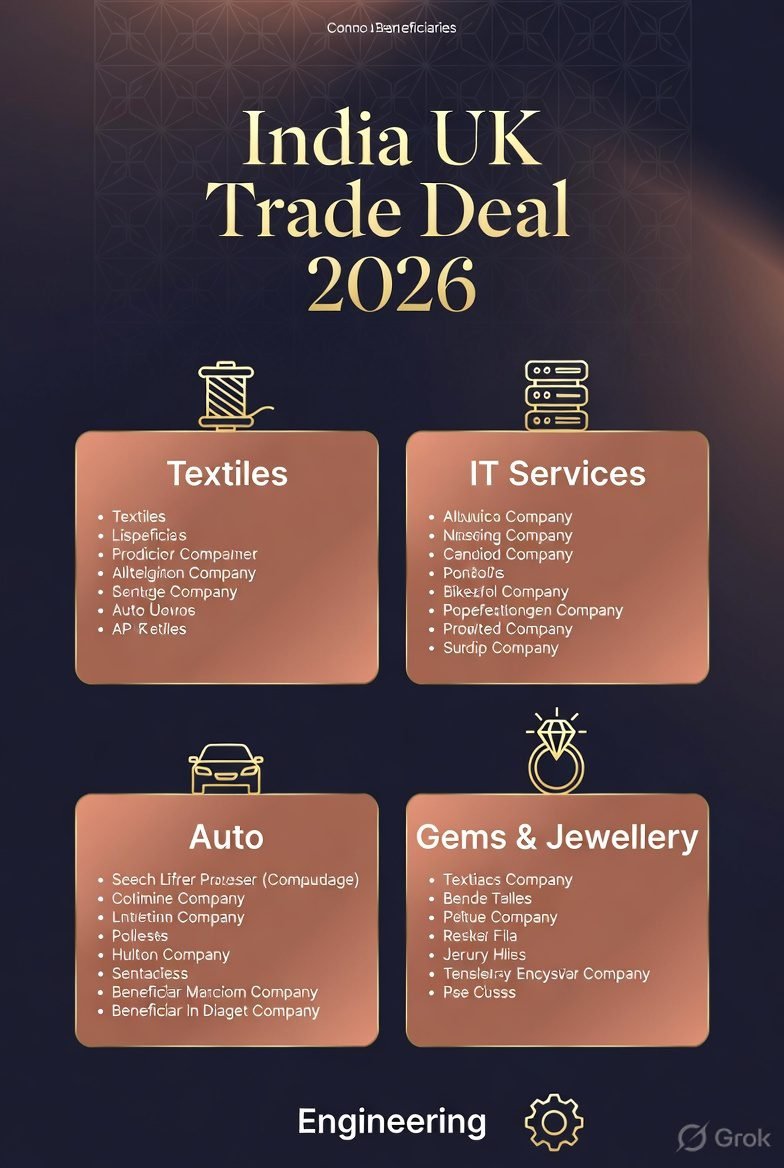
Five sectors, five very different transmission mechanisms — some immediate and tariff-driven, others slower and structural.
The One Sector Losing Ground: Steel
Not every part of this story is a win, and it's worth being upfront about the one clear loser. India exported roughly $900 million in steel and steel products to the UK in FY2026 — about 7% of India's total goods exports to Britain. That trade now faces headwinds from an entirely separate development: the UK tightened its own steel import safeguard regime from 1 July 2026, two weeks before CETA itself took effect. The two policies aren't directly connected, but Indian steel exporters are absorbing a tighter UK entry regime at almost exactly the same moment the rest of the India UK Trade Deal is opening doors elsewhere — a reminder that "trade deal goes live" doesn't mean every single sector moves in the same direction.
The Bigger Trade Picture
Zoom out from individual sectors and the broader trade numbers behind the India UK Trade Deal add useful context. India-UK bilateral trade reached $25.12 billion in 2025-26, up 8.62% from $23.13 billion the year before. But look closer at the composition and it's more complicated than a simple growth story: India's exports to the UK actually fell 7.6% to $13.44 billion over the same period, while imports from the UK surged 36.11% to $11.68 billion. FDI into India from the UK rose to $1 billion in 2025-26, up from $795 million the prior year.
Put together, that's a trade relationship where India was, if anything, losing some export ground even before this deal took effect — which is precisely the trend CETA is designed to reverse. Whether the tariff relief is enough to actually flip that export trajectory, rather than just slow its decline, is the real multi-year test this deal now faces.
India's exports to the UK actually declined in the year leading up to this deal — the trend line CETA is meant to reverse.
Rules of Origin: The Fine Print That Decides Everything
Here's the part almost nobody reads past the headline. None of these tariff cuts apply automatically just because a product ships from an Indian port. Rules of Origin provisions determine whether a product genuinely counts as "Indian" or "British" for the purposes of this deal — the mechanism that stops a Chinese-made product from getting routed through India with minimal processing purely to claim India UK Trade Deal benefits it was never meant to have.
These rules set a minimum threshold of local production, processing, or value addition a product needs before it qualifies. For a textile exporter already doing genuine end-to-end manufacturing in India, this is a formality. For a company that's more of an assembler or re-exporter, meeting the origin threshold could be the actual determinant of whether they capture any benefit from this deal at all — worth checking specifically rather than assuming eligibility.
This is also the mechanism that ultimately decides whether the India UK Trade Deal delivers its promised benefit to genuine manufacturers versus opportunistic re-routing. Customs authorities on both sides will apply origin verification checks, and exporters who can't document sufficient local value addition risk having preferential tariff treatment denied even after shipment — a compliance cost that smaller exporters, in particular, should budget time and resources to get right from day one rather than treating as an afterthought.
What's Deliberately Left Out
India held firm on a specific, short list of categories where no concessions were extended to the UK at all: fresh apples, walnuts, whey and modified whey products, blue-veined cheese, certain seed categories, gold bars, and smartphones. Each of these protects a specific domestic constituency — apple growers, dairy processors, seed companies, and, notably, India's own electronics manufacturing push, which explicitly didn't want cheaper UK smartphone imports undermining the "Make in India" push in that category.
This exclusion list is a useful reminder that trade negotiations are never purely about aggregate economic efficiency — they're also about which domestic lobbies had enough leverage to carve out protection, and which didn't. The apple growers of Himachal Pradesh and Kashmir, for instance, have historically pushed hard against agricultural liberalisation in past trade talks, and that pattern held here too.
How This Stacks Up Against India's Other Five FTAs
CETA is India's sixth FTA under the current government, following Mauritius, the UAE, Australia, EFTA, and Oman. What makes it different isn't the mechanics — tariff schedules, rules of origin, and phased timelines are standard FTA architecture regardless of partner country. What's different is the partner: this is India's first comprehensive trade agreement with a major Western, developed economy, rather than a smaller economy, a free-trade bloc, or a Gulf state. That's why it's being treated as a bigger signal of India's trade posture than the volume numbers alone might suggest — it's as much a statement about India's willingness to negotiate detailed market access with developed economies as it is about the specific tariff lines involved.
The Skeptic's Case: Will This Actually Move the Needle?
It's worth asking the uncomfortable question directly, because most coverage of trade deal launch days skips it: does a tariff cut alone guarantee actual export growth, or just create the opportunity for it? History with India's other recent FTAs offers a genuinely mixed answer — market access is a necessary condition for export growth, not a sufficient one. Indian exporters still need to win orders against Vietnam, Bangladesh, and other competing suppliers who may have their own trade advantages with the UK, still need to navigate Rules of Origin compliance costs, and still need UK buyers to actually shift existing supply relationships rather than just enjoying a lower landed cost on volumes they were already planning to buy.
There's also the India-side consumer question: will Scotch actually get meaningfully cheaper for the average buyer, or will distributor margins simply absorb part of the duty cut before it ever reaches a retail shelf? Early-stage duty cuts (150% to 110% initially, not the full glide to 75% or 40%) are modest enough that visible retail price movement in year one is likely to be limited — the more dramatic headline numbers describe where this ends up in year ten, not where it starts today.
Look at India's export performance to the UK in the year immediately before this deal took effect, and the skepticism gets a little more grounded. Exports fell 7.6% even as overall bilateral trade grew — meaning the trade relationship was already becoming more import-heavy from India's side, not less, right as CETA was being finalised. A tariff cut removes one obstacle to reversing that, but it doesn't automatically address the underlying competitiveness questions — currency movements, freight costs, and how aggressively competing exporters in Vietnam or Bangladesh price their own UK-bound shipments — that likely contributed to the export decline in the first place. The India UK Trade Deal changes the rules of the game; it doesn't guarantee Indian exporters win it.
What Retail Investors Should Actually Do
Chasing the specific textile names that already rallied in June carries the obvious risk of buying after the easy re-rating has happened — the market rarely leaves the same trade sitting open for a month for latecomers to collect. A more measured approach: treat the India UK Trade Deal as one input in ongoing sector research rather than a standalone reason to buy, watch actual quarterly export order data from the named beneficiaries over the next two to three quarters rather than reacting to the launch-day headline, and remember that sector-diversified exposure (through relevant mutual funds) spreads the execution risk that any single company might simply fail to convert improved market access into real revenue.
A useful discipline here: separate the "this sector benefits structurally" conclusion from the "this specific stock is a buy at this specific price" conclusion. The first is reasonably well-supported by the tariff mechanics described above. The second depends on valuation, balance sheet quality, and execution track record — factors this deal doesn't change one bit, no matter how favourable the new UK access looks on paper.
Key Dates to Watch From Here
The India UK Trade Deal isn't a single event that concludes today — it's the start of a multi-year implementation calendar worth actually tracking rather than filing away as "old news" after this week's coverage fades.
| Milestone | What to Watch |
|---|---|
| Q2-Q3 FY27 export data | First real signal of whether textile, leather, and marine exporters convert access into actual order growth |
| Year 3 tariff step-down | Scotch and premium spirits duty glides further; a more visible retail price effect becomes plausible |
| Year 6 | UK electric, hybrid, and hydrogen vehicles gain preferential access into India for the first time |
| Year 10 | Scotch duty reaches its final 40% floor; most phased tariff lines complete their glide path |
| Ongoing | UK steel safeguard regime and its knock-on effect on India's ~$900 million steel export relationship |
For anyone tracking this as an investment theme rather than a one-day news event, the quarterly export data releases over the next 12-18 months matter far more than today's launch-day headlines. That's genuinely where the India UK Trade Deal either proves itself as a durable export tailwind or turns out to be another market-access opportunity that looked better on paper than it played out in practice.
The Bottom Line
The India UK Trade Deal genuinely changes the tariff math for specific, identifiable sectors — textiles most directly, IT services through a narrower but real cost benefit, autos through an unusually two-sided structural story, and a handful of other export categories more slowly. It does not make this a mass-market "everything gets cheaper" story for Indian consumers, and it does not guarantee that tariff relief alone converts into durable export share gains against India's regional competitors. Today's launch is the starting gun, not the finish line — the real evidence of whether this deal delivers shows up in export order books over the next several quarters, not in this morning's headlines.
FAQs: India UK Trade Deal 2026
15 July 2026, roughly a year after it was signed in London on 24 July 2025. It follows a Double Contribution Convention on social security implemented alongside it.
No. The duty drops from 150% to 110% immediately, then glides down toward 75% and eventually 40% over roughly ten years — not a single overnight cut to 75%, despite how many headlines phrased it.
Textile and apparel exporters have shown the sharpest reaction, including Welspun Living, Indo Count Industries, Gokaldas Exports, KPR Mill, and Pearl Global Industries — all with established UK export relationships.
No. Preferential access for UK electric, hybrid, and hydrogen vehicles only begins in year six of the agreement. Petrol and diesel vehicles get concessional treatment sooner, within an annual quota.
A five-year exemption from UK social security contributions for employees sent from India directly lowers the cost of onsite UK deployments, improving project margins without requiring new revenue.
No, and steel is actually facing separate headwinds — the UK tightened its own steel import safeguard regime from 1 July 2026, adding pressure on India's roughly $900 million in annual steel exports to Britain.
India held firm on fresh apples, walnuts, whey and modified whey, blue-veined cheese, certain seed categories, gold bars, and smartphones — each protecting a specific domestic industry.
It's India's first comprehensive trade agreement with a major developed Western economy, following earlier deals with Mauritius, the UAE, Australia, EFTA, and Oman — a different category of trade partner than the prior five.
They determine whether a product counts as genuinely Indian or British for the deal's purposes, requiring a minimum level of local production or value addition. Without meeting this threshold, a company doesn't qualify for the tariff benefits regardless of where it ships from.
Much of the initial reaction happened in mid-June when the implementation date was first confirmed, meaning some of the easy re-rating may already be priced in. Watch actual export order data over coming quarters rather than reacting purely to today's launch headline.

References: Press Information Bureau: CETA Enters Into Force · Business Standard: CETA Tariff Changes Explained · The Federal: What CETA Means for Businesses · Observer Voice: CETA Benefits Explainer · 5paisa: Textile Stocks Gain on CETA · India Infoline: Textile Stock Rally · Sahi: Why Textile Stocks Are Rising · Asianet Newsable: What Costs Less From Today

Pranab Barman is a Financial Educator and Personal Finance Researcher with over 10 years of hands-on experience in stock markets, trading, and investing. Currently enrolled in the CFA Program, he is committed to continuous learning and professional excellence in finance.
As the Founder of PlayWithStock, Pranab covers a wide range of topics including Mutual Funds, SIP, Taxation, Stock Market Basics, and Financial Calculators — with a focus on simplifying complex financial concepts for everyday all investors.
Email: support@playwithstock.com
Website: playwithstock.com
Related posts:
 Stocks to Buy After India-US Trade Deal 2026: A Sector-by-Sector Breakdown
 India US Trade Deal 2026: Inside the Tariff Rollercoaster Before July 22
 H-1B $100K Visa Fee — Indian IT Stocks Pe Impact (2026 Update)
 Gold Price All Time High India: Should You Buy Now or Wait in 2026
 Monsoon 2026 India Inflation: Why a Dry June Hits Grocery Bills
 Crypto Bookkeeping for Tax in India: The Complete 2026 Guide
 Vedanta Demerger 2026: What It Means for Shareholders
 Share Buyback Tender vs Sell Calculator: 2026 Tax Guide