

RBI Repo Rate Cut 2026: The Complete Home Loan EMI Guide
Your EMI didn't move overnight the last time the RBI cut rates, and it won't this time either — unless you understand the mechanics. Here's what's actually happening, in plain language.
A quiet Friday policy announcement can change what a family pays every month for the next fifteen years.
- Where the Repo Rate Actually Stands Right Now
- How an RBI Repo Rate Cut Reaches Your EMI
- The Real Math: What a Rate Cut Saves You
- A Loan, A Cut, and What It Actually Meant for One Borrower
- EBLR vs MCLR: Which Loan Are You Even On?
- What to Expect from the Next MPC Meeting
- Myths About the RBI Repo Rate Cut, Cleared Up
- Should You Refinance Right Now?
- The Part-Prepayment Trick Almost Nobody Uses
- If You're Planning to Buy a Home This Year
- The Bottom Line
- FAQs
RBI Repo Rate Cut news has a strange effect on people. It shows up on your phone, you skim the headline, maybe you feel a small flicker of hope that your EMI is about to shrink — and then nothing happens. Or something happens, but three weeks later, quietly, without anyone from the bank actually calling to tell you. That gap between the RBI repo rate cut announcement and your actual bank statement is where most of the confusion lives, and it's exactly what this guide is here to close.
If you're paying a home loan right now, or thinking about taking one, the mechanics of how an RBI repo rate cut travels from Mint Street all the way down to your monthly EMI matter more than the headline number itself. So let's walk through it properly — not the version with ten bullet points and no context, but the version that actually explains why your bank behaves the way it does.
Where the Repo Rate Actually Stands Right Now
The Monetary Policy Committee met in early June 2026 — its 61st meeting under this cycle — and chose to hold the repo rate at 5.25%. All six members voted the same way. No drama, no split decision, just a clear "let's wait and watch" stance that the RBI itself described as neutral.
That pause came after a fairly aggressive run of cuts. Since February 2025, the RBI has trimmed the repo rate by 100 basis points in total through a series of RBI repo rate cut decisions, working through smaller and larger moves along the way, including one 50 basis point cut in June 2025 that surprised a few analysts with its size. By the time June 2026 rolled around, the RBI had clearly decided it wanted to see how all that easing was actually working through the economy before doing anything more.
Why pause instead of cutting again? Inflation, mostly. The RBI actually raised its FY27 inflation forecast slightly to 5.1%, citing pressure from the West Asia conflict pushing up crude prices, ongoing supply-chain disruption, and the usual monsoon-related uncertainty around food prices. Growth, meanwhile, stayed solid — GDP projections for FY27 were kept at 6.6%, which isn't a number that screams "emergency stimulus needed."
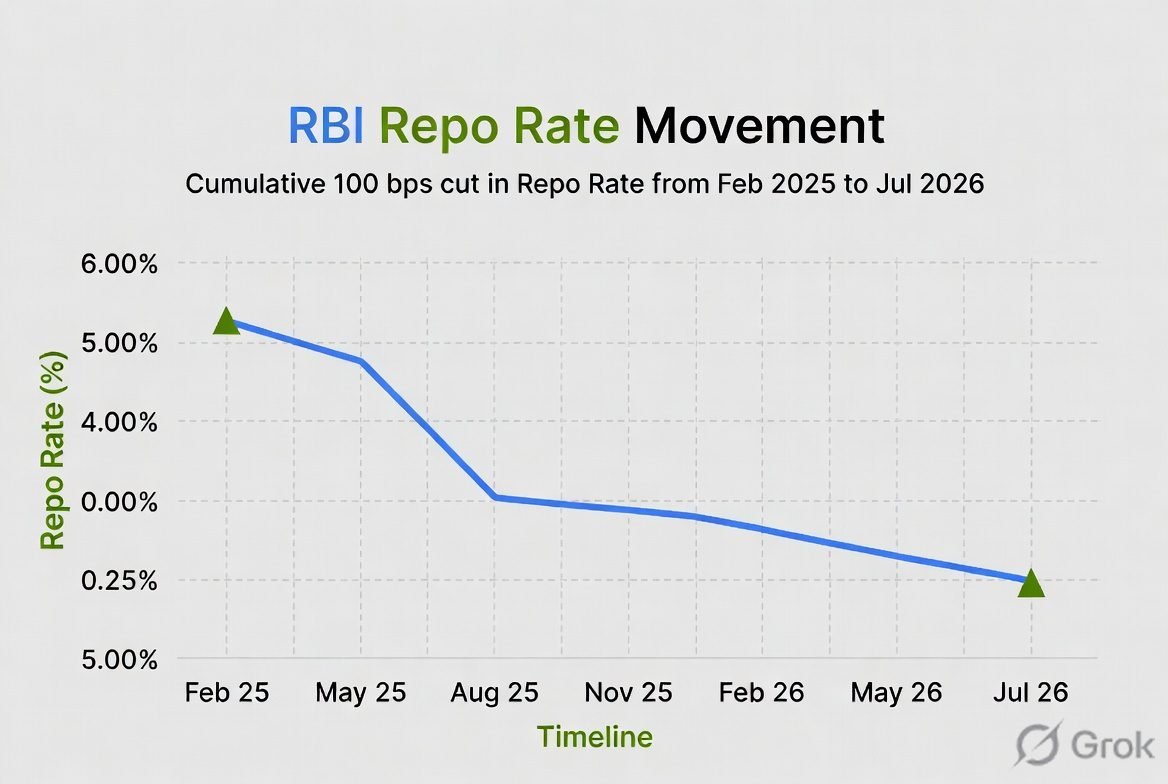
A cumulative 100 bps of cuts since February 2025 has already changed borrowing costs meaningfully — even before the next move.
How an RBI Repo Rate Cut Reaches Your EMI
Here's the part almost nobody explains properly: the repo rate itself is not your home loan interest rate. It's the rate at which the RBI lends money to commercial banks for short periods. What actually determines your EMI is your bank's final lending rate, which is built on top of the repo rate using a formula most borrowers have never actually seen written out.
That spread — sometimes called the margin — is where your bank makes its money and where your own creditworthiness comes into play. A borrower with an 800+ credit score might get a spread as low as 1.85%. Someone with a 650 score, on the exact same loan from the exact same bank, could be looking at a spread closer to 4.50%. Same repo rate. Wildly different final rate.
Since October 2019, RBI rules have required banks to link new floating-rate home loans to an external benchmark — usually the repo rate itself — rather than letting banks calculate rates internally the old way. Loans set up this way are called EBLR (External Benchmark Lending Rate) or sometimes RLLR (Repo-Linked Lending Rate) loans, and the whole point of that shift was to make an RBI repo rate cut show up in your EMI faster and more reliably than it used to.
The Real Math: What a Rate Cut Saves You
Numbers make this concrete in a way that "rates went down" never quite does. Take a ₹50 lakh home loan over 20 years.
Monthly EMI
Monthly EMI
That half-percent drop saves roughly ₹1,569 every month. Doesn't sound life-changing on its own, does it? Stretch it across 20 years, though, and it adds up to close to ₹3.8 lakh in total interest saved — money that would otherwise have gone straight to the bank, not toward your principal.
| Loan Amount | Rate Change | Monthly EMI Change | Total Saved Over Tenure* |
|---|---|---|---|
| ₹30 lakh, 20 yrs | 8.5% → 8.0% | ~₹942 lower | ~₹2.3 lakh |
| ₹50 lakh, 20 yrs | 8.5% → 8.0% | ~₹1,569 lower | ~₹3.8 lakh |
| ₹75 lakh, 20 yrs | 8.5% → 8.0% | ~₹2,353 lower | ~₹5.6 lakh |
*Approximate, assuming the full rate benefit is passed through and the loan runs its complete tenure without prepayment.
Run the numbers in reverse and the picture gets uncomfortable fast. Take that same ₹50 lakh loan and push the rate up from 8.5% to 9% instead — a move entirely possible if the RBI ever needs to hike again — and the EMI climbs to roughly ₹44,986, about ₹1,595 more every month, or close to ₹3.8 lakh in additional interest over the full term. An RBI repo rate cut and an RBI repo rate hike aren't mirror-image events for how they feel to a borrower; a hike tends to land harder, faster, and with a lot less public celebration than an RBI repo rate cut ever gets.
A Loan, A Cut, and What It Actually Meant for One Borrower
Ravi took a ₹42 lakh home loan in early 2023, back when rates were still elevated and EBLR loans linked to repo had already become the default at most banks. His original rate landed at 9.15%, and his EMI settled at just under ₹38,000 a month — a number he'd more or less made peace with.
When the RBI started cutting through 2025, Ravi didn't notice the first change at all. His bank's reset cycle was quarterly, meaning the new rate only kicked in three months after the actual RBI repo rate cut. By the time his EMI adjusted, the rate had dropped to 8.4%. His monthly payment fell by a little over ₹1,900 — not enough to change his life, but enough that he redirected the difference straight into an existing SIP instead of letting it disappear into general spending.
That's really the underrated lesson here. An RBI repo rate cut rarely arrives as a single dramatic windfall. It shows up as a series of small, easy-to-miss adjustments — and what you do with each one, rather than the RBI repo rate cut itself, is what actually compounds into something meaningful.

The gap between an RBI announcement and your bank's actual EMI reset is where most of the confusion — and the opportunity — sits.
EBLR vs MCLR: Which Loan Are You Even On?
This distinction matters more than most borrowers realise. If you took your loan after October 2019, you're almost certainly on an EBLR or RLLR structure, and an RBI repo rate cut should reach you within one to three months, depending on your bank's specific reset cycle.
If your loan is older, or your bank never migrated you over, you might still be sitting on an MCLR-linked rate. MCLR loans respond to repo rate changes much more slowly and less predictably, since the calculation involves the bank's own cost of funds rather than a direct external benchmark. Some borrowers on old MCLR loans have gone months, occasionally longer, without seeing a rate cut show up at all, even while newer EBLR customers at the same bank saw immediate relief.
How Different Banks Have Responded to the RBI Repo Rate Cut
Not every lender passes on an RBI repo rate cut at the same pace, and it's worth actually comparing rather than assuming your bank is being generous. Public sector lenders like SBI, Union Bank, and Bank of Baroda moved fairly quickly after the cuts through 2025, with home loan rates settling in the 7.10–7.35% band for well-qualified borrowers. Private lenders including HDFC Bank, ICICI Bank, and Axis Bank generally followed within days rather than weeks, though the exact spread each one offers still depends heavily on your individual credit profile.
The takeaway isn't that one type of bank is universally better after an RBI repo rate cut — it's that the gap between the fastest and slowest transmitters can genuinely run into a full percentage point at times, and that gap is worth a phone call or two before you assume your existing lender is giving you the best available deal.
What to Expect from the Next MPC Meeting
The next scheduled MPC meeting falls in early August 2026, and it's shaping up to be one of the more closely watched reviews of the year. By then, the committee will have fresh Q1 FY27 GDP data, actual inflation prints instead of forecasts, a clearer read on how the monsoon has actually played out, and hopefully more clarity on the West Asia conflict that's been keeping crude oil prices elevated.
Market commentary heading into the meeting is split. An RBI repo rate cut is plausible if the West Asia situation eases and crude prices settle down — global energy costs feed almost directly into India's inflation math. But if any of the risk factors the RBI flagged in June actually materialise, a hawkish hold, or in a less likely scenario a hike, isn't off the table either.
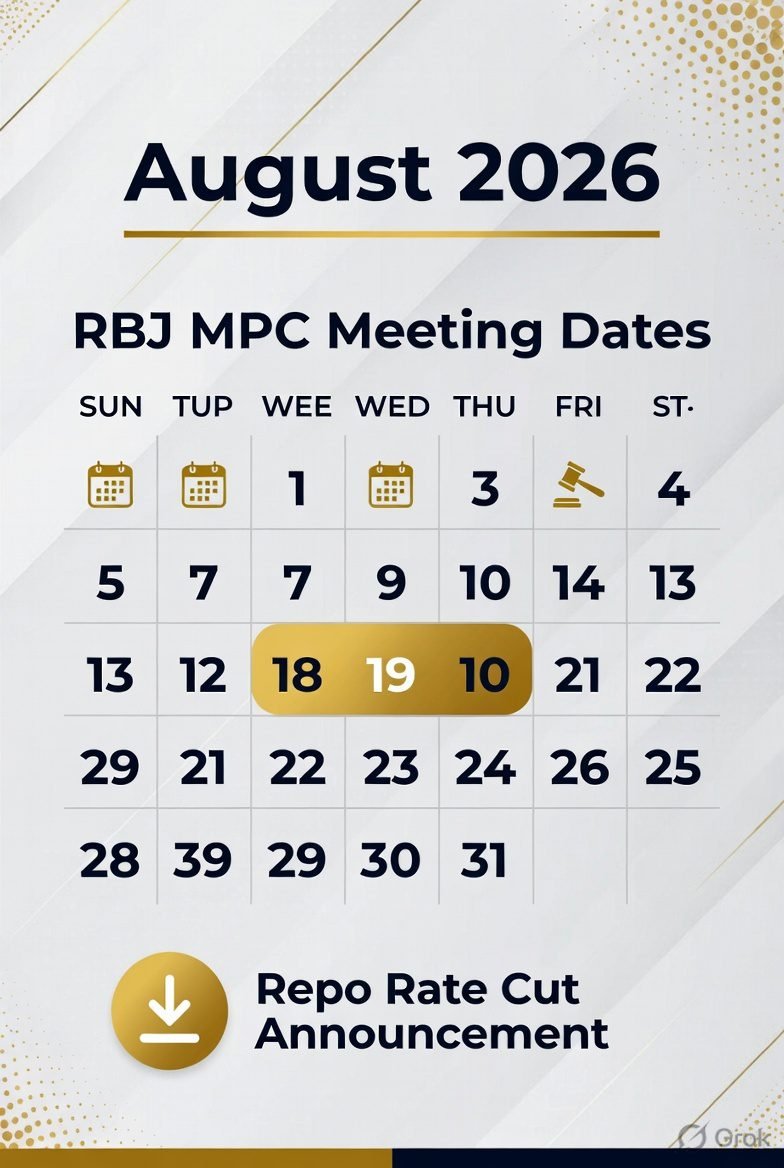
Early August 2026 is the next checkpoint — mark it if you're deciding whether to lock in a rate now or wait.
Myths About the RBI Repo Rate Cut, Cleared Up
| The Myth | What's Actually True |
|---|---|
| "My EMI drops the day the RBI repo rate cut is announced." | Transmission takes weeks to months, depending on your bank's reset cycle and loan structure. |
| "An RBI repo rate cut means my EMI amount definitely goes down." | Banks often keep EMI fixed and shorten your tenure instead — check your statement, don't assume. |
| "All banks pass on the full cut." | Some pass on the full benefit quickly; others transmit only partially or with a delay. |
| "Fixed-rate loans are always safer." | Fixed rates typically run 1–2% higher as a built-in premium — you're paying for certainty either way. |
Should You Refinance Right Now?
If you're still sitting on an old MCLR loan from 2018 or 2019 at something like 8.65%, the honest answer is probably yes — either convert to a repo-linked structure with your existing bank (usually a small conversion fee) or do a full balance transfer to a lender currently offering 7.10–7.35%. The math tends to work out clearly in your favour once you account for the one-time switching cost against years of lower payments.
If you're already on an EBLR loan and your bank has been passing through each RBI repo rate cut reasonably promptly, refinancing makes far less sense. You'd be paying processing fees and paperwork hassle to move somewhere that might not actually offer a meaningfully better spread than what you already have.
The Part-Prepayment Trick Almost Nobody Uses
Here's a habit worth building: when an RBI repo rate cut lowers your EMI, don't let your bank quietly shrink your payment. Instead, keep paying the old, higher amount, and treat the difference as an automatic monthly prepayment toward your principal.
It sounds like a small thing. It isn't. That extra amount, applied consistently every single month, can shave years off a 20-year loan tenure and save a genuinely large sum in total interest — often more than what the rate cut delivered on its own. Meera, a friend of a colleague at Play With Stock, did exactly this after a 2025 RBI repo rate cut trimmed her EMI by roughly ₹1,800. She kept paying the original amount. Eighteen months in, her outstanding principal was already meaningfully ahead of where a standard amortisation schedule would have placed it.
If You're Planning to Buy a Home This Year
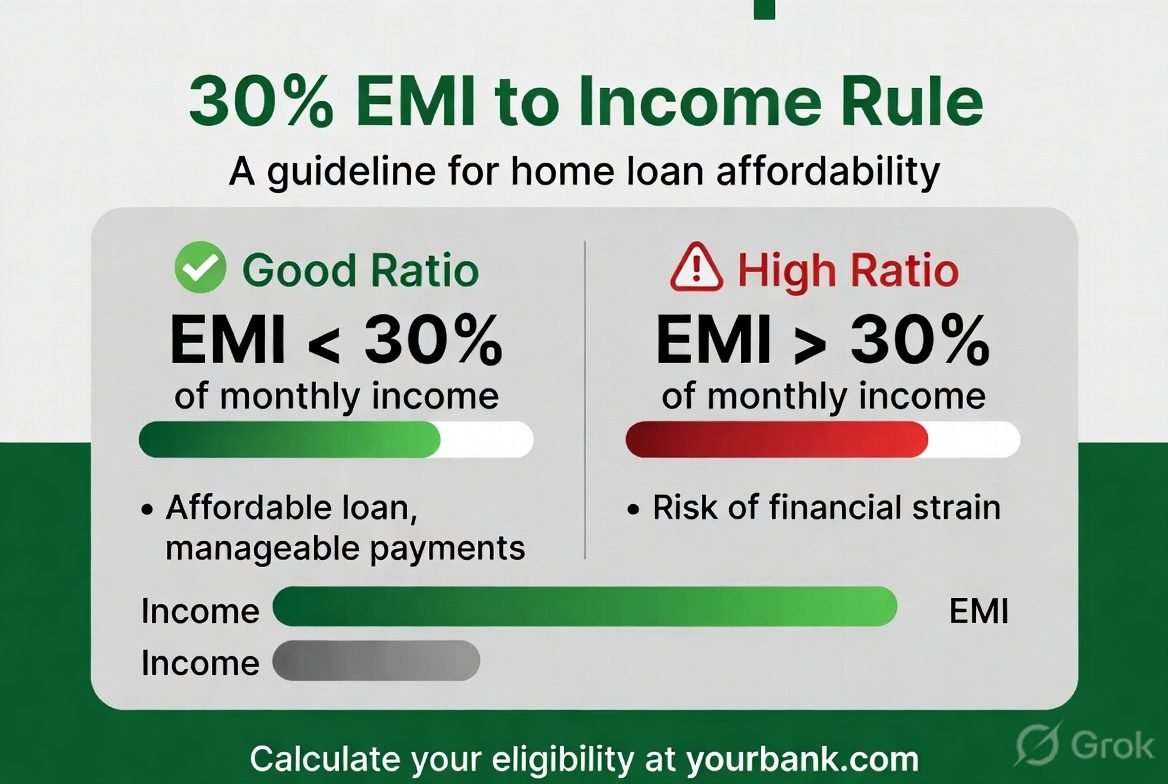
Two rules of thumb are worth keeping in your back pocket, regardless of what the RBI does next. First, never borrow more than 80% of the property's value — put down at least 20% yourself. Second, keep your EMI under roughly 30% of your take-home salary; anything higher starts squeezing out savings, investing, and the kind of financial breathing room that protects you if rates move against you later.
With home loan rates currently sitting around 8.5–9.5% following the RBI's pause at 5.25%, affordability is meaningfully better than it was back when rates peaked closer to 9%. Whether that window stays open depends heavily on what the August MPC meeting decides for the next RBI repo rate cut — which is exactly why this is worth tracking rather than ignoring until your next EMI statement arrives.
The Bottom Line
An RBI repo rate cut is never really about the headline number — it's about whether that number actually reaches your bank statement, and how quickly. Knowing your loan type, checking whether your bank is transmitting cuts promptly, and deliberately choosing to prepay rather than pocket every small saving are the three habits that separate borrowers who benefit meaningfully from an RBI repo rate cut from those who barely notice one happened at all.
The next real test comes in early August 2026. Whatever the RBI decides, you'll now know exactly where to look on your own loan statement to see whether it actually shows up.
FAQs: RBI Repo Rate Cut
5.25%, held steady since the June 2026 MPC meeting, after a cumulative 100 basis point cut since February 2025.
For repo-linked (EBLR/RLLR) loans, usually one to three months depending on your bank's reset cycle. MCLR-linked loans can take considerably longer and less predictably.
Not always automatically. Many banks keep the EMI fixed and shorten the loan tenure instead unless you specifically request a lower EMI — check your loan statement rather than assume.
Early August 2026. The RBI held rates in June 2026, so this meeting will be closely watched for any change in stance.
For most borrowers on older MCLR loans, yes — conversion fees are typically small compared to the faster, more reliable transmission of future RBI repo rate cuts under EBLR.
Fixed rates run roughly 1–2% higher than floating rates as a built-in premium for certainty. Most experts suggest floating rates unless you specifically expect the repo rate to rise sharply over your loan tenure.
References: RBI: Monetary Policy · ClearTax: Repo Rate 2026 · 5paisa: RBI MPC Meeting Schedule · CorpLawUpdates: Current RBI Repo Rate · CorpLawUpdates: June 2026 MPC Analysis · TradeCafe: RBI MPC Schedule 2026 · Ambak: Repo Rate Cut EMI Impact · Sahi: Repo Rate Cut Home Loan Impact · Axis Bank: Repo Rate Impact on EMIs · Upstox: Will Your EMI Reduce or Stay the Same

Pranab Barman is a Financial Educator and Personal Finance Researcher with over 10 years of hands-on experience in stock markets, trading, and investing. Currently enrolled in the CFA Program, he is committed to continuous learning and professional excellence in finance.
As the Founder of PlayWithStock, Pranab covers a wide range of topics including Mutual Funds, SIP, Taxation, Stock Market Basics, and Financial Calculators — with a focus on simplifying complex financial concepts for everyday all investors.
Email: support@playwithstock.com
Website: playwithstock.com
Related posts:
 SGB Premature Redemption Calculator 2026: Tax Rules, RBI Dates & Exit Guide
 The 20-30-40 Rule for Home Loan Affordability
 GST 2.0 for E-commerce Sellers (2026): Complete Guide
 ITR Refund Status Kaise Check Kare 2026: The Complete Step-by-Step Guide
 Fed Rate Hike 2026: Why the July 28-29 FOMC Meeting Could Change Everything
 How to Invest in Gold ETF: The Complete Gold ETF vs Physical Gold Guide
 Amrit Vrishti FD Calculator 2026: The Complete Guide
 Buyback Tender vs Sell Calculator 2026: The Complete Guide