
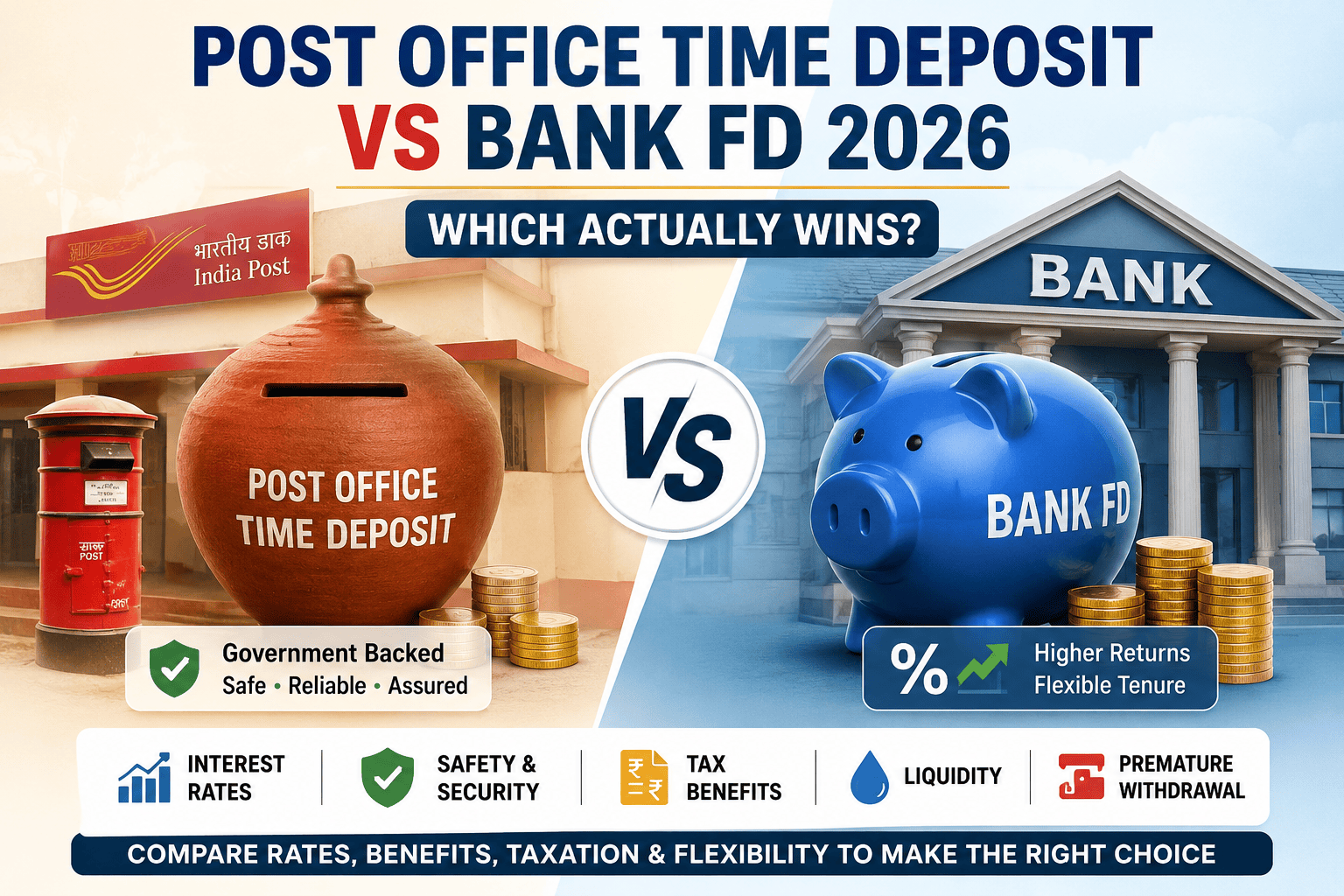

Post Office Time Deposit vs Bank FD 2026: Which Actually Wins
Post Office Time Deposit vs Bank FD is a question we hear a lot from readers who assume it has one clean answer — it genuinely doesn't. We've watched people default to whichever one their family has always used, without actually checking what the other side currently offers. The honest answer this year depends heavily on which bank you're comparing against, because a small finance bank FD and an SBI FD are nowhere near the same conversation, even though both get lumped together as "bank FD."
This continues our Government Schemes series alongside Sukanya Samriddhi Yojana, Kisan Vikas Patra, and NSC. This one's a genuine head-to-head rather than a single scheme explainer.
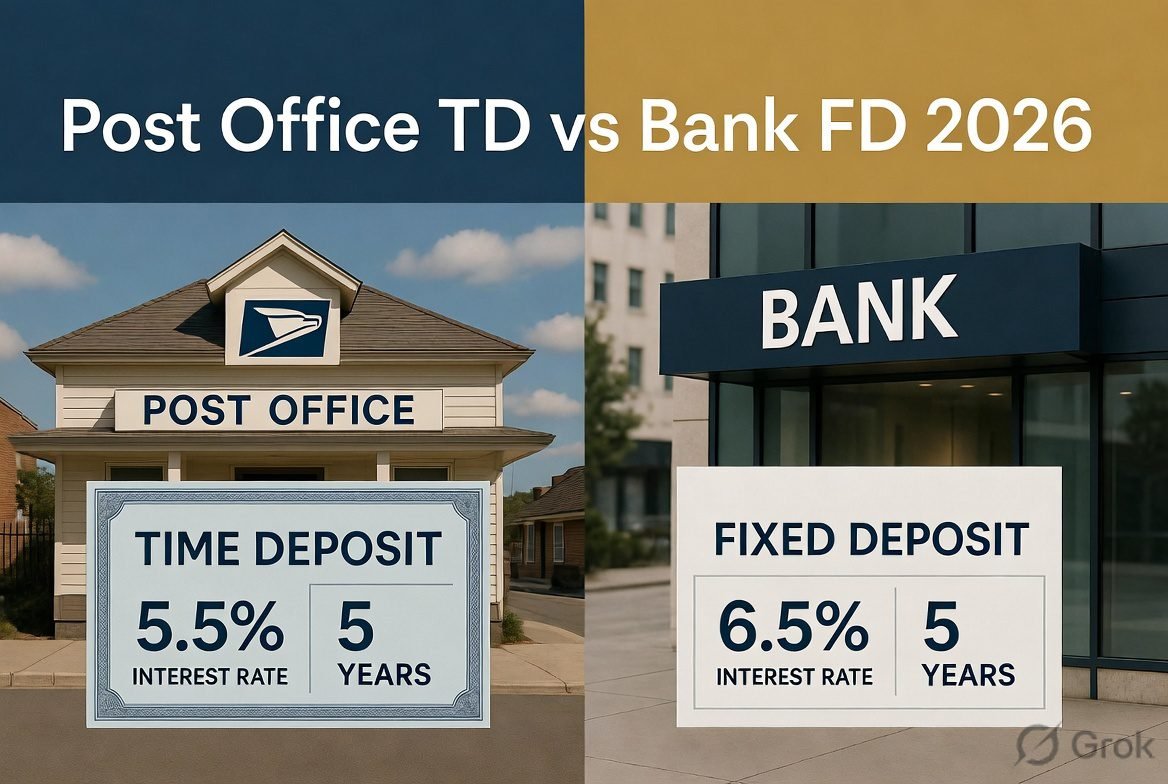
Table of Contents
- Current Rates, Side by Side
- The Safety Gap Almost Nobody Checks
- The Senior Citizen Catch on Post Office FDs
- Tax Treatment: Genuinely Identical, With One Exception
- Premature Withdrawal: Where the Rules Actually Differ
- When Post Office Time Deposit Genuinely Wins
- When a Bank FD Genuinely Wins
- How to Open Either One
- Frequently Asked Questions
Current Rates, Side by Side
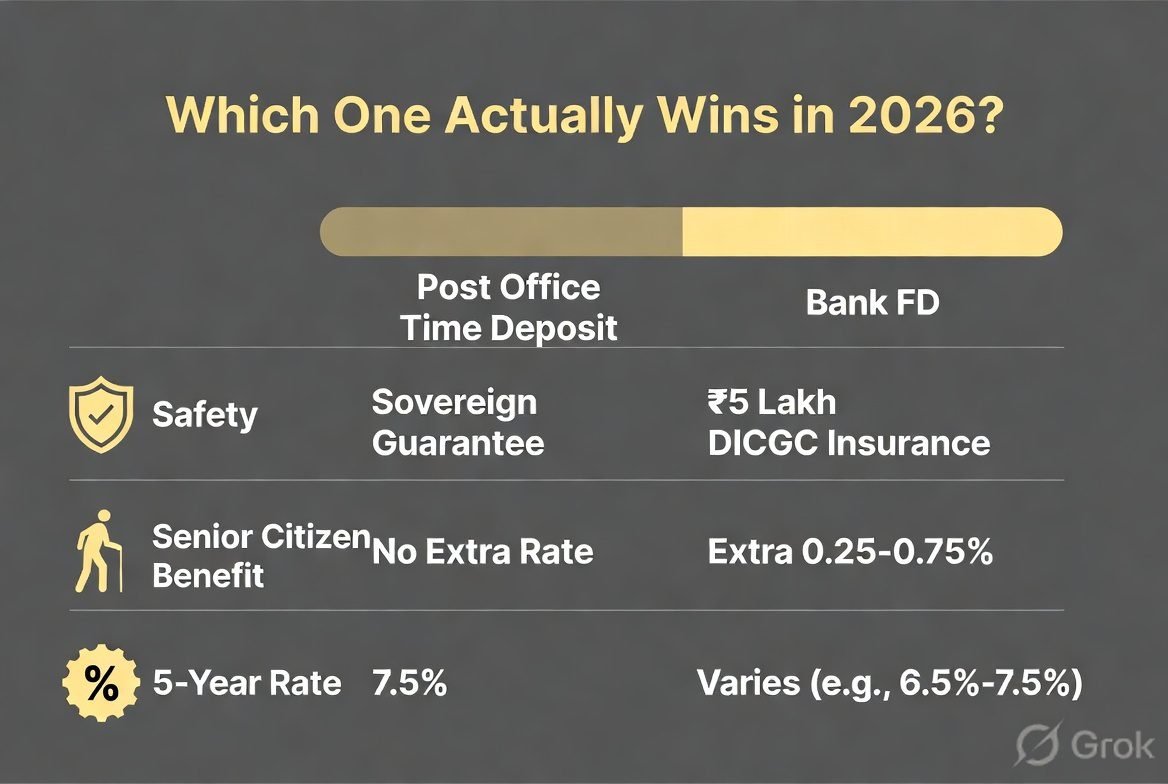
For April-June 2026, Post Office Time Deposit rates are 6.9% for one year, 7.0% for two years, 7.1% for three years, and 7.5% for five years, compounded quarterly and paid annually. The rate is fixed for the full term once the deposit is made — a five-year TD opened today keeps 7.5% even if later quarters bring a rate change.
Rate Snapshot — 2026
| Post Office TD, 1 year | 6.9% |
| Post Office TD, 5 years | 7.5% |
| PSU Bank FD (typical) | 6.0% – 6.75% |
| Private Bank FD (typical) | 6.5% – 7.35% |
| Small Finance Bank FD (top) | Up to 8.10% |
Small finance banks were offering FD rates up to 8.10%, several private banks between 6.5% and 7.35%, and PSU bank FD rates largely between 6% and 6.75%. Comparatively, POTD rates for April-June 2026 are currently more competitive than many PSU bank FDs specifically, even though they trail the top small finance bank rates. Live, bank-by-bank FD rate comparisons are tracked on aggregator sites like Paisabazaar's FD rate tracker, useful for checking today's actual numbers before committing to any single bank.
The Safety Gap Almost Nobody Checks
This is genuinely the detail we think gets underweighted in most comparisons, especially when small finance banks are offering the flashiest headline rates. Post Office FDs carry a sovereign guarantee from the Government of India — your entire principal and interest earned are fully protected, with no upper limit. Bank FDs, by contrast, are insured by DICGC only up to ₹5 lakh per depositor per bank. Full details on deposit insurance coverage are published on the DICGC's official website.
Post Office TD
Sovereign guarantee. Your full deposit is protected regardless of size — ₹5 lakh or ₹50 lakh, all of it is government-backed.
Bank FD
DICGC insurance covers only ₹5 lakh per depositor, per bank. Anything above that, in a genuine bank failure scenario, isn't guaranteed.
For smaller deposits well under ₹5 lakh, this distinction genuinely doesn't matter much in practice — both are effectively safe. But if you're parking a genuinely large sum, splitting it across post office and multiple banks (to stay under each bank's ₹5 lakh DICGC cap) is worth actually thinking through, rather than assuming any bank FD is automatically as safe as a government scheme regardless of size.
The Senior Citizen Catch on Post Office FDs
Here's a detail that surprises a lot of senior citizens specifically. Unlike banks, Post Office FDs do not offer additional interest benefits for senior citizens — the rate stays identical to the regular citizen rate across every tenure. Banks, by contrast, typically give senior depositors an extra 0.25% to 0.75% on top of the standard rate.
This is genuinely one of the clearer cases where a bank FD can outright beat the post office option for the exact same tenure, purely because of the senior citizen premium. That said, if you're a senior citizen with a genuinely large sum to place, our SCSS guide covers an option that beats both of these outright — SCSS is specifically built for this age group and currently pays meaningfully more than either a post office TD or most bank FDs.
Tax Treatment: Genuinely Identical, With One Exception
| Feature | Post Office TD | Bank FD |
|---|---|---|
| Interest Taxation | Fully taxable at slab rate | Fully taxable at slab rate |
| Section 80C Benefit | Only the 5-year tenure | Only specific 5-year "tax-saving FD" products |
| TDS Threshold | Standard bank TDS rules apply | Standard bank TDS rules apply |
The 5-year Post Office Time Deposit qualifies for deduction under Section 80C of the Income Tax Act. Tax-saving bank FDs with a matching 5-year lock-in also qualify for the same Section 80C benefit. The tax treatment here is genuinely a wash between the two — what matters is picking the specific 5-year product on either side, since shorter tenures on both post office and regular bank FDs don't carry any 80C benefit at all.
Premature Withdrawal: Where the Rules Actually Differ
If a 1-year, 2-year, or 3-year Post Office TD is closed after 6 months but before 1 year, interest is paid only at the applicable Post Office Savings Account rate for the completed period — a genuinely modest fallback rate, much lower than the TD rate you'd have earned by holding on. POTDs allow premature withdrawal only after six months, with reduced interest rates applying in that case.
Bank FDs generally offer easier premature withdrawal facilities, though penalties may apply — typically a percentage-point reduction on the rate rather than a full drop to a savings-account-level rate. This is genuinely one place where banks tend to have an edge in flexibility, even if the post office option wins on pure headline safety.
Read Our SCSS Guide for Retirees →When Post Office Time Deposit Genuinely Wins
You're depositing a large sum and want it fully government-guaranteed — the sovereign backing with no upper limit is a genuine advantage over DICGC's ₹5 lakh cap on bank FDs.
You're comparing against a PSU bank specifically — at 7.5% for a five-year term, POTD currently beats many PSU bank FD rates outright, which tend to sit in the 6-6.75% range.
You want the 5-year, 80C-eligible option without hunting for a specific "tax-saving FD" product at a bank — the post office 5-year TD is straightforwardly 80C-eligible by default.
When a Bank FD Genuinely Wins
You're a senior citizen — the additional 0.25-0.75% most banks offer can meaningfully beat the post office's flat, no-bonus rate across every tenure, though SCSS beats both if you're eligible.
You're comfortable with a small finance bank's slightly higher risk profile for a meaningfully higher rate — small finance banks were offering up to 8.10%, a real gap over even the best post office rate, provided you stay within DICGC's ₹5 lakh coverage per bank.
You want more flexible premature withdrawal terms — banks generally offer gentler penalties for early exit than the post office's savings-account-rate fallback.
How to Open Either One
A Post Office FD can be opened at any post office branch, or online through the India Post Mobile Banking app — download it, log in, go to the "Requests" tab, select "Open POFD Account," and fill in the required details. The minimum deposit is ₹1,000, with no upper ceiling.
Bank FDs can be opened through net banking, mobile apps, or in-branch, with most major banks now offering instant digital FD creation for existing account holders. Official post office rates are published quarterly by the National Savings Institute, while current bank-by-bank FD rates are worth checking directly on each bank's website since they change independently of the government's quarterly small savings notification.
Frequently Asked Questions
What is the current Post Office Time Deposit interest rate?
For April-June 2026, rates are 6.9% for 1 year, 7.0% for 2 years, 7.1% for 3 years, and 7.5% for 5 years, compounded quarterly.
Is Post Office FD safer than a bank FD?
Post Office FDs carry a full sovereign guarantee with no upper limit. Bank FDs are insured by DICGC only up to ₹5 lakh per depositor per bank, so for large deposits, the post office option is genuinely safer.
Do senior citizens get a higher rate on Post Office FDs?
No, Post Office FD rates are identical for senior and regular citizens. Banks, by contrast, typically offer senior citizens an additional 0.25% to 0.75%.
Which Post Office FD tenure qualifies for tax deduction?
Only the 5-year Post Office Time Deposit qualifies for Section 80C deduction. Shorter tenures do not carry this benefit.
Can I withdraw a Post Office FD before maturity?
Premature withdrawal is allowed only after 6 months, and interest is paid at a reduced rate for the period held, rather than the full TD rate.
Which offers a higher interest rate: Post Office TD or bank FD?
It depends on the bank. Post Office TD currently beats most PSU bank FD rates but trails top small finance bank rates, which can go up to 8.10%.
Our Bottom Line
There's genuinely no universal winner here — it depends on which specific bank you're comparing against, your deposit size, and whether you're a senior citizen. For large sums where safety is the priority, post office wins on the sovereign guarantee alone. For senior citizens specifically, a bank FD's bonus rate (or better yet, SCSS) usually beats the flat post office rate. And if you're chasing the highest possible number and comfortable with a small finance bank, that's where the real rate gap shows up.
For more government-backed comparisons in this series, our Kisan Vikas Patra and NSC guides cover other fixed-return options worth weighing alongside this one.

Pranab Barman is a Financial Educator and Personal Finance Researcher with over 10 years of hands-on experience in stock markets, trading, and investing. Currently enrolled in the CFA Program, he is committed to continuous learning and professional excellence in finance.
As the Founder of PlayWithStock, Pranab covers a wide range of topics including Mutual Funds, SIP, Taxation, Stock Market Basics, and Financial Calculators — with a focus on simplifying complex financial concepts for everyday all investors.
Email: support@playwithstock.com
Website: playwithstock.com
Related posts:
 All Post Office Savings Schemes Compared 2026: The Full Picture
 HDFC Bank, ICICI Bank, Axis Bank & Kotak Bank Q1 FY27 Results: The Complete Comparison
 119 Years Old and Still Beating Every Major Private Bank on FD Rates — Inside the Bank of Baroda FD Scheme Lineup
 EPF vs NPS vs PPF 2026: Which Retirement Option Actually Suits You
 Retirement Calculator India 2026: How Much You Actually Need to Save
 How Does SIP Actually Work? 7-Point Breakdown for All Investors
 Large Cap vs Mid Cap vs Small Cap Funds: What SEBI’s Rules Actually Mean for You
 Best AI Stocks India 2026: 7 Picks That Are Actually Worth Watching