

A number that doesn’t contain a single rupee in its formula, and yet quietly moves petrol prices, gold rates, and your mutual fund returns
Table of Contents
- A Number With No Rupee in It
- What Exactly the Dollar Index Measures
- This Week’s Dollar Story: What’s Actually Happening Right Now
- The Four Channels Through Which DXY Reaches Your Wallet
- A Real Example: The Rupee’s Record Low, and What Followed
- How RBI Steps Into the Picture
- Practical Takeaways for Indian Investors
- Frequently Asked Questions
- Disclaimer
A Number With No Rupee in It
The Strange Fact Most Explainers Skip
Here’s something that surprises most people the first time they hear it: the Indian rupee isn’t even one of the currencies used to calculate the Dollar Index. Neither is the Chinese yuan, despite China being one of America’s largest trading partners. The index tracks the dollar against just six currencies — the euro, Japanese yen, British pound, Canadian dollar, Swedish krona, and Swiss franc — a basket assembled back in 1973 and barely updated since.
And yet, on any given day, a move in this six-currency index can push the rupee up or down, shift the price of gold at your local jeweller, and change how much you pay to fill a fuel tank. Understanding why requires understanding what the index actually is, and what it isn’t.
What Exactly the Dollar Index Measures
The Dollar Index, commonly written as DXY (also called USDX or, informally, “the Dixie”), measures the value of the US dollar relative to a weighted basket of six major foreign currencies. It was created in 1973, shortly after the Bretton Woods system — which had pegged global currencies to the dollar, and the dollar to gold — was dismantled. The index started at a base value of 100, meaning any reading above 100 today indicates the dollar has strengthened since 1973, and any reading below indicates weakening.
Why the Euro Dominates the Calculatio
The euro carries by far the heaviest weight in the index — roughly 57.6%, more than all five other currencies combined. This is a direct legacy of the eurozone’s scale as a US trading partner. When financial news says “the dollar index fell because the euro strengthened,” this is exactly why a single currency pair can move the entire index so heavily.
A Softer Dollar Following a Weak US Jobs Report
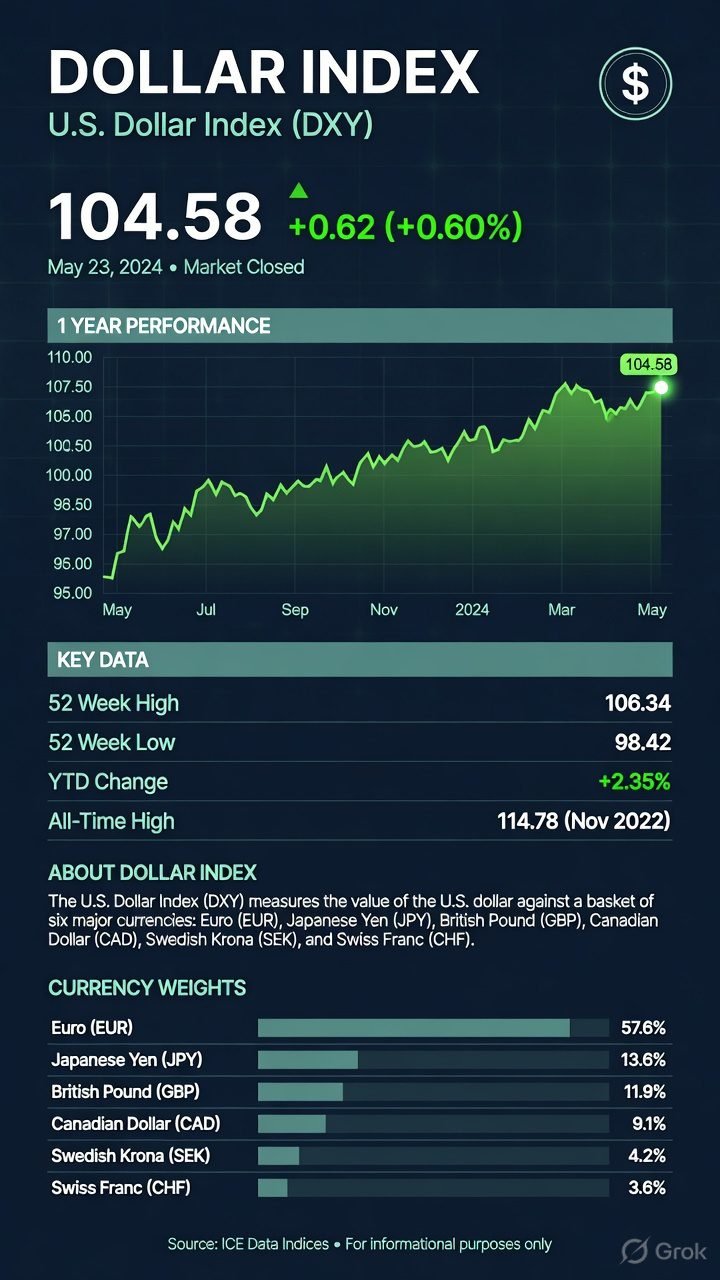
As of this week, the Dollar Index has been trading just below the 101 level, holding near a three-week low after posting its steepest weekly decline since April. The trigger was last week’s US jobs report, which showed a sharp slowdown in job growth for June, along with downward revisions to the payroll figures for the two months before that.
Fed Rate Hike Odds Have Been Cut in Half
That weaker labour market data immediately changed how traders are pricing the US Federal Reserve’s next move. Before the jobs report, markets had priced in roughly a two-thirds probability of a Fed rate hike by September. After the data, that probability dropped to somewhere close to 50%. Since higher US interest rates typically attract global capital into dollar assets, reduced odds of a hike take some of the wind out of the dollar’s sails — which is exactly what’s been playing out this week.
A Mixed Picture Beneath the Surface
The dollar’s weakness this week hasn’t been uniform. Against most major currencies, it has softened noticeably. But against the Japanese yen specifically, the dollar remains near a 40-year high, as persistent concerns about Japanese currency intervention keep traders cautious about betting too aggressively against the dollar-yen pair. Meanwhile, oil prices have been retreating toward pre-conflict levels, easing some of the inflationary pressure that had earlier supported the case for higher rates. Markets are now watching for the minutes of the Fed’s June policy meeting, due for release this week, for further clues on the path ahead.
The Four Channels Through
Which DXY Reaches Your Wallet
None of the six currencies in DXY is the rupee — so the connection to India works indirectly, through a handful of well-established channels.
India imports roughly 85% of the crude oil it consumes, and oil is priced globally in US dollars. When the dollar strengthens broadly (DXY rising), oil often becomes relatively more expensive for non-dollar economies to buy, even if the dollar-denominated oil price itself hasn’t moved — squeezing India’s import bill and, eventually, domestic fuel prices.
2. Gold Prices
Gold, like oil, is priced internationally in dollars. A stronger dollar generally makes gold more expensive in other currencies (including rupees), while a weaker dollar — like the one seen this week — tends to make gold relatively more affordable domestically, all else being equal.
A strengthening dollar tends to pull global capital toward dollar-denominated assets and away from emerging markets, including India. When DXY rises sharply, foreign investors have historically pulled money out of Indian equities and bonds; when it eases, as it has this week, that pressure tends to lighten, sometimes supporting Indian markets.
4. IT and Export Company Earnings
Indian IT services companies earn a large share of their revenue in dollars while paying most of their costs in rupees. A weaker rupee (often, though not always, associated with a stronger dollar) tends to boost their reported earnings when converted back to rupees — one of the few corners of the Indian market that can actually benefit from dollar strength.
Numbers make this connection concrete. On May 20, 2026, the Reserve Bank of India’s official reference rate recorded the rupee at an all-time low of 96.844 against the dollar — the weakest the rupee has ever been on record.
By July 8, 2026, less than two months later, that same reference rate had recovered to 95.224 — a meaningful improvement, though still historically weak by longer-term standards. This recovery lines up closely with the broader dollar weakness described above: as DXY eased off its highs following soft US economic data, the rupee, like most emerging market currencies, found some breathing room.
What This Shows About Cause and Effect

This doesn’t mean DXY is the only factor driving the rupee — India’s own trade deficit, inflation, and capital flows matter enormously too. But the timing of the rupee’s recovery alongside the dollar’s broader retreat illustrates the connection in a way that’s hard to dismiss as coincidence.
How RBI Steps Into the Picture
The Reserve Bank of India doesn’t simply let the rupee float freely in response to global dollar swings. With forex reserves exceeding $600 billion, the RBI actively intervenes in currency markets — buying or selling dollars as needed — to smooth out excessive volatility, even though it generally doesn’t target a specific exchange rate level. This is why the rupee’s moves, while correlated with DXY, are rarely a one-to-one mirror of it.
Five Things Worth Watching
- Don’t treat DXY as an India-specific indicator. It’s a US-centric measure; the rupee’s connection to it is real but indirect, filtered through oil, gold, FPI flows, and RBI action.
- A rising DXY is generally a headwind for Indian equities, since it tends to coincide with FPI outflows — though domestic factors can offset this.
- IT sector investors should watch DXY and USD/INR together — a weaker rupee alongside dollar strength has historically supported IT earnings in rupee terms.
- Gold buyers can benefit from dollar weakness, as a softer DXY tends to ease upward pressure on domestic gold prices.
- US Fed policy decisions move DXY, and DXY moves emerging markets — keeping half an eye on US jobs data and Fed commentary is genuinely relevant even for a purely domestic Indian portfolio.
Frequently Asked Questions
Does the Dollar Index include the Indian rupee?
No. DXY tracks only six currencies — the euro, Japanese yen, British pound, Canadian dollar, Swedish krona, and Swiss franc. The rupee, yuan, and most other emerging market currencies are not part of the index at all.
Why did the Dollar Index fall this week?
A weaker-than-expected US jobs report for June, along with downward revisions to prior months’ data, led traders to scale back expectations of a Federal Reserve interest rate hike in September, reducing demand for the dollar relative to other major currencies.
If DXY doesn’t include the rupee, why does it affect USD/INR?
Because oil, gold, and global capital flows — all of which influence the rupee — are priced or denominated in dollars globally. A broad move in the dollar’s strength against major currencies tends to ripple into emerging market currencies like the rupee, even without a direct mathematical link.
Is a weaker dollar good or bad for India?
Broadly positive for import costs (especially oil) and for easing pressure on the rupee, but it can modestly reduce the rupee-converted earnings of IT and other dollar-revenue exporters. The net effect depends on which sectors of the economy and market you’re looking at.
Where can I track the Dollar Index and USD/INR in real time?
Financial data platforms and the RBI’s own reference rate archive publish daily updates; for Indian investors, tracking both DXY and the RBI reference rate together gives a fuller picture than either number alone.
This article is for educational and informational purposes only and does not constitute investment or trading advice. Market levels, rates, and figures referenced reflect publicly available data as of the stated dates and are subject to constant change — please verify current levels before making any financial decisions, and consult a qualified financial advisor for guidance specific to your situation.
— Pranab, Play With Stock

Pranab Barman is a Financial Educator and Personal Finance Researcher with over 10 years of hands-on experience in stock markets, trading, and investing. Currently enrolled in the CFA Program, he is committed to continuous learning and professional excellence in finance.
As the Founder of PlayWithStock, Pranab covers a wide range of topics including Mutual Funds, SIP, Taxation, Stock Market Basics, and Financial Calculators — with a focus on simplifying complex financial concepts for everyday all investors.
Email: support@playwithstock.com
Website: playwithstock.com
Related posts:
 Rupee vs Dollar July 2026: 5 Shocking Reasons the Rupee Is Falling
 Monsoon 2026 India Inflation: Why a Dry June Hits Grocery Bills
 What is the Strait of Hormuz and Why Does It Affect India? Complete Guide 2026
 Why Is the Stock Market Falling Today? US-Iran Tensions, Crude Oil Spike & FII Selling Explained
 Fed Rate Hike 2026: Why the July 28-29 FOMC Meeting Could Change Everything
 India US Trade Deal 2026: Inside the Tariff Rollercoaster Before July 22
 Oil Price Crash 2026: How the End of a War Is Reshaping India’s Economy
 India Exports Q1 FY27: The Complete Growth Story (And the Part Most Headlines Skipped)