
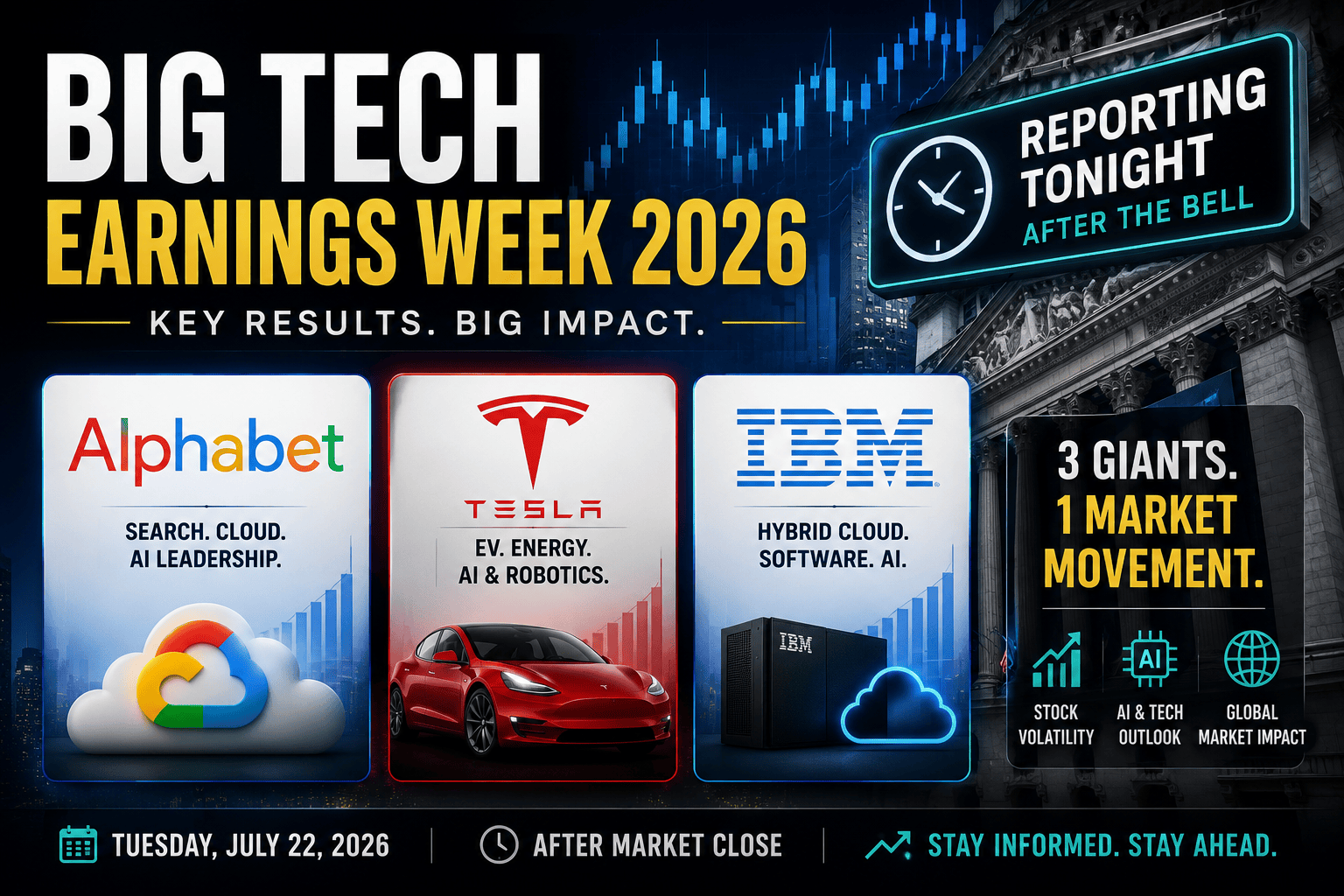

Big Tech Earnings Week 2026: Alphabet, Tesla, IBM Report Tonight
Big Tech Earnings Week 2026 reaches its most anxious night tonight. Three genuinely different companies — a search-and-cloud giant, an EV-and-AI bet, and a legacy enterprise software firm trying to prove it still matters — all report after the closing bell on the same Wednesday. That's not a coincidence traders love; options desks have been pricing in outsized moves for days.
We've been tracking this earnings season closely because the pattern it sets tends to ripple well beyond the three tickers reporting tonight — into chip stocks, into AI-adjacent names, and into how global markets, including ours here in India, read the health of the broader AI capital expenditure story. If you're also watching Indian AI-linked names, our best AI stocks India 2026 and AI investing guide covering both US and India connect directly to tonight's results.
Table of Contents
- Why Tonight Matters More Than a Normal Earnings Night
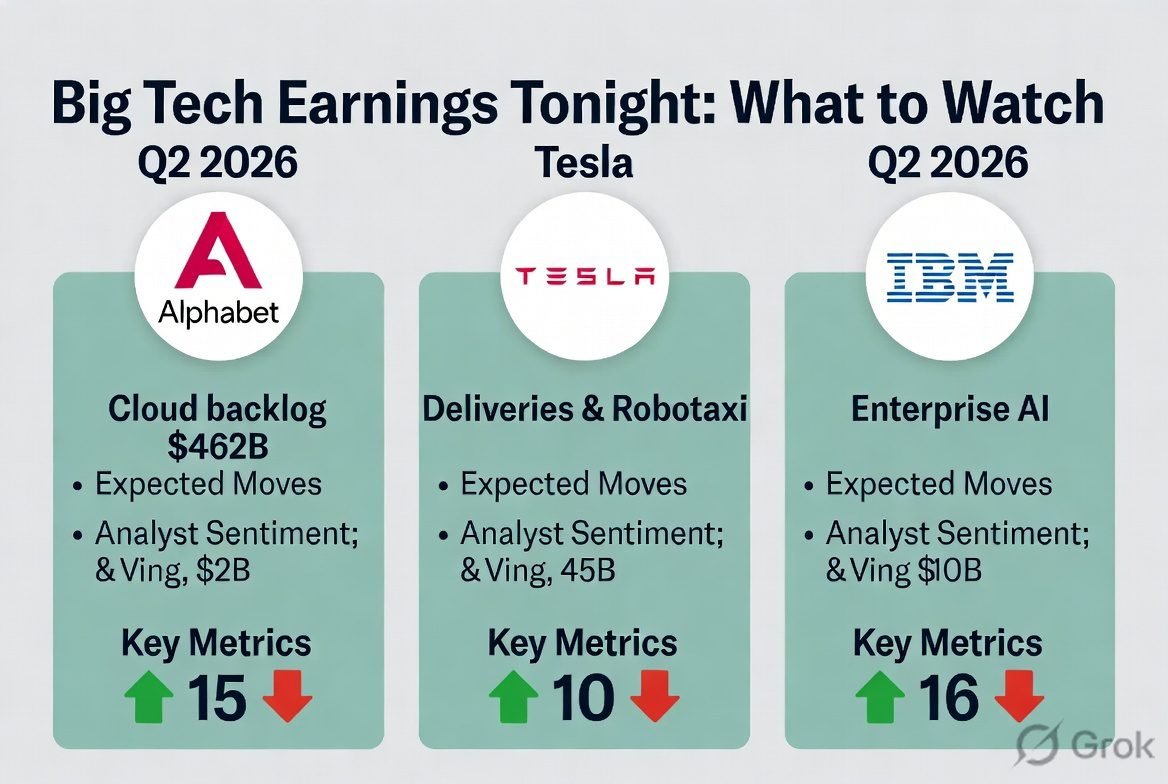
- Alphabet: The $462 Billion Cloud Backlog Question
- Tesla: Deliveries Beat, But the Real Test Is Elsewhere
- IBM: Limping In After a Brutal July
- What Options Traders Are Actually Betting
- The Broader Earnings Season Backdrop
- Iran Tensions and Oil Prices Are Still in the Room
- What to Watch When Results Actually Drop
- Frequently Asked Questions
Why Tonight Matters More Than a Normal Earnings Night
Alphabet, Tesla, and Intel's Q2 2026 earnings represent the first real test of whether AI capital expenditure is actually paying off at scale — and Tesla, Alphabet, and IBM are all reporting after Wednesday's closing bell, with options traders bracing for single-day swings as large as 7% from all three stocks. That's an unusually large expected move for companies this size, and it tells you the market genuinely doesn't have consensus on what tonight will bring.
The reports follow a genuinely tough week on Wall Street, with major benchmarks dragged lower by a decline in semiconductors and simmering tensions between Iran and the US. That backdrop matters — tonight's results are landing into a market that's already nervous, which tends to amplify whatever direction the numbers point.
It's also worth understanding why these three specific companies got grouped into the same night in the first place, since it isn't arbitrary. Alphabet and Tesla are both members of the so-called Magnificent Seven, the small cluster of mega-cap tech names that have driven an outsized share of US index returns over the past few years. IBM isn't part of that group by market cap, but it's become a genuinely useful bellwether for enterprise AI adoption specifically — the corporate, business-to-business side of the AI story, as opposed to the consumer and infrastructure side that Alphabet and Tesla represent. Watching all three together gives a more complete read on the AI trade than any single report could on its own.
Alphabet: The $462 Billion Cloud Backlog Question
Analysts project Alphabet's fiscal 2026 earnings per share at $14.32, representing 32.5% annual growth, with a further increase to $14.85 expected in fiscal 2027. Shares have risen roughly 98% over the past year, outperforming both the S&P 500 and the Communication Services Select Sector SPDR Fund, and 43 of 53 analysts rate the stock a Strong Buy with an average price target implying roughly 22% further upside.
The number everyone's actually watching, though, isn't the headline EPS figure. Alphabet's $462 billion Google Cloud backlog is the real test of whether the company's AI infrastructure spending is translating into durable, contracted future revenue — not just impressive-sounding capex announcements. The tech giant is expected to continue its growth trajectory with earnings and revenue up 23% and 24% respectively, according to consensus estimates.
You can track Alphabet's official investor communications directly through Alphabet's Investor Relations page, and live analyst estimate revisions are aggregated by Zacks Investment Research and MarketBeat's analyst ratings tracker.
There's a specific reason the stock recently cooled off a bit despite the bullish analyst ratings. The company raised additional equity to help finance its AI expansion, and while that's a reasonable capital allocation decision for a company betting big on infrastructure, any equity raise technically dilutes existing shareholders, which explains some of the near-term hesitation even among analysts who remain structurally bullish. Tonight's numbers will be the first real chance for the market to judge whether that additional capital is already showing up as accelerating cloud revenue, or whether it's still mostly sitting in unbuilt data center capacity.
Tesla: Deliveries Beat, But the Real Test Is Elsewhere
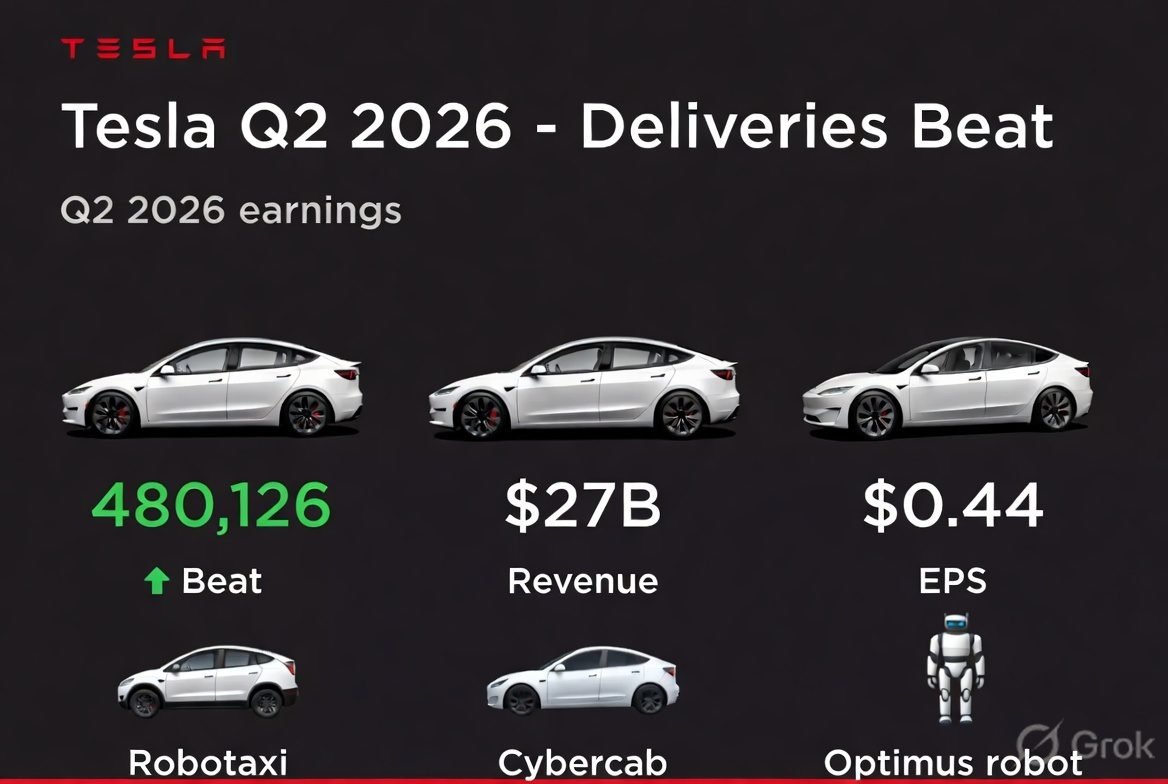
Tesla Q2 2026 — Analyst Consensus Snapshot
| Revenue Estimate | $27 billion |
| Net Income Estimate | $1.27 billion |
| EPS Estimate | $0.44 (GAAP) |
| Actual Q2 Deliveries | 480,126 units |
| Delivery Estimate (Beaten) | 406,024 units |
| 2026 Stock Performance | Down ~15% YTD |
Tesla already cleared one major hurdle before tonight even arrives. The company delivered 480,126 vehicles in Q2, handily beating the analyst average estimate of 406,024 — a genuinely large beat on the metric investors watch most closely before the financial numbers even land. Analysts expect Tesla to report second-quarter earnings per share of 44 cents, up from 40 cents in the same quarter last year.
But the stock's 2026 story has been rockier than the delivery beat suggests. Tesla has been one of the worst-performing Magnificent Seven stocks in 2026, with shares trading lower after three of the last four earnings reports, averaging a 5% loss over that stretch. That's exactly why tonight carries extra weight — shareholders are hopeful this quarter will be the one that helps turn things around, in the words of one market strategist tracking the stock closely.
What's actually going to move the stock probably isn't the revenue line. Executive commentary is expected to center on the status of the Robotaxi service and its expansion, concrete updates on the Cybercab and Optimus humanoid robot, and progress on unsupervised Full Self-Driving. Specifically, analysts and investors are looking for concrete deployment metrics from the Cybercab service, including fleet size and revenue contribution. Current analyst price targets range widely — from Morgan Stanley's $417 to Wells Fargo's $130 and GLJ Research's bearish $24.86, reflecting a genuinely unusual level of disagreement about the stock's fair value.
Real-time delivery and production data, along with official shareholder letters, are published directly on Tesla's Investor Relations site, and the live earnings call is typically streamed the same evening. Independent Tesla-focused coverage and forum sentiment can also be tracked through outlets like Electrek and Not a Tesla App, both of which tend to move faster on granular product updates than mainstream financial press.
One detail that's easy to miss in the headline delivery beat: strong unit deliveries don't automatically mean strong margins. Tesla has leaned on price cuts and incentives in various markets over the past several quarters to keep volume moving, and the gap between delivery growth and actual profit growth is exactly where a lot of the disagreement between bullish and bearish analysts comes from. A genuinely strong quarter tonight would show both rising deliveries and stabilizing or improving margins together — deliveries alone, without margin support, tends to get a more muted market reaction than the raw unit numbers might suggest.
IBM: Limping In After a Brutal July
IBM's story tonight is genuinely different in tone from the other two. IBM is set to report earnings after the closing bell, having suffered its worst session on record after posting preliminary figures earlier this month that sent the stock plunging. Analysts polled by LSEG expect the company to post earnings growth of more than 5% this quarter — a modest number compared to Alphabet's, but a genuinely important one for a company trying to prove its AI and enterprise software pivot has real legs.
IBM's quarterly filings and management commentary are available directly through IBM's Investor Relations page, and historical earnings reaction data can be cross-checked on FactSet's earnings insight reports, one of the primary sources most Wall Street desks rely on for blended earnings growth figures. Analyst sentiment specifically on IBM can be tracked through TipRanks' analyst consensus page.
IBM occupies a genuinely different role in this earnings trio than the other two. Neither Alphabet nor Tesla needs to convince the market it's relevant to AI — both are already treated as core AI infrastructure or AI-adjacent plays by default. IBM's challenge is different: it has to actively demonstrate that a decades-old enterprise software business can credibly pivot into the AI era without losing its existing customer base in the process. That's a harder story to tell in a single earnings call, which is part of why the stock's reaction to management's tone tonight may matter as much as the actual reported numbers.
What Options Traders Are Actually Betting
| Stock | Expected Move (Options Market) | Positioning Bias |
|---|---|---|
| Tesla | ~5.6% by Friday, 7.4% within a week | Large put bets, skewed bearish |
| Alphabet | Up to 7%, per broader estimate | Options flow leans strongly bullish |
| IBM | Up to 7%, historically volatile post-earnings | Cautious, given July's plunge |
Options traders are bracing for big single-day swings from all three stocks tonight, with recent history explaining the nerves — Alphabet's last report moved the stock almost twice as much as the options market had priced in, and IBM's July warning erased a quarter of its value in a single day. Big put bets are specifically targeting Tesla, while Alphabet's options flow leans strongly bullish — a genuinely different market read on the two stocks despite both reporting the same night.
If you're new to reading options pricing as a sentiment signal rather than trading options directly yourself, it's worth understanding that a large "expected move" priced by the options market isn't a prediction of direction — it's simply the market's estimate of how much uncertainty exists heading into the print. Live options data of this kind is tracked on platforms like OptionCharts and CBOE's delayed quotes page.
The Broader Earnings Season Backdrop
Tonight's three reports are landing into a genuinely strong overall earnings season, which raises the bar for what counts as a "good" result. The blended earnings growth rate for the S&P 500 in Q2 2026 stands at 24.7%, up from a starting estimate of 23.2% at the end of June, and would mark the second consecutive quarter of earnings growth above 20% if it holds through the rest of the season. Of the S&P 500 companies that have already reported, 88% have exceeded analyst earnings estimates — well above the five-year historical average of roughly 78%.
Interestingly, the story isn't confined to the mega-cap names everyone's watching tonight. The remaining 493 S&P 500 companies outside the Magnificent Seven are themselves on pace for 22.8% blended earnings growth in Q2, which would be their highest rate since Q4 2021, meaning the gap between mega-cap tech and the rest of the market is genuinely narrowing. That's a meaningfully different market than the narrow, mega-cap-driven rallies of a few years ago.
The week's broader earnings playbook also includes General Motors, which raised its 2026 guidance and topped Q1 estimates last quarter, and CME Group, which has topped analyst earnings expectations in 21 of the last 22 quarters. Later in the week, American Express offers a read on higher-income consumer spending and credit quality, while Verizon closes things out from the telecom side, with investors watching subscriber growth, pricing, and cash flow stability.
Compare: How India's Q1 FY27 Earnings Season Is Shaping Up →Iran Tensions and Oil Prices Are Still in the Room
Earnings aren't happening in a vacuum tonight. Wall Street investors bracing for the start of the megacap earnings season sent stocks lower earlier this week, with the market also falling as worries about an escalation in the Iran war boosted oil prices. The US had already completed its ninth consecutive day of strikes on Iran, though investor sentiment improved somewhat after Iranian officials signaled openness to a diplomatic settlement.
This same geopolitical backdrop is something we've tracked closely from the Indian market side too — see our coverage of the US-Iran tension impact on Indian markets and the Strait of Hormuz explainer, since oil price spikes genuinely connect US and Indian market sentiment on the same news cycle, even though the two markets are reacting to different specific stock-level catalysts.
Live geopolitical and oil market updates are tracked through Reuters' Middle East desk and OilPrice.com, both useful to check alongside earnings coverage tonight since a sudden escalation could overshadow even a strong Alphabet or Tesla print.
If Results Beat + Geopolitics Calm
Likely a genuinely strong overnight and next-day reaction, potentially lifting broader tech sentiment given how nervous positioning has been into tonight.
If Results Beat + Geopolitics Escalate
A mixed, choppier reaction is plausible — strong company-specific news competing with a risk-off macro tone that can cap gains regardless of the print.
If Results Miss
Given how much put positioning already exists on Tesla specifically and the market's already-tough week, a miss from any of the three could trigger an outsized move on top of already elevated volatility pricing.
What to Watch When Results Actually Drop
For Alphabet, watch the Google Cloud backlog growth rate and operating margin trend more than the headline EPS beat or miss — that's the number analysts are treating as the real AI-spending scorecard. For Tesla, watch the earnings call commentary on Cybercab deployment metrics and FSD progress far more closely than the reported financials, since the delivery beat is already known and priced in, making the qualitative updates the genuine swing factor. For IBM, watch whether management reiterates or walks back the guidance that triggered July's plunge — a steady reaffirmation could matter more than the actual earnings-growth number itself.
If you're holding any of these three stocks or ETFs with meaningful exposure to them, it's worth reviewing your own risk tolerance before the print rather than after — a lesson that applies as much to US mega-cap earnings nights as it does to the behavioral trading mistakes we've written about in the context of Indian markets. The instinct to react emotionally to a 5-7% overnight swing is universal, regardless of which market you're trading.
Frequently Asked Questions
When do Alphabet, Tesla, and IBM report Q2 2026 earnings?
All three companies report after market close on Wednesday, July 22, 2026, with earnings calls typically following shortly after the results are released.
What are analysts expecting from Alphabet's Q2 2026 report?
Analysts project fiscal 2026 EPS of $14.32, representing 32.5% annual growth, with earnings and revenue both expected to grow in the low-to-mid 20% range for the quarter, driven largely by Google Cloud's backlog and AI-related demand.
Did Tesla beat delivery estimates for Q2 2026?
Yes, Tesla delivered 480,126 vehicles in Q2 2026, well above the analyst average estimate of 406,024, though the stock has still underperformed the broader Magnificent Seven group in 2026.
Why did IBM stock crash earlier in July 2026?
IBM posted preliminary figures that sent shares down sharply, marking one of its worst trading sessions on record, and tonight's full report will show whether the company reaffirms or revises the guidance that triggered that decline.
How big of a stock move are options traders pricing in for these earnings?
Options markets are pricing swings of up to 7% for all three stocks, with particularly large put positioning on Tesla and strongly bullish options flow on Alphabet heading into the results.
How is the overall Q2 2026 earnings season performing?
Strongly. The S&P 500's blended earnings growth rate stands at 24.7%, and 88% of companies that have reported so far have beaten analyst estimates, well above the five-year historical average of roughly 78%.
Are Iran tensions affecting tonight's earnings reaction?
They add a layer of macro uncertainty. Markets have been volatile this week partly due to Iran-related oil price concerns, which could amplify or dampen the market's reaction to tonight's individual earnings results regardless of how strong the numbers are.
Our Bottom Line Heading Into Tonight
We'd rather you understand what each of these three companies is actually being judged on — Alphabet's cloud backlog conversion, Tesla's Robotaxi and Cybercab progress beyond the already-known delivery beat, and IBM's ability to reaffirm the guidance that spooked the market earlier this month — than just watch three stock prices flash red or green tomorrow morning. The headline EPS numbers matter, but the qualitative commentary on each call is genuinely where tonight's real signal is likely to come from.
If you're tracking how this connects back to Indian markets specifically, our Fed rate and FOMC watch and Dollar Index explainer are useful companion reads, since US mega-cap earnings sentiment and Fed policy expectations both flow into how FIIs position in emerging markets like India in the days that follow.

Pranab Barman is a Financial Educator and Personal Finance Researcher with over 10 years of hands-on experience in stock markets, trading, and investing. Currently enrolled in the CFA Program, he is committed to continuous learning and professional excellence in finance.
As the Founder of PlayWithStock, Pranab covers a wide range of topics including Mutual Funds, SIP, Taxation, Stock Market Basics, and Financial Calculators — with a focus on simplifying complex financial concepts for everyday all investors.
Email: support@playwithstock.com
Website: playwithstock.com
Related posts:
 Big Bank Earnings July 14: Alarming Preview of JPMorgan, BofA & More
 Q1 FY27 Earnings Season: 140+ Companies — Complete Weekly Results Calendar
 Give the Same $10,000 to Charity in 2025 vs 2026, and Your Tax Break Could Shrink — Here’s Why: OBBBA Tax Changes 2026 Explained
 Monsoon 2026 India Inflation: Why a Dry June Hits Grocery Bills
 India US Trade Deal 2026: Inside the Tariff Rollercoaster Before July 22
 SGB Premature Redemption Calculator 2026: Tax Rules, RBI Dates & Exit Guide
 FATF Anti-Fraud Rules 2026: What They Mean for Indian Investors
 OpenAI IPO 2026: 7 Surprising Facts About the $1 Trillion Listing