


Crude Oil Crosses $100: What the Iran-Israel-US War Means for Your Petrol Price, EMI & Stock Portfolio
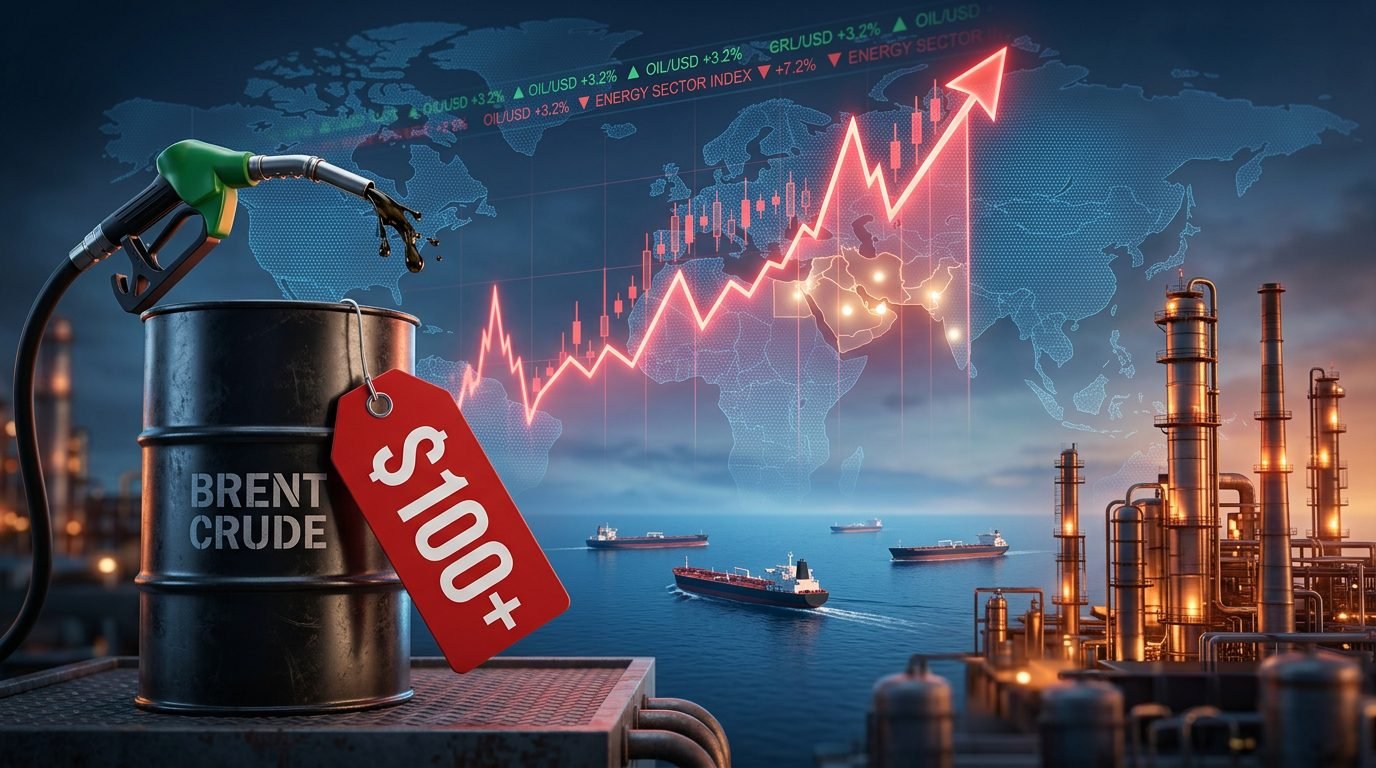
Crude oil has become genuinely impossible to ignore this week — Brent crude closed at $100.69 a barrel on Thursday, up 7% in a single session and briefly touching $102 intraday, its highest level since late May, before easing back toward $88 within the following day on reports that Pakistan, backed by China, was working to revive US-Iran negotiations. If you've felt whiplash trying to follow this story, you're not alone — this is one of the more genuinely volatile, fast-moving geopolitical-economic stories of 2026, and it directly affects your petrol bill, your loan EMI, your investment portfolio, and the broader Indian economy, whether or not you follow markets closely.
We wanted to lay out exactly what's happening, why it matters specifically for India, and — most importantly — what it actually means for your money, in plain terms rather than just repeating headline numbers.
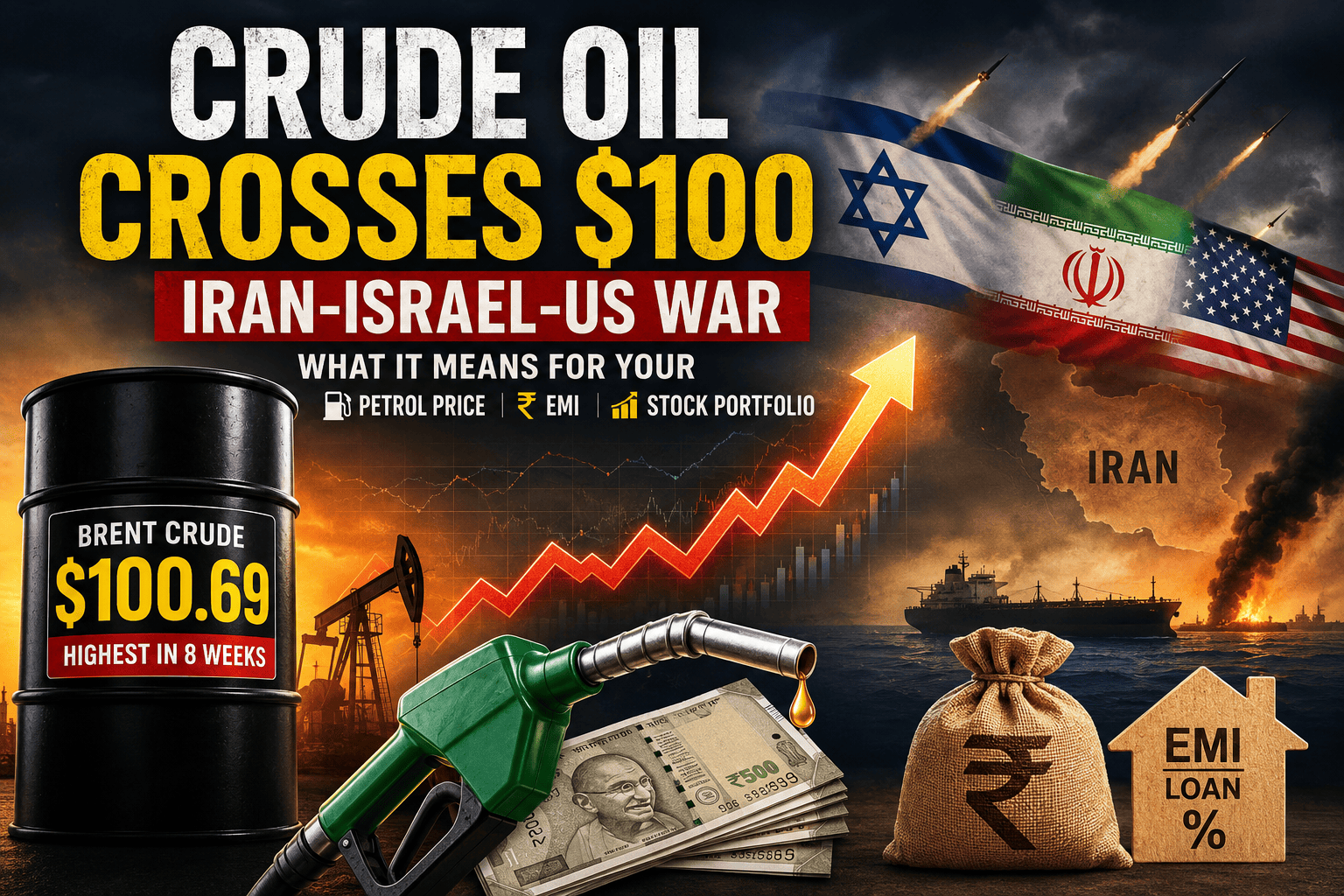
Table of Contents
- What Actually Happened This Week
- The Bigger Picture: 5 Months of Escalation
- Why This Matters So Much for India Specifically
- Impact on Your Petrol & Diesel Prices
- Impact on the Rupee & Inflation
- Impact on Your Home Loan EMI
- Impact on the Stock Market: Winners & Losers
- Real Example: A Household Budget Under Pressure
- What Happens Next: Scenarios to Watch
- What Should You Actually Do Right Now
- Frequently Asked Questions
What Actually Happened This Week
Oil prices jumped to their highest level in nearly two months after the latest escalation in the Iran conflict raised fresh fears of severe disruption to global energy supplies. Brent crude closed higher by 7% on Thursday at $100.69 a barrel, having risen as high as $102 intraday — its highest level in eight weeks. US crude (WTI) jumped for a second straight session, closing 6.2% higher at $92.19, its highest close since early June.
The immediate trigger: Iran-backed Houthi militants attacked two Saudi oil tankers in the Red Sea, a key alternative export route Saudi Arabia has been relying on as fighting continues to disrupt traffic through the Strait of Hormuz — the narrow waterway that carries roughly 20% of the world's oil and LNG trade. US President Trump responded by threatening "major military punishment" against Iran and the Houthis over further Red Sea attacks and said he was "considering a massive attack" on Iran.
As of the most recent data available, Brent has pulled back to around $88 a barrel, still up roughly 7-10% for the week even after the retreat, as traders continue weighing the genuine risk of further supply disruption against fresh diplomatic hope.
The Bigger Picture: 5 Months of Escalation
This week's spike isn't an isolated event — it's the latest chapter in a war that began February 28, 2026, when the US and Israel launched strikes on Iran. Understanding the full arc helps explain why oil markets remain so jumpy even on rumors, rather than confirmed events.
Key Milestones Since the War Began
| Feb 28, 2026 | US and Israel launch strikes on Iran; war begins |
| Early March 2026 | Brent climbs toward $84, highest since July 2024, as Iraq cuts output amid storage limits |
| Late March 2026 | Houthis strike Israel directly; Brent surges past $115 — steepest monthly gain since the 1990 Gulf War |
| April 30, 2026 | Brent hits post-war peak above $126/barrel |
| June 2026 | MoU signed between Washington and Tehran; Brent eases to ~$85, briefly falling below $71 on peace-talk optimism |
| Mid-July 2026 | Hostilities resume; US strikes Iran for a 13th straight day; Brent climbs back toward $85-90 |
| July 24, 2026 | Houthi attacks on Saudi tankers trigger fresh spike to $100.69 |
| July 25, 2026 | Brent eases to ~$88 on reports of revived Pakistan/China-mediated talks |
The pattern that emerges is genuinely important to understand: this conflict has already produced at least three distinct spike-and-retreat cycles in five months, swinging from a post-war peak above $126 down to briefly below $71, and now back up near $100 before easing again. Anyone treating any single day's price as a stable "new normal" has been proven wrong repeatedly this year — volatility, not a settled direction, has been the defining feature of this market so far.
Why This Matters So Much for India Specifically
India is the world's third-largest crude oil consumer and imports over 85% of its total requirement — a structural dependency that makes the country's economy genuinely sensitive to exactly this kind of oil price volatility, unlike energy-self-sufficient economies that can largely shrug off global supply shocks.
India's Oil Import Exposure
| Metric | Detail |
|---|---|
| Import dependency | Over 85% of crude requirement |
| Global consumption rank | 3rd largest, after US and China |
| Main import sources | Iraq, Saudi Arabia, Russia, UAE, US |
| Direct trade with Iran/Israel | Under 1% of India's total trade (limited direct exposure) |
An important nuance worth understanding: India's direct trade with Iran and Israel is minuscule — India's main export to Iran is basmati rice, and trade with Israel, while more diversified, remains small in the overall picture. India isn't directly caught in this conflict's crossfire commercially. The impact is almost entirely transmitted through the global oil price itself, since India buys crude on international markets at whatever the prevailing global price happens to be, regardless of who India's actual crude comes from.
Impact on Your Petrol & Diesel Prices
This is the most direct, tangible way this story reaches your daily life. Higher crude oil prices raise domestic prices across the board — refiners are unlikely to fully absorb higher import costs, and these costs eventually get passed on to consumers through petrol, diesel, and LPG prices, all of which are refined petroleum products used by nearly every household regardless of income level.
Why the Pump Price Doesn't Move Instantly
It's worth understanding why your local petrol price doesn't necessarily spike the same day Brent crude does. Indian oil marketing companies (OMCs) don't adjust retail fuel prices in perfect real-time sync with crude — many refiners hold forward contracts locked in at previously agreed prices, and government and OMC pricing decisions often smooth out short-term volatility rather than passing every single day's crude move directly to the pump. This is exactly why our coverage of oil price movements and India impact emphasizes watching the sustained trend over weeks, not any single day's crude price, as the more reliable signal for where retail fuel prices are actually headed.
That said, if crude prices stay elevated for a sustained period rather than reverting quickly (as they have in each of the previous spikes this year), retail fuel price pressure becomes considerably harder for OMCs to fully absorb, and pump prices historically do eventually move to reflect a genuinely sustained shift in the underlying crude cost.
Impact on the Rupee & Inflation
Beyond fuel prices directly, elevated crude oil costs widen India's import bill, which puts pressure on the current account and, historically, on the rupee's exchange rate against the US dollar. Our rupee vs dollar coverage tracks this relationship closely — a weaker rupee, in turn, makes all of India's other dollar-denominated imports more expensive too, creating a broader inflationary ripple beyond just fuel.
The Inflation Transmission Chain
| Step | Effect |
|---|---|
| 1. Crude oil price rises | India's import bill grows |
| 2. Import bill grows | Current account deficit widens, rupee faces depreciation pressure |
| 3. Rupee weakens | All dollar-denominated imports become costlier |
| 4. Fuel and import costs rise | Transportation and logistics costs rise across the economy |
| 5. Broader inflation | CPI inflation risk rises, potentially affecting RBI policy stance |
India's specific inflation basket gives this chain extra force compared to some other economies — food and energy carry a meaningfully higher weight in India's CPI calculation than in many developed markets, and a sustained oil-driven inflation impulse can complicate the RBI's policy calculus, particularly if it's already navigating a rate-cutting cycle, as our RBI repo rate coverage has tracked through 2026.
Impact on Your Home Loan EMI
This is the connection that surprises many readers — how does a war in the Middle East end up affecting a home loan EMI in India? The transmission runs through inflation and RBI policy: if sustained oil-driven inflation pressure pushes the RBI toward pausing rate cuts, or in a worse scenario, raising rates to control inflation, floating-rate home loan EMIs would rise as a direct consequence, reversing some of the EMI relief many borrowers have enjoyed through 2026's rate-cutting cycle.
Why This Isn't an Immediate Concern, But Is Worth Watching
To be clear about timing: a single week's oil price spike doesn't typically shift RBI policy on its own — central banks generally respond to sustained, multi-month inflation trends rather than short-term commodity volatility, especially given how quickly this specific conflict has swung between spikes and retreats throughout 2026. But if the current $88-100 range holds for an extended period rather than reverting again, it becomes a genuine input into the RBI's inflation outlook and future rate decisions, which is why we'd suggest home loan borrowers watch the sustained trend rather than reacting to any single day's crude headline.
Impact on the Stock Market: Winners & Losers
Rising crude oil doesn't affect all sectors equally — some genuinely benefit while others face real margin pressure, a pattern we've tracked in detail in our pre-market analysis coverage of this exact story.
Sector Impact Breakdown
| Sector | Typical Impact | Why |
|---|---|---|
| Oil Marketing Companies (IOC, BPCL, HPCL) | Negative | Higher input costs squeeze refining/marketing margins |
| Upstream Oil & Gas (ONGC, Oil India) | Positive | Higher crude realizations benefit E&P revenue |
| Aviation (IndiGo, SpiceJet) | Negative | Fuel is one of the largest airline cost line items |
| Paints & Tyres | Negative | Crude derivatives are key raw material inputs |
| IT Services (TCS, Infosys) | Indirect | More affected by USD strength and US demand than crude directly |
Broader index-level impact has also been visible — Indian markets have shown a gap-down opening pattern on days following sharp overnight crude spikes, alongside FII caution reflected in FII/DII flow data. This isn't unique to this specific conflict; it's a consistent pattern whenever crude spikes sharply on geopolitical risk, since rising oil is read by markets as both an inflation risk and a corporate earnings risk for crude-sensitive sectors simultaneously.
Real Example: A Household Budget Under Pressure
How This Actually Shows Up in a Monthly Budget
Consider a household spending ₹8,000/month on fuel (commute plus occasional travel) and ₹1,200/month on LPG. If sustained crude price pressure eventually pushes retail fuel prices up even 5-8% over a few months — a realistic range based on how previous sustained crude spikes have historically transmitted to Indian pump prices — that's roughly ₹400-650/month in additional fuel costs alone, before accounting for the knock-on effect of higher transportation costs on grocery and other delivered goods prices. This is exactly the kind of gradual, compounding pressure that makes maintaining a flexible household budget and a buffer fund genuinely useful — not for this specific event alone, but for the broader pattern of periodic, hard-to-predict cost shocks that households regularly face.
What Happens Next: Scenarios to Watch
Two Realistic Paths From Here
De-escalation scenario: If the reported Pakistan/China-mediated talks make genuine progress, Brent could ease back toward the $80-85 range relatively quickly, mirroring the pattern seen after June's MoU signing, when prices fell from post-war highs back toward pre-war levels within weeks.
Further escalation scenario: If Trump's threatened "massive attack" materializes, or if Houthi attacks on shipping continue disrupting the Strait of Hormuz and Red Sea routes further, Brent could retest or exceed this week's $100-102 peak, with some analysts having flagged $115-146 as historically-referenced upside scenarios in a genuinely severe supply disruption case (levels this conflict has already briefly touched once, in late March).
Given how repeatedly this specific conflict has swung between these two scenarios over the past five months, we'd genuinely caution against confident predictions in either direction. The single most reliable pattern from this year's data is the volatility itself, not a stable directional trend.
What Should You Actually Do Right Now
Practical Steps by Situation
| If You're... | Consider |
|---|---|
| A long-term equity investor | Avoid panic-selling on a single volatile week; review our bull vs bear market guide for context on staying invested through volatility |
| Running a SIP | Continue as planned — pausing SIPs during short-term volatility historically costs more than it saves, per our behavioral finance coverage |
| A home loan borrower | No immediate action needed, but monitor RBI commentary over the coming months rather than reacting to this week alone |
| Managing a household budget | Build a small fuel/transport buffer into your monthly budget using our 50/30/20 framework |
| Holding crude-sensitive stocks | Review sector exposure (OMCs, aviation) rather than making reactive single-day decisions |
Readers wanting to track this story as it develops should keep an eye on our daily market updates and our dedicated oil price impact coverage, since this remains a genuinely fast-moving, developing situation rather than a settled outcome.
Frequently Asked Questions
Why did crude oil prices spike to $100 this week?
Iran-backed Houthi militants attacked two Saudi oil tankers in the Red Sea, a key alternative export route amid ongoing Strait of Hormuz disruptions. Brent crude rose 7% to close at $100.69/barrel, its highest level in eight weeks, before easing on reports of revived US-Iran peace talks.
How does rising crude oil affect petrol prices in India?
Higher crude raises India's import costs, which are typically passed on to consumers through petrol, diesel, and LPG prices, though Indian OMCs often smooth short-term volatility rather than adjusting retail prices in perfect real-time sync with crude.
Will this oil price spike affect my home loan EMI?
Not immediately. A single week's spike rarely shifts RBI policy on its own. However, if elevated oil prices persist for a sustained period and drive broader inflation, it could factor into future RBI rate decisions, affecting floating-rate EMIs.
Which Indian stocks benefit from rising crude oil prices?
Upstream oil and gas companies like ONGC and Oil India typically benefit from higher crude realizations. Oil marketing companies (IOC, BPCL, HPCL), aviation, paints, and tyre companies typically face margin pressure instead.
Is India directly affected by the Iran-Israel-US conflict?
India's direct trade with Iran and Israel is under 1% of total trade, so direct commercial exposure is limited. The primary impact on India comes through the global oil price itself, since India imports over 85% of its crude requirement at prevailing international prices.
Should I pause my SIP or sell stocks because of this oil price volatility?
Generally not recommended. Historical data shows that reactive selling or pausing SIPs during short-term geopolitical volatility tends to hurt long-term returns more than the volatility itself, particularly given how repeatedly this specific conflict has swung between spikes and retreats in 2026.

Pranab Barman is a Financial Educator and Personal Finance Researcher with over 10 years of hands-on experience in stock markets, trading, and investing. Currently enrolled in the CFA Program, he is committed to continuous learning and professional excellence in finance.
As the Founder of PlayWithStock, Pranab covers a wide range of topics including Mutual Funds, SIP, Taxation, Stock Market Basics, and Financial Calculators — with a focus on simplifying complex financial concepts for everyday all investors.
Email: support@playwithstock.com
Website: playwithstock.com
Related posts:
 Why Is the Stock Market Falling Today? US-Iran Tensions, Crude Oil Spike & FII Selling Explained
 Oil Price Crash 2026: How the End of a War Is Reshaping India’s Economy
 How Inflation Affects Your Stock Portfolio
 Nifty, Sensex Today: Market Outlook for July 24, 2026 — Global Cues, Crude Oil, Rupee & Key Levels
 Gold Price Correction 2026: What It Means for Indian Investors
 US-Iran Tension Impact: 7 Sectors Hit as Markets React
 RBI Repo Rate Cut 2026: The Complete Home Loan EMI Guide
 Ship Crossings Through Hormuz Dropped From 93 to 17 in Three Weeks — What That Means for Your LPG, CNG, and PNG Bill