


New Gratuity Rules 2026: How the 50% Wage Floor Changes Your Payout
New Gratuity Rules 2026 genuinely deserve more attention than they've been getting, because the change buried inside them is quietly reshaping paychecks and payroll structures across private sector India right now, whether or not employees have actually noticed. For decades, companies structured salaries so that "basic pay" — the number gratuity is actually calculated on — sat artificially low, sometimes as little as 20-30% of total CTC. That loophole just closed.
We've written about the accumulation side of retirement planning in our EPF vs NPS vs PPF comparison and the pension side in our EPS explained article. Gratuity is the third leg of the traditional Indian retirement stool, and it just went through its biggest structural change in over fifty years.

Table of Contents
- What Actually Changed, in Plain Terms
- The Formula Hasn't Changed — the Base Has
- Fixed-Term Employees: From Zero to a Real Benefit
- A Real Before-and-After Number
- The Take-Home Pay Trade-off Nobody Mentions
- Gig and Platform Workers Get Their Own Mechanism
- When Can Gratuity Actually Be Forfeited
- What This Means for Employers and HR Teams
- Frequently Asked Questions
What Actually Changed, in Plain Terms
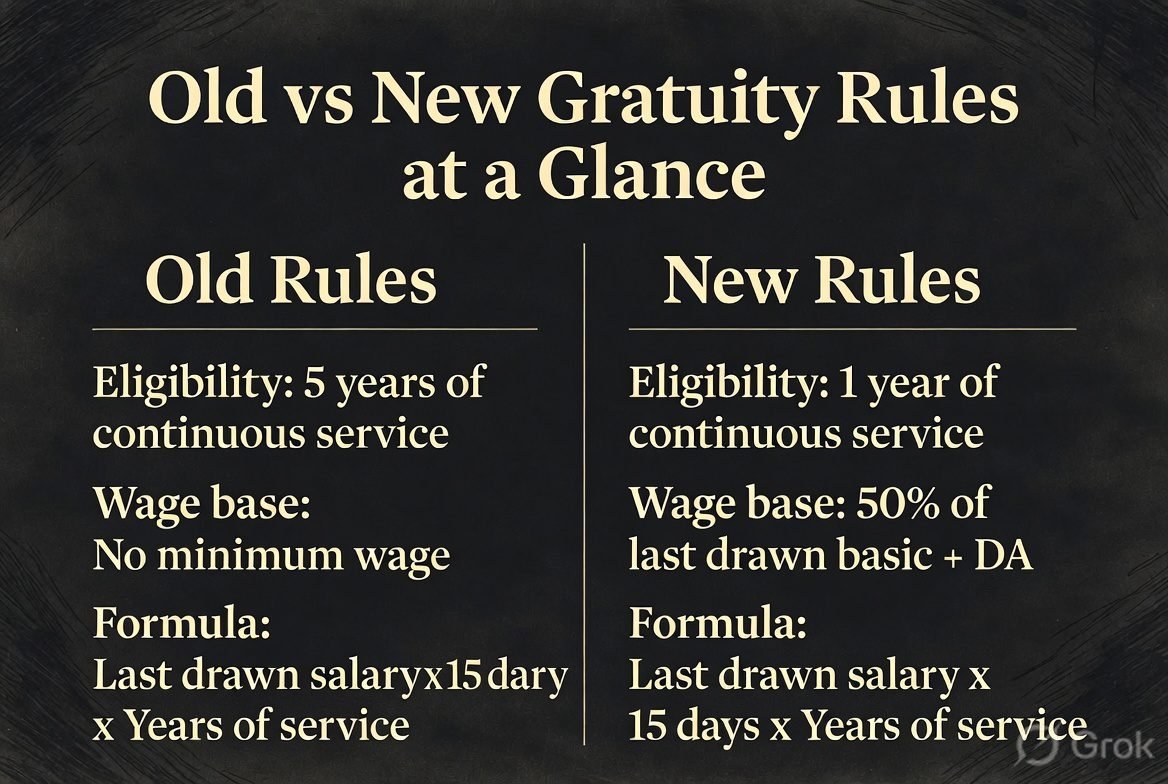
The Code on Social Security, 2020 consolidates nine older social security laws, including the Payment of Gratuity Act, 1972, and became operative on November 21, 2025, now reading alongside the 1972 Act rather than fully replacing it. Three key changes came with it: fixed-term employees are now eligible after just 1 year of service, down from 5 years; a new 50% wage rule requires basic wages to be at least 50% of total CTC, resulting in higher gratuity payouts; and the maximum tax-exempt ceiling remains ₹20 lakh for private sector employees. The full text of the Code is published on the Ministry of Labour & Employment's official codes page.
Gratuity — Old vs New at a Glance
| Effective Date | November 21, 2025 |
| Fixed-Term Eligibility | 1 year (was 5 years) |
| Wage Base Requirement | Min. 50% of CTC |
| Formula | Unchanged: (Wages × 15 × Years) ÷ 26 |
| Tax-Exempt Ceiling | ₹20 lakh (unchanged) |
| Payment Deadline | 30 days from due date |
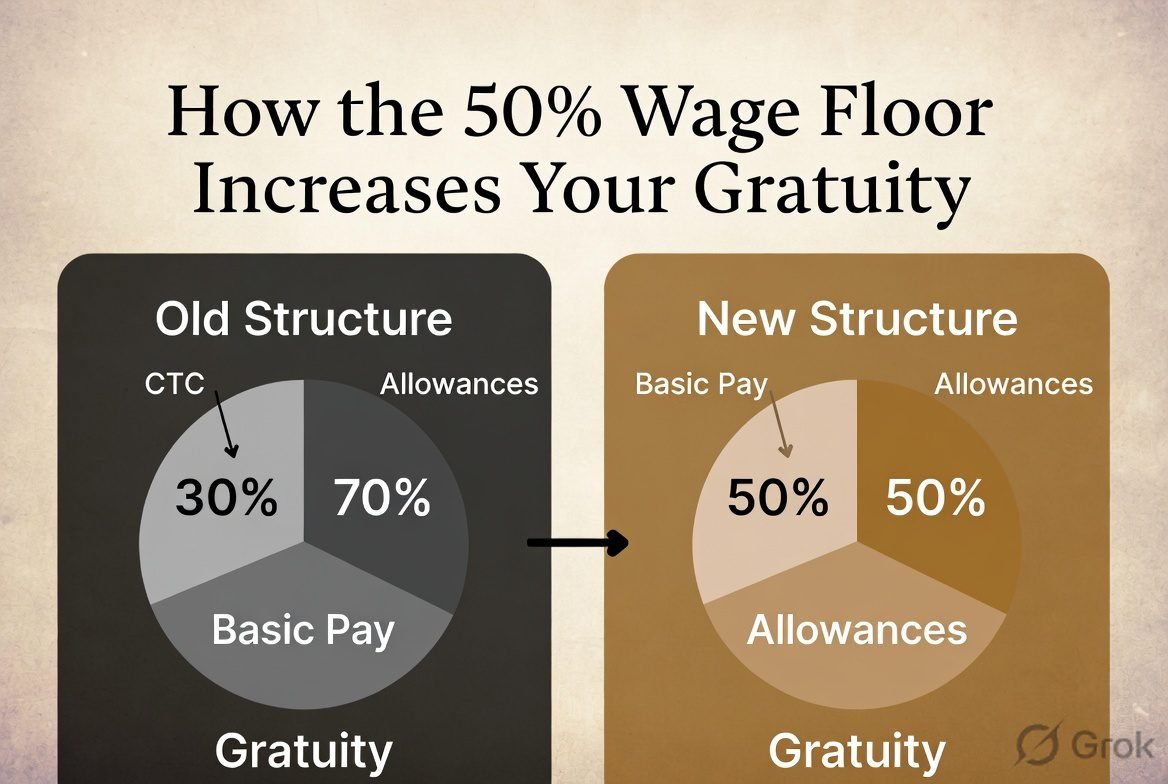
By systematically dismantling the five-year hurdle for fixed-term contract workers, establishing the protective 50% wage floor, and enforcing strict 30-day digital disbursement timelines, the law aims to balance workforce dignity with transparent corporate governance. For decades, Indian companies kept basic salaries artificially low — sometimes as little as 30-40% of CTC — while padding the rest with allowances like special allowance, conveyance, and telephone reimbursement, precisely because gratuity and PF are calculated on basic salary. That structural incentive to minimize basic pay is exactly what this rule closes.
The Formula Hasn't Changed — the Base Has
This is the single most important thing to understand, and it trips up almost everyone who first hears about these changes. The gratuity formula itself remains: Gratuity = (Last Drawn Basic + DA) × 15 ÷ 26 × Completed Years of Service. What changed isn't the math — it's that wages used for the calculation must now be a minimum of 50% of your total CTC, up from whatever artificially low basic your employer may have previously structured.
Result: gratuity payouts are running 40-70% higher for many private sector employees under the new wage base, purely because the number being multiplied by 15/26 and years of service is now meaningfully larger than it used to be. The base upon which gratuity is multiplied increases by 40% to 60% compared to legacy pay structures under most estimates, resulting in substantially larger lump-sum settlements upon resignation, contract termination, or retirement. Independent verification of your own gratuity entitlement can be cross-checked using the Income Tax Department's gratuity exemption guidance for the tax treatment side.
Fixed-Term Employees: From Zero to a Real Benefit
Under the old rules, an employee hired on a fixed-term contract — say, for 3 years — would previously leave with their salary and nothing else once the contract ended. Under the new rules, that same employee walks away with pro-rata gratuity, provided they've completed at least one year under the contract.
Old Rule
Fixed-term employees needed 5 years of continuous service to qualify — a threshold most contract roles, by design, never reached.
New Rule
Fixed-term employees qualify after just 1 year, receiving pro-rata gratuity using the same formula as permanent staff.
For fixed-term employees with service between 1 and 5 years, gratuity is calculated proportionately using the same (15 × wages × years) ÷ 26 formula as permanent employees, just applied against a lower eligibility threshold. A fixed-term employee engaged for just 11 months, however, is not eligible — the contract must run at least one full year from its start date.
This genuinely reshapes the economics of project-based and contract hiring — a shift with real weight for IT services, project-based manufacturing, and contractual staffing models specifically, where fixed-term arrangements are common.
A Real Before-and-After Number
Take an employee with a ₹12 lakh annual CTC and 7 years of service. Under an old-style pay structure where basic was 30% of CTC (₹30,000/month basic), the gratuity calculation would use ₹30,000 as the wage figure: (₹30,000 × 15 × 7) ÷ 26 ≈ ₹1,21,154.
Under the new 50% wage floor, with the same ₹12 lakh CTC now requiring basic to be at least 50% (₹50,000/month), the same formula produces: (₹50,000 × 15 × 7) ÷ 26 ≈ ₹2,01,923 — a genuinely substantial jump of roughly 67%, purely from the wage base change, with no change to the underlying formula, tenure, or CTC itself.
The Take-Home Pay Trade-off Nobody Mentions
This is genuinely the part most coverage of the new rules glosses over, and it's worth understanding before you get excited about a larger eventual gratuity payout. When basic pay increases to meet the 50% rule, PF contributions — 12% of basic, from both employee and employer — also increase proportionally. If total CTC stays fixed, this means net take-home pay decreases slightly, even though long-term retirement benefits (PF corpus and gratuity) both grow substantially.
In cost-to-company models where the employer's PF contribution is absorbed within the fixed package, monthly net take-home salary may see a modest reduction, while the long-term wealth accrual to the employee — from both a larger PF corpus and a larger gratuity base — is genuinely substantial. This is fundamentally a trade of some monthly cash flow today for meaningfully larger guaranteed retirement benefits later — the same principle we discuss in our NPS guide when weighing immediate take-home against long-term compounding.
Gig and Platform Workers Get Their Own Mechanism
Gratuity's traditional formula genuinely doesn't work for delivery partners, ride-share drivers, and similar gig workers who don't have a conventional "salary." Instead of direct gratuity from a single employer, the government has set up a Social Security Fund for this category — aggregator platforms must contribute 1-2% of their annual turnover, capped at 5% of the total amount paid to workers, into this fund.
This means gig workers, freelancers, and contract employees are no longer treated as simply "temporary help" under the law — they're now a recognized part of the broader social security framework, a genuinely significant philosophical shift even though the practical mechanism (a pooled fund rather than individual employer gratuity) differs meaningfully from the traditional model. Details on the Social Security Fund's operation are outlined by the e-Shram portal, the government's platform for unorganised and gig worker registration.
When Can Gratuity Actually Be Forfeited
A common misconception is that any termination, including a performance-related one, can result in forfeited gratuity. Gratuity can only be forfeited in full if the termination was specifically for riotous conduct involving violence, or for an offence involving moral turpitude committed during the course of employment. Standard performance-related termination does not justify forfeiture under the law.
If a company is sold, merged, or transferred as a going concern, an employee's continuous service carries over to the new entity for gratuity calculation purposes — a detail worth knowing if your employer goes through a corporate restructuring or acquisition, since it protects your accumulated service years from being reset to zero.
Related: EPS Explained — The Hidden Pension in Your EPF →What This Means for Employers and HR Teams
While this article is primarily written for employees, understanding the employer side helps explain why implementation has been staggered. The entire increase in gratuity liability from restructuring must be recognised immediately in the P&L as past service cost — not amortised over future periods — meaning companies preparing their March 2026 accounts had to account for this in full at once, under Ind AS 19 accounting standards. April 1, 2026 marked the point when most companies began restructuring payrolls to formally comply, even though the legal effective date was November 21, 2025.
If your own company hasn't yet visibly restructured your salary slip to reflect the 50% wage floor, it's genuinely worth raising with HR directly — the law's effective date has already passed, and the accounting obligation to reflect it has already landed on most large employers' books.
Frequently Asked Questions
When did the new gratuity rules take effect?
The Code on Social Security, 2020 became operative on November 21, 2025, introducing the 50% wage floor and reduced eligibility for fixed-term employees.
Has the gratuity calculation formula changed?
No, the formula remains (Last Drawn Wages × 15 × Years of Service) ÷ 26. What changed is that the wage figure used must now be at least 50% of total CTC, which increases the base and therefore the payout.
Are fixed-term employees now eligible for gratuity?
Yes, fixed-term employees are now eligible for pro-rata gratuity after just 1 year of continuous service, down from the previous 5-year requirement for permanent employees.
Will my take-home salary decrease because of the new rules?
Possibly, marginally. As basic pay rises to meet the 50% requirement, PF contributions (12% of basic) also rise, which can slightly reduce monthly net take-home if total CTC stays fixed, even as long-term retirement benefits increase substantially.
Is gratuity still tax-free up to ₹20 lakh?
Yes, the tax-exempt ceiling of ₹20 lakh for private sector employees remains unchanged under the new rules.
Can my employer forfeit my gratuity if I'm terminated?
Only in specific circumstances — riotous conduct involving violence or an offence involving moral turpitude during employment. Standard performance-related termination does not justify forfeiture.
Our Bottom Line
The new gratuity rules are genuinely one of the more consequential, under-discussed changes to Indian private sector compensation in decades, precisely because they close a loophole that had quietly shrunk millions of employees' eventual retirement payouts for years. If there's one action item from this article, it's this: check your own payslip's basic-to-CTC ratio directly, rather than assuming your employer has already implemented the 50% floor correctly.
For the broader retirement picture beyond gratuity, our retirement calculator and EPF vs NPS vs PPF comparison cover the pieces that work alongside this lump-sum benefit.

Pranab Barman is a Financial Educator and Personal Finance Researcher with over 10 years of hands-on experience in stock markets, trading, and investing. Currently enrolled in the CFA Program, he is committed to continuous learning and professional excellence in finance.
As the Founder of PlayWithStock, Pranab covers a wide range of topics including Mutual Funds, SIP, Taxation, Stock Market Basics, and Financial Calculators — with a focus on simplifying complex financial concepts for everyday all investors.
Email: support@playwithstock.com
Website: playwithstock.com
Related posts:
 SEBI 2026 F&O Rules: 8 Crucial Position Limit Changes Every Trader Must Know
 NPS National Pension System 2026: Complete Guide to Rules, Tax Benefits and Withdrawal
 Senior Citizens Savings Scheme 2026: Interest Rate, Limits and Tax Rules Explained
 Give the Same $10,000 to Charity in 2025 vs 2026, and Your Tax Break Could Shrink — Here’s Why: OBBBA Tax Changes 2026 Explained
 Atal Pension Yojana 2026: Complete Guide to Rules, Contribution and Eligibility
 Large Cap vs Mid Cap vs Small Cap Funds: What SEBI’s Rules Actually Mean for You
 SGB Premature Redemption Calculator 2026: Tax Rules, RBI Dates & Exit Guide
 FATF Anti-Fraud Rules 2026: What They Mean for Indian Investors