
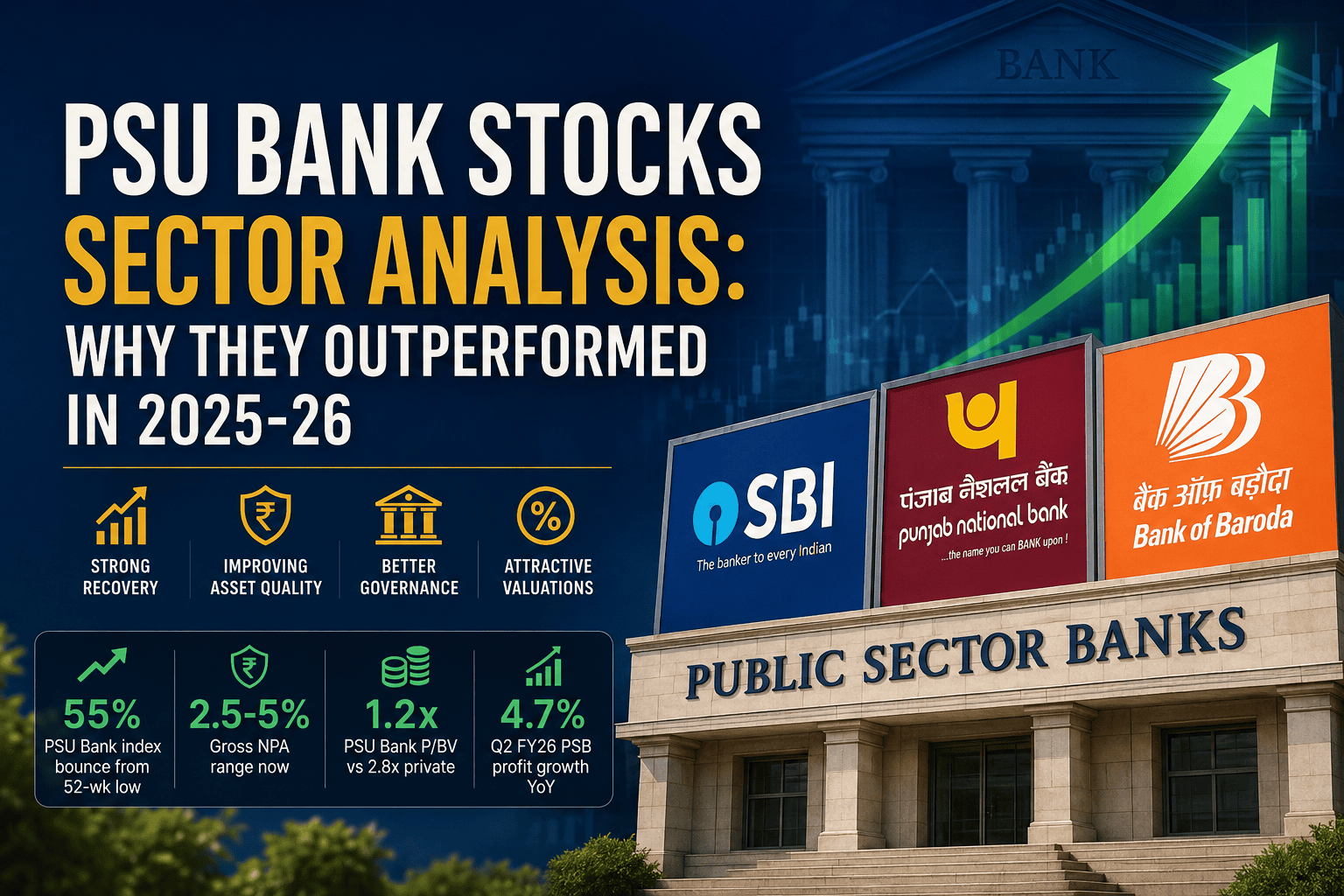

PSU Bank Stocks Sector Analysis: Why They Outperformed in 2025-26
PSU bank stocks spent the better part of a decade as the market's least-loved corner of Indian equities — a sector defined by crisis-era NPA pileups, repeated government bailouts, and years of underperformance against private peers. That story has genuinely reversed. The Nifty PSU Bank index bounced 55% from its 52-week low touched in March 2025, gross NPAs across the sector have fallen from crisis-era highs of 10-15% down to the 2.5-5% range, and several PSU bank stocks have become outright multibaggers since 2020.
We wanted to go beyond the "PSU banks are back" headline and actually walk through what's genuinely different this time versus prior false-dawn rallies in this space, since PSU banks have disappointed investors with premature optimism before.

Table of Contents
- The Turnaround: What Actually Changed
- The Outperformance in Real Numbers
- SBI vs Bank of Baroda vs PNB Compared
- The Valuation Gap vs Private Banks
- What Specifically Drove the 2025-26 Rally
- Real Example: Reading a PSU Bank's Q4 Result
- Is This Rally Sustainable or a Bounce?
- Key Risks Still Worth Watching
- How to Approach PSU Bank Exposure
- Frequently Asked Questions
The Turnaround: What Actually Changed
PSU banks have undergone a genuine fundamental turnaround since 2019, not just a sentiment-driven re-rating. Gross NPAs across the major public sector lenders have fallen from crisis-era highs of 10-15% down to a 2.5-5% range as of recent quarterly results, driven by resolution through the Insolvency and Bankruptcy Code (IBC), write-offs, and materially improved underwriting standards. Return on Equity has recovered above 12% across most names, and capital adequacy now sits above 15% — both genuinely healthy levels by historical PSU bank standards.
The Outperformance in Real Numbers
The scale of this move is genuinely striking. The Nifty PSU Bank index gained nearly 20% over a period when the broader Nifty 50 rose only around 7% — a meaningful sectoral outperformance gap. Individual names have moved even further: several PSU bank stocks have become multibaggers since March 2020, with gains as high as 1,544% for the strongest performers, and Punjab and Sind Bank's market cap rising 26.9x over the same window.
Market Cap Growth Since March 2020
| Bank | Market Cap Multiple |
|---|---|
| Punjab and Sind Bank | 26.9x |
| Indian Bank | 19.6x |
| Canara Bank | 8.5x |
| Several others (BoM, IOB, PNB, Union Bank, BoB, BoI, SBI) | 4.3x to 8.4x |
SBI, Bank of Baroda, Canara Bank, and Indian Bank have all touched fresh 52-week or record highs during this rally — a level of broad-based strength across the sector that's genuinely rare, since PSU bank rallies historically tended to concentrate in one or two names rather than lifting the entire cohort together.
SBI vs Bank of Baroda vs PNB Compared
Within the PSU bank universe, the three most-tracked names represent genuinely different stages of the same broader turnaround story, making a side-by-side comparison useful rather than treating "PSU banks" as one undifferentiated bet.
Q4 FY26 Comparison — SBI vs BoB vs PNB
| Bank | Gross NPA | Net NPA | Profit Growth (YoY) |
|---|---|---|---|
| SBI | ~2.5% | 0.39% | Strong, stable |
| Bank of Baroda | ~2.8% | — | 11.25% (₹5,615.68 crore) |
| PNB | ~4.5% (improving) | — | 14.41% (₹5,225.11 crore) |
SBI holds the strongest asset quality position of the three, with net NPA at just 0.39% and capital adequacy at 15.40%, making it the preferred long-term holding for investors prioritizing stability. Bank of Baroda delivered what analysts described as one of the most balanced performances among PSU lenders, with annual profit crossing ₹20,000 crore for the first time. PNB represents more of a genuine turnaround story specifically — its 14.4% YoY profit growth was the strongest of the three, though margin pressure remains a real concern, with NIMs declining to 2.57% and NII remaining largely flat despite the reported profit growth.
The Valuation Gap vs Private Banks
Even after this substantial rally, PSU banks continue to trade at a meaningful discount to private sector peers. The Nifty PSU Bank Index trades at approximately 1.2x Price-to-Book Value, versus roughly 2.8x for private banks — a discount that, while narrowing, still leaves genuine room for further re-rating if earnings quality continues to hold.
PSU vs Private Bank Valuation Snapshot
| Metric | SBI | Bank of Baroda | Canara Bank | PNB |
|---|---|---|---|---|
| Gross NPA | ~2.5% | ~2.8% | ~3.7% | ~4.5% |
| ROE | ~14.5% | ~13% | ~12.5% | ~11% |
| P/B | ~1.3x | ~0.9x | ~0.7x | ~0.7x |
This connects directly to the broader NIM compression story we've covered in our BFSI sector analysis — the same RBI rate-cutting cycle pressuring private bank margins is also affecting PSU banks, but the starting valuation discount means PSU names have historically had more room for multiple expansion to offset any earnings-side pressure, at least in this current cycle.
What Specifically Drove the 2025-26 Rally
Beyond the fundamental NPA and ROE improvement, several specific catalysts accelerated the rally through late 2025 and into 2026. Reports that the government was considering more than doubling the maximum FII investment limit in PSU banks (potentially to 49%) drove notable buying interest, as did a significant policy shift opening top PSU bank leadership positions to private sector candidates — a genuinely meaningful governance change for institutions historically staffed exclusively through internal government-linked promotion tracks.
Why the FII Limit Discussion Matters
Foreign institutional investor limits have historically been a real structural constraint on PSU bank valuations — even strong fundamentals can't fully translate into price appreciation if the pool of eligible buyers is artificially capped well below what private banks enjoy. A genuine increase in this ceiling, even before it's finalized, tends to draw anticipatory buying from investors positioning ahead of the policy change, which is part of why reports alone (not yet a confirmed final decision) were enough to move several PSU counters 4-5% in a short window.
Real Example: Reading a PSU Bank's Q4 Result
Why Headline Profit Growth Alone Isn't Enough
PNB's Q4 FY26 result reported 14.41% YoY profit growth — the strongest headline number among the three major names covered here — but a closer read reveals NII (Net Interest Income) remained largely flat and NIMs actually declined to 2.57%. This means the profit growth was driven substantially by lower credit costs (fewer provisions needed for bad loans) rather than genuine core banking business expansion. This is exactly the kind of nuance that separates a surface-level "profit beat" headline from the underlying business quality — a pattern worth checking across any PSU bank result, not just PNB's.
Is This Rally Sustainable or a Bounce?
This is genuinely the central question analysts are debating, and the honest answer is that both fundamental improvement and speculative momentum are present simultaneously. The NPA reduction, ROE recovery, and capital adequacy improvement are real, structural, and unlikely to reverse quickly. But the sheer pace of the rally — a 55% bounce from the 52-week low, with individual stocks up multiple times over — also carries the hallmarks of momentum-driven buying that can overshoot fundamentals in the short term.
Bull Case vs Bear Case
| Bull Case | Bear Case |
|---|---|
| Structural NPA improvement, unlikely to reverse | Rally pace has outrun near-term earnings growth |
| Still-wide valuation discount to private banks | NIM pressure from RBI rate cuts affects PSUs too |
| Potential FII limit increase, governance reforms | Agri and MSME segment stress remains a watch item |
Key Risks Still Worth Watching
What Could Derail the Story
1. Agri and MSME segment stress. Even with headline NPAs improved, these specific segments remain areas analysts flag as worth monitoring, particularly during any broader economic stress cycle.
2. NIM compression from the RBI rate-cutting cycle. PSU banks aren't immune to the same margin pressure affecting private peers, and PNB's declining NIM is an early example worth watching for signs of a broader pattern.
3. Momentum outrunning fundamentals. A rally this sharp always carries some risk of overshoot, and a disappointing quarter from a bellwether name like SBI could trigger a sharper-than-expected correction across the whole PSU bank basket.
4. Policy dependency. Part of the rally's momentum has been tied to still-unfinalized policy changes (FII limits specifically) — a delay or scaling-back of these reforms could remove a real catalyst investors have already partly priced in.
How to Approach PSU Bank Exposure

Given the genuine spread in asset quality and turnaround stage between the major names, distinguishing between "quality compounders" (SBI, arguably Bank of Baroda) and "genuine turnaround bets" (PNB and smaller PSU names) is more useful than treating the whole basket as a single homogeneous trade. Readers wanting broad, diversified exposure without picking individual PSU names can also access the sector through banking-focused index funds; our index funds vs active funds comparison covers this decision in more general terms.
For readers tracking the broader rate environment affecting this sector, our coverage of the RBI repo rate cut is directly relevant, and our FII vs DII explainer is worth reading given how central the FII investment limit discussion has been to this specific rally's momentum.
It's also worth situating PSU banks within the broader BFSI narrative rather than viewing them in isolation. Our HDFC, ICICI, Axis, and Kotak Bank Q1 FY27 results coverage provides the private-bank counterpart to the PSU story covered here, and reading both together gives a genuinely complete picture of how the entire Indian banking sector is navigating the current rate-cutting cycle. Investors specifically interested in dividend income alongside potential capital appreciation should note that several PSU banks, including SBI, have historically offered more consistent dividend payouts than growth-focused private peers, making them a genuinely different portfolio role even beyond the pure valuation-discount argument.
Readers newer to evaluating individual bank stocks may also find our bonus share explainer useful, since several PSU banks have used bonus issues and stock splits during past capital restructuring phases, and understanding these corporate actions helps make sense of historical price charts that might otherwise look confusing without that context. For a broader primer on comparing bank stocks generally, our sector rotation piece remains a useful companion read for understanding how BFSI sub-sectors like PSU banking move relative to the broader market cycle.
Frequently Asked Questions
Why have PSU bank stocks outperformed in 2025-26?
A genuine fundamental turnaround: gross NPAs fell from crisis-era highs of 10-15% to a 2.5-5% range, ROE recovered above 12%, and capital adequacy improved above 15%, alongside catalysts like potential FII limit increases and leadership reforms.
Which PSU bank has the strongest fundamentals right now?
SBI consistently ranks highest on a composite basis, with the best asset quality (net NPA of 0.39%), strong ROE, and diversified revenue. Bank of Baroda is considered a close second in improvement trajectory.
Are PSU bank stocks still cheaper than private banks?
Yes. The Nifty PSU Bank Index trades around 1.2x Price-to-Book Value versus approximately 2.8x for private banks, a discount that has narrowed but still leaves room for potential re-rating.
Is the PSU bank rally sustainable or just a short-term bounce?
Both fundamental improvement and momentum-driven buying appear present. The NPA and ROE improvements are structural, but the pace of the rally also carries risk of near-term overshoot beyond what current earnings growth alone would justify.
What is driving talk of increased FII limits in PSU banks?
Reports indicate the government is considering more than doubling the maximum FII investment limit in PSU banks, potentially to 49%, which would remove a long-standing structural constraint on foreign capital inflows into these stocks.
What are the biggest risks to the PSU bank story?
Agri and MSME segment stress, NIM compression from RBI rate cuts, momentum outrunning fundamentals, and dependency on still-unfinalized policy reforms like the FII limit increase.

Pranab Barman is a Financial Educator and Personal Finance Researcher with over 10 years of hands-on experience in stock markets, trading, and investing. Currently enrolled in the CFA Program, he is committed to continuous learning and professional excellence in finance.
As the Founder of PlayWithStock, Pranab covers a wide range of topics including Mutual Funds, SIP, Taxation, Stock Market Basics, and Financial Calculators — with a focus on simplifying complex financial concepts for everyday all investors.
Email: support@playwithstock.com
Website: playwithstock.com
Related posts:
 Stocks to Buy After India-US Trade Deal 2026: A Sector-by-Sector Breakdown
 HDFC Bank, ICICI Bank, Axis Bank & Kotak Bank Q1 FY27 Results: The Complete Comparison
 Give the Same $10,000 to Charity in 2025 vs 2026, and Your Tax Break Could Shrink — Here’s Why: OBBBA Tax Changes 2026 Explained
 Jio Financial Services Q1 FY27 Results Preview: Date, Estimates & Stock Analysis
 119 Years Old and Still Beating Every Major Private Bank on FD Rates — Inside the Bank of Baroda FD Scheme Lineup
 Best AI Stocks India 2026: 7 Picks That Are Actually Worth Watching
 What Is Sector Rotation? A Simple Guide for Indian Investors
 What is a Stock Split and Why Do Companies Do It