

Micro-Investing Apps for Beginners: A Complete Comparison
You don't need ₹10,000 to start investing anymore — you need ₹10 and a phone. Here's how India's micro-investing apps actually work, which micro-investing apps fit different needs, and what the fine print doesn't tell you.
Table of Contents
Micro-investing means putting very small amounts of money — sometimes as little as ₹10 — into mutual funds, digital gold, ETFs, or stocks, usually on a recurring or automated basis. The goal isn't to build wealth from any single contribution; it's to remove the psychological and financial barrier that stops most first-time investors from ever starting at all. Micro-investing apps have specifically targeted this exact gap in the Indian market, and the growth numbers reflect it: fintech data from 2025 shows that Tier 2 and Tier 3 city users now make up roughly 60% of all new micro-investor sign-ups nationally — proof that micro-investing apps are reaching exactly the audience traditional brokerages historically struggled to serve.
The Round-Up Mechanic Explained
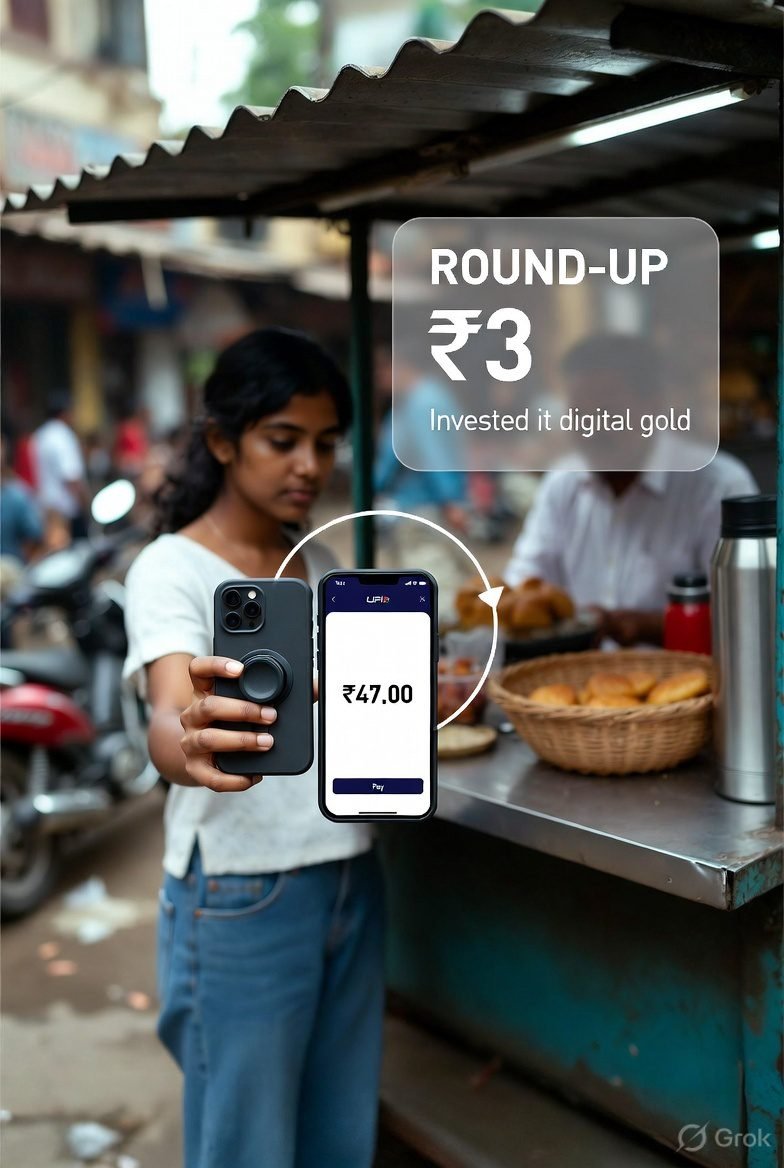
The signature feature behind many micro-investing apps is the "round-up." When you make a UPI payment of ₹97, the app rounds the transaction up to ₹100 and automatically invests the ₹3 difference — usually into digital gold or a liquid mutual fund. Individually, these amounts are trivial. Accumulated across dozens of daily UPI transactions, they quietly build a real, growing investment habit without requiring any conscious daily decision. This mechanic works specifically because of how deeply UPI, regulated under the Reserve Bank of India's digital payments framework, is embedded into everyday Indian spending — a level of payment infrastructure integration that makes automated micro-investing apps genuinely frictionless in a way that wasn't possible even five years ago.
Not all micro-investing apps work the same way. Broadly, three distinct models have emerged in the Indian market.
Round-Up Apps
Automatically invest the spare change from UPI payments — usually into digital gold. Lowest effort, lowest risk.
Micro-SIP Apps
Let you start mutual fund SIPs from as little as ₹100/month, with full fund selection and portfolio tracking.
Banking + Investing Combo
Combine a savings/spending account with automated micro-investing, so contributions happen alongside everyday banking.
Round-Up Apps
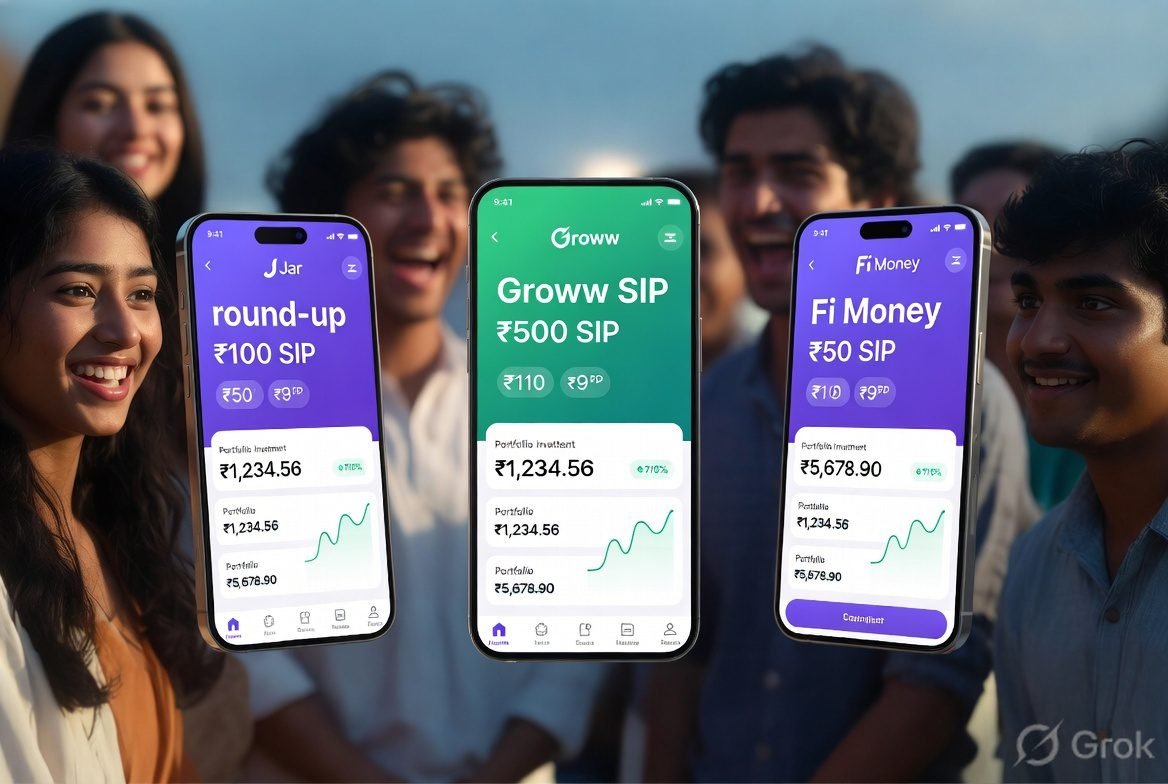
Apps like Jar pioneered this model in India — automatically rounding up UPI payments and investing the difference into 24K digital gold, a category covered in detail by Billcut's 2026 roundup of Indian micro-investing platforms. This is deliberately designed as a low-risk entry point, since digital gold doesn't carry the volatility of equity markets, making it psychologically easier for a complete beginner to stay invested without panic.
Micro-SIP Apps
Platforms like Groww, Kuvera, and Paytm Money allow full mutual fund SIPs starting from ₹100 per month — a meaningfully lower entry point than the ₹500-1,000 minimums that were standard just a few years ago, as documented by BrokerChooser's independent 2026 broker testing. These apps offer complete fund selection, letting a beginner build an actual diversified portfolio rather than being limited to a single gold-backed product.
Fractional Investing: A Related but Different Feature
Apps like Tickertape and INDmoney extend the same small-ticket philosophy to fractional stock investing, allowing exposure to expensive individual shares without needing the full share price upfront. This works differently from a round-up or SIP mechanic but serves the same underlying goal: removing the capital barrier to entry, a pattern also common among the global fractional-investing platforms that first popularised this approach abroad. Understanding basic corporate actions like a stock split becomes genuinely relevant once you're holding fractional positions in individual companies, since these events directly affect how your fractional holding is adjusted.
Banking + Investing Combo Apps
Fi Money and Kotak Neo represent a third model, blending everyday banking (savings accounts, debit cards) with automated micro-investing features built directly into the same app — useful for users who want investing to feel like a natural extension of how they already manage money, rather than a separate destination requiring a dedicated app. Industry analysis from fintech infrastructure researchers notes this combo model as one of the fastest-growing categories globally, not just in India, precisely because it removes an entire extra app download and onboarding step for the end user. This combo approach also naturally supports broader money habits, similar to how a well-run 50-30-20 budgeting rule allocates a portion of income toward saving and investing before it ever gets a chance to be spent elsewhere.
The table below summarises how the most widely-used micro-investing apps in India differ, drawing on comparative analysis from independent India-focused reviews and broader global micro-investing app evaluations for context on how the category has evolved.
| App | Model | Minimum Investment | Best For |
|---|---|---|---|
| Jar | Round-up → digital gold | Spare change (as low as ₹1-3) | Absolute beginners wanting zero-effort investing |
| Groww | Micro-SIP + stocks | ₹100/month | Beginners wanting full mutual fund + stock access |
| Kuvera | Micro-SIP (direct plans) | ₹100/month | Cost-conscious investors wanting direct (lower-fee) mutual fund plans |
| Paytm Money | Micro-SIP + gold + UPI automation | ₹100/month | Existing Paytm users wanting an all-in-one app |
| Fi Money | Banking + micro-SIP combo | ₹100/month | Users wanting banking and investing in a single app |
| Tickertape / INDmoney | Fractional stocks + mutual funds | Varies by stock price | Beginners wanting fractional exposure to specific companies |
For those ready to graduate from purely micro-investing into more active participation in the broader stock market, full-service brokers like Zerodha and Upstox remain the natural next step, typically requiring a proper demat account and offering access to both the NSE and BSE. Understanding foundational mechanics like stock splits and circuit breakers becomes more relevant at this stage than it typically is while using a pure micro-investing app, as does comparing costs using tools like our share buyback comparison calculator once holdings involve individual stocks rather than pooled funds.
How India's Approach Differs from Global Micro-Investing Apps
Globally, micro-investing pioneers like Acorns and Robinhood built their model primarily around fractional US equities and ETFs. India's version of micro-investing apps has evolved somewhat differently, leaning more heavily on digital gold and mutual fund SIPs rather than direct fractional stock ownership — a reflection of both regulatory structure and the cultural familiarity Indian savers already have with gold as an investment vehicle, discussed further in our coverage of gold price trends in 2026. This isn't a lesser approach; if anything, starting with a more stable, familiar asset class may better suit first-time Indian investors than immediately being exposed to individual stock volatility.
Adjust your daily micro-investment amount and time horizon below to see how consistently investing small, "spare change" amounts could genuinely add up over time — a similar illustrative approach to the calculators we've built for salary projections and gold bond redemptions elsewhere on Play With Stock.
Micro-Investing Growth Calculator
Assuming a 10% average annual return, compounded monthly
This is an illustrative estimate using a fixed assumed return, not a guarantee — actual mutual fund and market returns vary and can be negative in any given year.
The Fee Ratio Problem
This is the single most important thing beginners overlook. If an app charges a flat monthly or per-transaction fee and your invested balance is still tiny, that fee can quietly consume a large percentage of your actual capital.
The ₹100 Test
If a platform charges even ₹3 per month and you're only investing ₹100, that's a 3% fee purely from platform costs — before any market movement at all. Always check whether an app charges a flat fee, a percentage-based expense ratio, or is genuinely free for the specific instrument you're using (many gold and direct mutual fund products carry minimal or zero platform fees). This is directly comparable to comparing mutual fund expense ratios at any investment size — the smaller your balance, the more a fixed fee distorts your real returns.
Is It SEBI-Regulated?
Before trusting any app with recurring money, confirm that the underlying investment product — mutual funds, stocks, ETFs — is genuinely regulated by SEBI (Securities and Exchange Board of India), and that mutual fund distribution complies with AMFI (Association of Mutual Funds in India) norms. The app itself doesn't need to be a bank, but the instruments it invests your money into absolutely need proper regulatory backing — a distinction recent 2026 app comparisons increasingly flag as verified badges and security certifications become standard expectations across the industry.
Digital Gold vs Market-Linked Investments
It's worth understanding that round-up apps investing in digital gold are fundamentally different from apps running mutual fund SIPs. Gold behaves differently from equities — for context on how gold specifically has moved recently, see our coverage of the 2026 gold price cycle, and for investors who eventually want more structured gold exposure, comparing this against a Sovereign Gold Bond is a natural next step once amounts grow larger. Diversifying beyond a single asset class — the same logic behind life cycle funds — matters even at the micro-investing stage, not just once portfolios grow large.
Tax Treatment of Micro-Investment Gains
A detail many beginners overlook entirely: gains from micro-investing apps are taxed exactly the same way as gains from any other investment of the same type. Digital gold gains follow gold taxation rules, and mutual fund gains through a micro-SIP app follow the same short-term and long-term capital gains framework as a SIP started through a traditional full-service broker. The small size of individual contributions doesn't create any special tax exemption — every gain, however small, technically needs to be tracked and reported by the annual ITR filing deadline once redeemed. Most micro-investing apps provide downloadable capital gains statements specifically to make this reporting easier, which is worth checking before you actually need the document during tax season.
Micro-investing apps are genuinely well-suited to specific situations rather than being a universal solution for every investor. Understanding who benefits most helps set the right expectations before downloading yet another app.
- Complete beginners who feel intimidated by traditional investing and need a low-stakes way to build the habit before committing meaningful capital
- Students and gig workers with irregular, small amounts of surplus income who can't commit to large fixed monthly contributions
- Anyone building a savings habit from scratch, where the psychological win of "I'm investing" matters as much as the actual rupee amount early on
- Tier 2 and Tier 3 city users newly entering formal investing — notably, this segment already represents roughly 60% of new micro-investor sign-ups in India, reflecting how effectively these apps have expanded access beyond traditional metro-city investor bases
Those with a stable income and the ability to commit larger, regular sums are generally better served moving toward a full structured investing approach and consistent SIP contributions relatively quickly, since micro-investing's core advantage — removing the psychological barrier to starting — becomes less relevant once that barrier is already gone.
Scaling Up: What Comes After Micro-Investing
Once the habit is established and income grows, the natural progression is increasing contribution size rather than switching apps entirely — most Groww, Kuvera, and Paytm Money users, for instance, can simply raise their SIP amount within the same account they already trust. This mirrors the broader financial planning principle behind tools like our 8th Pay Commission salary calculator for salaried professionals, or the annual ITR filing obligations that become more relevant as investment income grows alongside salary.
Even with the barrier to entry removed, a handful of avoidable mistakes show up repeatedly among first-time users of micro-investing apps:
- Treating micro-investing as the entire strategy: Round-ups and ₹100 SIPs are a starting habit, not a retirement plan on their own — they should scale up as income grows
- Ignoring the fee ratio at small balances: As covered above, a flat fee on a tiny balance can silently erode returns faster than market growth can offset
- Confusing gold round-ups with diversified investing: A portfolio that's 100% digital gold isn't diversified — it should eventually expand into equity and debt instruments too, following principles similar to the 50-30-20 budgeting rule
- Not checking regulatory backing: Assuming an app is safe simply because it's popular or well-marketed, rather than verifying the underlying instruments are SEBI-regulated
- Withdrawing at the first sign of a market dip: The same behavioural discipline that prevents emotional, poorly-timed decisions in the broader stock market applies just as much to a ₹100 SIP as it does to a ₹1 lakh one, a discipline also relevant when comparing fund costs over time rather than reacting to short-term price swings
The best micro-investing apps ultimately succeed by making the very first step easy, not by making anyone wealthy through spare change alone. Whether you choose a round-up app, a micro-SIP platform, or a combo banking app, the specific choice among micro-investing apps matters far less than the decision to actually start — and to keep going once the initial novelty wears off. Comparing micro-investing apps side by side is a useful exercise, but it shouldn't become a reason to delay starting with whichever option is genuinely accessible to you today. For related foundational reading, explore our full Stock Market section and Personal Finance section, or browse the complete Play With Stock article library.
Some round-up apps let you start with just ₹1-10 through UPI spare change, while most micro-SIP apps set a formal minimum of ₹100 per month for mutual fund investments.
As long as the underlying instruments (mutual funds, stocks, ETFs) are genuinely SEBI-regulated and the app follows proper KYC and AMFI-compliant distribution norms, these apps operate within the same regulatory framework as traditional investing platforms.
Micro-investing is best understood as a habit-building bridge rather than a complete wealth-building strategy on its own. It works best when contribution amounts scale up as income grows, rather than staying fixed at spare-change levels indefinitely.
Round-up apps (like Jar) automatically invest small, passive amounts based on your spending, usually into digital gold. Micro-SIP apps (like Groww or Kuvera) require an active, fixed monthly commitment starting from ₹100 into mutual funds of your choosing.
Many micro-investing apps like Groww already function as full brokerages, so a switch isn't always necessary. However, active traders or those wanting deeper research and charting tools may eventually prefer a dedicated platform once their needs outgrow simple automated investing.



Pranab Barman is a Financial Educator and Personal Finance Researcher with over 10 years of hands-on experience in stock markets, trading, and investing. Currently enrolled in the CFA Program, he is committed to continuous learning and professional excellence in finance.
As the Founder of PlayWithStock, Pranab covers a wide range of topics including Mutual Funds, SIP, Taxation, Stock Market Basics, and Financial Calculators — with a focus on simplifying complex financial concepts for everyday all investors.
Email: support@playwithstock.com
Website: playwithstock.com
Related posts:
 Beginner Investing: 7 Proven Steps to Start the Right Way
 What is a Demat Account? A Complete Beginner’s Guide
 Term Insurance vs Endowment Plan: Which is Better for Beginners in 2026
 How to Invest in Gold ETF: The Complete Gold ETF vs Physical Gold Guide
 What is a Stock Split and Why Do Companies Do It
 Common Behavioral Mistakes in Stock Trading
 Tax-Loss Harvesting: How It Works in India
 Cold Wallet vs Hot Wallet: The Complete Crypto Security Guide