


Mutual Fund Guide India 2026:
The Essential 7-Step Blueprint
India's mutual fund AUM just crossed ₹82 lakh crore. SIP contributions hit ₹31,781 crore in June 2026 alone. And most first-time investors still don't know the difference between NAV and returns. This guide fixes that — in plain language, with real numbers.
I started my first SIP with ₹2,000 a month. I had no idea what NAV meant. I thought a higher NAV meant an expensive fund — and I almost avoided the wrong fund for the wrong reason. That confusion is more common than any financial article admits.
This guide on mutual fund investing in India covers the seven things every beginner must actually understand — not definitions you'll forget, but the ideas that change how you make decisions with real money. If you've already started a SIP and aren't sure why you picked that fund, this is worth reading too.

Step 01What a Mutual Fund Actually Does
A mutual fund pools money from thousands of investors and hands it to a professional fund manager who invests it in stocks, bonds, or a mix of both. In exchange for managing your money, the fund charges a small annual fee called the expense ratio. You own "units" of this pool — and the value of each unit moves as the underlying investments move.
That's it. Every complicated-sounding term in mutual fund investing — NAV, SIP, ELSS, exit load — is just a label on one part of this basic structure. Starting as a beginner investor in India today, this is genuinely the easiest it has ever been: minimum SIP amounts as low as ₹500, instant KYC via Aadhaar OTP, and thousands of options across 44 AMCs.
The mutual fund industry in India is regulated by SEBI (Securities and Exchange Board of India) and data is published monthly by AMFI (Association of Mutual Funds in India). Both are worth bookmarking — when a fund company makes a claim about returns, AMFI data is the cross-check.
Step 02The Types You Actually Need to Know
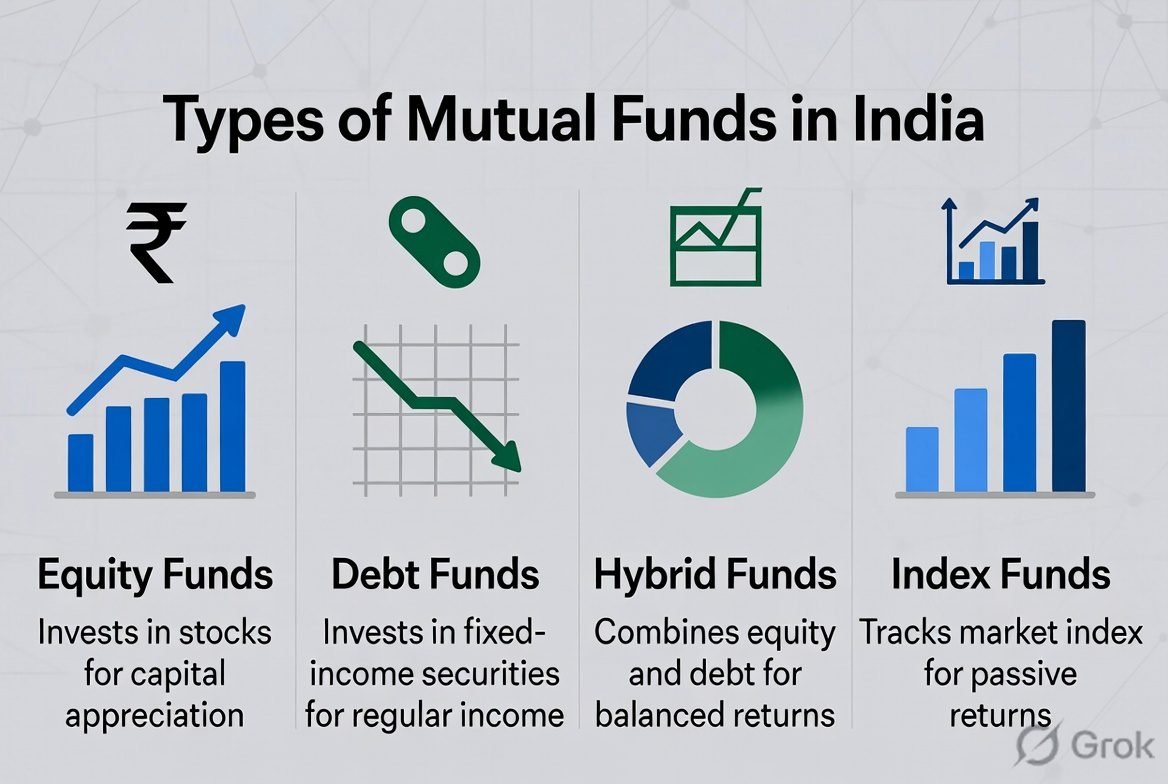
SEBI has categorised mutual funds into around 36 categories. You don't need all of them. You need five, mapped to real use cases.
| Fund Type | What It Invests In | Best For | Risk Level | Suggested Horizon |
|---|---|---|---|---|
| Index Fund (Nifty 50) | Top 50 Indian companies | First-time investors | Moderate | 5+ years |
| Flexi Cap Fund | Any market cap, any ratio | Core long-term holding | Moderate-High | 5+ years |
| ELSS Fund | Primarily equity (80%+) | Tax saving under 80C | High | 3 years minimum (locked) |
| Balanced Advantage Fund | Dynamic equity + debt mix | Lower volatility investors | Moderate | 3–5 years |
| Liquid Fund / Overnight Fund | Short-term debt instruments | Parking idle cash (not FD alternative) | Low | Days to 3 months |
The category that surprised most investors in 2026: Flexi Cap funds emerged as the largest equity mutual fund segment by AUM at ₹5.59 lakh crore, leading inflows for multiple consecutive months. This happened because fund managers have full freedom to move between large, mid, and small cap based on valuations — which individual investors can't easily do on their own.
For a deeper look at how different fund structures impact your portfolio, the lifecycle funds explainer and our guide to BER vs TER are useful companions to this section. And if you're comparing mutual funds to direct equity, understanding the Nifty 50 benchmark is the right place to start.
Step 03NAV — The Most Misunderstood Number in Mutual Funds
NAV stands for Net Asset Value. It is the per-unit price of the fund, calculated daily using this formula:
| Component | What It Means | Example |
|---|---|---|
| Total Portfolio Value | Current market value of all securities held | ₹100 crore |
| Minus Liabilities | Management fees, operational costs owed | ₹0.10 crore |
| Net Assets | What's actually left for investors | ₹99.90 crore |
| Total Units Outstanding | How many units investors collectively hold | 1 crore units |
| NAV | Net Assets ÷ Total Units | ₹99.90 per unit |
Here is the single most important thing to understand about NAV: a higher NAV does not mean an expensive fund. A fund with NAV of ₹250 is not "costly" compared to one with NAV of ₹15. What matters is the percentage change in NAV over time — that's your return.
If a ₹250 NAV fund grows to ₹300, your return is 20%. If a ₹15 NAV fund grows to ₹16, your return is 6.7%. The absolute number is irrelevant.
Step 04SIP vs Lumpsum — Which One, When
A Systematic Investment Plan (SIP) is not a type of fund. It's a method of investing — you set a fixed amount to go in automatically on a set date every month. A lumpsum is a one-time investment of whatever amount you have available right now.
✓ SIP is better when…
- You're salaried with monthly income
- You can't time the market (nobody can)
- You want to remove emotion from investing
- You're building the habit first, amount second
- Markets feel volatile or uncertain
↗ Lumpsum works when…
- You received a bonus, inheritance, or tax refund
- Markets are at a meaningful correction (not guaranteed)
- Your time horizon is 7+ years
- You already have an emergency fund in place
- You're adding to an existing long-term holding
SIP's key mathematical advantage is called rupee-cost averaging. When the market falls, your fixed ₹5,000 buys more units. When it rises, it buys fewer. Over a few years, your average purchase cost smooths out — reducing the damage any single bad month can do to your overall returns.
This is why SIP inflows in India kept hitting records even during volatile months in 2025 and 2026.
| Monthly SIP | Duration | Total Invested | At 10% CAGR | At 12% CAGR | At 15% CAGR |
|---|---|---|---|---|---|
| ₹5,000 | 10 years | ₹6,00,000 | ₹10.24L | ₹11.62L | ₹13.93L |
| ₹5,000 | 15 years | ₹9,00,000 | ₹20.87L | ₹25.23L | ₹33.40L |
| ₹5,000 | 20 years | ₹12,00,000 | ₹38.28L | ₹49.96L | ₹75.61L |
| ₹5,000 | 25 years | ₹15,00,000 | ₹66.64L | ₹93.81L | ₹1.65 Cr |
These numbers assume returns are consistent — which they won't be year to year. But they illustrate why time horizon matters more than return rate. At ₹5,000/month over 25 years, even the 10% scenario produces ₹66 lakh from ₹15 lakh invested. Our salary calculator can help you figure out what SIP amount fits your actual monthly take-home after commitments.
A 25-year-old investing ₹5,000 monthly until 60 at 12% returns accumulates approximately ₹3.24 crore. Starting at 35 instead reduces this to about ₹95 lakh — the same amount invested for 10 fewer years produces one-third the outcome. That's not motivation-poster math; that's actual compounding, and it's why waiting to start is the most expensive mistake most investors make.

Step 05Direct vs Regular Plan — Where the Gap Really Is
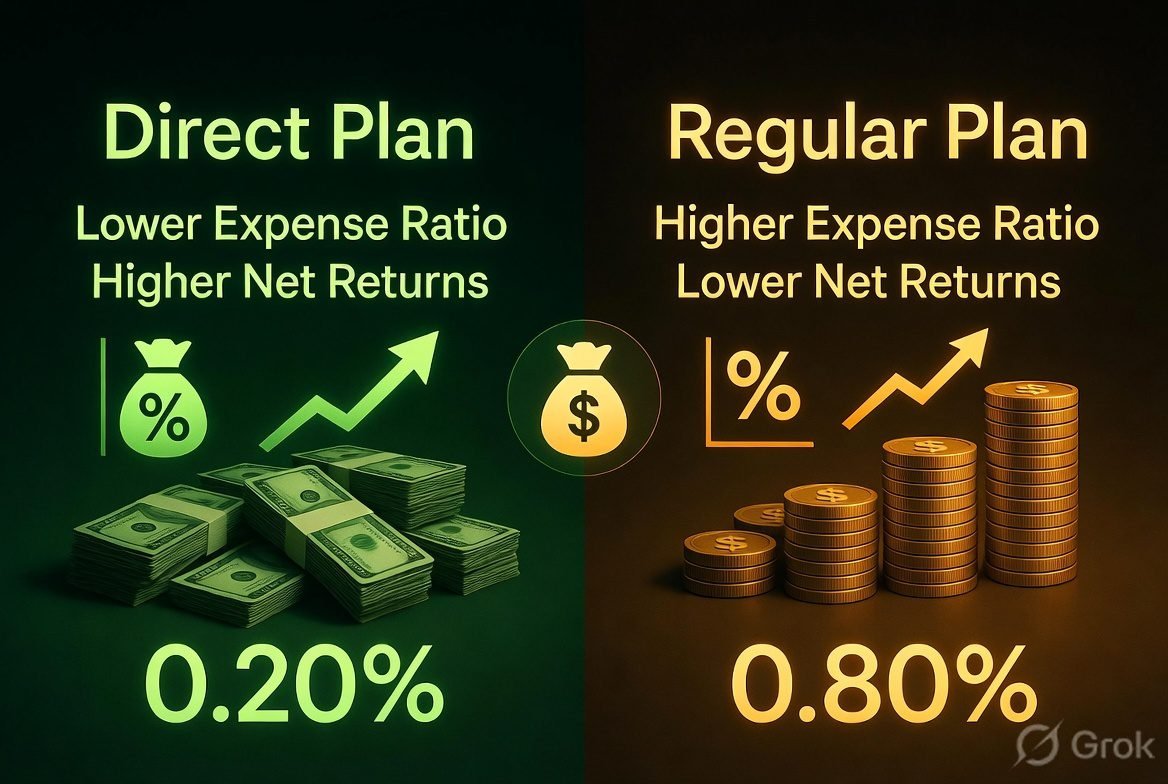
Every mutual fund scheme in India exists in two versions: a Direct Plan (you invest straight with the AMC, no intermediary) and a Regular Plan (you invest through a broker or distributor who earns a commission from the fund).
The commission in a Regular Plan is built into the expense ratio — so a Regular Plan of the same fund always has a higher expense ratio than its Direct Plan equivalent. The difference looks small: typically 0.5% to 1% per year. But over 20 years, that 1% difference compounds into a significant gap.
| Scenario | Monthly SIP | Duration | Direct Plan (11% CAGR) | Regular Plan (10% CAGR) | Difference |
|---|---|---|---|---|---|
| Conservative | ₹5,000 | 15 years | ₹23.66L | ₹20.87L | ₹2.79L less |
| Moderate | ₹10,000 | 20 years | ₹1.03 Cr | ₹76.57L | ₹26L less |
| Long-term | ₹10,000 | 25 years | ₹1.89 Cr | ₹1.33 Cr | ₹56L less |
This gap is why every informed investor eventually moves to Direct Plans. You can invest directly on any AMC's website, on platforms like MFCentral, or through SEBI-registered investment advisors who charge a transparent flat fee instead of taking hidden commissions.
For understanding how expense ratios affect your actual returns in rupee terms — not percentages — our MF BER vs TER calculator shows the exact difference for your specific SIP amount and tenure.
Step 06Mutual Fund Tax Rules in India — 2026 (Updated)
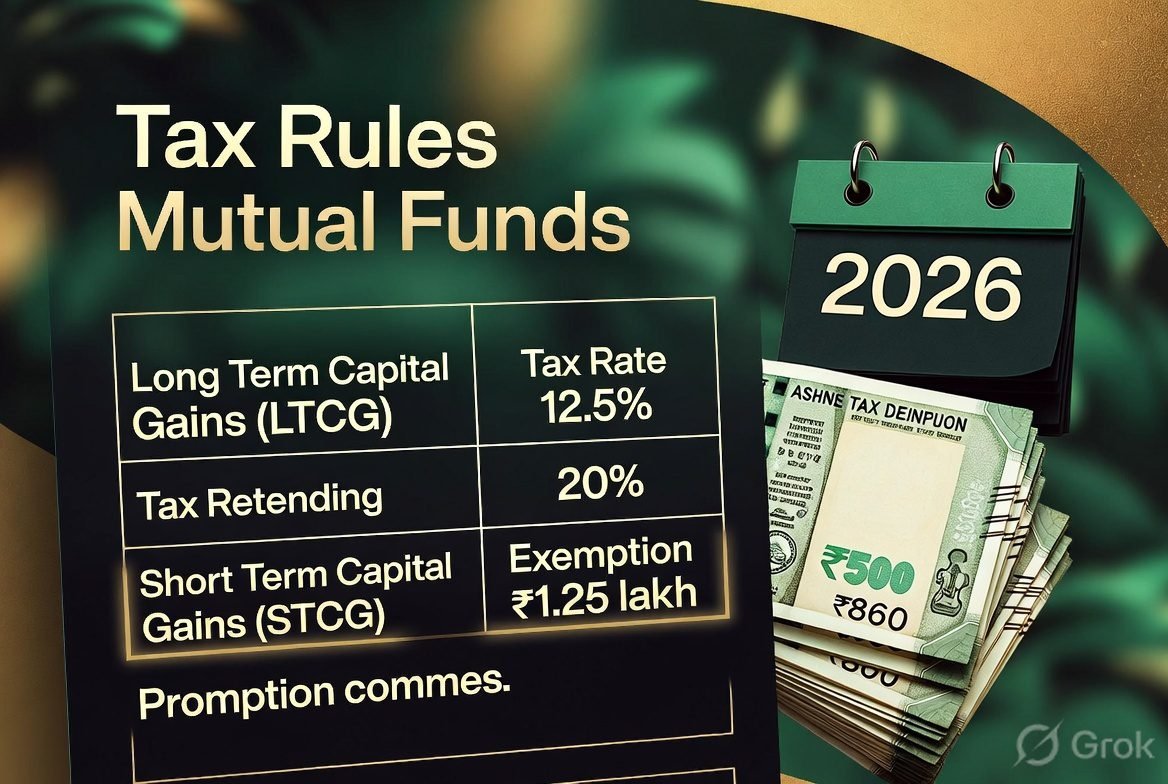
Tax rules on mutual funds changed materially in July 2024 (Budget 2024) and were confirmed unchanged in Budget 2026. Here are the current rules, confirmed as of February 2026:
| Fund Type | Holding Period for LTCG | STCG Tax Rate | LTCG Tax Rate | LTCG Exemption |
|---|---|---|---|---|
| Equity Funds (65%+ equity) | 12 months | 20% | 12.5% | ₹1.25 lakh/year |
| ELSS Funds | 3 years (mandatory lock-in) | N/A (locked) | 12.5% | ₹1.25 lakh/year |
| Debt Funds (post Apr 2023) | No LTCG benefit | Slab rate | Slab rate | None |
| Hybrid Funds (35–65% equity) | Check factsheet monthly | Varies | Varies | Varies |
| Gold ETF | 12 months | Slab rate | 12.5% | None stated |
| International Funds | 24 months (not equity-classified) | Slab rate | 12.5% | None |
The most important tax planning move for equity fund investors: you get a ₹1.25 lakh LTCG exemption every financial year. If you're sitting on long-term gains, consider redeeming up to that limit before 31 March, then reinvesting immediately. This "tax harvesting" move resets your cost basis without triggering any tax — completely legal, and surprisingly underused.
For ELSS specifically: you save tax at entry (up to ₹1.5 lakh under 80C, old regime only) and any gains above ₹1.25 lakh at exit are taxed at just 12.5%. In most scenarios, ELSS gives you both the tax saving and equity-level growth — no other 80C instrument offers both. Our guide to ITR filing in 2026 covers how to report mutual fund gains correctly, and if you're filing with investment income for the first time, the ITR-4 investment disclosure calculator simplifies the process. For crypto investors who also hold mutual funds, our crypto bookkeeping guide explains how to handle both asset classes in a single tax year.
Step 07The 5 Mistakes That Actually Kill Mutual Fund Returns
Most mutual fund mistakes aren't about picking the wrong fund. They're about behaviour — what you do after you've invested. These five patterns show up consistently in underperforming investor portfolios.
| # | The Mistake | Why It Costs You | What to Do Instead |
|---|---|---|---|
| 01 | Chasing last year's top performer | Past returns don't predict future returns. The top fund of any year usually reverts. You buy high and experience the correction. | Pick based on 5-year rolling returns vs benchmark, not 1-year absolute return. |
| 02 | Stopping SIPs during a market fall | You stop buying exactly when units are cheapest. You lock in the loss and miss the recovery's early gains. | Automate SIPs so emotion can't reach the button. Market falls are when SIPs work hardest. |
| 03 | Investing in Regular Plan when Direct is available | You silently pay 0.5–1% extra per year. Over 20 years that's often ₹20–50 lakh on a modest SIP. | Invest in Direct Plans. Use AMC websites or SEBI-registered platforms. |
| 04 | Too many funds (over-diversification) | Eight funds with similar large-cap exposure is not diversification — it's just expense ratio multiplication. | 3–4 well-chosen funds across categories is genuinely diversified for most investors. |
| 05 | Ignoring expense ratio difference | 0.1% vs 1.5% sounds trivial. On ₹10,000/month SIP over 20 years, it's often a ₹20–30 lakh gap. | Always check the expense ratio in the fund's factsheet. Lower is better, all else equal. |
The pattern we find most instructive is mistake #2 — stopping SIPs during a fall. Analysis of investor behaviour consistently shows that retail investors underperform the very funds they're invested in, simply because they buy and sell at the wrong times. Our piece on behavioural mistakes in stock trading covers this psychology in more depth, and the same biases apply to mutual fund investing.
(1) 5-year rolling return vs benchmark — not absolute, vs the index it claims to beat.
(2) Expense ratio (Direct Plan). Everything else is noise for a beginner. Fund manager tenure matters, but only after these two checks pass.
For readers tracking the broader market context in which these funds operate, our guide to how inflation affects equity portfolios and our gold ETF vs physical gold comparison are useful reads before finalising your asset allocation. If you're also considering real-money tax-saving strategies beyond ELSS, the tax-loss harvesting guide for Indian investors is directly applicable.
Finally, if you're a beginner just deciding how to start: the simplest version of this entire guide is to open a Direct Plan SIP in a Nifty 50 index fund with whatever amount you can sustain for three years without breaking it. Start with opening a demat account, pick a fund on the AMC's own website, set the date to your salary credit day, and let compounding do the rest. Our micro-investing apps guide covers which platforms make this easiest in 2026.
Frequently Asked Questions
- AMFI India — amfiindia.com — Monthly industry AUM and SIP data
- AMFI Monthly Note March 2026 — Official PDF
- Outlook Money — AMFI Data June 2026: Equity MF Inflows Rise 26%
- StartupTalky — India MF AUM ₹81.58 lakh crore, SIP crosses ₹30,000 crore
- Finnovate — SIP Stability or Stagnation: 2026 AMFI Data Analysis
- Business Standard — Beginner's Guide to Mutual Funds
- ClearTax — Direct vs Regular Mutual Fund: Full Comparison
- India Tax Tools — Tax on Mutual Funds 2026: LTCG, STCG Guide
- IndMoney — Mutual Fund Taxation India: Current Rules
- OnePercentClub — Mutual Fund Taxation India 2026
- Univest — Mutual Fund Investing India 2026: Types and Top Picks
- Tickertape — Best Mutual Funds for Beginners 2026
- Jarviix — Best Mutual Funds for Beginners India (2026)
- Groww — Best SIP Mutual Funds 2026
- SEBI India — sebi.gov.in — Regulatory framework for mutual funds
- Acumen Group — Tax on Mutual Funds and Stocks 2026

Pranab Barman is a Financial Educator and Personal Finance Researcher with over 10 years of hands-on experience in stock markets, trading, and investing. Currently enrolled in the CFA Program, he is committed to continuous learning and professional excellence in finance.
As the Founder of PlayWithStock, Pranab covers a wide range of topics including Mutual Funds, SIP, Taxation, Stock Market Basics, and Financial Calculators — with a focus on simplifying complex financial concepts for everyday all investors.
Email: support@playwithstock.com
Website: playwithstock.com
Related posts:
 ITR Refund Status Kaise Check Kare 2026: The Complete Step-by-Step Guide
 What Are Life Cycle Funds? SEBI’s Quiet New Mutual Fund Category
 SBI Mutual Fund IPO 2026: Dates, Price Band, GMP & Should You Apply
 Mutual Fund BER vs TER Calculator (2026): Compare BER vs TER Online
 SBI Mutual Fund IPO Opens Tomorrow: Everything Before You Apply
 What is a Demat Account? A Complete Beginner’s Guide
 What Is a Bonus Share? The Complete Beginner’s Guide
 Beginner Investing: 7 Proven Steps to Start the Right Way