
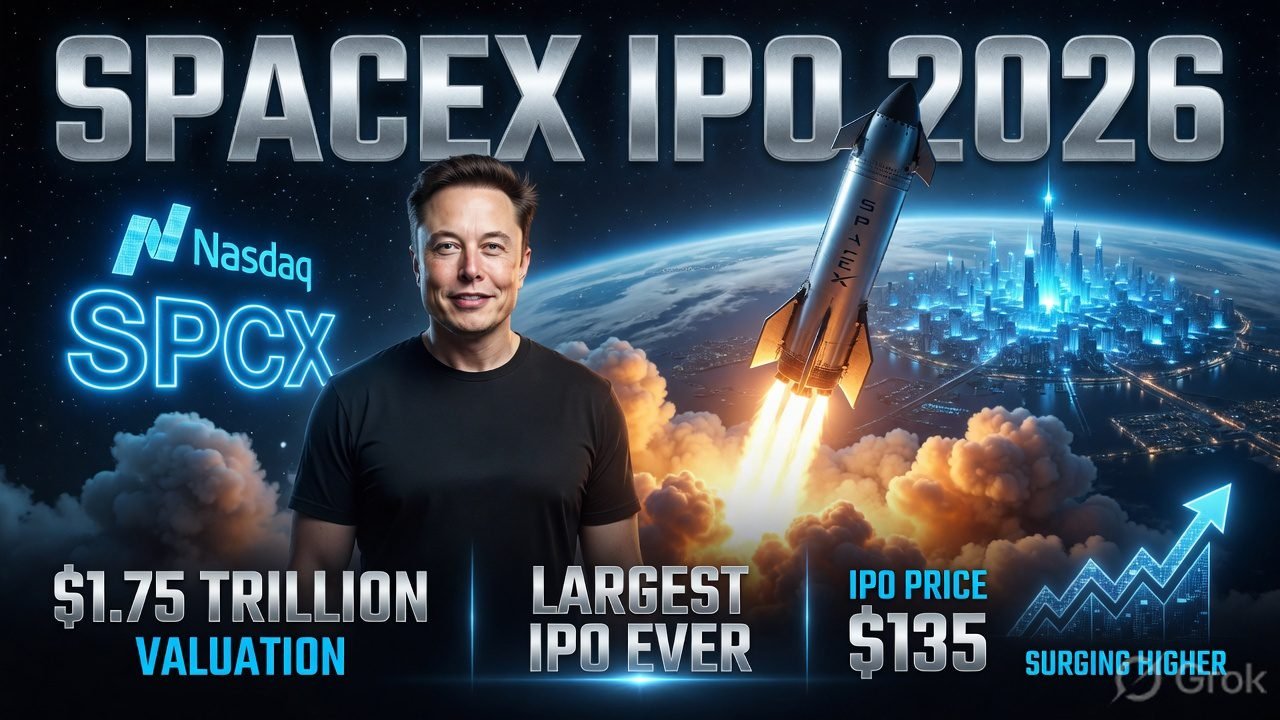

SpaceX IPO 2026: The Complete Story of the Largest Listing Ever
SpaceX IPO 2026 happened in June, and it genuinely broke records the day it priced. But the story that matters more right now, six weeks later, isn't the record-breaking debut — it's what's happened to the stock since. SPCX has swung from a euphoric first-day pop to trading meaningfully below where it started, and that gap between the hype and the current reality is worth understanding in full before you decide whether the stock deserves a place in your portfolio.
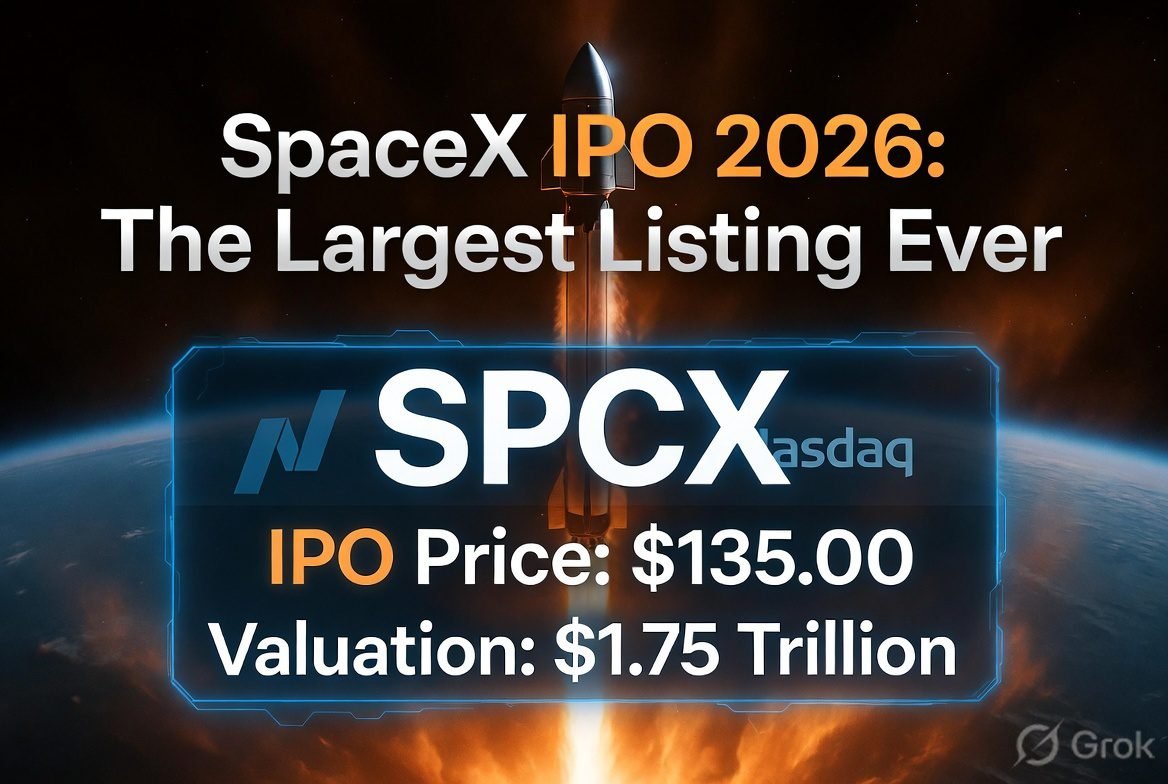
Table of Contents
- The Record-Breaking Numbers
- The Road to Listing: From $800 Billion to $1.75 Trillion
- What Happened on Day One
- Where SPCX Stands Today — and Why It's Fallen
- The Real Financials Behind the Hype
- Musk's Control: The Governance Story Nobody Can Ignore
- The Elizabeth Warren Warning
- The "Three Engines" Framing Bulls Use
- Should You Actually Buy SPCX
- Frequently Asked Questions
The Record-Breaking Numbers
SpaceX IPO — Key Facts
| Listing Date | June 12, 2026 |
| Exchange / Ticker | Nasdaq: SPCX |
| IPO Price | $135 per share |
| Shares Offered | ~556.6 million |
| Amount Raised | ~$75 billion |
| Valuation at Listing | ~$1.75–1.8 trillion |
| Day 1 Closing Price | $160.95 (+19%) |
SpaceX set its final IPO price at $135 on the day before listing, beginning trading with a valuation of $1.77 trillion. The IPO priced at $135, opened at $150 — about 11% above the offer price — and closed Day 1 at $160.95, a 19% first-day gain. The offering raised approximately $75 billion, entering SpaceX into public markets at a valuation approaching $1.8 trillion, making it, by a wide margin, the largest IPO in stock market history.
SpaceX is expected to have raised more money than all US IPOs in 2024 and 2025 combined, and the listing was set to be three times larger than the prior largest IPO on record. For context on scale, it drew comparisons even to Saudi Aramco's 2019 debut, which had previously held the record at a $1.7 trillion valuation and $29.4 billion raised. Historical IPO size rankings and comparisons are tracked by Renaissance Capital's IPO research and Bloomberg's markets rankings.
The Road to Listing: From $800 Billion to $1.75 Trillion
The valuation climbed fast in the months leading up to listing, and tracking that climb tells its own story about investor appetite for space and AI-adjacent names. In late January 2026, reports suggested SpaceX was weighing a mid-June IPO targeting a $1.5 trillion valuation, up from an $800 billion valuation in a secondary share sale the previous month. Earlier reporting had pointed to an offering north of $30 billion at that same roughly $1.5 trillion mark, itself already a jump from prior private valuations.
By the time the roadshow actually launched, the number had climbed further still. SpaceX publicly filed its S-1 prospectus on May 20, 2026, and the roadshow launched on June 4 — accelerated from an originally reported week-of-June-8 start after a faster-than-expected SEC review. SpaceX targeted a $1.75 trillion valuation based on a proposed price of $135 per share, with the final valuation confirmed when shares priced on June 11, ahead of the first trading day on June 12. Roadshow and IPO process mechanics of this kind are explained in plain language by Investopedia's roadshow explainer.
One detail that separates this IPO from most mega-cap debuts: retail investors weren't an afterthought. Roughly 30% of available shares were reportedly earmarked for individual investors, compared with the single-digit allocations more typical of large public offerings, distributed through major brokerage platforms including Charles Schwab, Fidelity, Robinhood, SoFi, and E*TRADE. You can verify current brokerage availability directly through Charles Schwab, Fidelity, or Robinhood's official platforms.
What Happened on Day One
SpaceX listed June 12, 2026 on Nasdaq as SPCX, priced at $135, and closed its first day at $160.95, up 19% and giving the company a market cap of roughly $2.1 trillion. That single-day pop meant early allotment holders were sitting on a genuinely substantial paper gain within hours of the stock actually trading.
The debut was described at the time as a referendum on Musk himself, as well as the latest major test of red-hot demand for the artificial intelligence boom, with reporters drawing comparisons to Facebook's 2012 Nasdaq debut, which was marred by technical glitches that delayed its opening. SpaceX's own listing, by contrast, proceeded without major technical disruption. We've seen similarly outsized first-day reactions on Indian exchanges too — our coverage of the Reliance Jio IPO and SBI Mutual Fund's listing day both show how much a single day's demand can move a stock away from its offer price, regardless of which market it's listed on.
Where SPCX Stands Today — and Why It's Fallen
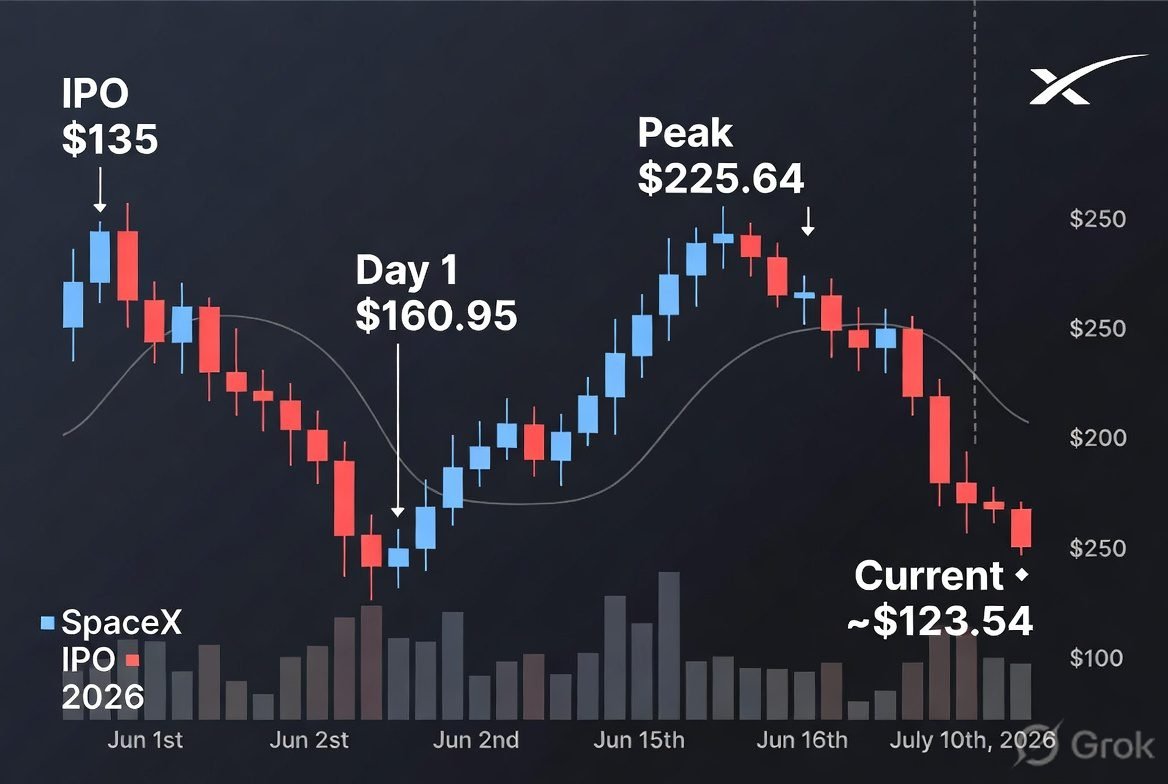
Here's where the story genuinely shifts from triumphant headline to something more cautionary. As of July 22, 2026, SpaceX is trading at around $123.54, below both its $135 IPO price and well below its 52-week high of $225.64 — a range that spans from $119.68 to $225.64. Current market cap sits at roughly $1.58 trillion, down substantially from the roughly $2.1 trillion reached after Day 1's rally.
| Milestone | Price | vs IPO Price |
|---|---|---|
| IPO Price (June 11 close) | $135.00 | — |
| Day 1 Close (June 12) | $160.95 | +19% |
| 52-Week High | $225.64 | +67% |
| Current (July 22) | ~$123.54 | -8.5% |
| 52-Week Low | $119.68 | -11.3% |
That's a genuinely dramatic round trip in a little over a month — from a stock trading two-thirds above its IPO price at its peak, to one now sitting below where it started. This is exactly the kind of volatility pattern we've discussed in the context of Indian IPOs too, in our India IPO Boom 2026 pipeline article, where we flagged that a busy, hyped IPO market doesn't automatically mean profitable listings for everyone who buys in near the peak.
The Real Financials Behind the Hype
Strip away the valuation headlines and the actual financial picture is genuinely a mixed bag — strong revenue growth paired with a large net loss. SpaceX generated $18.67 billion in 2025 revenue, anchored by a profitable Starlink business, but posted a $4.94 billion net loss, driven mainly by AI investment. Revenue grew to $18,674 million in 2025, and analysts model 2026 revenue in the range of $22 to $24 billion.
The valuation-to-revenue math is genuinely extreme by almost any historical standard. At $1.75 trillion, SpaceX priced at roughly 94 times trailing 2025 revenue and about 73 times consensus 2026 estimates — extraordinary, though not a total outlier within the launch-and-space company cohort, where Rocket Lab trades at an even higher 131 times sales. The company also carries a $41.3 billion accumulated deficit on its balance sheet — a reminder that even a company with a profitable core business (Starlink) can still be burning significant capital overall while it invests aggressively in newer bets.
Independent, continuously updated financial data on SPCX is available through Investing.com's SpaceX stock page and Nasdaq's official SPCX listing page, both of which update valuation multiples and earnings estimates as new data becomes available. SpaceX's next earnings report is scheduled for August 6, 2026, which will be the first full quarterly report investors get to judge against the company's own guidance since going public — a similar milestone moment to how we track India's Q1 FY27 earnings calendar for newly listed Indian companies.
Musk's Control: The Governance Story Nobody Can Ignore
This is arguably the single most important thing to understand before buying SPCX, and it's structurally different from almost any other mega-cap stock on the market. Musk holds the founder, CEO, CTO, and chairman titles on listing day, retaining about 85% of the voting power on roughly 42% of the company's equity, through a super-voting share class. The dual-class structure leaves Musk with over 80% voting power regardless of how many shares he personally sells to the public over time.
SpaceX lists as a "controlled company" under Nasdaq rules, which exempts it from certain independent-director requirements that apply to widely-held public companies. Practically, this means public shareholders own a meaningful economic stake in the business but have essentially no ability to influence board composition or major strategic decisions the way shareholders of a normally-governed public company would.
There's also a genuinely unusual detail buried in the filing that's worth knowing about. The S-1 discloses a performance grant of up to one billion additional shares tied to milestones, including a million-resident Mars colony — an extraordinarily long-dated, almost science-fiction-sounding target that nonetheless represents real potential future dilution if those milestones are ever formally structured into compensation triggers.
The Elizabeth Warren Warning
Not everyone was cheering the listing before it even happened. Around June 10, 2026, Senator Elizabeth Warren sent a letter urging the SEC to delay the offering, arguing the valuation had outrun the company's financials, that the dual-class structure handed Musk outsized voting control, and that accelerated Nasdaq-100 inclusion could force retirement and index funds to buy SpaceX shares whether their underlying investors chose to or not.
The SEC did not stop the listing, and the June 12 debut went ahead on schedule — the market pricing SPCX 19% above the offer price on Day 1 signaled that, at least in the short term, investors set the governance warnings aside. Whether that judgment holds up over a longer horizon, especially given where the stock trades today relative to its post-listing peak, is exactly the kind of question worth revisiting as more quarters of public reporting accumulate. It's worth noting the SEC's review process focuses specifically on disclosure transparency, not on whether a listing's price is fundamentally fair — those are two genuinely different regulatory questions.
Official correspondence and SEC filings related to the listing can be reviewed directly through the SEC's EDGAR filing system, the primary source for S-1 prospectus details rather than any secondary summary.
The "Three Engines" Framing Bulls Use
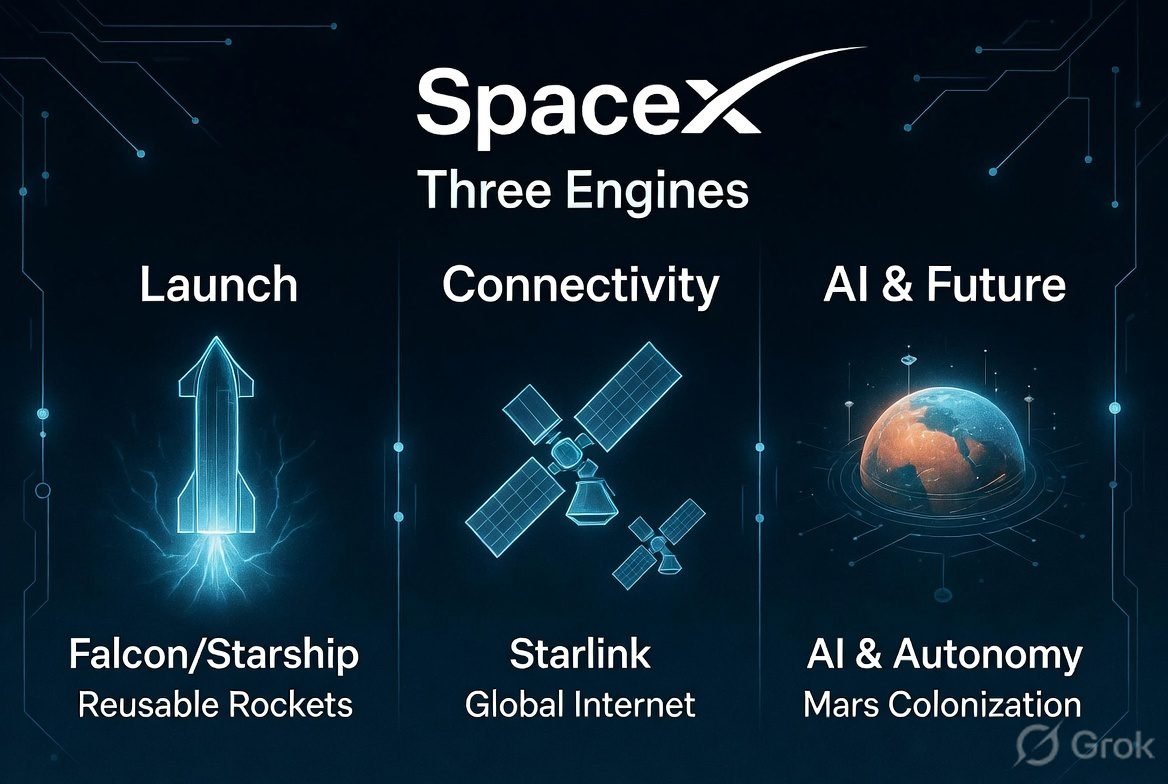
Investors bullish on SPCX tend to lean on a specific mental model to justify the valuation. Bulls argue a "three-engine" framing — launch, connectivity, and AI — justifies the headline valuation, increasingly positioning SpaceX as a potential addition to the "Magnificent Seven" club of mega-cap tech names, citing Starlink's high-margin growth and Starship's market-expanding economics.
Engine 1: Launch
Falcon rockets and reusability have already reshaped launch economics industry-wide, giving SpaceX a structural cost advantage over most competitors.
Engine 2: Connectivity
Starlink is the profitable core of the business today — a genuinely large, high-margin satellite internet operation already generating real cash flow.
Prediction markets were reportedly implying post-IPO valuations as high as $2 trillion around the time of listing — a figure the stock briefly exceeded before pulling back to current levels. Whether the AI engine specifically — which is currently the source of the company's net losses rather than its profits — eventually justifies its share of the valuation is genuinely the open question that will likely define SPCX's next few years of trading more than the already-established launch and Starlink businesses.
Compare: Best AI Stocks India 2026 →Should You Actually Buy SPCX
We're not going to tell you SpaceX is a "buy" or a "sell" — that's a decision that depends entirely on your own risk tolerance, time horizon, and conviction in the company's AI and Mars ambitions actually panning out over a genuinely long timeframe. What we would flag clearly:
You're buying into a controlled company, not a normally governed one. Musk's roughly 85% voting control means public shareholders are financial participants in the business's economics, not meaningful voters on its direction — a structurally different arrangement than buying shares in most S&P 500 companies.
The valuation already prices in significant future success. At 73-94 times revenue depending on which year's estimate you use, a large amount of optimism about Starlink's continued growth, Starship's commercial economics, and the AI business eventually turning profitable is already baked into today's price — not something you're getting for free by buying now.
Volatility has already proven to be extreme. A stock that moved from $135 to $225 and back down toward $120 within about six weeks of listing is not a low-volatility holding, regardless of how compelling the long-term business case might be. Position sizing matters enormously here, the same principle we've emphasized in our behavioral mistakes in stock trading guide, just applied to a US mega-cap name instead of an Indian one.
Frequently Asked Questions
When did SpaceX IPO and what was the price?
SpaceX listed on the Nasdaq on June 12, 2026, under the ticker SPCX, with an IPO price of $135 per share, raising approximately $75 billion at a valuation of roughly $1.75-1.8 trillion.
Is SpaceX stock (SPCX) up or down since its IPO?
As of July 22, 2026, SPCX trades around $123.54, which is below the $135 IPO price and well below its post-listing 52-week high of $225.64, though it did close its first trading day up 19% at $160.95.
Why is SpaceX's IPO valuation considered extreme?
At roughly $1.75 trillion, SpaceX priced at about 94 times trailing 2025 revenue and 73 times 2026 revenue estimates — an extraordinarily high multiple, even compared to other space companies like Rocket Lab, which trades at a higher 131 times sales.
Does buying SPCX stock give investors voting control?
No, essentially. Elon Musk retains approximately 85% of voting power through a super-voting share class while holding roughly 42% of total equity, meaning public shareholders have limited influence over board composition or major company decisions.
Is SpaceX profitable?
Partially. Starlink, SpaceX's satellite internet business, is profitable and growing, but the company posted an overall net loss of $4.94 billion in 2025, driven mainly by AI investment, and carries a $41.3 billion accumulated deficit.
Did any regulators oppose the SpaceX IPO?
Senator Elizabeth Warren sent a letter to the SEC urging a delay, citing valuation concerns and the dual-class governance structure, but the SEC did not stop the listing and it proceeded as scheduled on June 12, 2026.
How can I buy SpaceX stock?
SPCX trades on the Nasdaq and can be purchased through most major US brokerages, including Charles Schwab, Fidelity, Robinhood, SoFi, and E*TRADE, the same platforms that participated in the original IPO's retail share allocation.
Our Bottom Line on SpaceX's Public Debut
We'd rather you understand the full arc of this story — record-breaking hype, a genuinely strong Day 1, a run to $225, and a pullback to below the IPO price within about six weeks — than just remember the "largest IPO ever" headline from June. That headline is true and remarkable. It's also not the whole picture six weeks later, and the governance structure alone is different enough from a typical public company that it deserves real thought before you decide whether SPCX belongs in your portfolio.
If you're comparing mega-cap tech names more broadly heading into this earnings season, our Big Tech Earnings Week 2026 coverage of Alphabet, Tesla, and IBM is a useful companion read, since AI infrastructure spending is a common thread running through nearly every major tech story right now, SpaceX included.

Pranab Barman is a Financial Educator and Personal Finance Researcher with over 10 years of hands-on experience in stock markets, trading, and investing. Currently enrolled in the CFA Program, he is committed to continuous learning and professional excellence in finance.
As the Founder of PlayWithStock, Pranab covers a wide range of topics including Mutual Funds, SIP, Taxation, Stock Market Basics, and Financial Calculators — with a focus on simplifying complex financial concepts for everyday all investors.
Email: support@playwithstock.com
Website: playwithstock.com
Related posts:
 Reliance Jio IPO 2026: India’s Biggest-Ever Listing, Explained
 OpenAI IPO 2026: 7 Surprising Facts About the $1 Trillion Listing
 India Exports Q1 FY27: The Complete Growth Story (And the Part Most Headlines Skipped)
 SBI Mutual Fund IPO Listing: 7 Essential Facts to Know Before July 21 Debut
 SK Hynix ADR Premium 2026: The Ajab Arbitrage Story Everyone’s Watching
 Monthly SIP of ₹5,000 for 20 Years: Real Numbers, Real Story, and a Calculator
 Zepto IPO 2026: Complete Guide — Date, Valuation, Financials, and Should You Apply?
 India IPO Boom 2026: ₹2.65 Lakh Crore Pipeline Explained in Simple Terms