
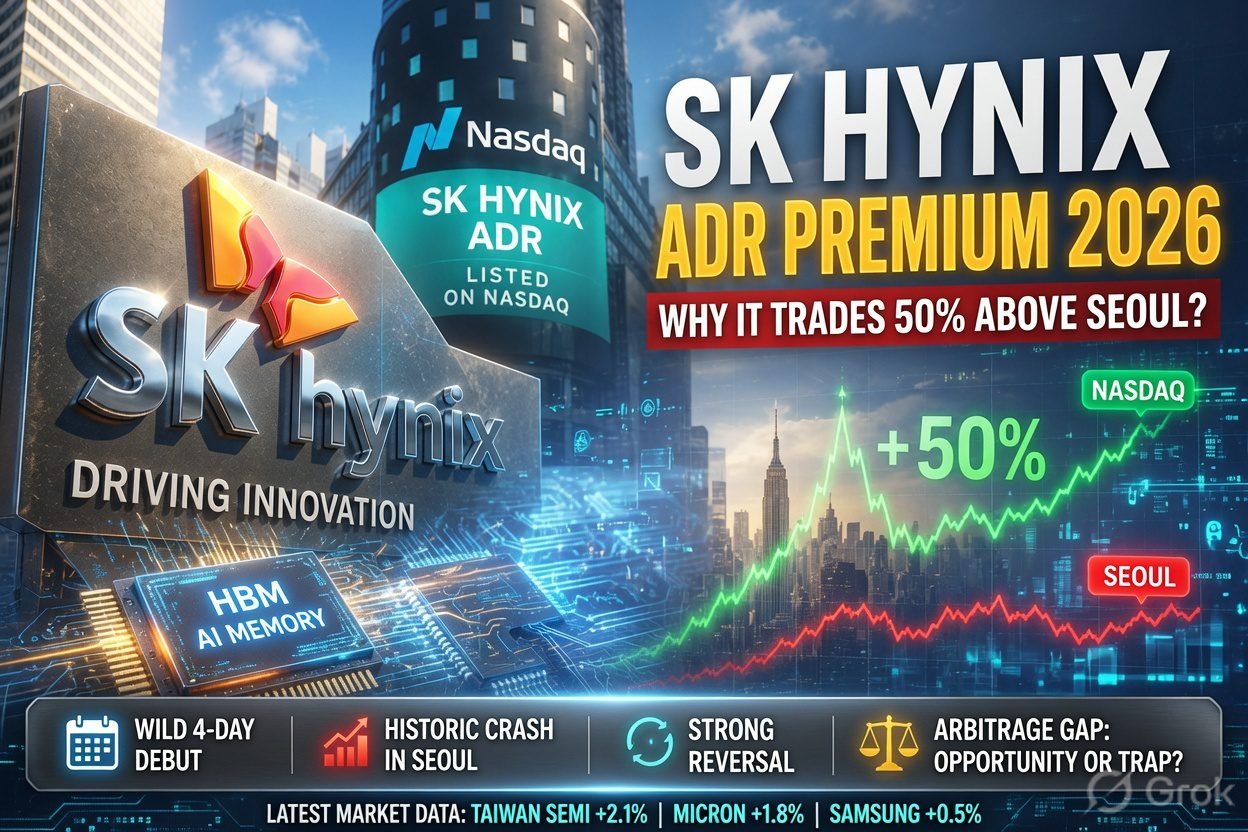

SK Hynix ADR Premium 2026: The Ajab Arbitrage Story Everyone's Watching
In four trading days, SK Hynix's US shares popped 13%, its Seoul stock had its worst crash on record, wiped out $100 billion, then roared back 13% the next day — and through all of it, the Nasdaq-listed version has stayed roughly 50% more expensive than the original. Here's why.
Same company, two prices, one very confused arbitrage market.
- The Four-Day Story, Day by Day
- What "ADR Premium" Actually Means
- Why This Premium Might Not Just Fade Away
- The Business Behind the Drama: HBM and the AI Memory Boom
- The "Korea Discount" This Listing Was Meant to Fix
- SK Hynix vs Micron vs TSMC: Comparing Your Options
- The Leveraged ETF Layer Making It Wilder
- The Real Risks Here
- Can Indian Investors Actually Buy This?
- FAQs
SK Hynix ADR Premium has become one of the strangest live case studies in modern markets — a single company, trading in two places, with the newer of the two listings sitting roughly 50% more expensive than the original for reasons that aren't fully mechanical. This isn't a small, obscure dislocation either. SK Hynix just completed the largest foreign ADR offering in Nasdaq history, and the premium attached to it is big enough that serious analysts are publicly disagreeing about whether it's a temporary listing quirk or the market finally pricing this company correctly.
If you've been anywhere near AI or semiconductor investing content this week, you've probably seen the headline number. What's harder to find is the actual mechanics — why the premium exists, why it might not behave like normal cross-listing gaps, and what it means for anyone (in the US or in India via LRS) actually considering buying in.
The Four-Day Story, Day by Day
Understanding why this premium is so unusual means walking through exactly what happened, because the sequence itself is the story.
SK Hynix prices its American Depositary Receipts at $149 each, raising $26.5 billion — surpassing Alibaba's 2014 debut as the largest US listing by a foreign company ever. Each ADR represents one-tenth of a Korean common share.
Trading opens at $170, a 14% pop over the offer price. Shares close at $168.01, up 13% on day one, under the temporary ticker SKHYV before switching to SKHY. Chairman Chey Tae-won tells CNBC "the demand is enormous, exponentially."
The ADR drifts lower from its debut-day high, briefly approaching the $149 offer price as initial euphoria cools.
Korean brokerage KIS publishes a Q2 profit estimate roughly 8% below consensus, citing slower HBM4 shipments. SK Hynix's Seoul-listed shares crash 15.4% — its worst single day on record — dragging the KOSPI down 9% and triggering a trading halt. Roughly $100 billion in market value evaporates in Seoul.
Seoul shares reverse entirely, jumping nearly 13% as the KOSPI closes 6.24% higher. Foreign investors buy a net 2.3 trillion won. The SK Hynix ADR surges 27.29% in the US to close at $193.92. Barclays initiates coverage the following day with an Overweight rating and a $330 price target — roughly 70% above the 14 July close.
Four sessions, three completely different narratives about the same company — and through the entire swing, the ADR held a meaningfully larger premium over the Seoul shares than it started with.
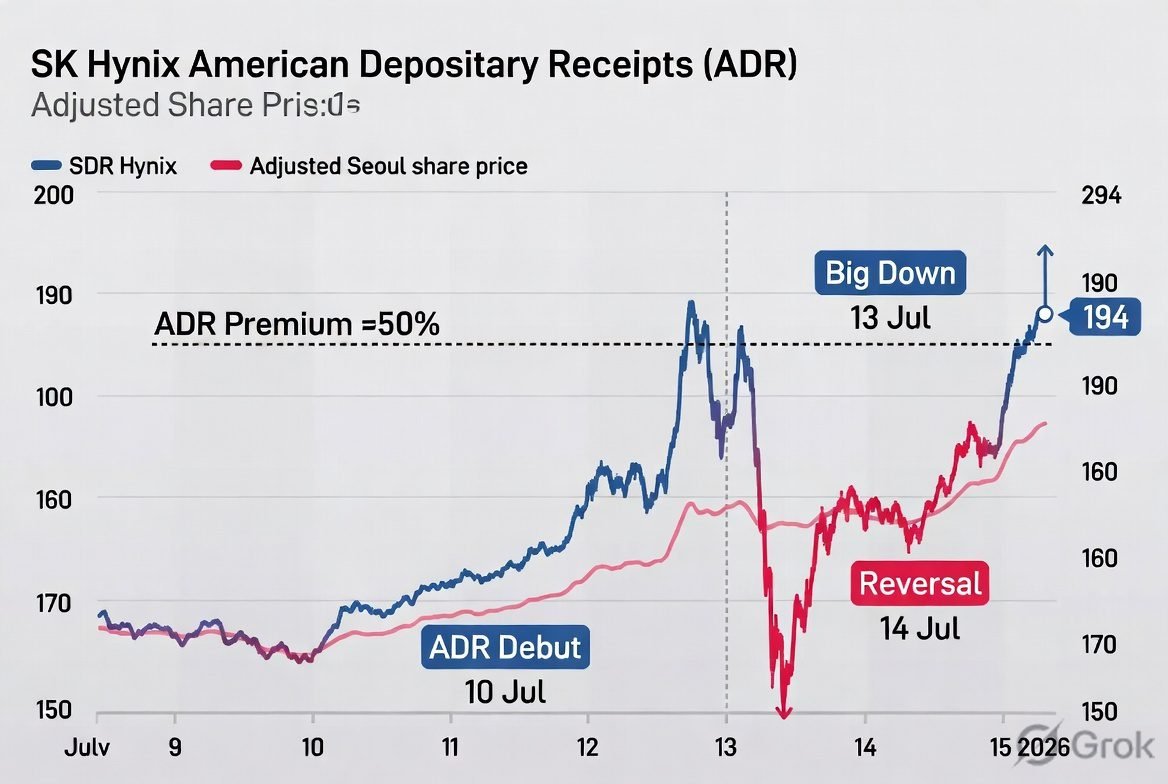
Two lines, one company — and the gap between them widened even as both moved wildly in the same direction.
What the SK Hynix ADR Premium Actually Means
An American Depositary Receipt lets US investors buy a foreign stock in dollars, through a normal US brokerage account, without opening a foreign trading account or dealing with foreign settlement systems directly. A bank holds the underlying foreign shares and issues receipts against them. In theory, an ADR and its underlying stock should track each other closely, adjusted for the exchange ratio — arbitrageurs are supposed to buy the cheaper version and sell the more expensive one until the gap closes.
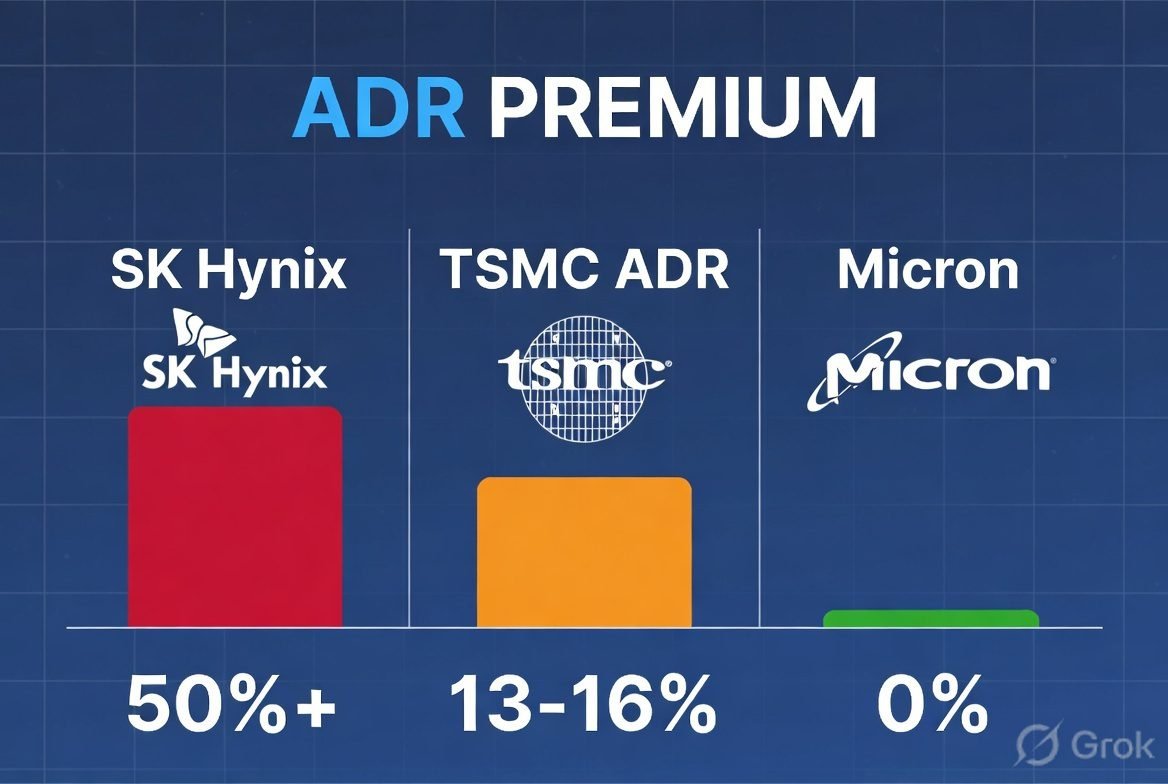
For SK Hynix, each ADR represents exactly one-tenth of a Korean common share. On 14 July, with the ADR at $193.92 and Seoul shares at 1,913,000 won (roughly $1,280 at prevailing exchange rates), the implied per-share value gap put the ADR at roughly 51% above the Korean listing on a like-for-like basis.
Why This Premium Might Not Just Fade Away
Normal cross-listing arbitrage works like a pressure valve: when the US-listed version trades rich, traders buy the cheaper domestic shares, convert them into ADRs, and sell at the higher price — a process that mechanically narrows the gap over time. That mechanism depends entirely on two-way convertibility actually working smoothly and cheaply.
SK Hynix's conversion mechanism reportedly may follow a one-way model — investors can potentially convert Korean shares into ADRs, but not necessarily the reverse. If that holds, the pressure valve only works in one direction, and the premium doesn't have the same natural closing mechanism a fully fungible dual listing would.
This isn't a hypothetical concern — it's exactly what's already visible in TSMC's ADRs, a genuinely useful comparison case. Taiwan Semiconductor's US-listed shares have maintained premiums of roughly 13-16% over their Taiwan-listed stock for extended periods, occasionally exceeding 20%, precisely because restricted convertibility keeps the arbitrage mechanism that would normally close the gap partially disabled. If SK Hynix follows a similar structural pattern, a persistent — not just temporary — premium becomes the more likely outcome, even if the size of that premium eventually settles lower than today's roughly 50%.
The Business Behind the Drama: HBM and the AI Memory Boom
Strip away the listing mechanics and the underlying business case is straightforward, if you've followed any AI infrastructure story this year. High-bandwidth memory — HBM — is the specialised, stacked memory that sits directly next to AI accelerators like Nvidia's GPUs, and it's become one of the tightest bottlenecks in the entire AI supply chain. SK Hynix is the dominant HBM supplier globally, holding an estimated 50-60% market share depending on the source and time period measured, with its order book reportedly effectively sold out for 2026.
The company projects 2026 revenue of roughly $231 billion, and its stock had already climbed more than 280% over the prior year even before the Nasdaq listing added a second venue for price discovery. In June 2026, SK Hynix overtook Samsung Electronics to become South Korea's most valuable listed company — a genuinely significant shift in a market where Samsung has been the default blue-chip name for decades.
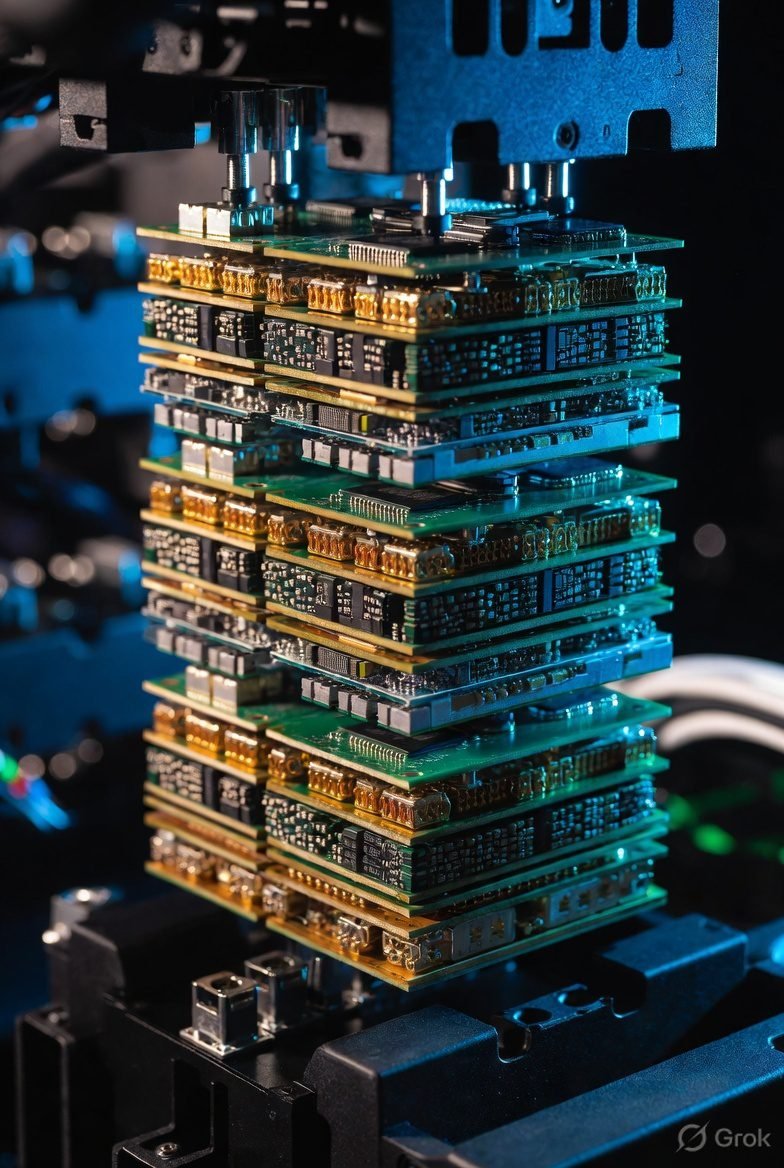
HBM sits at the tightest chokepoint in the AI hardware supply chain — which is exactly why this listing generated so much noise.
Demand estimates from Meritz Securities suggest DRAM suppliers currently meet only 75-80% of demand, with that fulfilment rate potentially dropping into the 60% range by 2027 — a supply-demand imbalance that, if it plays out, supports elevated pricing power for whichever suppliers can actually deliver. SK Hynix's chairman was blunt about the growth driver on debut day: "AI agents and robots need a lot of memory chips."
The "Korea Discount" This Listing Was Meant to Fix
Before this listing, SK Hynix traded at just 4.8 times forward earnings, according to LSEG data — compared to an industry median of nearly 30 times and US rival Micron's 6.6 times, despite SK Hynix's leadership position in the fastest-growing segment of the memory market. This gap is what market participants call the "Korea discount": a persistent tendency for South Korean companies to trade cheaper than global peers, generally attributed to governance concerns and the complexity of Korea's conglomerate (chaebol) corporate structures.
The explicit stated purpose of the Nasdaq listing was to open SK Hynix up to the world's deepest capital pool and let "its true corporate value be properly evaluated," in the company's own words. Early evidence is genuinely mixed on whether that's working: the ADR premium suggests real appetite for direct US-dollar access, but the same week also produced Seoul's worst single-day crash on record for the stock — hardly a clean validation of instantly closing the discount.
SK Hynix vs Micron vs TSMC: Comparing Your Options
For a US-based (or LRS-funded Indian) investor who wants exposure to the AI memory boom specifically, the SK Hynix ADR Premium changes the calculus meaningfully compared to simply buying the theme through an established, unpremium-priced alternative. There are now genuinely different ways in, each with a different risk-and-cost profile.
| Option | What You're Paying For | Key Consideration |
|---|---|---|
| SK Hynix ADR (SKHY) | Direct, most concentrated HBM exposure | ~50% premium over Seoul shares; limited trading history; premium could persist or narrow unpredictably |
| Micron Technology | Same shortage/HBM theme, established US listing | No listing premium; years of US disclosure history; deep liquidity |
| TSMC ADR | Broader semiconductor exposure (foundry, not just memory) | Established 13-16% typical premium pattern — useful reference case for how SK Hynix's premium might behave |
| Roundhill Memory ETF (DRAM) | Diversified memory-sector exposure | Top three holdings still represent roughly 73% of assets — less diversified than the fund name suggests |
The practical framing several analysts have used: buying SKHY over Micron means paying specifically for direct SK Hynix exposure and access convenience, not for exposure to the AI memory theme itself, which Micron already offers without any premium attached.
The Leveraged ETF Layer Making It Wilder
Adding to the volatility, GraniteShares moved quickly to launch 2x leveraged long and short ETFs tracking SK Hynix's daily ADR performance, targeting a launch around 13 July — right in the middle of the wildest days of trading. Goldman Sachs specifically pointed to these newly launched, concentrated leveraged products as having amplified the Seoul selloff on 13 July, even though the underlying semiconductor cycle itself hadn't actually deteriorated.
The Real Risks Behind the SK Hynix ADR Premium
Beyond the mechanical premium question, several structural risks are worth naming directly rather than glossing over — because a listing this dramatic in its first week tends to attract attention to the upside story while the risk side gets less airtime.
Concentration at the index level: Samsung Electronics and SK Hynix together account for more than 40% of the KOSPI, meaning a huge share of South Korea's benchmark index now rides on the health of just two semiconductor companies — a real systemic exposure for anyone holding broad Korean market funds, not just SK Hynix directly.
Cyclicality: Memory chip demand has a long history of boom-bust cycles tied to broader tech spending waves — the dot-com era, the smartphone build-out, the cloud transition all produced memory booms that eventually cooled. Nothing about the current AI-driven cycle guarantees it avoids the same pattern eventually, even if the near-term supply-demand picture looks genuinely tight.
Premium snapback risk: If Korean regulatory changes or market developments eventually make cross-border arbitrage cheaper and easier, the ADR premium could compress relatively quickly — a real risk specifically for US holders who bought at today's elevated premium, even if the underlying company performs well.
Newly listed volatility: A stock with less than two weeks of US trading history, combined with leveraged ETF flows sitting on top of limited tradable float, produces exactly the kind of amplified volatility already visible in the 13-14 July swing.
Can Indian Investors Actually Buy This?
Yes, in principle, through the same route covered in our broader AI Investing 2026 guide: the RBI's Liberalised Remittance Scheme allows resident Indians to remit up to USD 250,000 per financial year for overseas investment, including US-listed ADRs like SKHY, through platforms such as Vested, INDmoney, or Interactive Brokers. The mechanics don't change for a newly listed ADR — KYC, a W-8BEN form, LRS funding under the equity investment purpose code, and standard 12.5% LTCG treatment on gains held over 24 months.
What should change is the sizing. A stock with this little trading history, this much recent volatility, and a premium whose long-term behaviour genuinely isn't settled yet is a poor candidate for anything beyond a small, deliberate satellite position — not a core holding, and certainly not a leveraged bet, for a first-time LRS investor still building comfort with the process.
The Bottom Line
The SK Hynix ADR Premium is a genuinely rare, live example of market structure — not fundamentals — creating a real, tradable price gap for the same underlying business. The company's HBM dominance and the AI memory shortage behind it are real; the premium itself is a separate, structural question about convertibility and access friction that the TSMC precedent suggests could persist far longer than a typical new-listing quirk. For most investors, the more defensible move is to understand exactly what you'd be paying for before deciding whether SKHY, Micron, or a diversified memory-sector fund fits your actual goal.
FAQs: SK Hynix ADR Premium
Primarily due to access friction — US institutional investors face currency conversion, market access, and settlement barriers to buying Korean shares directly, which the ADR removes. Potential one-way conversion restrictions may also prevent normal arbitrage from closing the gap quickly.
Each SK Hynix ADR represents one-tenth of a Korean common share, so ten ADRs are economically equivalent to one Seoul-listed ordinary share.
A Korean brokerage, KIS, published a Q2 profit estimate roughly 8% below consensus, citing slower HBM4 shipments. The stock's worst single-day crash on record followed, dragging the broader KOSPI index down 9% and triggering a trading halt.
It's genuinely unclear. If conversion between the two listings is restricted to one direction, as some reports suggest, the premium could behave like TSMC's persistent 13-16% ADR premium rather than fully closing.
SK Hynix offers more concentrated, direct HBM exposure as the market leader, but at a roughly 50% premium and with limited US trading history. Micron offers the same underlying theme with no listing premium and years of established liquidity.
Yes, through the RBI's Liberalised Remittance Scheme (up to USD 250,000 per financial year) via platforms supporting US stock investing, though the stock's limited history and premium volatility make it suitable only as a small satellite position.
GraniteShares launched 2x leveraged long and short ETFs tracking SK Hynix's daily ADR performance around 13 July 2026. These reset daily and are trading instruments, not suitable for long-term holding due to compounding effects over time.
A persistent tendency for South Korean companies to trade at lower valuations than global peers, generally attributed to corporate governance concerns and complex conglomerate structures. SK Hynix traded at just 4.8x forward earnings before the Nasdaq listing, versus an industry median near 30x.
References: CNBC: SK Hynix Nasdaq Debut · CNBC: Will the Listing Bridge the Korea Discount · CNBC: SK Hynix $29B ADR Listing Plan · TheStreet: Wild Nasdaq Trading Debut · Korea JoongAng Daily: Analysts Split on Premium · Crypto Briefing: ADR Premium Explained · Crypto Briefing: Arbitrage Challenges vs TSMC · GraniteShares: What the Listing Means for US Investors

Pranab Barman is a Financial Educator and Personal Finance Researcher with over 10 years of hands-on experience in stock markets, trading, and investing. Currently enrolled in the CFA Program, he is committed to continuous learning and professional excellence in finance.
As the Founder of PlayWithStock, Pranab covers a wide range of topics including Mutual Funds, SIP, Taxation, Stock Market Basics, and Financial Calculators — with a focus on simplifying complex financial concepts for everyday all investors.
Email: support@playwithstock.com
Website: playwithstock.com
Related posts:
 SK Hynix IPO: Massive $26.5B Debut Shocks Wall Street
 Vodafone Idea Stock 2026: The Complete ₹35,000 Crore Guide
 AI Investing 2026: The Complete India-US Stock Guide
 Jio IPO 2026: 10 Crucial Facts Every Investor Must Know
 SBI Mutual Fund IPO 2026: Dates, Price Band, GMP & Should You Apply
 F&O STT Hike Breakeven Calculator: 2026 New Rates
 Gold Price Prediction Diwali 2026: Will Gold Recover After the Correction?
 Stocks to Buy After India-US Trade Deal 2026: A Sector-by-Sector Breakdown