
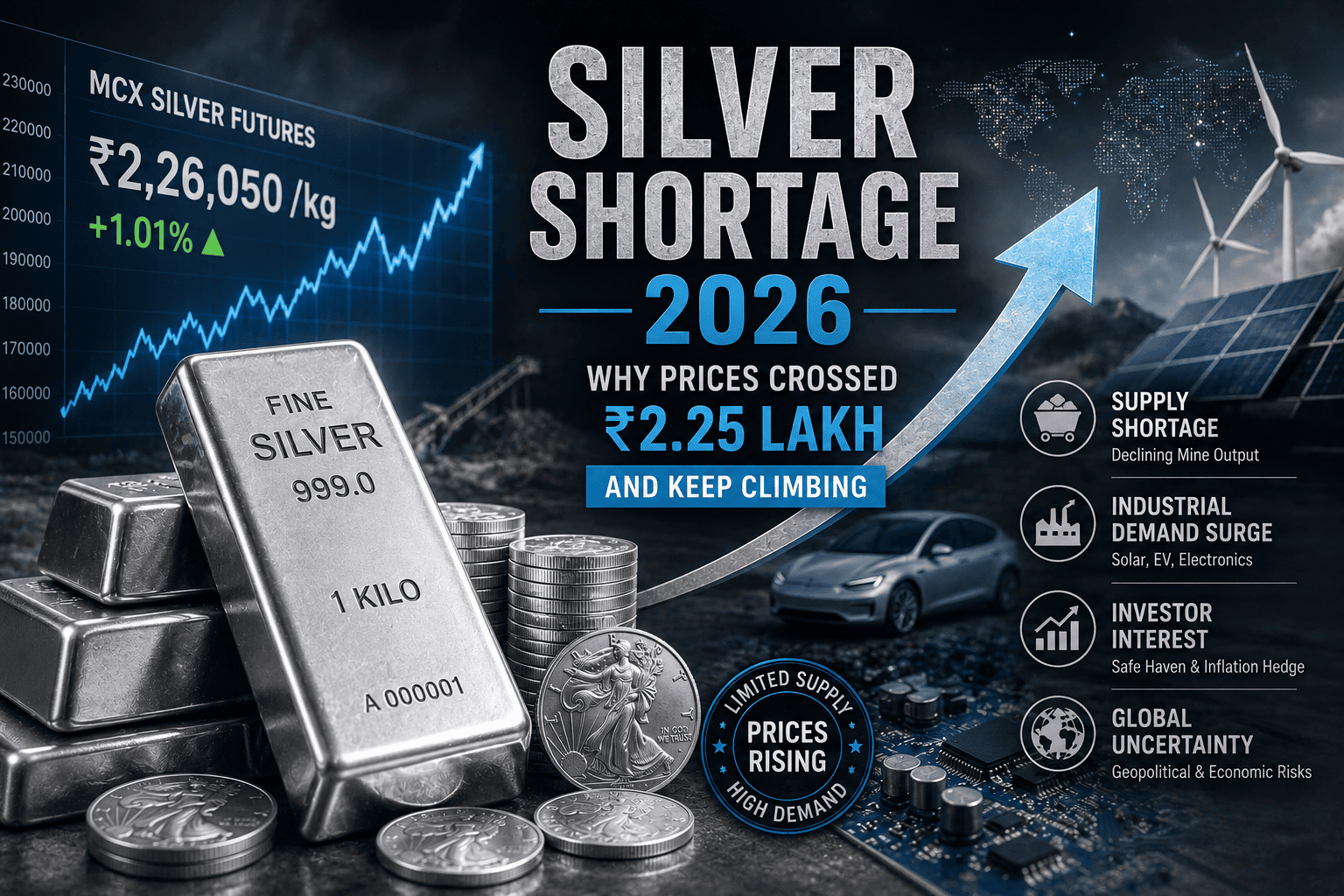

Silver Shortage 2026: Why Prices Crossed ₹2.25 Lakh and Keep Climbing
Silver Shortage 2026 is the phrase actually behind the price you're seeing at the jeweller right now, and it's a more specific, more explainable story than "gold went up so silver followed." MCX silver futures rose roughly 1.01% to ₹2,26,050 per kilogram, and the metal has genuinely crossed levels this year that nobody in the trade was seriously forecasting even eighteen months ago.
We've written about silver's climb before on this blog — our pieces on the silver all-time high and the silver price surge both captured moments in this run. Global coverage of the same structural story has come from the Silver Institute and commodity research desks like Metals Focus. What we hadn't done is sit down with the actual supply and demand numbers, because once you see them, "why is silver expensive" stops being a vague question and becomes a fairly simple math problem — the world is using more silver than it digs out of the ground, and has been for six years running.
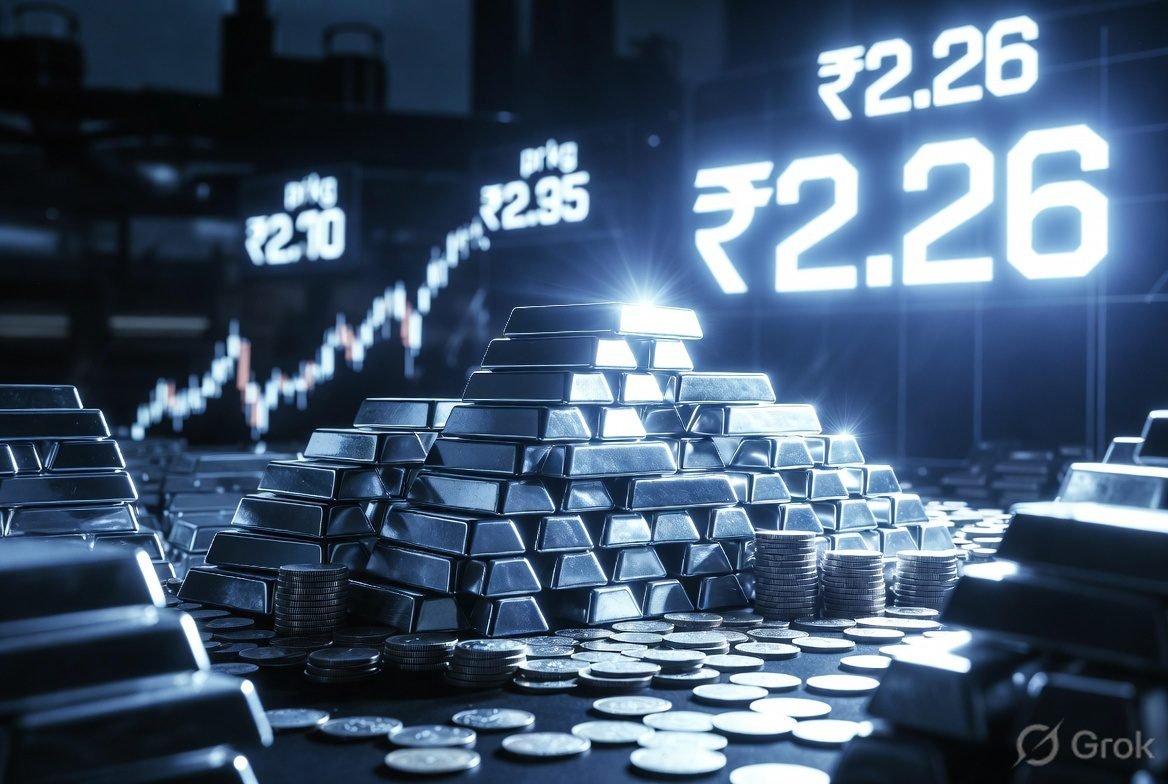
Table of Contents
- Silver Rate Today in India
- A Sixth Straight Year of Deficit — What That Actually Means
- The Solar Panel Twist Nobody Expected
- China's Export Restrictions Made It Worse
- Where the Demand Is Actually Coming From
- Gold vs Silver: Which Is the Better Buy Right Now
- What This Means for Indian Jewellery and Investment Demand
- How to Actually Invest in Silver
- Frequently Asked Questions
Silver Rate Today in India
Silver Snapshot — July 22, 2026
| Silver (per gram, retail) | ₹235–240 |
| Silver (per kilogram, retail) | ₹2,35,000–2,40,000 |
| MCX Silver Futures (per kg) | ₹2,26,050 |
| Global Deficit, 2026 (forecast) | 46.3 million oz |
| Consecutive Deficit Years | 6th straight year |
| Cumulative Stock Drawdown Since 2021 | 760+ million oz |
The price of silver in India today is around ₹240 per gram and ₹2,40,000 per kilogram in the retail market, while MCX futures were trading closer to ₹2,26,050 per kilogram, up roughly 1.01% on the day. The gap between retail and futures pricing is normal — retail rates carry a premium for making, purity certification, and local dealer margins. If you want a live number rather than a snapshot, Goodreturns' silver rate page and MCX India's official site both update through the trading day.
Earlier this year, the numbers were even more dramatic globally. As of January 7, 2026, spot silver prices reached a global record of $82.58 per ounce, while the March 2026 MCX contract touched an all-time high of ₹2,59,692 per kilogram — meaning the metal has actually cooled somewhat from its peak even while still sitting at levels that would have seemed extreme two years ago.
A Sixth Straight Year of Deficit — What That Actually Means
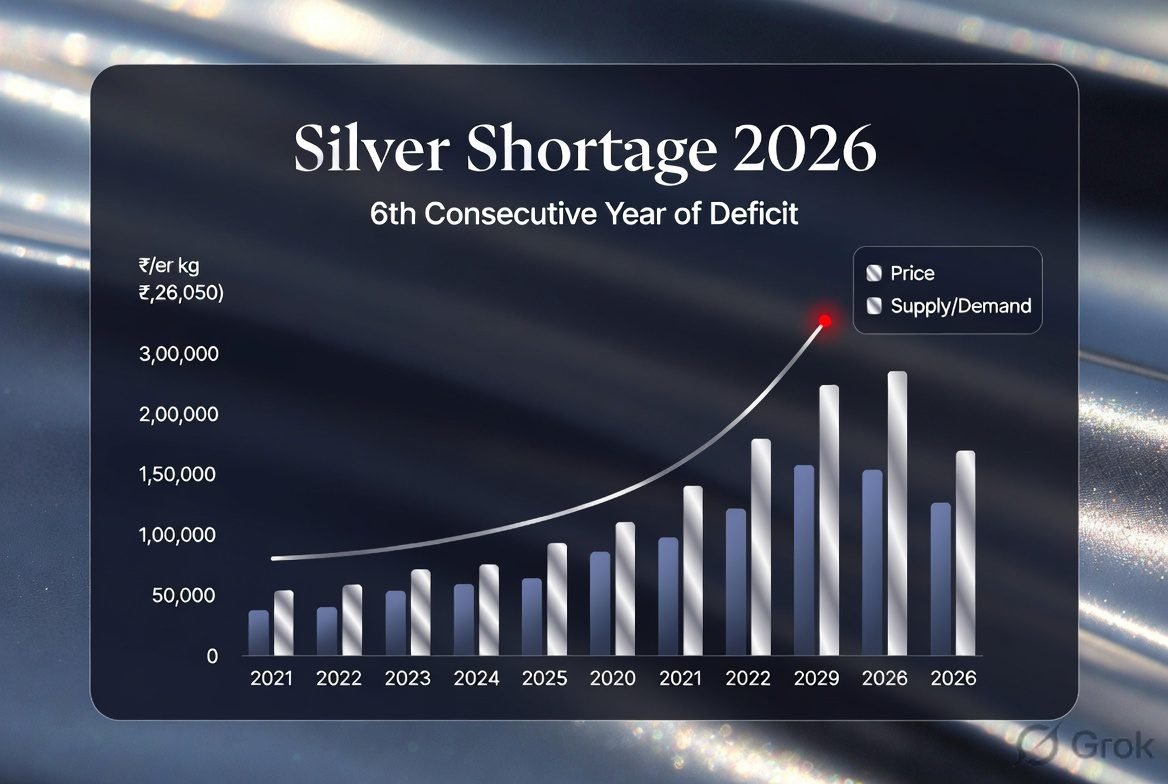
This is the number we think gets buried under every "silver hits record high" headline, and it's genuinely the whole story. According to the Silver Institute's World Silver Survey, the market is heading for a 46.3 million ounce shortfall in 2026, widening from a 40.3 million ounce deficit in 2025. That's not a one-year blip — it's the sixth consecutive year that global silver demand has exceeded global silver supply.
Every year that deficit persists, it has to be filled from somewhere, and that somewhere is above-ground stockpiles — the silver already sitting in vaults, bars, and industrial inventories. The cumulative deficit from 2021 to 2026 is estimated at approximately 1,050 to 1,100 million ounces, more than a full year of global mine production, drawn from LBMA vaults, COMEX warehouses, and other inventories. Registered silver stocks at COMEX fell from 150 million ounces in early 2021 to under 70 million by late 2025 — a genuinely steep drawdown by any measure. You can check current COMEX and LBMA vault data yourself through the CME Group's silver market page and the London Bullion Market Association's official site.
We track this kind of supply-demand imbalance in stock markets too, through the lens of our sector rotation guide — but with silver, the imbalance isn't a rotation between sectors, it's a genuine, physical, shrinking pile of metal that the world can't mine its way out of quickly.
The Solar Panel Twist Nobody Expected
Here's the counterintuitive part of this story that most coverage skips entirely. You'd assume rising silver prices would come from rising solar demand, since solar panels use silver paste in their cells. Instead, the opposite happened — a pattern worth comparing against our best AI stocks India 2026 and AI investing guide, since AI data center growth is now one of silver's own demand drivers, linking these two themes more closely than most investors realize. Solar photovoltaic manufacturers reduced silver consumption by 19% in 2026, to roughly 151 million ounces — the largest single-year reduction on record, as manufacturers actively "thrifted" silver out of each panel to protect their margins against high raw material costs.
And despite that genuinely large cutback from the solar industry, the global silver market is still heading for a wider deficit than the year before, because mine supply is contracting faster than industrial demand is falling. In other words, even solar manufacturers cutting nearly a fifth of their silver use wasn't enough to fix the shortage — that's how tight the underlying supply picture actually is. The full technical breakdown of this thrifting trend is available in the World Silver Survey 2026, published jointly by the Silver Institute and Metals Focus.
China's Export Restrictions Made It Worse
Supply-side policy added its own pressure on top of the structural deficit. China, which controls roughly 60% of the world's refined silver supply, implemented a restrictive new licensing regime for silver exports on January 1, 2026, effectively locking out all but a small number of state-approved exporters. When the country responsible for well over half the world's refined silver tightens the export tap, the effect on global availability is immediate and hard for any other producer to offset quickly.
This is the kind of geopolitical supply shock we've written about in other contexts too — see our pieces on the India-US trade deal and the India-UK CETA agreement, where trade policy decisions in one country ripple through global commodity availability in ways that aren't always obvious until the price moves. Reporting on China's export licensing changes has been tracked in detail by Reuters' commodities desk and Mining.com.
Where the Demand Is Actually Coming From
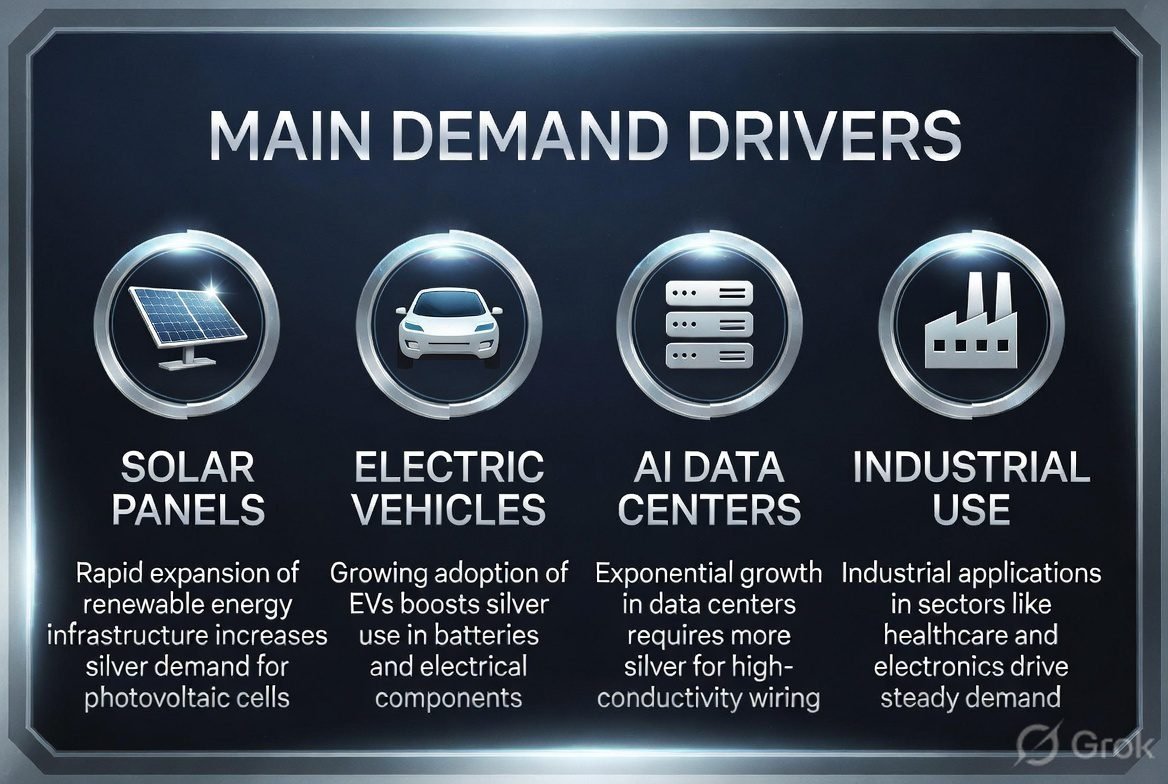
| Demand Source | 2026 Trend |
|---|---|
| Solar (Photovoltaic) | Down 19% due to thrifting, still the largest single industrial use |
| Electric Vehicles | Growing steadily as EV electronics require silver contacts and connectors |
| AI Data Centers | Rising sharply due to silver's superior electrical conductivity |
| Automotive (broader) | Expected to account for 59% of industrial share by 2031 |
| Physical Investment (coins, bars) | Up roughly 20%, reaching a three-year high |
| Jewelry (India-led) | Down over 9%, as record prices curb consumption |
The Silver Institute has flagged strong structural growth in data centers, artificial intelligence infrastructure, and the automotive sector, since silver conducts electricity better than almost any other metal. Industrial applications now account for roughly 60% of total silver consumption, up from about 50% a decade ago — a genuine structural shift in what silver is actually used for, away from jewellery and toward technology. Detailed industrial usage breakdowns are published in Metals Focus' commodity reports.
On the investment side, physical investment is forecast to rise 20% to a three-year high of 227 million ounces in 2026, as Western investors return to the market after several weak years, supported by strong prices and economic uncertainty, while investment demand in India is also expected to build on last year's substantial gains, amid positive investor sentiment.
Gold vs Silver: Which Is the Better Buy Right Now
This is genuinely one of the most common questions we get from readers right now, and there isn't a single correct answer — but the underlying stories are different enough to be worth understanding separately. Our gold price rally 2026 explainer covers gold's drivers in depth — mainly central bank buying, Fed rate cuts, and safe-haven demand. Silver shares some of that safe-haven appeal, but it also has a genuine industrial demand story gold simply doesn't have.
Case for Gold
Central bank buying is a structural, slow-moving force. Gold tends to be less volatile day to day, and its role as a portfolio hedge is more established and easier to size confidently.
Case for Silver
A genuine, multi-year physical supply deficit with growing industrial demand from AI, EVs, and data centers — a story with real structural tailwinds beyond just investor sentiment, though it comes with noticeably higher price volatility.
A reasonable, non-dramatic approach many readers take is holding both in smaller proportions rather than picking one exclusively — treating gold as the stabilizer and silver as the higher-volatility, higher-growth-story component of a precious metals allocation, similar to how we've suggested diversifying using sector rotation principles in equities. Interestingly, silver is now priced above a barrel of oil, an unusual benchmark that itself reflects how much the demand and supply dynamics for the metal have shifted — worth comparing against our oil price and India impact article if you're curious how the two commodities have diverged.
How This Compares: Full Gold Price Rally 2026 Breakdown →What This Means for Indian Jewellery and Investment Demand
Record prices are genuinely reshaping Indian silver consumption in two opposite directions at once. Global jewelry fabrication dropped 8% in 2025 and is projected to fall a further 16% in 2026 to a five-year low, with India specifically leading much of that decline as high prices curb consumption. At the same time, Indian investment demand for silver is expected to build on last year's substantial gains, driven by positive investor sentiment around the metal's price performance.
That split — jewellery demand falling while investment demand rises — is a genuinely useful signal if you're deciding how to buy your own silver. Buying for personal use or a wedding right now means paying near-record prices for something you'll wear, while buying for investment means participating in a documented structural shortage that most analysts don't expect to resolve quickly. Domestic bullion trade data of this kind is tracked by the India Bullion and Jewellers Association and reported through Moneycontrol's commodities section. If a wedding purchase is on your calendar, our sinking fund for festival expenses guide can help you plan the purchase in stages rather than absorbing the full cost at once.
How to Actually Invest in Silver
If you've decided silver's supply story is compelling enough to warrant an actual allocation, there are a few practical routes, each with different trade-offs:
Physical silver (coins, bars) means storage responsibility and a making or premium charge, but zero counterparty risk — you physically hold the metal.
Silver ETFs trade on the stock exchange like any other security through your existing demat account, tracking the silver price closely without storage headaches — a similar logic to how we've compared gold ETFs against physical gold.
Silver mining or industrial-exposure stocks offer indirect exposure, though they carry company-specific risk on top of the metal's own price movement — worth understanding through our broader beginner investing guide if this is your first time considering commodity-adjacent equities. If you're starting with a small amount, our micro-investing apps for beginners guide covers low-minimum entry points that also apply to precious metal ETFs.
Whichever route you choose, sizing matters more than timing. We'd suggest treating any silver allocation the same cautious way we suggested for gold in our companion article — a modest percentage of a diversified portfolio, added gradually, not a lump-sum bet chasing a rally that's already run hard. Our tax planning guide and the ITR filing deadline 2026 article are both worth bookmarking once any silver holding is large enough to matter at tax time.
Frequently Asked Questions
Why is silver so expensive in 2026?
The main reason is a genuine physical supply deficit — the world has used more silver than it has mined for six consecutive years, forecast at 46.3 million ounces short in 2026 alone, compounded by China's tightened export restrictions and rising industrial demand from AI, EVs, and data centers.
What is today's silver price in India?
As of July 22, 2026, retail silver trades around ₹235-240 per gram, or approximately ₹2,35,000-2,40,000 per kilogram, while MCX futures were closer to ₹2,26,050 per kilogram.
Is silver in a genuine supply shortage or just a price rally?
It's a genuine physical shortage — the market has recorded consecutive annual deficits since 2021, with cumulative drawdowns of over a billion ounces from above-ground stockpiles, not just speculative price movement.
Why did solar panel demand for silver fall if silver prices are still rising?
Solar manufacturers reduced silver use per panel by about 19% in 2026 to protect their margins against high raw material costs — a practice called thrifting. Despite this cutback, the overall market deficit still widened because mine supply is contracting even faster than industrial demand.
Should I buy gold or silver right now?
Both have different underlying drivers — gold is supported mainly by central bank buying and Fed rate cuts, while silver has an additional structural industrial demand and supply deficit story. Many investors hold both in smaller proportions rather than choosing one exclusively.
How can I invest in silver in India?
Common routes include physical silver coins or bars, silver ETFs traded through a demat account, and silver mining or industrial-exposure stocks, each with different storage, liquidity, and risk trade-offs.
Will the silver supply deficit continue after 2026?
Most industry forecasts, including the Silver Institute's World Silver Survey, don't project the structural deficit closing quickly, since mine supply has stayed roughly flat for a decade while industrial demand from EVs, AI infrastructure, and automotive continues to grow.
Our Bottom Line on This Silver Shortage
We'd rather you understand the real mechanics behind this — a genuine, multi-year physical deficit, a solar industry actively cutting its own silver use and still not being enough to fix the gap, and a major exporter tightening its supply chain — than just remember a big rupee number from a headline. This isn't a speculative bubble in the traditional sense; it's a documented shortage with a paper trail going back to 2021.
If you're weighing silver against other parts of your portfolio, our Nifty and Sensex guide, how inflation affects your portfolio article, and demat account basics are useful companions before deciding how much room, if any, precious metals should occupy alongside your equity holdings.

Pranab Barman is a Financial Educator and Personal Finance Researcher with over 10 years of hands-on experience in stock markets, trading, and investing. Currently enrolled in the CFA Program, he is committed to continuous learning and professional excellence in finance.
As the Founder of PlayWithStock, Pranab covers a wide range of topics including Mutual Funds, SIP, Taxation, Stock Market Basics, and Financial Calculators — with a focus on simplifying complex financial concepts for everyday all investors.
Email: support@playwithstock.com
Website: playwithstock.com
Related posts:
 Silver Price Surge 2026: Why Silver Is Beating Gold This Year
 Passive Investing in India Just Crossed ₹14 Lakh Crore — Here’s the Index Funds vs Active Funds Math Behind It
 Gold Price Rally 2026: Why It Jumped 44% and Nears ₹1.45 Lakh
 Silver Crash 2026: What Happened After Its All-Time High of $121
 India IPO Boom 2026: ₹2.65 Lakh Crore Pipeline Explained in Simple Terms
 Reliance Q1 FY27 Results: Revenue Hits Record ₹3.12 Lakh Crore, Profit Slips 22%
 Give the Same $10,000 to Charity in 2025 vs 2026, and Your Tax Break Could Shrink — Here’s Why: OBBBA Tax Changes 2026 Explained
 Monsoon 2026 India Inflation: Why a Dry June Hits Grocery Bills