
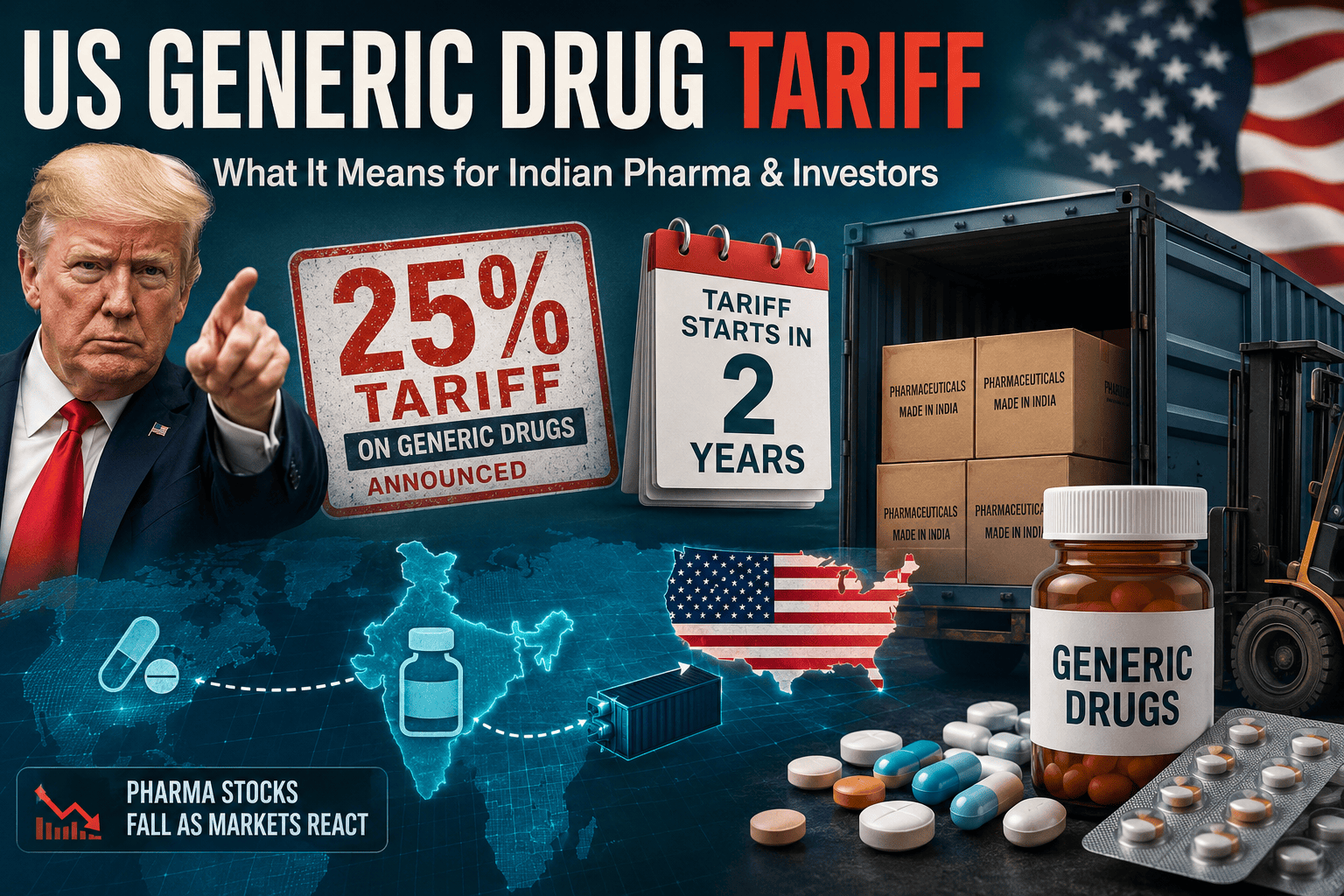

Trump Just Gave Indian Pharma a Two-Year Countdown Clock — Here's What the US Generic Drug Tariff Actually Means
Cipla, Lupin, Dr Reddy's and a dozen other pharma names fell today after a Truth Social post most investors are still misreading. The tariff isn't starting tomorrow — but that's exactly why it matters more, not less.
- 1. What Actually Happened Today
- 2. The Real Timeline — Not "Tomorrow," But Not "Never" Either
- 3. Which Pharma Stocks Fell, and By How Much
- 4. Why Generic Drugs Specifically Are the Big Deal
- 5. This Is Different From the Branded-Drug Tariff You Might Remember
- 6. What Analysts Are Actually Saying
- 7. Which Companies Have the Most at Stake
- 8. Can India's Pharma Industry Actually Adapt in Two Years
- 9. What This Means If You Hold Pharma Stocks
- 10. FAQs
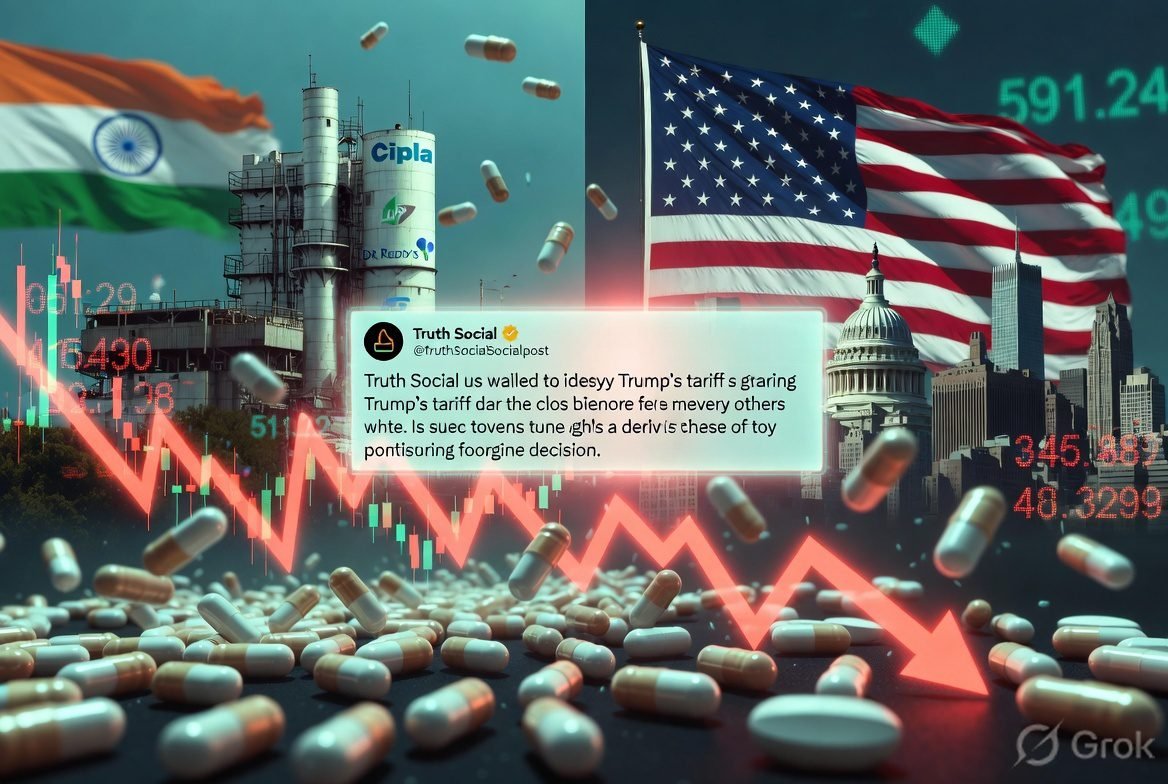
The US generic drug tariff announced today isn't the kind of policy that hits your portfolio tomorrow morning — and that's precisely what makes it worth understanding properly rather than reacting to the headline. US President Donald Trump posted on Truth Social that generic drugs entering the United States will carry a zero percent tariff for the next two years, starting August 1, 2026. After that, the rate jumps to 100% for one year, then to 200% permanently. Indian pharmaceutical stocks fell across the board within hours of the announcement — but the actual mechanics of this policy, and who it really threatens, are more layered than a single day's stock chart shows.
⚡ US Generic Drug Tariff — Quick Snapshot
| Announced | July 22, 2026 (via Truth Social) |
| Zero Tariff Period | Aug 1, 2026 – Jul 31, 2028 |
| Tariff After That | 100% (1 year), then 200% permanently |
| Nifty Pharma Reaction | Broad decline, 18-20 constituents lower |
| Worst Hit Today | Lupin (-4%), Piramal, Aurobindo, Gland (each 3%+) |
| India's US Pharma Exports (FY25) | ~$10.5 billion, up 20% YoY |
1. What Actually Happened Today
In a post on Truth Social, President Trump laid out the specifics himself: "Effective August 1st, 2026, all Generic Drugs being brought into the United States will continue to have a TARIFF of ZERO PERCENT for a two year period of time, after which the TARIFF will be raised to 100% for a one year period of time, and 200% thereafter." He framed the policy explicitly as an incentive to "RESHORE Generic Pharmaceutical Production into America," with an exemption for any company that has already broken ground on US manufacturing facilities before the deadline.
The market's initial reaction was immediate and broad — nearly every major Indian pharma name traded lower within the first hour, even though the actual tariff won't bite for another two years. That gap between "long-dated policy" and "immediate stock reaction" is itself the first thing worth understanding about how this US generic drug tariff is playing out — a pattern our why is the stock market falling today tracker covers repeatedly across different trigger events.
2. The Real Timeline — Not "Tomorrow," But Not "Never" Either
It's worth being precise about the actual dates here, since a lot of the reaction today conflates "announced" with "in effect."
| Period | Tariff Rate |
|---|---|
| Now – July 31, 2026 | Existing rates apply (mostly zero on generics) |
| Aug 1, 2026 – July 31, 2028 | 0% (explicit two-year grace period) |
| Aug 1, 2028 – July 31, 2029 | 100% |
| From Aug 1, 2029 onward | 200% |
The two-year runway is the whole point of the policy design — it's meant to give pharmaceutical companies a defined window to either build US manufacturing capacity or accept that their India-made generics will face a punishing tariff starting in 2028. Companies that are already "building" — defined by the administration as having broken ground or under active construction — are exempted from the tariff regardless of when it takes effect.
3. Which Pharma Stocks Fell, and By How Much
Selling was widespread across the Nifty Pharma index today, though the magnitude varied significantly by company. Cipla and Dr Reddy's Laboratories were among the biggest decliners on the Nifty 50 specifically, falling roughly 1.6-1.8%, while Sun Pharma held up somewhat better, down under 1%.
| Company | Today's Move |
|---|---|
| Lupin | ~-4% |
| Piramal Pharma | -3%+ |
| Aurobindo Pharma | -2.2% to -3% |
| Gland Pharma | -3%+ |
| Cipla | -1.2% to -1.8% |
| Dr Reddy's Laboratories | ~-1% to -1.6% |
| Sun Pharma | ~-0.9% to -1% |
Beyond the largest names, the decline was genuinely broad — Ajanta Pharma, Glenmark Pharma, IPCA Laboratories, Zydus Lifesciences, Alkem Laboratories, and Mankind Pharma all traded lower too, suggesting this wasn't a story about one or two companies with specific exposure, but sector-wide risk repricing. If you're trying to understand how this fits into today's broader market picture, our US-Iran tension market impact coverage covers the other major headwind weighing on Indian indices this same week, and our Nifty and Sensex explainer covers how sector-specific selloffs like this one show up at the index level.
4. Why Generic Drugs Specifically Are the Big Deal
This is the detail that separates today's US generic drug tariff from most previous pharma tariff scares, and it's the reason the market reaction, while still measured, was meaningfully broader than earlier episodes. India's pharmaceutical export story to the US is overwhelmingly a generics story — the US takes slightly more than a third of India's total drug exports, and the vast majority of that is cheaper generic medicine, not branded or patented drugs.
India's pharma exports to the US rose 20% to roughly $10.5 billion in fiscal 2025, and generics made up the bulk of that growth. A tariff that specifically targets this category — even with a two-year delay — is a direct threat to the business model most Indian pharma exporters actually run, rather than a tariff on a product category India barely touches.
5. This Is Different From the Branded-Drug Tariff You Might Remember
If this story sounds familiar, that's because it partly is — but it's genuinely a different policy. Back in late September 2025, Trump announced a separate 100% tariff specifically on branded and patented pharmaceutical imports, effective October 1, 2025. That announcement also triggered a pharma sell-off, but analysts at the time were fairly unanimous that the real-world impact on Indian companies would be limited, precisely because Indian pharma exports to the US are mostly generics, not branded or patented drugs.
Today's US generic drug tariff closes that gap. Where the 2025 branded-drug tariff largely spared Indian exporters by targeting a category they don't heavily participate in, this new policy targets the category India actually dominates. That's the structural reason today's reaction, while still relatively contained given the two-year delay, represents a more directly relevant risk than last year's announcement.
6. What Analysts Are Actually Saying
Reaction from sell-side analysts so far has leaned toward "serious but not catastrophic," largely because of the two-year runway built into the policy. The near-term earnings impact for FY27 and FY28 is expected to be minimal, since the zero-tariff window covers that entire period — a timeline worth tracking alongside our Q1 FY27 earnings calendar as pharma majors report through this quarter. The real question analysts are focused on is what happens structurally over 2026 and 2027 — whether Indian pharma majors begin announcing US manufacturing investments to qualify for the "already building" exemption, and how much margin compression the eventual 100-200% tariff would cause for companies that don't relocate any production.
There's also a recurring theme in prior pharma tariff episodes worth remembering here: in earlier rounds of similar tariff threats, some analysts described the stock reaction as largely "sentimental" rather than fundamentally justified, since actual financial impact estimates often came in smaller than the initial share price moves suggested. Whether that pattern holds for this specific generics-focused tariff, given how much more directly it targets India's actual export mix, remains the open question the next few quarters will answer.
7. Which Companies Have the Most at Stake
Exposure isn't uniform across the sector — it depends heavily on how much of a given company's revenue comes specifically from US generic sales versus other markets or other drug categories.
- Companies with high US generic revenue concentration face the most direct long-term risk if they don't establish qualifying US manufacturing before 2028.
- Companies with existing or announced US manufacturing plans are best positioned, since breaking ground before the deadline exempts them entirely from the eventual tariff.
- Companies more diversified across Europe, emerging markets, and India's domestic formulation business carry comparatively lower US-generic-specific risk.
Our sector rotation guide and Q1 FY27 bank results coverage are useful companion reads for understanding how sector-specific shocks like this one typically ripple through into broader portfolio allocation decisions during an already volatile earnings season, alongside our circuit breaker explainer for context on how severe single-day sector moves are handled on Indian exchanges.
8. Can India's Pharma Industry Actually Adapt in Two Years
Building qualifying pharmaceutical manufacturing capacity in the US within a two-year window is a genuinely difficult undertaking — plant construction, FDA facility approval, and supply chain relocation typically take considerably longer than two years from a standing start. This is exactly why the "already building" exemption matters so much: it effectively rewards companies that started US capacity investments well before today's announcement, and leaves companies starting from scratch now in a much tighter position. This dynamic sits alongside the broader India-US trade relationship that's been reshaping several export-facing sectors this year.
Industry bodies have historically pushed back on the premise that reshoring generic drug manufacturing to the US is straightforward, given that the cost structure advantage Indian manufacturers hold is tied to labor costs, scale, and an established regulatory-compliant supply chain that took decades to build — none of which transfers quickly to a new US facility, even with a tariff incentive attached. Our India exports growth story covers how this pharma story fits into India's broader export picture heading into FY27.
9. What This Means If You Hold Pharma Stocks
For existing pharma investors, the two-year runway is the single most important number in this entire story — it means today's stock price moves are pricing in a risk that, by design, doesn't materially hit company earnings for at least six to eight quarters. That's a meaningfully different situation than a tariff taking effect immediately, and it's worth resisting the urge to treat today's decline as a verdict on near-term earnings.
What's genuinely worth tracking over the coming months is company-specific capital expenditure announcements — any Indian pharma major disclosing US manufacturing investment plans is effectively telling you how seriously they're taking the 2028 deadline. Our behavioral mistakes in trading guide, why investors lose money analysis, and sector rotation guide are all worth revisiting before making a large portfolio decision based on a single headline day, especially one with a policy timeline stretching years into the future.
10. Frequently Asked Questions
When does the US generic drug tariff actually take effect?
Generic drugs will carry a zero percent tariff from August 1, 2026, for two years. The tariff rises to 100% starting August 1, 2028, and to 200% one year after that.
Why did Indian pharma stocks fall today if the tariff isn't effective for two years?
Markets typically price in future policy risk immediately rather than waiting for implementation, especially when the policy directly targets a category — generic drugs — that makes up the bulk of India's pharmaceutical exports to the US.
How is this different from the 2025 pharma tariff announcement?
The September 2025 tariff targeted branded and patented drugs, a category where Indian exporters have limited exposure. This new tariff specifically targets generic drugs, which represent the vast majority of India's actual pharmaceutical exports to the US.
Are any companies exempt from the US generic drug tariff?
Yes. Companies that have already broken ground on US manufacturing facilities, or are under active construction, before the tariff takes effect are exempted regardless of the announced deadlines.
How much of India's pharma exports go to the US?
The US accounts for slightly more than a third of India's total pharmaceutical exports, which rose 20% year-on-year to approximately $10.5 billion in fiscal 2025, with generics making up the large majority.
Should I sell my pharma stocks because of this tariff?
This depends on individual risk tolerance and time horizon. The two-year zero-tariff window means near-term earnings impact is limited; the more relevant factor for long-term holders is whether specific companies announce US manufacturing plans to qualify for the exemption before 2028.

Pranab Barman is a Financial Educator and Personal Finance Researcher with over 10 years of hands-on experience in stock markets, trading, and investing. Currently enrolled in the CFA Program, he is committed to continuous learning and professional excellence in finance.
As the Founder of PlayWithStock, Pranab covers a wide range of topics including Mutual Funds, SIP, Taxation, Stock Market Basics, and Financial Calculators — with a focus on simplifying complex financial concepts for everyday all investors.
Email: support@playwithstock.com
Website: playwithstock.com
Related posts:
 Gold Price Correction 2026: What It Means for Indian Investors
 Best AI Stocks India 2026: 7 Picks That Are Actually Worth Watching
 How Does SIP Actually Work? 7-Point Breakdown for All Investors
 Trump Accounts Explained: The $1,000 Baby Bonus Already Reaching 6 Million Kids
 India US Trade Deal 2026: Inside the Tariff Rollercoaster Before July 22
 Vedanta Demerger 2026: What It Means for Shareholders
 Silver Price Surge 2026: Why Silver Is Beating Gold This Year
 Nifty July Seasonality: Why July Is Nifty’s Strongest Month (27-Year Data)