
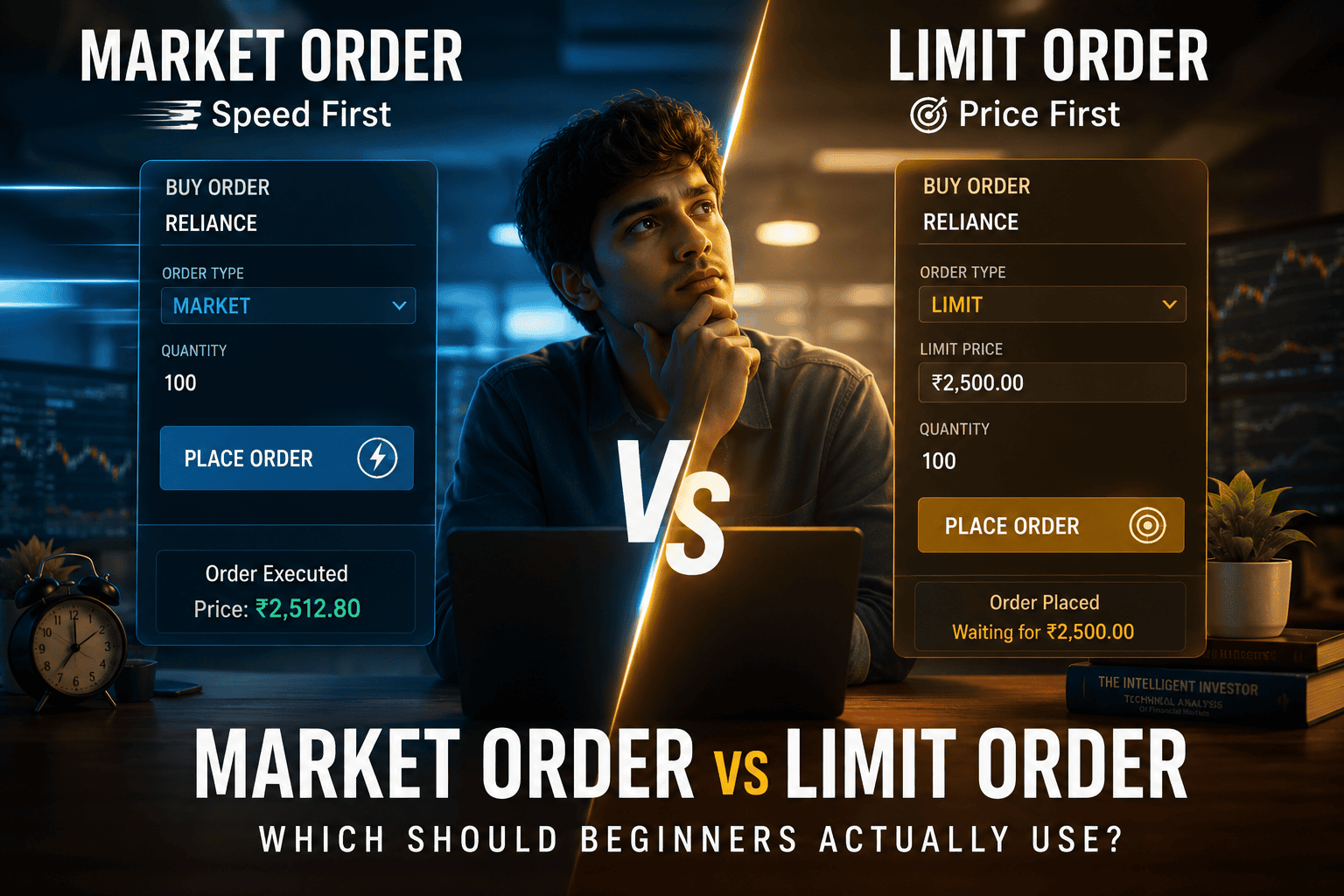

Market Order vs Limit Order: Which Should Beginners Actually Use
Market order vs limit order is the first real decision every beginner faces the moment they actually try to place a trade — and it's genuinely surprising how many first-time investors, after opening a demat account and doing all the KYC, freeze at this exact screen because neither option was explained to them clearly. One gets you in fast with an uncertain price; the other gets you your exact price with no guarantee you'll actually get filled. That trade-off between speed and control sits at the heart of every single order you'll ever place.
We're writing this the way we wish someone had explained it to us the first time — with a plain comparison, real price numbers, and no unnecessary jargon. By the end, you'll know exactly which one to reach for and when.

Table of Contents
- The Simplest Way to Think About It
- Market Order: How It Actually Works
- Limit Order: How It Actually Works
- Real Example: Same Stock, Two Different Orders
- Side-by-Side Comparison Table
- When to Use Which One
- Slippage: The Hidden Risk of Market Orders
- Other Order Types Worth Knowing
- Common Mistakes Beginners Make
- Frequently Asked Questions
The Simplest Way to Think About It
Here's the comparison that made this finally click for us: a market order is like taking the first taxi you see, whatever the fare turns out to be — you get moving immediately, but you don't know the exact price until the ride starts. A limit order is like waiting for a cab that agrees to your specific fare upfront — you know exactly what you'll pay, but you might wait longer, and if no driver agrees to your price, you don't get a ride at all.
Market Order
"Get me in now, whatever the current price is."
Limit Order
"Get me in, but only at my price or better."
Market Order: How It Actually Works
A market order instructs your broker to buy or sell a stock immediately at the best available price in the market right now. You don't specify a price at all — you only specify the quantity — and the exchange fills your order against whatever the current best bid or ask happens to be at that exact moment.
How It Plays Out in Practice
Suppose SBI shares are trading around ₹1,166. You place a market order to buy 10 shares. Your order goes straight to the exchange and executes almost instantly — but because prices move constantly, even by a fraction of a second, you might actually get filled at ₹1,167 or ₹1,165 rather than the exact ₹1,166 you saw on your screen. This small gap between the expected price and the actual execution price is completely normal, and it's the trade-off you accept in exchange for near-guaranteed, immediate execution.
Market orders are the easiest order type for beginners to understand — you just pick quantity and hit buy or sell — and they're generally the most likely to actually get filled, since you're not waiting for the market to reach a specific price.
Limit Order: How It Actually Works
A limit order lets you specify the exact price you're willing to buy at (or sell at), and the order only executes if the market actually reaches that price or better. Think of it as telling your broker: "I'll buy this share, but only if I get it at my price or cheaper" — or on the sell side, "I'll sell, but only at my price or higher."
How It Plays Out in Practice
Say a stock is currently trading at ₹255, but you place a limit buy order at ₹250 for 100 shares. The exchange will not execute your order until the price actually drops to ₹250 or lower. If the stock never falls to your price during the order's validity, your order simply doesn't execute at all — no shares bought, no money spent, but also no participation in whatever happens next if the price moves up instead.
This is the core trade-off: a limit order gives you complete control over your entry or exit price, but it comes with real opportunity cost — you might miss a trade entirely if the market never reaches your specified level.
Real Example: Same Stock, Two Different Orders
Buying an ETF Trading at ₹200 — Bid ₹199.90, Ask ₹200.10
| Order Type | What Happens | Final Result |
|---|---|---|
| Market Order (buy 100 units) | Fills immediately at the best ask price | Filled at ₹200.10, total cost ₹20,010 |
| Limit Order at ₹199.50 (buy 100 units) | Waits until price drops to ₹199.50 or lower | May not fill at all if price never drops that low |
Notice the market order guarantees you actually own the ETF, but at a slightly worse price than the last quoted trade (₹200.10 instead of ₹200). The limit order could save you ₹0.60 per unit if it fills — but there's a real chance it never fills at all, and you simply don't own anything while the market potentially moves on without you.
Side-by-Side Comparison Table
Market Order vs Limit Order
| Factor | Market Order | Limit Order |
|---|---|---|
| Price control | None — accepts current market price | Full — executes only at your price or better |
| Execution guarantee | High — almost always fills | Not guaranteed — may never fill |
| Speed | Immediate | Depends on when/if price is reached |
| Risk of slippage | Higher, especially in volatile stocks | None — you get your price or nothing |
| Best suited for | Highly liquid, large-cap stocks | Volatile or low-volume stocks |
| Beginner-friendliness | Easiest to understand and use | Slightly more setup, but often safer |
When to Use Which One
A market order makes the most sense when speed genuinely matters more than price precision — reacting to breaking news, entering or exiting a highly liquid stock like a Nifty 50 or Sensex constituent where the bid-ask spread is naturally tight, or when you simply want certainty that your trade will actually go through today.
A limit order makes more sense when you're trading a smaller, less liquid, or more volatile stock, where the bid-ask spread can be wide and a market order risks a genuinely bad fill. It's also the better choice whenever price discipline matters more to you than speed — for instance, when you've done your research and decided you're only willing to buy a stock below a specific valuation, regardless of what happens in the next few minutes.
Quick Decision Guide
| Situation | Better Choice |
|---|---|
| Trading a highly liquid, large-cap stock | Market Order |
| Trading a small-cap or low-volume stock | Limit Order |
| Need to exit a position immediately | Market Order |
| Willing to wait for your specific price | Limit Order |
| Reacting to fast-breaking news | Market Order |
| New to trading and want fewer surprises | Limit Order |
Slippage: The Hidden Risk of Market Orders
Slippage happens when the price you actually get filled at differs from the price you expected when you placed a market order — and it's worth understanding in more depth, because it's the single biggest hidden cost of relying on market orders too casually. Studies of Indian market microstructure have shown that smaller companies, lower trading volume, and higher volatility tend to produce substantially wider bid-ask spreads, which directly increases the odds of meaningful slippage.
This is exactly why experienced traders tend to favor limit orders in volatile stocks or during turbulent market sessions — like the kind of sharp moves we cover in our pieces on circuit breakers and broader market-wide sell-offs — since a market order placed during a fast-moving session can fill at a meaningfully worse price than what you saw just seconds earlier.
Other Order Types Worth Knowing
Once you're comfortable with the market-vs-limit basics, a few other order types are worth knowing, since most Indian broker apps offer them: a Stop-Loss order automatically triggers a sell once a stock falls to a specified price, helping manage downside risk without you needing to watch the screen constantly. A GTT (Good Till Triggered) order stays active for a much longer window than a standard day order, useful for a price target you expect to take weeks to reach. AMO (After Market Orders) let you place orders outside regular trading hours, queued for execution when the market opens.
For most beginners, mastering market and limit orders thoroughly before layering in these more advanced tools is the more sensible sequence — our beginner investing guide and behavioral mistakes in stock trading piece are good companion reads for building that broader foundation.
Common Mistakes Beginners Make
Watch Out For These
1. Using market orders on low-liquidity, small-cap stocks. Wide bid-ask spreads on thinly traded stocks can lead to meaningfully worse fills than expected — a limit order is safer here.
2. Setting a limit price too far from the current market price. An unrealistic limit order may simply never execute, leaving you sitting on the sidelines while the stock moves on without you.
3. Forgetting a limit order's validity period. Standard limit orders often expire at the end of the trading day unless you specifically choose a longer-duration order type like GTT.
4. Assuming a market order always gets you the exact last-traded price. It gets you the best currently available price, which can differ from the last price you saw, especially in fast-moving markets.
5. Not checking the bid-ask spread before choosing an order type. A wide spread is a strong signal to lean toward a limit order rather than a market order.

Understanding order types properly is one of the more practical pieces of stock market basics for beginners, and it applies whether you're trading on the NSE or the BSE, or through any broker's app. Once this feels comfortable, our coverage of sector rotation and FII vs DII activity are natural next steps for understanding what actually moves the prices you're placing these orders against.
It's also worth connecting this back to the broader trading vs investing decision we've covered separately — if you're a long-term investor buying a handful of shares occasionally, the small price differences between market and limit orders matter far less to your overall returns than they would for someone placing dozens of trades a week. Our why investors lose money in the stock market piece touches on how obsessing over a few rupees of execution price while ignoring bigger-picture decisions like what to actually invest in is a classic case of beginners optimizing the wrong variable.
For anyone specifically trading during volatile sessions — say, around a big earnings announcement or a macro event like the ones we track in our daily market updates — the order type decision becomes genuinely more consequential. A market order placed in the seconds after a surprising earnings beat or miss can fill at a price meaningfully different from what triggered your decision in the first place, which is exactly the scenario where a well-placed limit order, even with the risk of non-execution, often serves a disciplined trader better than chasing a fast-moving price.
One final habit worth building early: check your broker app's order confirmation screen carefully every single time before submitting, regardless of order type. It's a small discipline, but it's the last checkpoint between an intended trade and an actual one — and it costs nothing beyond a few extra seconds of attention.
Frequently Asked Questions
What is the main difference between a market order and a limit order?
A market order executes immediately at the best available current price with no price control. A limit order executes only at your specified price or better, but isn't guaranteed to fill at all.
Which order type is better for beginners?
Limit orders are generally considered safer for beginners because they prevent unexpected execution prices, especially in volatile or low-liquidity stocks. Market orders are simpler to use and best suited for highly liquid, large-cap stocks.
Does a market order guarantee the price I see on screen?
No. A market order guarantees execution, not price. The actual fill price can differ slightly from the last quoted price due to normal price fluctuations, a phenomenon known as slippage.
What happens if my limit order never gets filled?
If the market never reaches your specified price during the order's validity period, the order simply expires unfilled — you won't own the shares, but you also won't lose anything beyond the missed opportunity.
What is slippage in stock trading?
Slippage is the difference between the expected price of a trade and the price at which it actually executes. It's more common with market orders in volatile or low-volume stocks with wider bid-ask spreads.
Can I use both market and limit orders in the same trading strategy?
Yes. Many traders use market orders for highly liquid stocks or urgent exits, and limit orders for volatile or thinly traded stocks where price control matters more than immediate execution.

Pranab Barman is a Financial Educator and Personal Finance Researcher with over 10 years of hands-on experience in stock markets, trading, and investing. Currently enrolled in the CFA Program, he is committed to continuous learning and professional excellence in finance.
As the Founder of PlayWithStock, Pranab covers a wide range of topics including Mutual Funds, SIP, Taxation, Stock Market Basics, and Financial Calculators — with a focus on simplifying complex financial concepts for everyday all investors.
Email: support@playwithstock.com
Website: playwithstock.com
Related posts:
 Bull Market vs Bear Market: Meaning, Examples & How to Identify Them
 How to Read Stock Charts: A Complete Candlestick Guide for Beginners
 SEBI 2026 F&O Rules: 8 Crucial Position Limit Changes Every Trader Must Know
 Micro-Investing Apps for Beginners: A Complete Comparison
 What Is Circuit Breaker Stock Market: Meaning, Limits & 2026 Update
 Nifty July 2026: Will It Hit 24,800? Complete Market Outlook and Stock Guide
 Today Nifty India Market Outlook: Oil, Rupee, VIX and FII Selling Explained
 Nifty, Sensex Today: Market Outlook for July 24, 2026 — Global Cues, Crude Oil, Rupee & Key Levels