
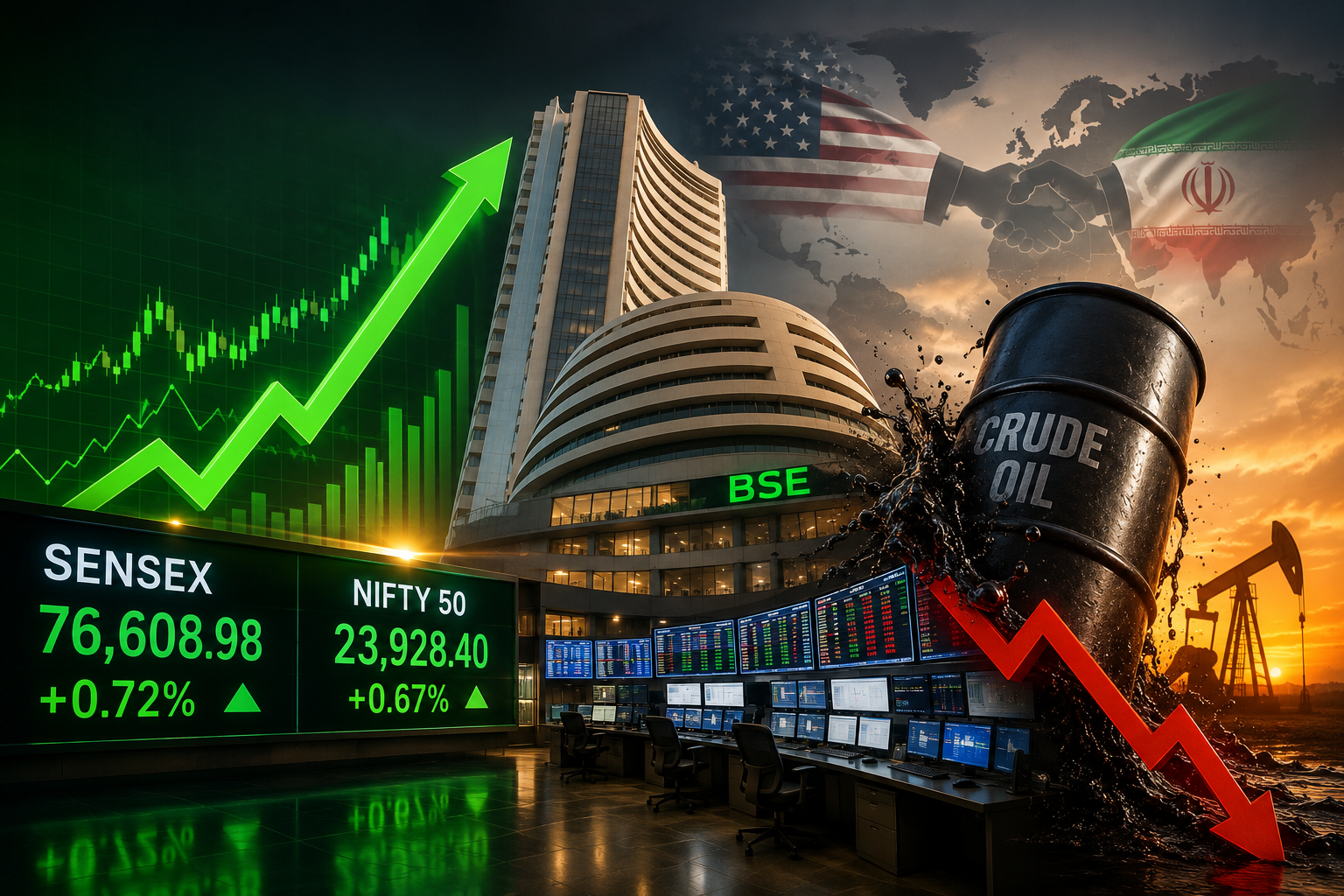

Sensex Jumps 550 Points, Nifty Reclaims 23,900 as Crude Oil Crashes on US-Iran De-Escalation: What Changed Today
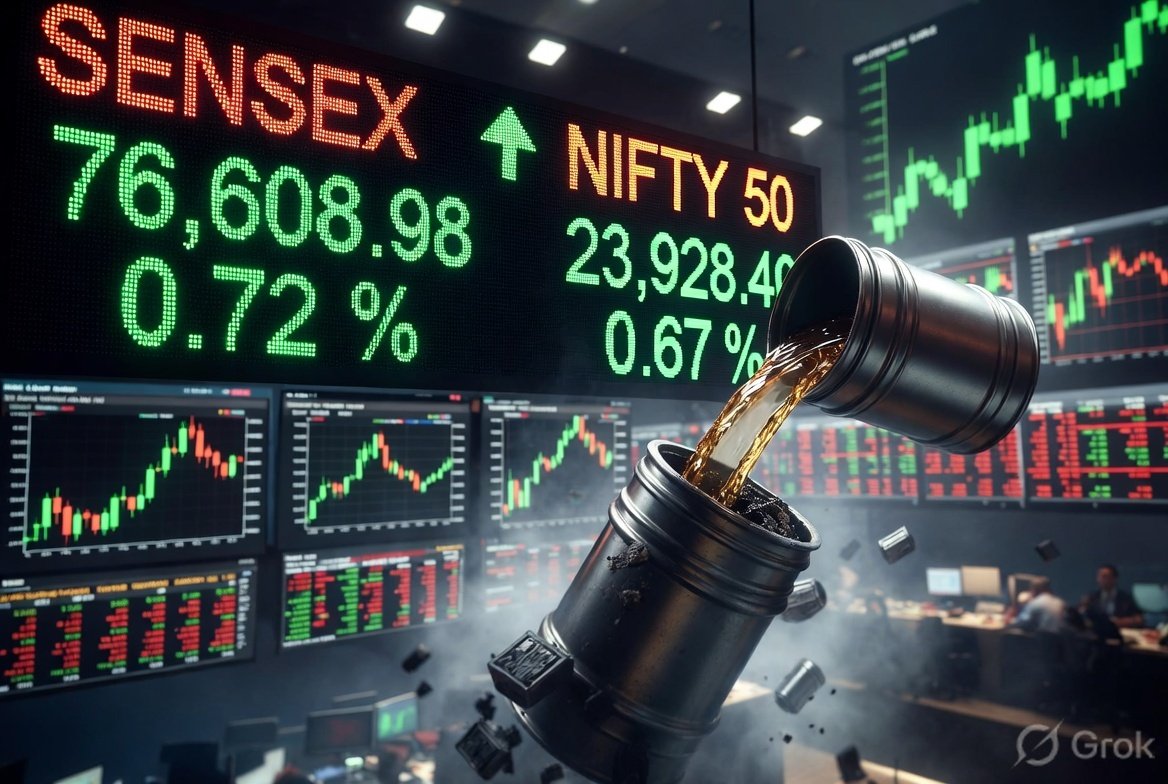
The Sensex Nifty Rebound underway this morning ended five straight days of losses on D-Street, and the reason has almost nothing to do with anything happening inside India. Global crude oil prices collapsed sharply on Monday, with Brent crude falling over 13% and WTI dropping more than 8% in a single session, as the risk premium that had been baked into oil prices for weeks suddenly evaporated. For an economy that imports roughly 85% of its crude needs, that kind of move doesn't stay confined to the energy sector — it ripples through the entire market within hours, and that's exactly what we watched happen this morning.
What Actually Happened With Oil Today
The immediate trigger was a genuine, if fragile, de-escalation between the United States and Iran. Reports of a temporary cooling-off eased fears over continued supply disruption through the Strait of Hormuz, the narrow waterway through which a huge share of the world's seaborne oil passes. Oil prices had surged nearly 40% over the preceding month as fighting expanded from the Strait of Hormuz into the Red Sea, with Houthi-linked strikes on tankers pushing traders into serious supply-disruption pricing. Today's move is essentially the market unwinding a chunk of that risk premium in one sharp session, after signals that Iran had halted retaliatory strikes and that Pakistan-backed diplomatic efforts, reportedly with Chinese support, were working to revive US-Iran talks.
We'd flag one thing clearly here, because a lot of coverage this morning is treating this as a done deal: there is no formal peace agreement in place. Houthi threats in the Red Sea haven't disappeared, and the Caspian Pipeline Consortium's terminal suspension (which had been disrupting roughly 80% of Kazakhstan's oil exports) is a separate, still-unresolved supply concern. This is a genuine relief rally in oil, not a confirmed resolution — and that distinction matters for how durable today's equity market bounce actually is.
How the Rebound Showed Up on D-Street
The BSE Sensex opened up 549.21 points, or 0.72%, at 76,608.98, while the Nifty 50 gained 160.95 points to open at 23,928.40 — comfortably back above the psychologically important 23,900 mark it had slipped under during Friday's session. That prior session had been the fifth consecutive day of losses, with the Sensex settling at 76,059.77 (down 331.62 points) and the Nifty ending at 23,767.45 (down 102.15 points) on Friday, as cautious sentiment, elevated crude prices, and continued selling pressure in certain sectors weighed on the market.
| Metric | Friday Close | Monday Open | Move |
|---|---|---|---|
| Sensex | 76,059.77 | 76,608.98 | +549.21 pts (0.72%) |
| Nifty 50 | 23,767.45 | 23,928.40 | +160.95 pts (0.67%) |
| BSE Midcap Select | — | — | +234.46 pts |
| BSE Smallcap Select | — | 8,677.49 | +89.85 pts (1.05%) |
Market breadth this morning was clearly positive, with 2,093 stocks advancing against just 317 declining on the NSE and 141 unchanged — a genuinely broad-based move rather than a narrow rally led by a handful of index heavyweights. From the Sensex pack, IndiGo led gainers with a jump of over 3%, alongside Eternal, Infosys, Asian Paints, and Bajaj Finance. IT stocks like Infosys extending gains today is worth watching alongside the sector's other live pressure point — the H-1B $100K visa fee's impact on Indian IT stocks — since IT counters are currently navigating both a domestic macro tailwind and a US policy headwind at the same time. IndiGo's outsized move makes intuitive sense here — aviation is one of the most direct beneficiaries of falling crude, since jet fuel (ATF) is one of an airline's largest single cost lines, and a 13% crude move drops straight to the bottom line for fuel-intensive businesses.
Why a Crude Oil Crash Is Genuinely Good News for Indian Markets
This connection isn't abstract — it runs through several concrete channels that we think are worth spelling out rather than just asserting.
Import bill and the rupee
India imports roughly 85% of the crude oil it consumes, making the country's trade balance and currency unusually sensitive to oil price swings compared to most large economies. A sustained drop in crude prices directly shrinks India's import bill, which supports the rupee and reduces one of the biggest structural pressures on the Dollar Index and INR relationship that we've covered before.
Inflation and the RBI's next move
Fuel costs feed into transport, logistics, and ultimately retail prices across the economy. A meaningful, sustained fall in crude eases inflationary pressure, which matters directly for how the RBI approaches its upcoming policy decisions — something we track closely in our RBI repo rate coverage. Lower inflation expectations generally give the central bank more room to consider supportive rate moves rather than defensive ones.
Corporate margins
Any business with meaningful fuel or petrochemical input costs — airlines, paints, tyres, logistics, cement — sees margin relief almost immediately when crude drops sharply, well before it shows up in reported quarterly numbers. That's a big part of why we saw the specific stocks we did leading today's gainers list. For smaller businesses and e-commerce sellers watching their own input and logistics costs, this sits alongside other 2026 cost-structure shifts we've covered, including how GST 2.0 is affecting e-commerce sellers — a lower fuel cost environment combined with GST changes materially changes the margin math for logistics-heavy small businesses this year.
If you're holding paint, aviation, tyre, or logistics stocks in your portfolio, today's move is a direct tailwind on input costs, not just sentiment. We'd caution against chasing today's specific gainers purely because they're green right now — the more useful exercise is checking whether your existing holdings in fuel-sensitive sectors are positioned to benefit if this oil-price relief holds for more than a single session, rather than reacting to one day's price action in isolation.
The Case for Caution — This Could Reverse
We'd be doing readers a disservice presenting only the bullish read. A few real risks sit underneath today's rally that deserve equal weight.
First, oil demand itself fell close to 5% globally in the second quarter, according to IEA data — a natural consequence of the earlier price spike pricing out some consumption. That demand destruction is part of why prices are now falling so sharply; it's not purely a supply-side relief story, and if demand stays soft even as supply risk fades, the price recovery in oil could be capped from both directions, which is a more complicated read than a simple "good news" headline suggests.
Second, "temporary de-escalation" is doing a lot of work in today's narrative. We've seen this pattern before through this conflict cycle — strikes pause, oil retraces, then a fresh escalation sends prices right back up within days. Until there's an actual signed agreement, not just paused hostilities, we'd treat today's oil crash as a genuine but reversible relief move rather than a settled new baseline. Readers who've followed our coverage of behavioral mistakes in stock trading will recognise this as exactly the kind of headline that tempts overreaction in either direction — chasing today's gainers on the assumption peace is now permanent, or dismissing the rally as noise because the underlying conflict hasn't fully resolved. The honest answer sits between both extremes.
Third, technical resistance near the 24,000 zone on the Nifty remains a real level to watch. As one market analyst put it, the setup suggests the market is attempting to stabilise after defending crucial support levels, but higher volatility and resistance near that zone could still limit aggressive upside even with today's positive open.
What to Watch This Week
A few concrete things worth tracking over the coming days rather than reacting only to today's single session: whether Brent and WTI hold their losses through Tuesday and Wednesday trading, any formal statement (versus informal de-escalation) from either Washington or Tehran, continued FII/DII flow data given the sustained selling pressure seen through the prior five sessions, and how ongoing Q1 FY27 earnings season results interact with this macro relief — strong individual company results landing alongside a favourable oil backdrop would be a genuinely stronger signal than either factor alone. If you're actively trading around volatility like today's move, remember that gains and losses from these positions still need to be disclosed correctly at tax time — our ITR-4 investment disclosure calculator is worth bookmarking well before filing season rather than scrambling in a hurry later.
Our Take on Today's Sensex Nifty Rebound
Today's bounce is real and broad-based — the market breadth numbers (2,093 advancing versus 317 declining) tell a more convincing story than the headline index points alone would. But we'd resist the temptation to call this a trend reversal off a single session driven by a geopolitical de-escalation that hasn't been formalised. The more useful question for a retail investor isn't "should I buy today's gainers" — it's whether your existing portfolio's sector mix is appropriately positioned for a scenario where oil prices stay lower for the next few months, versus one where today's relief proves temporary and prices snap back on the next escalation headline.
Frequently Asked Questions
Oil prices fell as Middle East risk premiums eased following reports of a temporary de-escalation between the US and Iran, including a halt in Iran's retaliatory strikes and revived diplomatic efforts reportedly backed by Pakistan and China to reopen US-Iran talks.
Brent crude fell over 13% and WTI dropped more than 8% in Monday's session, unwinding a significant portion of the roughly 40% surge oil prices had seen over the preceding month amid Middle East supply disruption fears.
India imports around 85% of its crude oil needs, so falling oil prices reduce the country's import bill, ease inflationary pressure, support the rupee, and improve profit margins for fuel-sensitive sectors like aviation, paints, and logistics.
IndiGo led Sensex gainers with an increase of over 3%, followed by Eternal, Infosys, Asian Paints, and Bajaj Finance, as markets responded positively to the sharp fall in crude oil prices.
It's uncertain. The oil price de-escalation is not backed by a formal peace agreement, Houthi threats in the Red Sea persist, and technical resistance near the 24,000 zone on the Nifty could limit further upside even if crude prices stay lower in the near term.
Analysts flagged resistance near the 24,000 zone on the Nifty 50, noting that while the market appeared to be stabilising after defending crucial support levels, higher volatility could still limit aggressive upside.
Related Reading on Play With Stock
- Oil Price Crash 2026: India Impact
- Nifty 50 and Sensex Explained
- Dollar Index (DXY) Explained
- RBI Repo Rate Cut 2026
- What Is the Strait of Hormuz: India Impact
- Behavioral Mistakes in Stock Trading
- Q1 FY27 Earnings Calendar
- US-Iran Tension: Impact on Indian Stock Market
- What Is Sector Rotation
Official & External Sources

Pranab Barman is a Financial Educator and Personal Finance Researcher with over 10 years of hands-on experience in stock markets, trading, and investing. Currently enrolled in the CFA Program, he is committed to continuous learning and professional excellence in finance.
As the Founder of PlayWithStock, Pranab covers a wide range of topics including Mutual Funds, SIP, Taxation, Stock Market Basics, and Financial Calculators — with a focus on simplifying complex financial concepts for everyday all investors.
Email: support@playwithstock.com
Website: playwithstock.com
Related posts:
 Nifty, Sensex Today: Market Outlook for July 24, 2026 — Global Cues, Crude Oil, Rupee & Key Levels
 TCS Q1 FY27 Results: Profit Rises 5%, Sensex Jumps 828 Points
 Why Is the Stock Market Falling Today? US-Iran Tensions, Crude Oil Spike & FII Selling Explained
 Crude Oil Crosses $100: What the Iran-Israel-US War Means for Your Petrol Price, EMI & Stock Portfolio
 Sensex Nifty Crash July 2026: 3 Real Reasons Behind the Fall
 Today Nifty India Market Outlook: Oil, Rupee, VIX and FII Selling Explained
 Nifty 50 and Sensex: 7 Things Every Investor Should Know
 Nifty July Seasonality: Why July Is Nifty’s Strongest Month (27-Year Data)