

Best AI Stocks India 2026:
7 Picks Worth Watching
Everyone is talking about AI stocks India investing. Most of what's being written is vague. This is not that — it's a stock-by-stock breakdown with actual financials, analyst positions, and the risks nobody wants to mention.
Something shifted in early 2026. AI moved from "pilot project" to "budget line item" for most global enterprises. The companies that were already three years deep into building AI capability started separating from those still writing strategy documents about it.
That shift is what makes the best AI stocks India 2026 conversation interesting — and different from the one everyone was having two years ago.
Back then, "AI stock" meant any Indian IT company that added the words "generative AI" to an investor presentation. Now, there's actual revenue to point to.
Actual deal wins. Actual margin pressure from compute costs. The conversation has numbers in it.
This article covers seven AI stocks India worth serious consideration — not a magic list, but a structured breakdown of what each company actually does in AI, what the financials look like, and where the real risks are. We've included our own honest take on each one, because "all of these are great buys" is not a useful thing to say. Some of these are more compelling than others, and we'll tell you which and why.
Section 01Why AI Stocks India Actually Matter in 2026
India's AI story in 2026 is bigger than most people realise, and it's being built on three pillars that compound each other: government money, global corporate money, and the IT services companies that are the delivery engine for both.
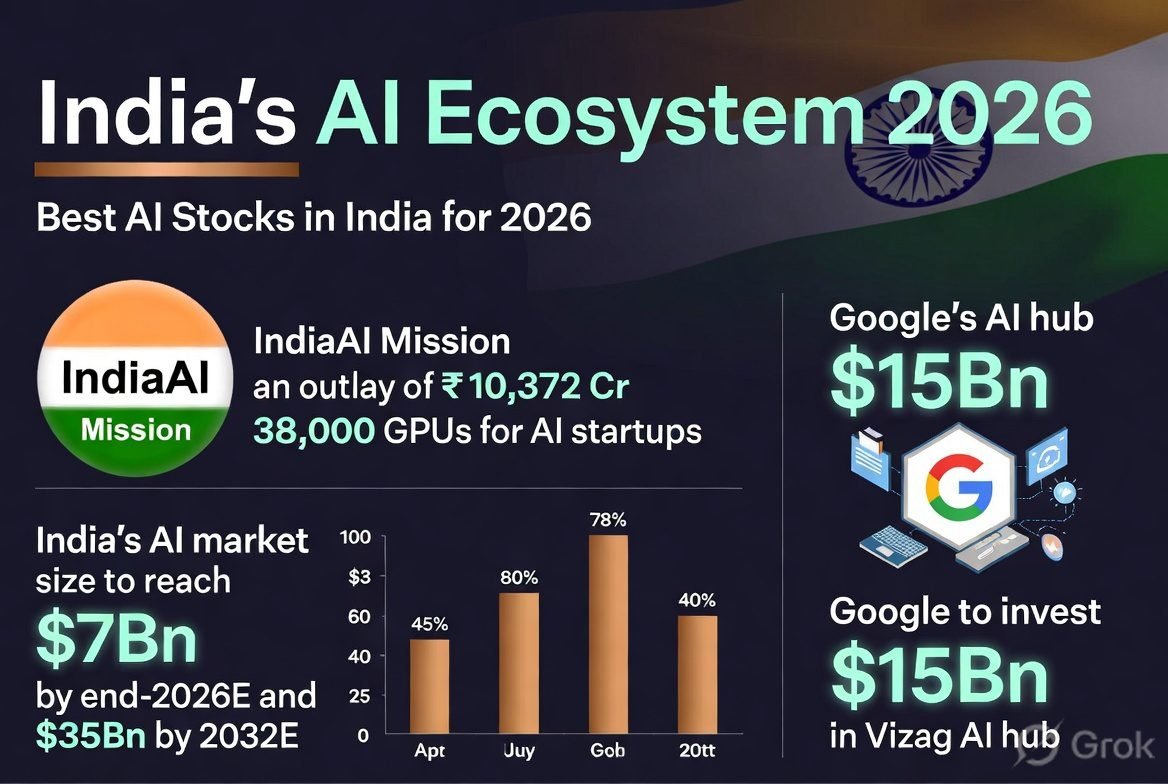
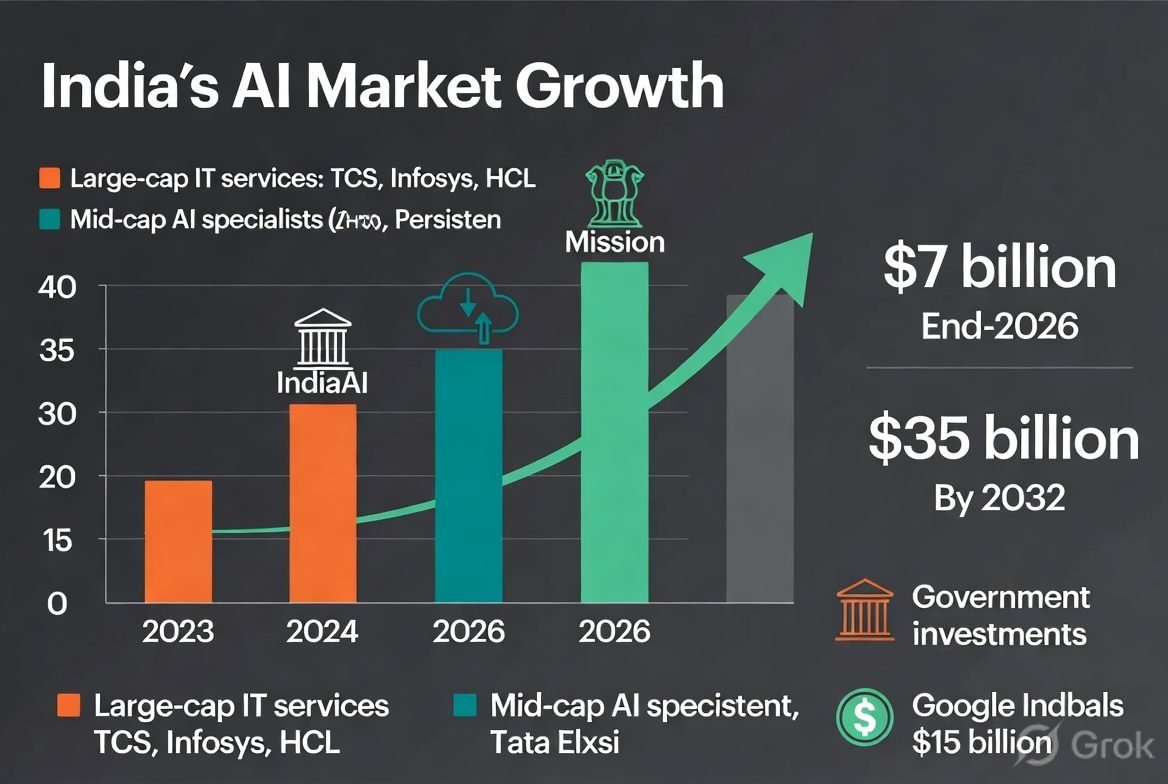
Start with government: the IndiaAI Mission has an approved five-year outlay of ₹10,371.92 crore, with ₹1,000 crore allocated specifically in Budget 2026. The mission has committed to deploying 38,000+ subsidised GPUs, funding indigenous foundation model development, and skilling the next generation of AI workers. Implementation has been slower than hoped — only ₹400 crore released in the first two years — but the direction is clear and the money is committed.
Then there's the global private sector. Google announced a $15 billion AI hub investment in Visakhapatnam, Andhra Pradesh — its largest investment in India ever. Amazon and Microsoft have committed $50 billion+ in cloud and AI infrastructure in India. These numbers matter because compute infrastructure is what every Indian AI services company needs more of, and that infrastructure is now being built at scale.
And then there's what all of this means for the listed companies. India has around 2.36 million people working in AI-related roles across 2,100+ global capability centres.
The IT services companies — especially the mid-cap specialists — are the firms actually deploying AI in enterprise environments. When global enterprises commit to AI transformation, a significant portion of that spend flows to Indian services companies. That's the basic investment thesis for AI stocks India 2026.
For broader context on what's driving global AI investment — and why money is flowing the way it is — our Reliance Q1 FY27 analysis touches on how even India's largest conglomerate is repositioning around digital infrastructure, and our H-1B visa fee impact piece explains one specific cost pressure that AI-heavy IT companies are navigating right now.
Section 02Persistent Systems — Top Pick Among AI Stocks India 2026
If you ask analysts at Motilal Oswal, HDFC Securities, or Kotak to name one AI stocks India pick they'd hold for three years, most of them name Persistent Systems. That's not an accident.
Persistent's story is straightforward: it is a Pune-based digital engineering company that has spent the last four years methodically building AI delivery capability across BFSI, healthcare, and hi-tech clients globally. In FY26, revenue grew 17.4% to $1.65 billion and profit climbed 33.2%. The company has delivered 23 consecutive quarters of sequential revenue growth. That kind of sustained execution is rare in mid-cap Indian IT.
The $2 billion FY27 revenue target is the number everyone is watching. Management confirmed in its most recent earnings call that they remain "firmly on track" toward this aspiration. TCV (total contract value) of $520.8 million and ACV of $385.3 million in recent quarters provide near-term visibility. The company has expanded clients in the $5M+ annual revenue bucket to 56 — a metric that shows it's winning larger, stickier mandates, not just small project work.
What actually differentiates Persistent is its SASVA platform — an AI-powered digital engineering tool that helps accelerate software delivery for clients. The company has also partnered with NVIDIA to launch a Generative Molecules and Virtual Screening Solution, and has built AI solutions on Databricks' platform. These aren't PowerPoint slides — they're shipped products with paying clients.
Section 03Tata Elxsi — The Deep-Tech Specialist With Industry-Leading Margins
Tata Elxsi occupies a very specific and defensible corner of the AI market: engineering R&D services for automotive, healthcare, and media companies. If you want exposure to AI in autonomous vehicles and AI-driven medical diagnostics — two sectors where the long-term potential is enormous — Tata Elxsi is one of the few listed Indian companies where that's actually a meaningful part of the current business.
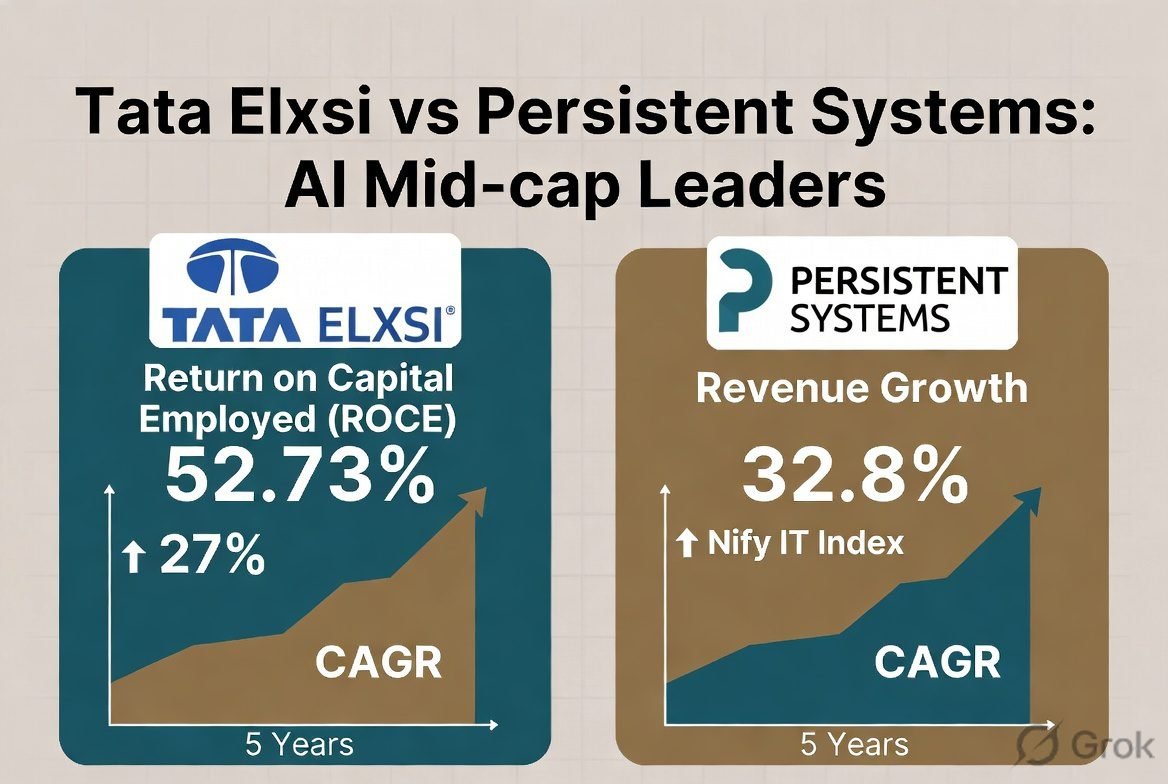
The ROCE figure — 52.73% — is the number that stops financial analysts mid-sentence. It means Tata Elxsi is generating more than half a rupee of operating profit for every rupee of capital employed in the business. For a services company, that's exceptional. It's also debt-free, which in a period of elevated interest rates is an underappreciated advantage.
The risk is concentration. Automotive is Tata Elxsi's largest vertical, and automotive spending has been volatile globally as EV adoption slows in some markets and OEMs tighten budgets. Healthcare is a growing offset, but it's still a smaller piece.
If you have strong conviction on long-term AI in automotive — and the thesis there is strong — this is a compelling pick among AI stocks India. If automotive AI takes longer to reach scale than expected, margin pressure could be real.
Section 04Happiest Minds — The AI Stocks India Dark Horse
Happiest Minds is the smallest company on this list and the one with the most to prove. It has positioned itself explicitly as an "AI First" company — the brand has been built around that identity since 2020 — and FY26 showed the strategy is beginning to deliver, though not without bumps.
The FY26 full-year numbers were solid: revenue up 12.3% to ₹2,315 crore, profit 15% higher at ₹212.62 crore. More interesting than the headline, though, is what's happening inside the business. BFSI grew from 22.5% to 26.1% of revenue in FY26 — a sector where AI deployment has accelerated sharply. The Generative AI Business Unit (GBS) reported 22 scalable projects, each progressing from "proof of concept" to "replicable client solution." The revenue potential attached to these is $50 million over three years.
There's a Q3 FY26 EPS miss to acknowledge — 30% below estimates, which analysts flagged as a negative. The company gave guidance of 12.5% constant-currency growth for FY27 with margin improvement of at least 100 basis points. That guidance is credible if execution holds, but Happiest Minds has had inconsistent quarterly delivery in the past.
Section 05TCS, Infosys, HCL — The Anchors (And Why You Probably Already Know This)
The large caps deserve a section, but I'll keep this shorter because most investors researching best AI stocks India 2026 already own at least one of these through mutual funds or direct equity. The question isn't whether these companies are involved in AI — they are, substantially — but whether that involvement justifies paying a premium specifically for AI exposure.
| Company | NSE Ticker | Core AI Bet | FY26 Revenue Growth | AI Revenue Share | Risk Level |
|---|---|---|---|---|---|
| TCS | TCS | Cloud + Analytics + Enterprise AI | ~5.6% | Growing rapidly | Low |
| Infosys | INFY | Topaz AI platform, enterprise solutions | ~5.1% | Significant | Low |
| HCL Technologies | HCLTECH | AI-powered enterprise platforms | ~8-9% | Growing | Low-Moderate |
The argument for large caps as AI stocks India is stability plus optionality. TCS at a market cap of ~₹8 lakh crore isn't going to be a multi-bagger from AI adoption alone. But it also won't collapse if one AI project misses.
These are businesses that have been navigating technology transitions for decades. They will survive and likely benefit from AI — the question is how much of that benefit is already priced in.
Our TCS Q1 FY27 results and preview cover the most recent numbers in detail. The short version: IT sector growth has been modest, but the AI-related deal pipeline is growing. For long-term investors who already hold these through SIPs into diversified funds, the exposure is already there — the question of adding more comes down to valuation relative to growth expectations, which is a separate conversation from "is this an AI company."
Section 06Best AI Stocks India 2026: Side-by-Side Comparison
| Company | Type | AI Angle | 5Y Return (Approx) | Risk | Best For |
|---|---|---|---|---|---|
| Persistent Systems | Mid-cap | GenAI delivery, SASVA platform, $2B target | 32.8% CAGR | Moderate | Core AI holding, 3-5 yr view |
| Tata Elxsi | Mid-cap niche | Automotive + healthcare AI engineering | 27% CAGR | Moderate-High | Thematic bet on automotive AI |
| Happiest Minds | Small-mid cap | AI-First brand, GenAI BU, BFSI focus | Variable | High | Satellite position, active monitoring |
| TCS | Large-cap | Enterprise AI, cloud, analytics at scale | Steady | Low | Stable anchor, already in most MFs |
| Infosys | Large-cap | Topaz platform, AI-led transformation | Steady | Low | Stability + AI optionality |
| HCL Technologies | Large-cap | AI-powered platforms, strong IP | Steady | Low-Moderate | Better growth rate vs TCS/Infy |
| Oracle Financial Services | Niche | AI-driven banking software (FLEXCUBE) | High | Moderate | BFSI AI play, high ROE |
Section 07AI Stocks India: Risks Nobody Is Talking About Enough
Every article on best AI stocks India will give you the bull case. Here's the honest list of what can go wrong, and which stocks it affects most.
| Risk | What It Means | Most Affected |
|---|---|---|
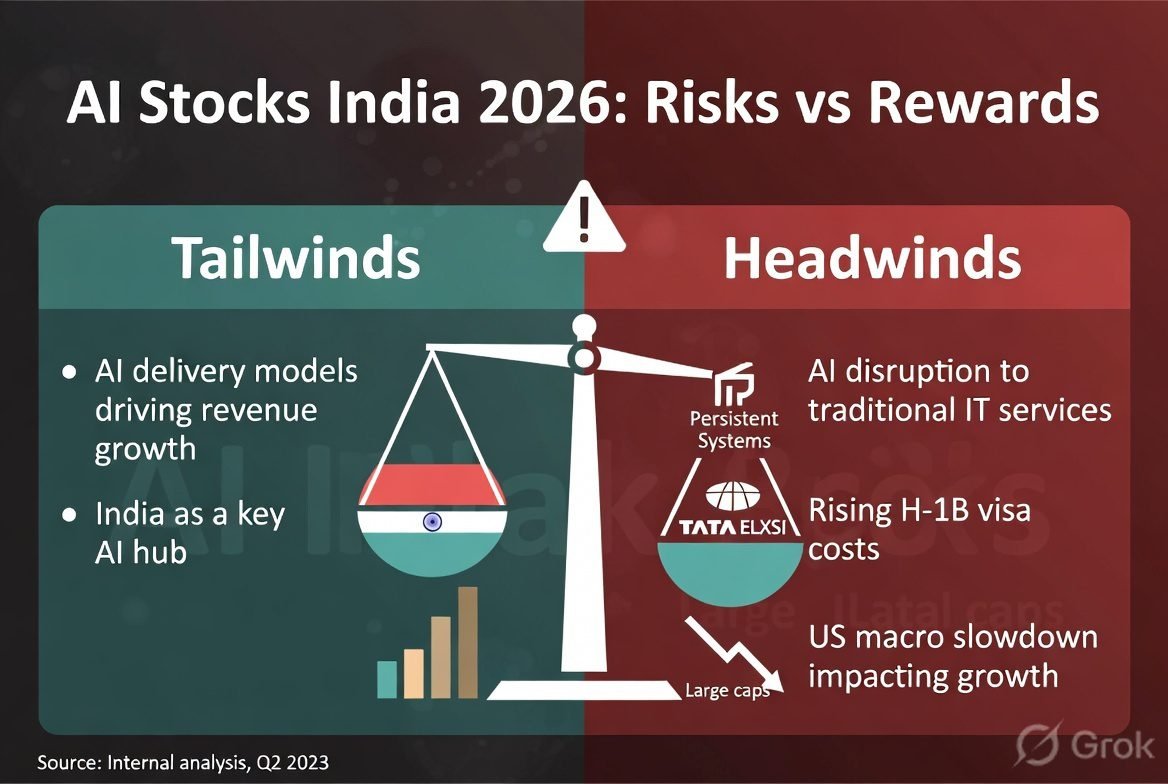
| AI disruption to IT services themselves | Anthropic's automation tools caused Nifty IT to fall 5.8% in a single session (June 3, 2026). If AI makes software delivery significantly cheaper or faster, it could compress the billable-hours model | All, but large-caps have more buffer |
| H-1B visa cost increases | New $100,000 H-1B visa fees increase the cost of deploying talent in the US — India IT's biggest market | TCS, Infosys, HCL most exposed |
| US macro slowdown | Most of these companies earn 60-75% of revenue from the US. A slowdown in enterprise tech spending hits deal wins first | Persistent, Happiest Minds (higher US concentration) |
| Valuation premium compression | Mid-cap AI specialists are trading at significant premiums to the broader IT sector. Any earnings miss compresses those multiples fast | Persistent, Tata Elxsi, Happiest Minds |
| Competition from global AI platforms | If clients can use AI tools to reduce headcount or do more with less, some services revenue could be genuinely disintermediated | All services companies, long-term |
The disruption risk deserves particular attention. The Jefferies downgrade of six major IT companies in June 2026 — specifically citing AI automation concerns — was the market's first real test of the "AI hurts Indian IT" thesis. The stocks recovered, but the concern didn't disappear. We've written about this specifically in the context of H-1B costs and Indian IT stocks — the companies that will survive and thrive are those building AI delivery tools, not just selling headcount.
On valuation: using even conservative assumptions, the market is pricing in sustained above-sector growth for the mid-cap AI specialists. That's justified if execution continues. It becomes expensive very quickly if a quarter or two disappoints. See common behavioural mistakes in trading for why this matters — AI stock run-ups are exactly the environment where FOMO-driven buying at peaks tends to happen.
Section 08How to Actually Think About Building an AI Portfolio in India
Rather than a blanket list of AI stocks India to buy, here's a framework that depends on what kind of investor you are and what you're actually trying to do.
| Investor Type | Suggested Approach | Why |
|---|---|---|
| SIP investor (long-term, low involvement) | Nifty IT index fund or diversified flexi-cap fund. Already has TCS, Infosys, HCL. | You get AI exposure without stock-specific risk or monitoring burden |
| Direct equity investor (3-5 year view) | Core position in Persistent (60-70%), satellite in Tata Elxsi (20-30%), small position in Happiest Minds if you can monitor quarterly (10%) | Conviction weighted toward the most consistent executor |
| US stocks access via LRS | QQQ (NASDAQ-100) or SMH (semiconductor ETF) for pure global AI hardware/platform exposure not available in India | NVIDIA, Microsoft, Google direct exposure — different risk-return than Indian IT services |
| Conservative investor | Large caps only (TCS, HCL) through existing positions or mutual funds. No separate AI allocation needed. | AI exposure exists in any diversified Indian equity portfolio already |
The most important thing to internalise: every Indian investor who holds a diversified equity mutual fund already has AI exposure through TCS, Infosys, and HCL. The decision to add a mid-cap AI specialist like Persistent or Tata Elxsi is a decision to tilt your portfolio toward higher-growth, higher-volatility AI delivery companies — with the associated risk. That tilt can make sense, but it should be conscious and sized accordingly.
For understanding how to size positions as part of a broader portfolio, the 50-30-20 rule and our guide on why investors lose money are relevant starting points. For building the actual investment vehicle — demat account, SIP setup — our demat account guide and beginner investing explainer cover the mechanics. And if you're thinking about gold or other asset classes as complements to equity in a period of elevated volatility, our gold ETF vs physical gold comparison is worth reading alongside this. The macro context — how inflation affects equity portfolios, the Fed rate watch — matters too, because US monetary policy affects the global risk-on environment that drives IT stock valuations.
Frequently Asked Questions
- Univest — AI Stocks India 2026: Best Indian AI Stocks List With Live Prices
- Appreciate Wealth — Artificial Intelligence Stocks in India to Invest in 2026
- Groww — Best Artificial Intelligence Stocks in India 2026
- Samco — Top 5 AI Stocks To Buy In India July 2026
- Forgeup — Best AI Stocks in India 2026: Tata Elxsi and 4 More
- Persistent Systems FY26 Annual Results — persistent.com investor relations
- Newsbytes — Persistent Systems leans on AI to hit $2 billion FY27
- Business Standard — Happiest Minds Q4 FY26: Net profit jumps 80%
- Google Cloud Press — Google $15 Billion AI Hub — Visakhapatnam, Andhra Pradesh
- AngelOne — Budget 2026: India allocates ₹1,000 crore for IndiaAI Mission
- MediaNama — IndiaAI Mission: Only Rs 400 crore released in two years
- ValueAddVC — India's AI Policy 2026: GPU Procurement and Startup Support
- PM India — Cabinet approves IndiaAI Mission — ₹10,371.92 crore outlay
- NSE India — nseindia.com — Stock data and exchange filings
- BSE India — bseindia.com — Regulatory filings
- Lakshmishree — Best AI Stocks in India 2026 — ROCE and fundamentals
- SEBI India — sebi.gov.in — Regulatory framework

Pranab Barman is a Financial Educator and Personal Finance Researcher with over 10 years of hands-on experience in stock markets, trading, and investing. Currently enrolled in the CFA Program, he is committed to continuous learning and professional excellence in finance.
As the Founder of PlayWithStock, Pranab covers a wide range of topics including Mutual Funds, SIP, Taxation, Stock Market Basics, and Financial Calculators — with a focus on simplifying complex financial concepts for everyday all investors.
Email: support@playwithstock.com
Website: playwithstock.com
Related posts:
 SK Hynix ADR Premium 2026: The Ajab Arbitrage Story Everyone’s Watching
 Stocks to Buy After India-US Trade Deal 2026: A Sector-by-Sector Breakdown
 India UK Trade Deal 2026: What Gets Cheaper, and Which Stocks Just Won
 H-1B $100K Visa Fee — Indian IT Stocks Pe Impact (2026 Update)
 Vodafone Idea Stock 2026: The Complete ₹35,000 Crore Guide
 AI Investing 2026: The Complete India-US Stock Guide
 HDFC Bank, ICICI Bank, Axis Bank & Kotak Bank Q1 FY27 Results: The Complete Comparison
 Q1 FY27 Earnings Season: 140+ Companies — Complete Weekly Results Calendar