
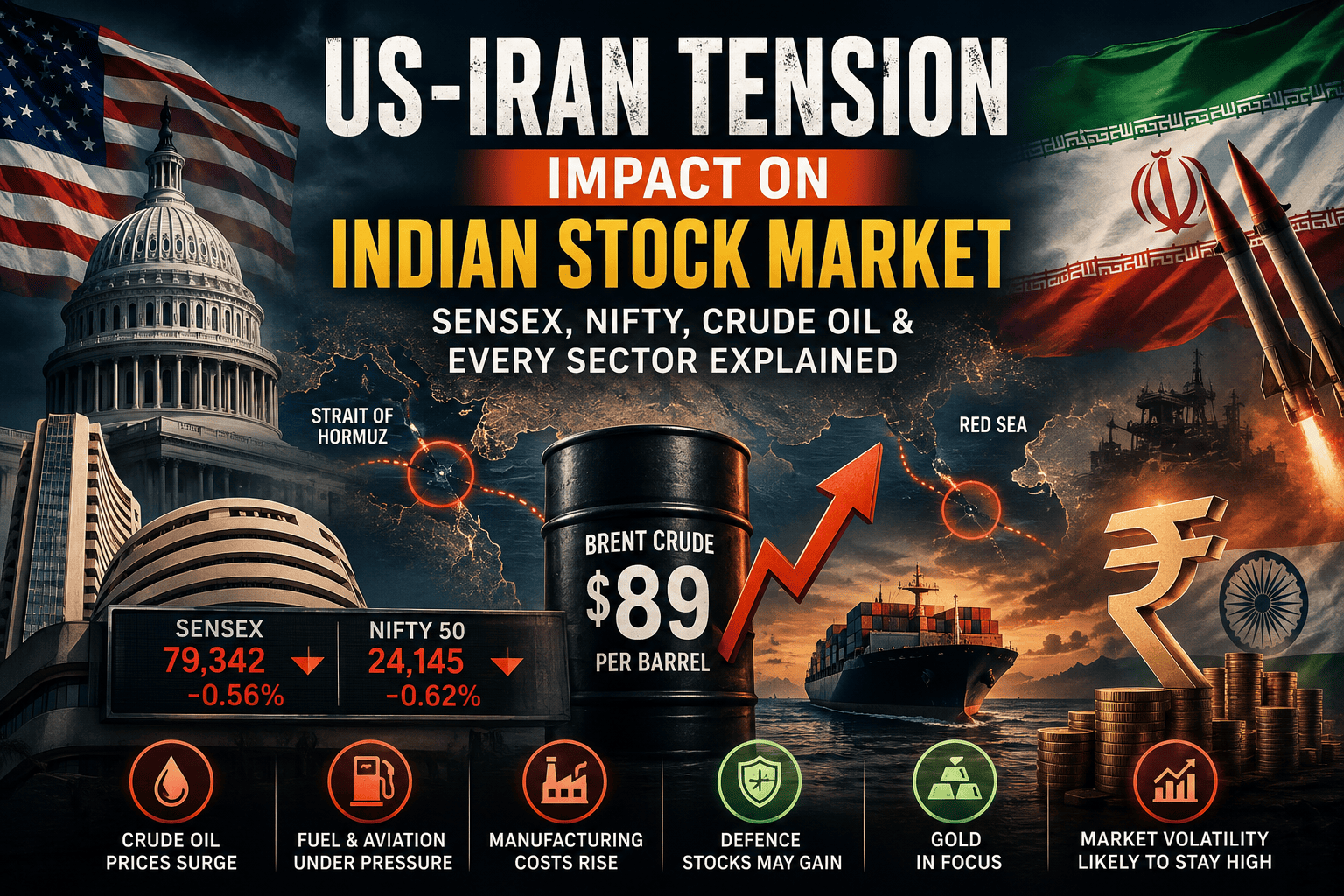

US-Iran Tension Impact on Indian Stock Market: Sensex, Nifty, Crude Oil, and Every Sector Explained
The Sensex and Nifty opened lower today as US-Iran conflict escalates, Houthis threaten a Red Sea blockade, and Brent crude nears $89 a barrel. Here's exactly what's happening and what it means for your portfolio.
- 1. What's Happening Today
- 2. Why US-Iran Tension Moves Indian Markets
- 3. Strait of Hormuz and the Red Sea: The Two Chokepoints
- 4. Sectors Under Pressure
- 5. Sectors That Could Benefit
- 6. Rupee, Inflation, and the Twin Deficit Problem
- 7. Trade Disruption: Rice, Fruit, and Tea Exports
- 8. FIIs vs DIIs: Who's Actually Selling
- 9. What Should Investors Actually Do
- 10. FAQs
US-Iran Tension Impact on Indian Stock Market is dominating trading desks again this week. The Nifty 50 and Sensex opened lower on July 21, 2026, extending losses from the previous session's near-450-point Sensex decline, as Brent crude pushed toward $89 a barrel on fears that the conflict could disrupt two of the world's most critical oil shipping routes. If you're trying to understand why your portfolio moved today, or which sectors to watch as this story develops, this is the complete breakdown.
⚡ Market Snapshot — July 21, 2026
| Sensex (open) | 77,649.63 (-58.89 pts) |
| Nifty 50 (open) | 24,216.05 (-22.45 pts) |
| Brent Crude | ~$89/barrel |
| Rupee vs USD | ₹96.41 (nearly flat) |
| FII Flow Today | -₹1,121.04 crore (5th straight sell day) |
| DII Flow Today | +₹1,312.03 crore (9th straight buy day) |
1. What's Happening Today
Indian benchmark indices opened marginally lower on July 21, 2026, tracking mixed global cues and geopolitical anxiety. The Sensex fell nearly 59 points to 77,649.63, while the Nifty 50 slipped roughly 22 points to 24,216.05, following a previous session in which the Sensex had already lost close to 450 points on Middle East concerns. Despite the cautious headline numbers, market breadth was actually positive — 1,782 stocks advanced against 801 decliners on the NSE, and both the BSE Midcap and Smallcap indices edged higher, suggesting the selling pressure was concentrated in specific large-cap, oil-sensitive names rather than broad-based panic.
The immediate trigger is a fresh escalation between the US and Iran: reports indicate US strikes on Iran's Bandar Abbas and Chabahar ports, Iran retaliating against US assets in Kuwait and Bahrain, and — most significantly for markets — Yemen's Houthi movement declaring a naval blockade against Saudi Arabia, with Iran reportedly instructing the group to prepare for a possible closure of the Bab el-Mandeb Strait if US strikes continue.
2. Why US-Iran Tension Moves Indian Markets
India imports close to 90% of its crude oil requirement, which makes it structurally more sensitive to Middle East instability than most large economies. Every time tension flares in the region, the transmission mechanism into Indian markets follows a fairly consistent pattern: oil prices rise on supply-disruption fears, the rupee weakens because a bigger oil import bill means more dollar demand, inflation expectations tick up, and equity markets sell off on the combined worry of costlier imports and a wider current account deficit.
This isn't a new pattern — it played out during the Soleimani strike in January 2020, again during the Israel-Iran escalation earlier in 2026, and it's playing out again now. What differs each time is the specific trigger and how long the disruption actually lasts. If you want the full mechanics of how crude oil price moves flow through to Indian portfolios, our oil price impact analysis and inflation and stock portfolio guide cover this in more depth.
3. Strait of Hormuz and the Red Sea: The Two Chokepoints
This particular escalation is unusually serious because it threatens two critical maritime chokepoints simultaneously, not just one. The Strait of Hormuz carries roughly one-fifth of global oil consumption and sits at the mouth of the Persian Gulf — any move to restrict it directly threatens crude supply from Saudi Arabia, Iraq, UAE, and Iran itself. The Bab el-Mandeb Strait, the southern gateway to the Red Sea, is one of the world's busiest trade corridors linking the Indian Ocean to the Suez Canal — shipping through this route has already been disrupted for over a year by repeated Houthi attacks on commercial vessels.
A closure or serious disruption at either point forces vessels onto the much longer route around the Cape of Good Hope in Africa, which increases both freight costs and delivery times substantially. War risk insurance premiums for ships transiting the region have reportedly already risen to four or five times their normal levels, with many policies carrying 72-hour cancellation clauses that let insurers reprice risk almost in real time as the conflict evolves.
4. Sectors Under Pressure
Higher crude prices and shipping disruption don't affect every sector equally. Based on how this pattern has played out in past escalations, these are the sectors facing the most direct pressure:
| Sector | Why It's Exposed |
|---|---|
| Aviation | Aviation Turbine Fuel is 30-40% of airline operating costs; margin pressure is immediate |
| Oil Marketing Companies (BPCL, HPCL, IOC) | Face marketing losses if retail fuel prices are held flat while crude costs rise |
| Paints & Specialty Chemicals | Crude-derived raw material costs rise immediately with oil prices |
| Tyres | Carbon black and synthetic rubber inputs are crude-linked |
| Automobiles | Higher fuel costs dampen demand for ICE vehicles; component costs also rise |
| FMCG & Logistics | Rising diesel costs increase freight and packaging expenses |
| Cement & Construction | Petrochemical-derived input costs climb |
Travel and tourism-linked businesses with Middle East exposure can also see direct disruption from airspace restrictions, separate from the broader cost-pressure story. For a sense of how this compares to previous market-falling episodes, our why is the stock market falling today tracker is a useful companion read, and our circuit breaker explainer covers what happens if volatility gets severe enough to trigger trading halts.
5. Sectors That Could Benefit
It's not one-directional pressure across the board. A handful of sectors and stock categories tend to see relative strength during exactly this kind of escalation:
- Upstream oil producers like ONGC and Oil India benefit from higher crude realisations on their own production, partially offsetting the pain felt elsewhere in the energy chain.
- Defence-linked stocks often see sentiment-driven gains during any period of rising geopolitical tension, regardless of direct revenue impact.
- Gold tends to rally as a safe-haven asset when geopolitical risk rises — our gold price analysis and gold price correction guide cover how this safe-haven dynamic has played out through 2026 specifically.
- Industrial conglomerates and rate-sensitive banks can rebound sharply on any de-escalation signal — this happened in a previous 2026 episode, when Titan, UltraTech, L&T, and Bajaj Finance each jumped more than 4% on ceasefire talk alone, illustrating how quickly sentiment can reverse in either direction.
6. Rupee, Inflation, and the Twin Deficit Problem
India runs what analysts call a persistent "twin deficit" — a trade deficit and a fiscal deficit — and oil sits directly at the center of both. A sustained $10-20 per barrel rise in crude can add billions of dollars to India's annual import bill, pressuring the rupee and widening the current account deficit simultaneously. A weaker rupee combined with higher dollar-denominated oil prices creates what's sometimes called a "double whammy" of imported inflation, since India pays for oil in dollars regardless of what the rupee is doing.
The Reserve Bank of India typically monitors currency movements closely during episodes like this and can intervene to limit excessive volatility, though it generally avoids trying to defend a specific rupee level outright. Our Dollar Index explainer and RBI repo rate coverage are useful for understanding how currency and rate policy interact during periods of imported inflation pressure like this one.
7. Trade Disruption: Rice, Fruit, and Tea Exports
Beyond the headline market numbers, this conflict has real, specific effects on Indian trade that don't always make it into market commentary. The Middle East drives a substantial share of India's basmati rice demand, and Indian rice exporters have reportedly advised members to halt fresh shipments to the region because insurance for Gulf-bound vessels has become effectively unavailable or unaffordable. On the import side, India depends on Iran for a meaningful share of its apple and almond imports — with those shipments stalled, budget-segment fruit and nut supply in Indian markets has tightened. Banana exports bound for Gulf ports have reportedly been stranded due to a shortage of refrigerated containers willing to enter the conflict zone, and tea exports — historically a meaningful India-Iran trade line — face disruption through affected payment channels.
These aren't abstract macro numbers; they represent real revenue impact for specific listed and unlisted agri-exporters, and they're worth tracking separately from the broader oil-and-equities narrative if you follow companies in these specific export categories.
8. FIIs vs DIIs: Who's Actually Selling
Today's flow data tells an interesting story on its own. Foreign Institutional Investors have been net sellers for five straight sessions, offloading ₹1,121.04 crore worth of equities today, while Domestic Institutional Investors have been net buyers for nine consecutive sessions, picking up ₹1,312.03 crore today — more than offsetting the FII selling in absolute terms.
This pattern — foreign investors turning cautious on geopolitical risk while domestic institutions continue accumulating — is fairly typical during episodes like this. FIIs tend to de-risk emerging market exposure quickly when global uncertainty rises, while domestic mutual funds, backed by steady SIP inflows, often continue buying through the volatility. Our sector rotation guide and Nifty and Sensex explainer give useful context on how this kind of institutional tug-of-war typically resolves over subsequent weeks.
9. What Should Investors Actually Do
We'd resist the urge to make big portfolio moves purely on a single day's geopolitical headline. Oil-linked volatility driven by Middle East tension has a long history of being sharp but short-lived when the underlying conflict doesn't escalate into an actual, sustained supply disruption — the market's reaction over the following one to two weeks, not the first day's move, usually tells you more about whether this is a genuine structural risk or a headline-driven wobble.
- Avoid panic-selling broad index positions based on a single volatile session — our behavioral mistakes in stock trading guide covers exactly this pattern.
- Watch sector-specific exposure if you're overweight aviation, OMCs, paints, or tyres — these are the names most directly affected by a sustained crude price move.
- Track Brent crude and shipping/insurance data over headline war rhetoric — actual supply disruption, not political statements, is what ultimately moves fundamentals.
- Keep an eye on the Q1 FY27 earnings season running in parallel — our Q1 FY27 earnings calendar can help you separate company-specific results-driven moves from broader geopolitical noise in your portfolio this week.
For readers newer to investing who are seeing a volatile week like this for the first time, our beginner investing guide and why investors lose money analysis are worth reading before making any reactive decisions. You can also track ongoing coverage of this story as it develops in our Global Economy category.
10. Frequently Asked Questions
Why is the US-Iran conflict affecting the Indian stock market?
India imports close to 90% of its crude oil, so any threat to Middle East oil supply routes directly raises fears of higher import costs, a weaker rupee, and higher inflation — all of which weigh on investor sentiment and equity markets.
Which sectors are most affected by rising oil prices?
Aviation, oil marketing companies, paints, tyres, automobiles, FMCG, logistics, and cement face the most direct cost pressure. Upstream oil producers like ONGC and Oil India, along with gold and select defence stocks, can see relative strength.
Will petrol and diesel prices rise in India because of this?
Retail petrol and diesel prices in India are influenced by, but not automatically tied to, global crude movements — oil marketing companies and the government weigh crude cost increases against inflation and consumer sentiment before adjusting pump prices, so a short-term crude spike doesn't always translate immediately into higher retail fuel prices.
What is the Strait of Hormuz and why does it matter?
The Strait of Hormuz is a narrow waterway at the mouth of the Persian Gulf that carries roughly 20% of global oil consumption. Any disruption there is one of the most direct ways Middle East conflict can affect global crude supply.
Are FIIs selling Indian stocks because of the Iran conflict?
FIIs have been net sellers for five consecutive sessions as of July 21, 2026, which aligns with typical foreign-investor risk-off behaviour during geopolitical uncertainty. Domestic institutional investors have been net buyers for nine straight sessions over the same period.
Should I sell my stocks because of the US-Iran tension?
This depends on your individual risk profile and time horizon — we can't offer personalised advice. Historically, oil-driven geopolitical volatility has often been sharp but short-lived unless the conflict causes a sustained supply disruption, which is why reacting to a single day's move is generally considered less reliable than watching the trend over the following weeks.

Pranab Barman is a Financial Educator and Personal Finance Researcher with over 10 years of hands-on experience in stock markets, trading, and investing. Currently enrolled in the CFA Program, he is committed to continuous learning and professional excellence in finance.
As the Founder of PlayWithStock, Pranab covers a wide range of topics including Mutual Funds, SIP, Taxation, Stock Market Basics, and Financial Calculators — with a focus on simplifying complex financial concepts for everyday all investors.
Email: support@playwithstock.com
Website: playwithstock.com
Related posts:
 Nifty July 2026: Will It Hit 24,800? Complete Market Outlook and Stock Guide
 Why Is the Stock Market Falling Today? US-Iran Tensions, Crude Oil Spike & FII Selling Explained
 H-1B $100K Visa Fee — Indian IT Stocks Pe Impact (2026 Update)
 Q1 FY27 Results Preview: What to Expect from Auto and FMCG Sectors This Quarter
 Oil Price Crash 2026: How the End of a War Is Reshaping India’s Economy
 What is the Strait of Hormuz and Why Does It Affect India? Complete Guide 2026
 India US Trade Deal 2026: Inside the Tariff Rollercoaster Before July 22
 Gold Price Correction 2026: What It Means for Indian Investors