
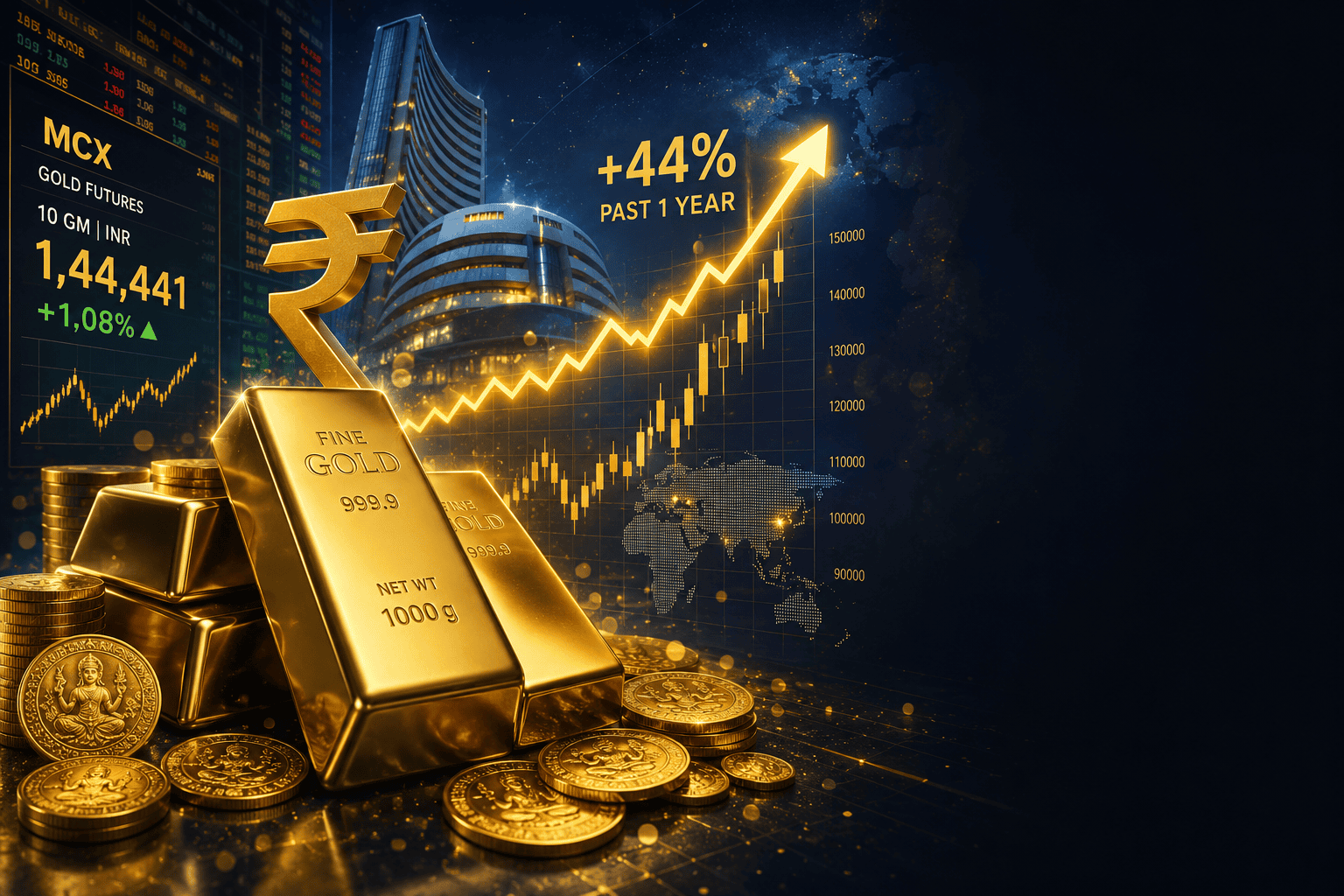

Gold Price Rally 2026: Why It Jumped 44% and Nears ₹1.45 Lakh
Gold Price Rally 2026 has quietly become one of those numbers people bring up at family dinners the same way they used to talk about petrol prices. And honestly, it deserves the attention — gold futures on MCX touched around ₹1,44,441 per 10 grams, up roughly 1.08% on the day, and if you compare that to where gold stood exactly a year ago, the jump is genuinely hard to ignore.
We've covered pieces of this story before on the blog — our articles on gold hitting all-time highs and the gold price correction that followed both touched on parts of this rally. Global coverage of the same move has come from outlets like Reuters' commodities desk and Bloomberg's commodities section. But we hadn't sat down and actually connected the full 12-month story with the real numbers, so that's what this article does.
Table of Contents
- Today's Gold Rate in India (July 22, 2026)
- The 44% Jump: Last Year vs Today
- 6 Reasons Gold Has Rallied This Hard
- Why Indian Gold Prices Move Differently From Global Prices
- Silver Is Rallying Even Harder
- Should You Buy Gold Right Now
- Physical Gold vs Gold ETF vs Sovereign Gold Bonds
- What Analysts Are Actually Forecasting for 2026-27
- Frequently Asked Questions
Today's Gold Rate in India (July 22, 2026)
Gold & Silver Snapshot — July 22, 2026
| 24K Gold (per gram) | ₹14,422 |
| 22K Gold (per gram) | ₹13,220 |
| 18K Gold (per gram) | ₹10,817 |
| MCX Gold Futures (per 10g) | ₹1,44,441 |
| Silver (per gram) | ₹235–240 |
| MCX Silver Futures (per kg) | ₹2,26,050 |
| 1-Year Change (24K, per gram) | +44.64% |
Today's gold price in India stands at ₹14,422 per gram for 24 karat gold, ₹13,220 per gram for 22 karat gold, and ₹10,816 per gram for 18 karat gold. On the commodities exchange, MCX gold futures were trading around ₹1,44,441 per 10 grams, up about 1.08%, while silver futures rose roughly 1.01% to ₹2,26,050 per kilogram. If you're checking city-specific rates before heading to a jeweller, live trackers like Goodreturns' gold rate page, GoldMeter, and the India Bullion and Jewellers Association (IBJA) official rate sheet all update daily and are worth bookmarking.
Prices do vary slightly city to city because of local making charges and state-level duties — in Chennai specifically, gold rose by ₹2,080 on July 22 alone, moving from roughly ₹1,05,360 to ₹1,07,440 per sovereign in a single day, while Delhi's 24-karat rate stood close to ₹14,438 per gram and 22-karat at ₹13,236 per gram on the same date. Business news coverage of the same day's move is available on Business Today's personal finance section and DT Next.
The 44% Jump: Last Year vs Today
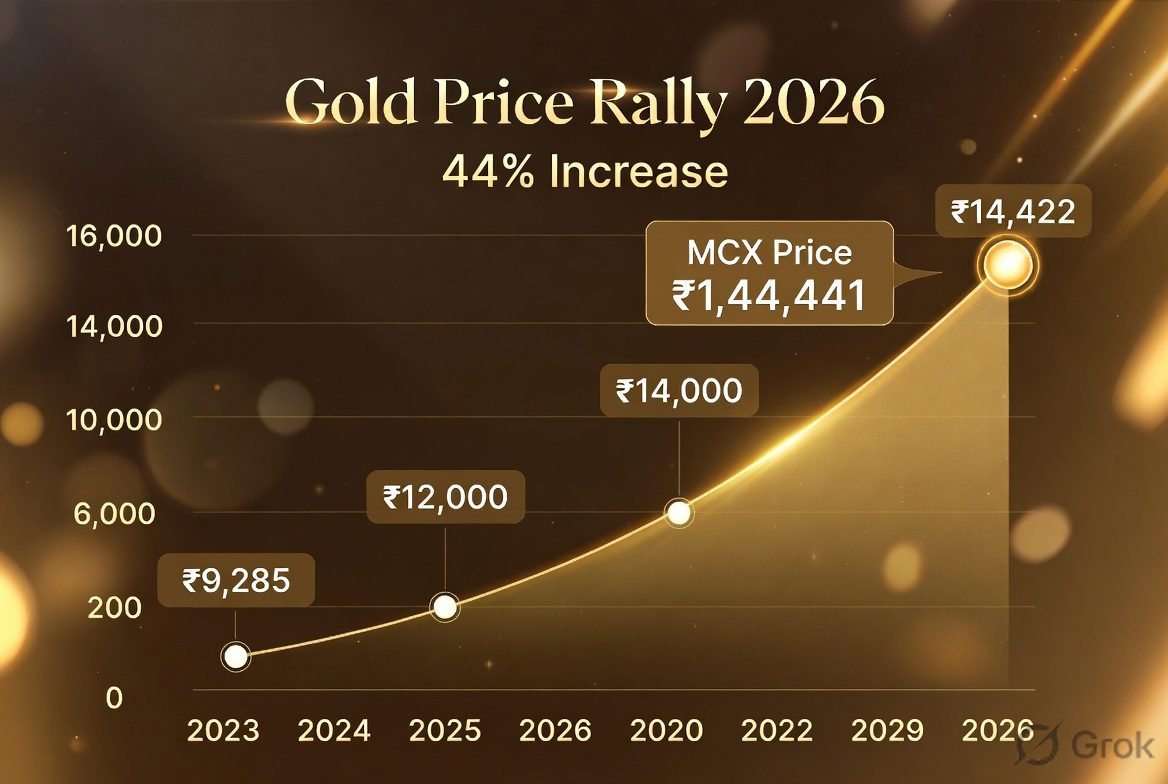
Here's the number that actually matters if you're trying to understand the scale of this move. Gold has surged from ₹9,285 per gram on July 22, 2025, to ₹13,430 per gram on July 22, 2026 — an increase of roughly ₹33,160 per sovereign, or about 44.64% in exactly one year.
Put in context most of our readers will recognize instantly: that's a materially higher one-year return than what most Nifty 50 index investors would have earned over the same period, and it's arguably outpaced even a fair number of actively managed equity funds. We're not saying gold should replace equity in your portfolio — we'll get to that — but the size of the move genuinely deserves the attention it's getting.
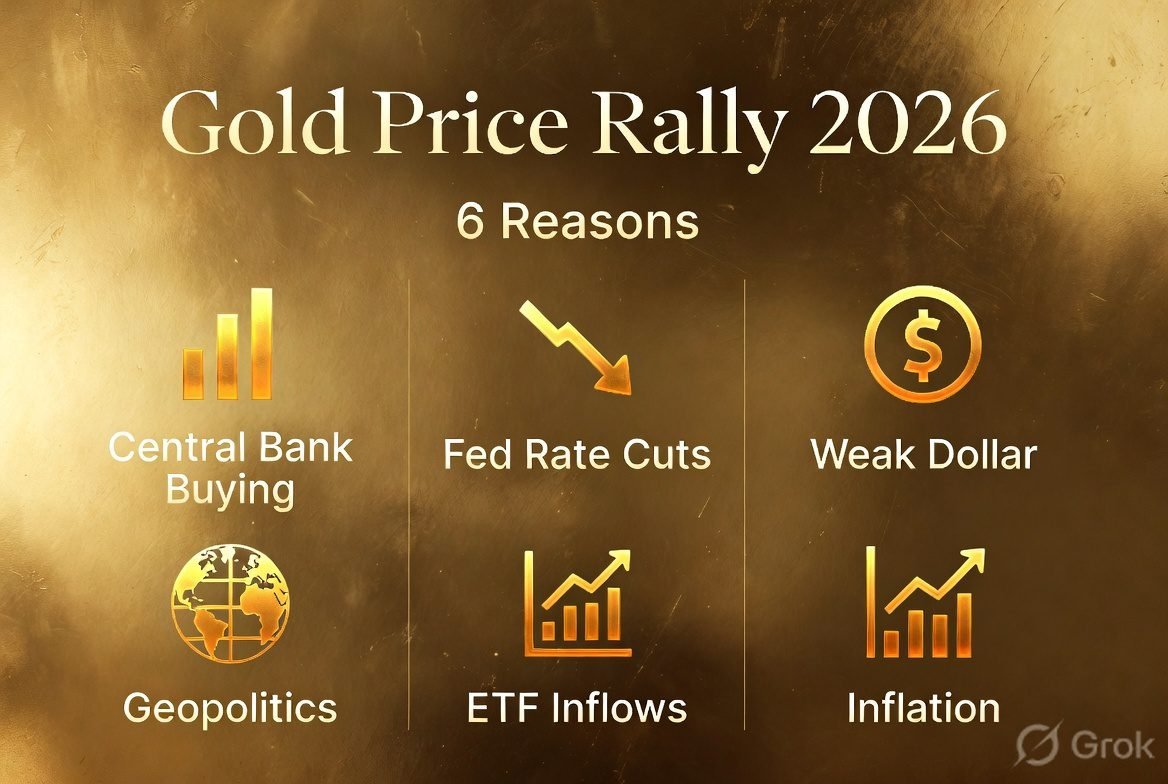
6 Reasons Gold Has Rallied This Hard
1. Central Banks Are Buying Gold Like Never Before
This is arguably the single biggest structural force behind the entire move. Gold has surpassed the share of US Treasuries in central bank reserves for the first time since 1996, according to Morgan Stanley Research, and roughly 95% of central banks surveyed by the World Gold Council plan to further increase their gold reserves in 2026. You can read the World Gold Council's own central bank survey data on their Goldhub research portal. When the institutions that traditionally held government bonds start preferring gold instead, that's not a short-term trading trend — that's a genuine shift in how the world's biggest financial institutions think about safety.
2. US Federal Reserve Rate Cuts
Gold pays no interest, so when interest rates fall, the opportunity cost of holding gold instead of a bond or FD falls too — making gold relatively more attractive. After three rate cuts already this year, markets are pricing in at least two more Fed cuts, and lower rates reduce the appeal of holding non-yielding assets, making gold a more attractive store of value. We track this same Fed dynamic separately in our Fed rate and FOMC watch article, since it affects gold, the dollar, and Indian equities all at once. The Fed's own policy statements are published directly on the Federal Reserve's press release page.
3. A Weaker US Dollar
Gold and the dollar have historically moved in opposite directions — when the dollar weakens, gold priced in dollars tends to rise, partly because it becomes cheaper for buyers holding other currencies. Morgan Stanley points directly to a falling US dollar as one of the core drivers behind continued gold upside. If you want the mechanics of exactly how the dollar's strength or weakness ripples through to Indian prices, our Dollar Index (DXY) explained article breaks it down in more depth, and live DXY levels can be tracked on Investing.com's US Dollar Index page.
4. Genuine Geopolitical Anxiety
Wars, blockades, and regional flashpoints reliably push investors toward gold as a safe haven. Risks including a US blockade of oil supplies from Venezuela and an attack on a Russian shadow fleet tanker in the Mediterranean were cited among the factors pushing investors toward gold. Closer to home, the ongoing tension around the Strait of Hormuz and broader US-Iran tensions we've covered separately are exactly this kind of flight-to-safety trigger. CBS News' original reporting on this specific factor is available at CBS News' gold surge explainer.
5. Record ETF Inflows
Gold-backed ETFs have been pulling in significant fresh money globally, and that buying pressure shows up directly in spot prices. ETFs backed by gold have kept posting record inflows alongside the central bank buying, creating a rare situation where both institutional and retail-driven demand are pushing in the same direction simultaneously. Fund flow data of this kind is tracked by LSEG Lipper and reported regularly through CNBC's commodities section.
6. Monsoon and Domestic Inflation Pressure in India
On the India-specific side, gold's rise has itself become a meaningful contributor to headline inflation readings. The RBI's own commentary this year flagged rising precious metal prices as a factor behind an upward inflation revision — a link we cover in detail in our RBI MPC August 2026 preview and our monsoon and inflation explainer.
Why Indian Gold Prices Move Differently From Global Prices
Global gold is quoted in US dollars per ounce, but what you see at your local jeweller is priced in rupees per gram — and that conversion adds a second, independent layer of movement on top of the international price. Indian gold prices are influenced by international spot prices from the London Bullion Market, USD/INR exchange rates, import duties currently around 15%, GST at 3%, and local demand.
This means a weakening rupee against the dollar can push Indian gold prices higher even on a day when international gold is flat — a dynamic we've unpacked more fully in our rupee vs dollar July 2026 article. Import duty and GST rules on gold are set out officially on the Central Board of Indirect Taxes and Customs (CBIC) website. It's part of why Indian gold and global gold headlines sometimes seem to tell slightly different stories on the same day.
Silver Is Rallying Even Harder, in Percentage Terms
Gold isn't the only precious metal having a moment. Silver futures rose to around ₹2,26,050 per kilogram, up roughly 1.01% on the day, and it's already crossed the ₹2.25 lakh mark — a level that would have sounded almost unbelievable just a couple of years ago. We've covered this specific silver move in more depth in our silver all-time high article and the more recent silver price surge explainer.
| Metal | July 22, 2025 | July 22, 2026 | 1-Year Change |
|---|---|---|---|
| Gold (24K, per gram) | ₹9,285 | ₹14,422 | +44.64% approx. |
| Gold (per sovereign, 8g) | ₹74,280 | ₹1,07,440 | +44.64% |
| Silver (per gram) | ~₹95–100 (est.) | ₹235–240 | Sharply higher |
Silver's rally is being driven by a mix of the same safe-haven demand pulling gold higher, plus genuine industrial demand from solar panel manufacturing and electronics, which gold doesn't have to the same degree. If you're deciding between the two metals for a fresh allocation, that industrial-demand angle is one of the more useful distinctions worth understanding before you choose.
Should You Buy Gold Right Now
Reasonable Approach
Treat gold as 5-15% of a diversified portfolio, bought gradually over months rather than all at once, mainly as a hedge against inflation and currency weakness rather than a short-term trading bet.
Risky Approach
Putting a large lump sum into gold purely because the price has already risen 44% this year, assuming the same pace of gains will simply continue indefinitely.
We'd genuinely caution against chasing a rally that's already happened. A 44% one-year gain is exactly the kind of number that pulls in late buyers right before a correction — the same behavioural pattern we've written about in our why investors lose money in the stock market guide applies just as much to gold as it does to equities.
We generally suggest treating any lump sum gold purchase decision the way you'd treat a mutual fund lump sum — spreading it across a few months rather than trying to time the exact bottom, since nobody, including us, can reliably call the top or bottom of a precious metals cycle.
How This Compares: Gold ETF vs Physical Gold →Physical Gold vs Gold ETF vs Sovereign Gold Bonds
If you've decided gold deserves a place in your portfolio, the "how" matters almost as much as the "how much." Our detailed Gold ETF vs physical gold comparison covers the storage, liquidity, and cost differences in full, but here's the short version:
Physical gold (jewellery, coins, bars) carries making charges and storage risk, and jewellery specifically is rarely a great investment once you account for the making charges you pay going in and the deduction jewellers apply coming out.
Gold ETFs trade on the stock exchange like any other security, track the gold price closely, and avoid storage and purity concerns entirely — you'll need the same demat account you'd use for stocks. Compare fund-level costs using our index vs active funds framework, since expense ratios matter for gold ETFs too.
Sovereign Gold Bonds (SGBs) add an annual interest payment on top of gold's price movement and carry no GST at purchase, though liquidity before maturity is more limited — our SGB redemption tax calculator is worth checking before you decide, especially if you're weighing an early exit. Official SGB scheme details and interest rates are published on the RBI's press release page, since the RBI issues SGBs on behalf of the Government of India.
What Analysts Are Actually Forecasting for 2026-27
Forecasts genuinely vary quite a bit depending on which desk you ask, and we think that spread itself is useful information. State Street expects the 2025 rally to moderate somewhat in 2026, consolidating in the $4,000 to $4,500 per ounce range, while J.P. Morgan Global Research analysts expect gold to push toward $6,000 per ounce by the end of 2026, with $6,300 a possibility for 2027. Moderate forecasts across the industry cluster around $4,800 to $5,400 per ounce, assuming inflation moderates gradually and no major new crises emerge.
What almost every forecast agrees on is the direction of the underlying drivers even when the exact price target differs — continued central bank buying, a Fed leaning toward rate cuts, and persistent geopolitical uncertainty. The World Gold Council itself notes that gold already achieved over 50 all-time highs and returned over 60% in 2025, supported by heightened geopolitical and economic uncertainty, a weaker dollar, and positive price momentum.
None of these forecasts are guarantees, and we'd treat every single one — ours included — as an informed estimate rather than a prediction to bet your emergency fund on. If you want the raw data behind these calls rather than secondhand summaries, the World Gold Council's Gold Outlook report, Morgan Stanley's gold research, and J.P. Morgan's commodities research page are all publicly accessible primary sources.
What This Means If You're Buying Gold for a Wedding or Festival
A lot of Indian gold demand isn't investment-driven at all — it's tied to weddings and festivals, and at these price levels, a lot of families are genuinely rethinking how much gold they buy versus how they structure the purchase. If a wedding or festival purchase is on your calendar, our sinking fund for festival expenses guide and the more specific gold price prediction for Diwali 2026 article can help you plan the purchase in stages rather than all at once, which also smooths out some of the day-to-day price volatility you'd otherwise be exposed to with a single lump-sum buy.
It's also worth remembering gold purchases and eventual sales have tax implications — our tax planning guide and the broader ITR filing deadline 2026 article are useful if you're holding any of this as a genuine investment rather than jewellery for personal use.
Frequently Asked Questions
What is the gold price in India today?
As of July 22, 2026, 24 karat gold is priced around ₹14,422 per gram and 22 karat gold around ₹13,220 per gram, though exact rates vary slightly by city.
Why has gold price increased by 44% in one year?
The main drivers include record central bank gold buying, US Federal Reserve interest rate cuts, a weaker US dollar, ongoing geopolitical tensions, and strong ETF inflows, all reinforcing each other over the past twelve months.
Is it a good time to buy gold in 2026?
There's no universally correct answer, but most analysts suggest treating gold as a modest 5-15% portfolio allocation bought gradually over time, rather than a large lump-sum bet chasing an already-completed rally.
Will gold prices fall in 2026-27?
Forecasts vary significantly — some analysts expect prices to consolidate or moderate, while others like J.P. Morgan project continued gains toward $6,000 per ounce by end of 2026. The main risks to further gains are a stronger dollar, delayed Fed rate cuts, or reduced geopolitical tension.
Why is silver rising along with gold?
Silver benefits from the same safe-haven demand as gold, plus additional industrial demand from solar panel manufacturing and electronics, which has pushed it to record highs alongside gold in 2026.
What's the difference between physical gold, gold ETFs, and Sovereign Gold Bonds?
Physical gold involves making charges and storage risk, gold ETFs trade like stocks with no storage concerns, and Sovereign Gold Bonds add annual interest on top of price appreciation but have more limited early liquidity.
Why do Indian gold prices differ from global gold prices?
Indian prices depend on the international spot rate, the rupee-dollar exchange rate, import duty, and GST, so a weaker rupee can push Indian gold prices higher even when international prices are flat.
Our Final Take on This Gold Rally
We'd rather you walk away from this article understanding the six forces actually driving this move than just remembering the 44% headline number. Central bank buying and Fed policy are genuinely structural — they don't reverse in a week. Geopolitical tension is more unpredictable, and that's exactly the part that could add sudden volatility in either direction.
If you're new to thinking about gold as part of a broader portfolio rather than just jewellery, our beginner investing guide and how inflation affects your portfolio article are good next reads before making any allocation decision.

Pranab Barman is a Financial Educator and Personal Finance Researcher with over 10 years of hands-on experience in stock markets, trading, and investing. Currently enrolled in the CFA Program, he is committed to continuous learning and professional excellence in finance.
As the Founder of PlayWithStock, Pranab covers a wide range of topics including Mutual Funds, SIP, Taxation, Stock Market Basics, and Financial Calculators — with a focus on simplifying complex financial concepts for everyday all investors.
Email: support@playwithstock.com
Website: playwithstock.com
Related posts:
 Gold Price Prediction Diwali 2026: Will Gold Recover After the Correction?
 How to Invest in Gold ETF: The Complete Gold ETF vs Physical Gold Guide
 Silver Price Surge 2026: Why Silver Is Beating Gold This Year
 Gold Price Correction 2026: What It Means for Indian Investors
 Gold Price All Time High India: Should You Buy Now or Wait in 2026
 India IPO Boom 2026: ₹2.65 Lakh Crore Pipeline Explained in Simple Terms
 Reliance Q1 FY27 Results: Revenue Hits Record ₹3.12 Lakh Crore, Profit Slips 22%
 Passive Investing in India Just Crossed ₹14 Lakh Crore — Here’s the Index Funds vs Active Funds Math Behind It