
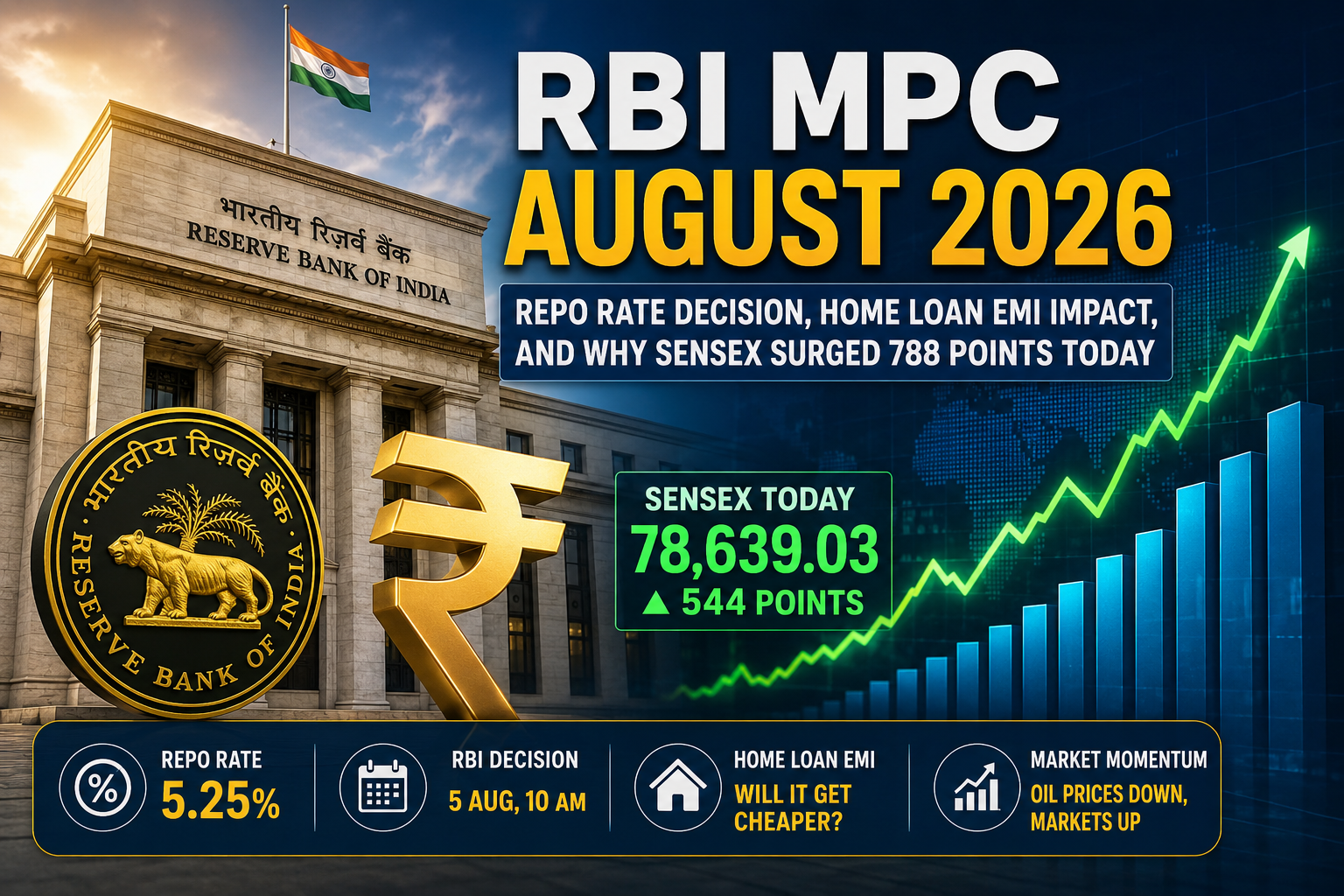

RBI MPC August 2026: Repo Rate Decision, Home Loan EMI Impact, and Why Sensex Surged 788 Points Today

Two big financial stories are colliding this week, and if you're an Indian investor, homeowner, or borrower, both directly affect your money. The Reserve Bank of India's Monetary Policy Committee (MPC) began its three-day meeting today, August 3, with Governor Sanjay Malhotra set to announce the repo rate decision on August 5 — and in the same 24 hours, the Sensex opened up a striking 788.7 points (10.09%) before settling to a 544-point gain, driven by a sharp fall in crude oil prices. We're covering both together here because they're not actually separate stories — the same macro backdrop of easing oil prices, contained inflation, and geopolitical uncertainty is shaping both the RBI's thinking and today's market move.
What's Happening With the RBI MPC Meeting This Week
The RBI's six-member Monetary Policy Committee meets six times a year to review the repo rate — the rate at which the central bank lends to commercial banks, which cascades down into home loan, personal loan, and business lending rates across the economy. This particular meeting runs from August 3 to August 5, 2026, with the policy resolution and Governor's press conference scheduled for 10 AM and 12 PM respectively on Wednesday, streamed live on RBI's official website, YouTube channel, and X handle.
The overwhelming consensus among economists tracking this meeting is a fourth consecutive pause at 5.25% — the same level the RBI has held since executing three back-to-back holds through February, April, and June 2026, following a cumulative 125 basis point rate-cutting cycle through 2025. The ongoing West Asia conflict, elevated (though now easing) crude oil prices, and a cautious global monetary environment are the primary reasons the MPC is expected to hold rather than cut.
| MPC Meeting | Decision | Repo Rate After |
|---|---|---|
| February 2026 | Hold | 5.25% |
| April 2026 | Hold | 5.25% |
| June 2026 | Hold | 5.25% |
| August 2026 (expected) | Hold (consensus view) | 5.25% |
Alongside the headline rate, the RBI is expected to maintain its FY27 GDP growth forecast around 6.6% while preserving policy flexibility through a "neutral" stance — meaning it isn't signalling a clear future direction (up or down) and wants to stay fully data-dependent. The standing deposit facility (SDF) rate has been sitting at 5% and the marginal standing facility (MSF)/bank rate at 5.5%, and most economists don't expect movement there either.
What This Means for Your Home Loan EMI
This is the part that actually matters for most readers checking this article, so let's be direct about the math. The repo rate doesn't set your home loan rate directly, but it heavily influences the cost of funds for banks, which feeds into repo-linked lending rates for floating-rate borrowers.
Consider a ₹50 lakh home loan over 20 years at 8.00% interest — the EMI works out to roughly ₹41,822/month. If the RBI had cut the repo rate by 25 basis points and your bank passed that through to a 7.75% lending rate, the same EMI would drop to around ₹41,022/month — a saving of about ₹800/month, or roughly ₹9,600/year. With a hold expected instead, existing borrowers shouldn't see any change either way this cycle, which — depending on how you look at it — is either "no relief" or "no fresh burden," since a hold also means your current EMI stays exactly where it is rather than rising.
For readers actively tracking this, our 20-30-40 rule for home loans and repo rate cut EMI impact guide both walk through the mechanics of how and when repo-linked rate changes actually show up in your monthly payment — the transmission typically takes 1-3 months depending on your lender's reset cycle, not immediately on announcement day.
Why Sensex Jumped 788 Points at the Open Today
Separately from the RBI story, markets opened today's session sharply higher. The BSE Sensex gained 788.7 points to open at 78,883.34, while the Nifty 50 added 189.1 points to open at 24,572.70 — before settling through the day to close up a still-strong 544.39 points at 78,639.03. The trigger was the same one we flagged in our coverage of last week's oil-driven rebound: crude oil prices falling sharply after the United States refrained from launching fresh military strikes on Iran, easing the geopolitical risk premium that had been weighing on markets.
| Index | Previous Close | Today's Open | Move |
|---|---|---|---|
| Sensex | 78,094.64 | 78,883.34 | +788.7 pts (10.09%)* |
| Nifty 50 | 24,383.60 | 24,572.70 | +189.1 pts |
| BSE Midcap Select | — | — | +123.12 pts |
| BSE Smallcap Select | — | 8,837.07 | +33.45 pts (0.38%) |
*Note: the 10.09% figure reflects the reported point-gain percentage at the day's opening tick; the index settled to a more moderate 0.7% gain (544.39 points) by close.
Bank Nifty, meanwhile, continued to consolidate around the 57,000 mark, forming its third consecutive high-wave candle — a pattern that reflects stock-specific positioning rather than a broad directional move, according to market commentary. Brent crude itself declined roughly 5% intraday before recovering slightly to settle near $84.50 a barrel, with continued uncertainty stemming from conflicting statements out of Washington and Tehran on the state of talks.
A New Wrinkle: SEBI's Closing Auction Session (CAS)
Adding a layer of near-term caution to an otherwise positive setup, the newly implemented Closing Auction Session (CAS) mechanism has prompted traders to stay alert to potential increased volatility, particularly around the market close. This is a fresh structural change to how the final minutes of trading are conducted, and until traders and algorithms fully adapt to the new mechanism, some analysts expect choppier price action specifically in the closing window — worth knowing if you place orders near market close.
Where Technical Resistance Sits From Here
Beyond today's specific move, market technicians are watching a well-defined range on the Nifty. Bajaj Broking Research noted that the index bias remains positive, with dips seen as buying opportunities toward short-term resistance in the 24,500-24,600 zone — the confluence of the July and April 2026 highs. A confirmed breakout above that zone would open a fresh move toward 24,800 and eventually 25,000 in the coming weeks. On the downside, immediate support sits in the 24,100-24,200 range, with a stronger support base between 24,000 and 23,800, reinforced by the 50-day exponential moving average and a rising trendline connecting previous major lows.
We'd flag this technical picture the same way we did in our previous oil-crash rebound coverage — a positive setup isn't the same as a guaranteed one. Event risk is genuinely elevated this week between the RBI decision, ongoing geopolitical headlines, and the new CAS mechanism, and as one SEBI-registered analyst put it, a stock-specific approach with disciplined risk management is the preferred strategy in this kind of environment rather than aggressively chasing the index.
How These Two Stories Connect
It's worth stepping back and asking why the RBI decision and today's market move are happening in the same window — because it's not a coincidence. Both are downstream of the same set of forces: easing crude oil prices reduce India's import bill and inflation pressure (supporting the RBI's case for continued policy stability rather than urgent tightening), while the same oil relief is directly lifting equity sentiment through lower input costs for fuel-sensitive sectors and improved macro confidence.
This is also earnings season, and strong Q1 FY27 corporate results are cited by multiple analysts as a key reason the "healthy domestic macros" argument is holding up even with global uncertainty in the background. Markets rarely move on a single factor, and this week is a clean example of three threads — monetary policy, commodity prices, and corporate earnings — pulling in a broadly similar direction at the same time.
What Small Businesses and Sellers Should Also Watch This Week
If you're running a small business or e-commerce operation rather than just tracking the index, this week's macro backdrop has practical relevance beyond the headline numbers. Stable interest rates mean stable borrowing costs for working capital, which matters if you're managing inventory financing. Separately, if you're an online seller navigating the compliance side of your business, our guide on how GST 2.0 is affecting e-commerce sellers is worth reviewing alongside this week's macro picture, since GST changes and interest-rate stability together shape the real cost structure small sellers are operating under right now.
IT-sector readers should also keep half an eye on a separate, US-driven headwind running in parallel to this domestic story — our coverage of the H-1B $100K visa fee's impact on Indian IT stocks is directly relevant if your portfolio has meaningful IT-sector weight, since that policy pressure is unrelated to, and currently running alongside, this week's more favourable domestic macro setup.
What to Do With This Information as an Investor
We'd resist the urge to treat either story as a reason for a dramatic portfolio move. A rate hold is the widely expected, already-priced-in outcome — the market has largely built this into current valuations, so the bigger signal to actually watch on August 5 isn't the rate itself but the RBI's commentary on inflation, crude oil, and external risks, since forward guidance tends to move markets more than an already-anticipated hold does.
On the equity side, today's bounce is genuinely broad-based and tied to a real macro tailwind (falling oil), but the technical resistance zone at 24,500-24,600 is a real level, not a formality — a confirmed break above it matters more than any single day's point gain. If you're managing your own trading activity through periods like this, remember that gains realised now still need to be reported correctly — our ITR-4 investment disclosure calculator is worth using well ahead of filing season rather than scrambling to reconstruct a volatile trading week's transactions months later.
Frequently Asked Questions
RBI Governor Sanjay Malhotra will announce the Monetary Policy Committee's decision on Wednesday, August 5, 2026, at 10 AM, with a post-policy press conference at 12 PM, streamed live on RBI's official website, YouTube channel, and X handle.
No. The overwhelming consensus among economists is that the RBI will hold the repo rate unchanged at 5.25% for a fourth consecutive meeting, citing inflation above the medium-term target, elevated crude oil prices, and ongoing geopolitical uncertainty in West Asia.
If the repo rate holds as expected, existing floating-rate home loan EMIs should not change. A 25 basis point cut, if it had occurred, would have reduced the EMI on a ₹50 lakh, 20-year loan by roughly ₹800/month, but that outcome is not the base-case expectation for this meeting.
The Sensex opened up 788.7 points and closed up 544.39 points, driven by a sharp fall in crude oil prices after the United States refrained from launching fresh military strikes on Iran, easing the geopolitical risk premium in oil markets.
The Closing Auction Session is a newly implemented mechanism affecting how the final minutes of trading are conducted. Traders are exercising increased caution around potential volatility during the closing window as the market adapts to the new process.
Analysts point to the 24,500-24,600 zone as the key short-term resistance level, representing the confluence of the July and April 2026 highs. A confirmed breakout above this zone could open a move toward 24,800 and 25,000 in the coming weeks.
The repo rate has stood at 5.25% since the RBI's June 2026 policy review, following three consecutive holds through February, April, and June 2026 after a cumulative 125 basis point rate-cutting cycle in 2025.
The RBI's Monetary Policy Committee holds six bi-monthly meetings each financial year, with each meeting typically spanning three days before the policy resolution is announced by the Governor.
Related Reading on Play With Stock
- RBI Repo Rate Cut 2026: Home Loan EMI Impact
- Sensex Nifty Rebound: Oil Crash July 2026
- Oil Price Crash 2026: India Impact
- The 20-30-40 Rule for Home Loans
- Nifty 50 and Sensex Explained
- Q1 FY27 Earnings Calendar
- What Is the Strait of Hormuz: India Impact
- GST 2.0 Impact on E-commerce Sellers
- H-1B $100K Visa Fee Impact on Indian IT Stocks
- ITR-4 Investment Disclosure Calculator
- Behavioral Mistakes in Stock Trading
- Dollar Index (DXY) Explained
- What Is Sector Rotation
- US-Iran Tension: Impact on Indian Stock Market
Official & External Sources
- Reserve Bank of India (RBI)
- National Stock Exchange (NSE)
- Bombay Stock Exchange (BSE)
- Securities and Exchange Board of India (SEBI)
- U.S. Energy Information Administration (EIA)
- Business Standard — Finance News
- Goodreturns — Market Updates
- Moneycontrol — Markets Data
- The Economic Times — Markets
- ICRA Ratings

Pranab Barman is a Financial Educator and Personal Finance Researcher with over 10 years of hands-on experience in stock markets, trading, and investing. Currently enrolled in the CFA Program, he is committed to continuous learning and professional excellence in finance.
As the Founder of PlayWithStock, Pranab covers a wide range of topics including Mutual Funds, SIP, Taxation, Stock Market Basics, and Financial Calculators — with a focus on simplifying complex financial concepts for everyday all investors.
Email: support@playwithstock.com
Website: playwithstock.com
Related posts:
 RBI MPC August 2026: 5 Key Things to Watch Before the Repo Rate Decision
 RBI Repo Rate Cut 2026: The Complete Home Loan EMI Guide
 TCS Q1 FY27 Results: Profit Rises 5%, Sensex Jumps 828 Points
 Sensex Jumps 550 Points, Nifty Reclaims 23,900 as Crude Oil Crashes on US-Iran De-Escalation: What Changed Today
 Gold Loan NBFC Sector Deep Dive 2026: Why Muthoot, Manappuram and IIFL Finance Are India’s Quietest Investment Story
 Fed Rate Hike 2026: Why the July 28-29 FOMC Meeting Could Change Everything
 Free STT Hike Breakeven Calculator 2026 — see exactly how much extra STT the Budget 2026 hike adds to your F&O trades and how many points you now need to break even.
 Crude Oil Crosses $100: What the Iran-Israel-US War Means for Your Petrol Price, EMI & Stock Portfolio