


Gold Loan NBFC Sector Deep Dive 2026: Why Muthoot, Manappuram and IIFL Finance Are India's Quietest Investment Story

There's a category of Indian NBFC that almost never makes front-page business news, doesn't get discussed at dinner parties the way IT or banking stocks do, and yet has quietly compounded investor wealth for over a decade while growing faster than nearly every other lending segment in the country. That's the gold loan business — and in 2026, it's having its loudest year yet, even though most retail investors still barely understand how the model actually works. We spent time going through recent RBI circulars, quarterly filings, and rating agency reports to put together what we think is a genuinely useful, non-generic explanation of this sector — not just another "top gold loan stocks" listicle.
- 1. What Actually Is a Gold Loan NBFC
- 2. The 2026 Numbers: How Big Has This Sector Gotten
- 3. The Big Three — Muthoot, Manappuram, IIFL Finance
- 4. RBI's New LTV Rules and What They Change
- 5. Why the Sector Is Growing So Fast Right Now
- 6. The Risk Side Nobody Talks About Enough
- 7. Banks vs NBFCs vs Fintechs in Gold Lending
- 8. Valuation Snapshot: Are These Stocks Still Cheap
- 9. Who Should Actually Consider This Sector
- 10. Our Take
- 11. FAQs
1. What Actually Is a Gold Loan NBFC
A gold loan NBFC is a non-banking financial company whose core business is lending money against pledged household gold — mostly jewellery — rather than property, salary slips, or business cash flows. You walk in with your gold, an in-house appraiser assesses its purity and weight, the branch offers you a loan against a percentage of that assessed value, and you walk out with cash — often within 30-45 minutes. Your gold sits in the branch's vault until you repay, at which point you get it back exactly as you left it.
What makes this model genuinely different from most other lending categories covered on Play With Stock is the collateral itself. Unlike a home loan, where the underlying asset (property) is illiquid and can take months to seize and sell in a default, gold is instantly liquid, has a transparent daily market price, and can be auctioned within days if a borrower genuinely defaults. That single structural fact is why gold loan NBFCs post asset quality numbers that most unsecured lenders would kill for.
India is uniquely positioned for this business to exist at scale in the first place. According to the World Gold Council, Indian households are estimated to be sitting on more than 25,000 tonnes of gold — worth somewhere in the neighbourhood of ₹160 lakh crore at current prices — and only around 4.3% of that has ever been pledged for a loan. That gap between "gold owned" and "gold monetised" is, in plain terms, the entire growth runway for this sector.
2. The 2026 Numbers: How Big Has This Sector Gotten
The scale of growth here genuinely surprised us when we pulled the numbers together. The organised gold loan market — banks plus NBFCs combined — stood at roughly ₹4 lakh crore in 2025, and CRISIL Ratings now projects it crossing ₹4 trillion (well beyond that) by March 2027, with gold-loan NBFCs specifically expected to compound at close to 40% CAGR between FY25 and FY27.
| Metric | Figure | Period |
|---|---|---|
| Organised gold loan market (banks + NBFCs) | ~₹15-19 lakh crore | Nov 2025 – March 2026 |
| Gold-loan NBFC projected CAGR | ~40% | FY25–FY27 |
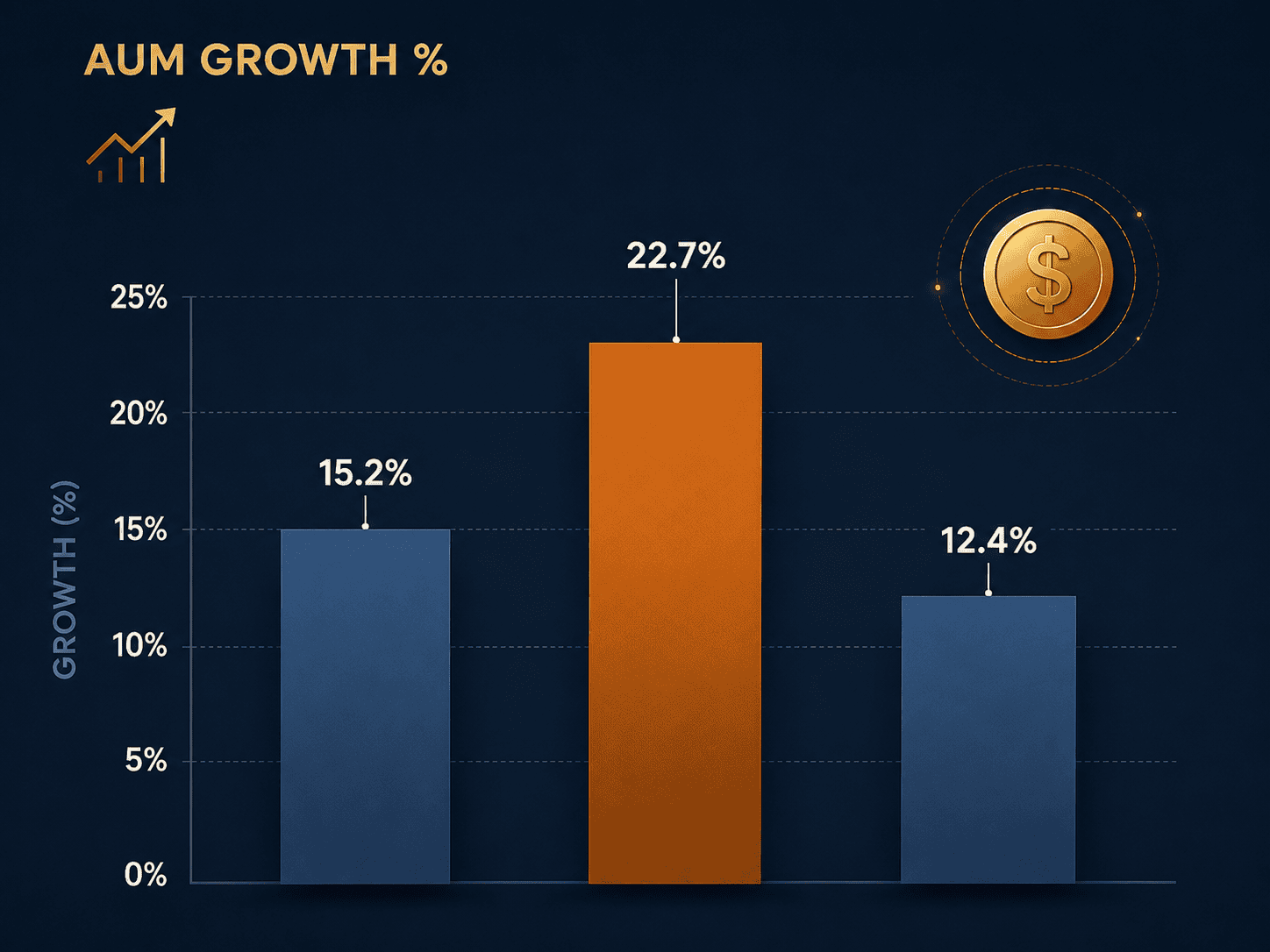
| Muthoot Finance AUM growth | +51% YoY, ₹1.47 lakh crore | Q3 FY26 |
| Manappuram Finance AUM growth | +56.8% YoY | Q3 FY26 |
| Household gold pledged (penetration) | ~4.3% of total holdings | 2025 estimate |
To put that Muthoot number in context — a 51% year-on-year AUM jump for a company that's already the largest player in its category is not a small-base illusion. This is genuinely one of the fastest-growing large lending books in the country right now, and it's happening in a segment most retail investors associate with roadside pawn shops rather than a sophisticated, RBI-regulated lending machine.
3. The Big Three — Muthoot, Manappuram, IIFL Finance
Muthoot Finance — The Category Leader
Muthoot remains India's largest gold loan financier by a wide margin, with a gold AUM in the region of ₹88,000 crore–₹1.47 lakh crore depending on which quarter's filing you're looking at, spread across more than 5,600 branches. Its net interest margin sat around 12.8% in Q3 FY26 — a genuinely strong number for a secured lending book. What we'd flag for anyone researching the stock: Muthoot's average loan size is close to ₹78,000, its average tenure runs about 7.2 months, and its typical branch disbursement time is around 35 minutes — this is a high-velocity, high-turnover retail lending machine, not a slow-moving corporate lender, and that changes how you should think about its earnings cyclicality.
Manappuram Finance — The Faster Grower, Higher Multiple
Manappuram posted even faster AUM growth than Muthoot in Q3 FY26 (56.8% YoY) and reported a gold-loan segment NIM around 18.5% — notably higher than Muthoot's. The market has rewarded that growth with a materially richer valuation; Manappuram's P/E has traded anywhere from the mid-60s to high-60s through early-to-mid 2026, versus Muthoot sitting closer to a 16-20x range across the same period. We'd be cautious about reading Manappuram's higher multiple as simply "better company" — it also reflects a market pricing in continued outsized growth, which raises the bar for what the company needs to deliver each quarter to avoid disappointing.
IIFL Finance — The Recovery Story
IIFL Finance is a slightly different animal — a multi-product NBFC where gold loans are the largest single segment, alongside home loans, business loans, and digital lending. It's worth remembering that IIFL faced RBI regulatory action on its gold loan sourcing practices in April 2024, which briefly halted its gold lending business entirely. That chapter has since been resolved and growth has resumed, with gold AUM expansion back in the 20-25% range — but it's a useful reminder that regulatory risk in this sector isn't hypothetical, and we'll come back to that in the risks section.
CSB Bank — The Bank With an NBFC-Like Concentration
CSB Bank deserves a mention even though it's technically a bank, not an NBFC, because roughly half of its entire ₹30,000 crore loan book is gold loans — the highest concentration of any bank in the country. Its gold-loan-specific NIM runs 4.5-5%, above sector average for the banking side, and its Kerala-based Catholic and Christian community banking relationships give it an unusually stable low-cost deposit (CASA) base to fund that lending.
4. RBI's New LTV Rules and What They Change
This is the single most important regulatory development in the sector for 2026, and it's worth understanding properly rather than just knowing it happened. Historically, most lenders capped loan-to-value (LTV) at a flat 75% of assessed gold value across the board. Effective April 2026, the RBI moved to a tiered LTV structure instead:
| Loan Amount | Maximum LTV |
|---|---|
| Up to ₹2.5 lakh | 85% |
| ₹2.5 lakh – ₹5 lakh | 80% |
| Above ₹5 lakh | 75% |
In practical terms, this is actually good news for the majority of ordinary borrowers, since most retail gold loans in India fall well under the ₹2.5 lakh bracket — meaning most borrowers can now access more cash against the same quantity of gold than before. For the NBFCs themselves, the change cuts two ways: it should help expand loan volumes at the smaller end of the book (which is where Muthoot and Manappuram do the bulk of their business), but it also raises the price risk they're carrying, since a higher LTV on smaller loans means a smaller cushion if gold prices fall sharply before a loan matures.
The RBI has also simplified compliance for smaller gold loan NBFCs — companies with assets under ₹1,000 crore that neither accept public deposits nor plan to convert to a deposit-taking model are now exempt from certain registration requirements, and prior approval requirements for branch expansion have been eased. This is a meaningful tailwind for growth-stage players trying to scale branch networks quickly, similar in spirit to how easier compliance has helped other lending categories we've covered, like the 8th Pay Commission-related banking activity or general EPF administrative simplifications.
5. Why the Sector Is Growing So Fast Right Now
Three forces are converging at the same time, and it's worth separating them because they don't all have the same durability.
First, gold prices are elevated. With spot prices running around ₹1.6 lakh per 10 grams through early-to-mid 2026, the same physical quantity of household gold now unlocks a meaningfully larger loan than it did even two years ago. This is arguably the single biggest driver of AUM growth in the sector right now, and it's directly tied to how our own gold price all-time high coverage and gold price correction analysis connect to this story — a rising gold price doesn't just make gold owners richer on paper, it directly expands the addressable lending market for these NBFCs.
Second, there's a structural shift from unsecured to secured lending. Tighter regulatory norms on unsecured personal loans and consumer credit over the past couple of years have pushed both lenders and borrowers toward secured alternatives, and gold loans sit right in that sweet spot — fast, simple, secured, and requiring no income proof or credit history check, which matters enormously for India's large self-employed and informal-income population.
Third, formalisation is still in its early innings. Remember that 4.3% penetration figure from earlier — the overwhelming majority of India's household gold has never been used as loan collateral through a formal, regulated channel. Every percentage point of that gap closing represents genuine, durable AUM growth for organised players, independent of what gold prices do in any given year. This is the growth driver we'd weight most heavily for a long-term thesis, since it doesn't depend on gold prices staying elevated forever.

6. The Risk Side Nobody Talks About Enough
We'd be doing readers a disservice if we only presented the growth story without being equally direct about what can go wrong, because most sector content online is written by people trying to sell you a demat account opening, not people who actually want you to make a well-informed decision.
Gold price correction risk
Every gold loan NBFC's book is, at its core, a leveraged bet on gold prices staying stable or rising. If spot gold falls sharply — say 15% or more — after a loan has been disbursed, the lender's collateral cushion shrinks fast, and margin calls or forced auctions can follow. Given how much of the current AUM growth is itself a function of elevated gold prices, a sharp correction doesn't just hurt asset quality — it can simultaneously slow new loan origination, creating a double hit to growth.
Valuation risk in the higher-multiple names
Manappuram trading north of 60x earnings for a chunk of 2026 is not a typical NBFC valuation by any historical standard, and we saw a preview of what happens when growth expectations wobble — Muthoot Finance fell over 11% in a single session on 13 February 2026 following its earnings report, despite the underlying growth numbers still looking strong on paper. That's a useful real-world reminder that in a sector trading at premium multiples, even a "good but not spectacular enough" quarter can trigger a sharp re-rating.
Regulatory risk is real, not theoretical
IIFL Finance's 2024 regulatory action on gold loan sourcing practices — which temporarily froze its entire gold lending business — is exactly the kind of event that can hit any player in this space with little warning. The RBI has shown it's willing to act decisively on sourcing, documentation, and evergreening practices in this sector, and investors should treat this as an ongoing risk factor, not a one-off event specific to one company.
Concentration risk
For a company like CSB Bank, where gold loans make up half the entire book, or for Muthoot and Manappuram where gold lending is essentially the whole business, there's very little diversification cushion if this specific asset class runs into trouble simultaneously across price, regulation, and credit quality.
7. Banks vs NBFCs vs Fintechs in Gold Lending
The competitive landscape here has genuinely gotten more interesting over the past year, and it's not just the traditional NBFC-versus-bank dynamic anymore.
| Lender Type | Strength | Best Suited For |
|---|---|---|
| Banks (SBI, HDFC, ICICI) | Lowest interest rates, higher trust | Borrowers with stable income wanting the cheapest long-term rate |
| NBFCs (Muthoot, Manappuram, IIFL) | Speed — cash in under 20-30 minutes, dense branch networks | Tier-2/Tier-3 city borrowers needing urgent cash |
| Fintechs (Rupeek, Indiagold, Oro Money) | Doorstep appraisal, "phygital" model, bank-linked rates | Metro-city borrowers wanting convenience without a branch visit |
What's notable in 2026 is how much these lines are blurring — traditional NBFCs are launching slicker apps and doorstep services to compete with fintechs, while fintechs like Rupeek are increasingly partnering directly with banks to offer bank-grade rates with fintech-grade convenience. For anyone evaluating these stocks as an investment rather than just as a borrower, this blurring matters — it means the moat that pure-play gold loan NBFCs have historically enjoyed (branch density and speed) is under gradual, structural pressure, even as overall market growth remains strong.
8. Valuation Snapshot: Are These Stocks Still Cheap
Muthoot Finance, trading at roughly 16-20x earnings and around 5.1x book value through 2026, doesn't scream "cheap" by classic value-investing standards, but relative to its growth rate (51% AUM growth is not a typo) and its net interest margins, a lot of analysts would argue it's still reasonably priced for the growth on offer. Manappuram, at a P/E north of 60x for stretches of the year, is a different conversation entirely — that valuation only makes sense if growth continues to accelerate or at least hold at current elevated levels for several more years, which is a much higher bar to clear.
We'd encourage readers to think about this the way we'd frame any high-growth financial stock — refer back to our broader framework in common behavioral mistakes in stock trading before assuming a high-growth NBFC narrative alone justifies any price. A useful sanity check: compare each company's price-to-book against its return on equity, rather than looking at the P/E in isolation, since lending businesses are fundamentally book-value-driven, not just earnings-driven.
9. Who Should Actually Consider This Sector
Gold loan NBFC stocks tend to suit investors comfortable with cyclical, commodity-price-linked exposure inside their broader equity allocation — not as a core defensive holding, despite the "secured lending" label sometimes giving that impression. If you already hold physical gold or gold ETFs as an inflation hedge, adding gold loan NBFC equity exposure on top effectively doubles down on the same underlying commodity trend, which is worth being deliberate about rather than accidental.
For readers newer to sector-specific stock investing generally, it's worth first working through our beginner investing fundamentals guide and understanding how sector rotation works before allocating meaningfully to a single-theme play like this one. This isn't a sector we'd suggest as someone's first individual stock purchase.
10. Our Take
The gold loan NBFC sector is, in our honest reading of the data, one of the more genuinely durable growth stories in Indian financial services right now — underpinned by a real structural gap (that 4.3% penetration number) rather than purely speculative momentum. But "durable growth story" and "cheap stock at any price" are two very different claims, and 2026's valuation spread between Muthoot and Manappuram shows the market is already pricing that distinction in. We'd treat this as a sector worth understanding deeply and watching closely, with position sizing that respects both the commodity-price sensitivity and the regulatory risk that's already shown up once with IIFL Finance and could resurface elsewhere.
11. Frequently Asked Questions
Muthoot Finance remains India's largest gold loan financier by AUM, operating over 5,600 branches with a gold AUM in the ₹88,000 crore to ₹1.47 lakh crore range depending on the reporting quarter.
Effective April 2026, RBI introduced tiered LTV limits: 85% for loans up to ₹2.5 lakh, 80% for loans between ₹2.5-5 lakh, and 75% for loans above ₹5 lakh — replacing the earlier flat 75% cap across all loan sizes.
Manappuram has traded at a significantly higher P/E (often 60x+) than Muthoot Finance (typically 16-20x) through 2026, reflecting the market pricing in faster growth expectations. Whether that premium is justified depends on Manappuram sustaining its higher AUM growth rate, which carries real execution risk.
RBI took regulatory action against IIFL Finance in April 2024 over gold loan sourcing practices, temporarily halting the company's gold lending operations. The issue was subsequently resolved, and gold AUM growth has since resumed in the 20-25% range.
Approximately 4.3% of India's estimated 25,000+ tonnes of household gold has been pledged for loans, according to World Gold Council estimates — indicating substantial untapped growth potential for organised gold lenders.
A sharp correction in gold prices is the most direct risk, since it can simultaneously reduce collateral value on existing loans (triggering margin calls) and slow new loan disbursement, since elevated gold prices are a key driver of current AUM growth.
Generally yes. NBFCs like Muthoot and Manappuram are known for rapid disbursement — often within 20-45 minutes — due to dense branch networks and in-house gold appraisal, whereas banks typically offer lower interest rates but a comparatively slower process.
CRISIL Ratings projects the organised gold loan market crossing ₹4 trillion by March 2027, with gold-loan NBFCs specifically expected to grow at approximately 40% CAGR between FY25 and FY27.
Related Reading on Play With Stock
- Gold Price All-Time High India 2026
- Gold Price Correction 2026: What Indian Investors Should Know
- Gold ETF vs Physical Gold
- Gold Price Prediction Diwali 2026
- Silver Price Surge 2026
- What Is Sector Rotation
- Behavioral Mistakes in Stock Trading
- Beginner Investing: Complete Guide
- RBI Repo Rate Cut 2026: Home Loan EMI Impact
- FII vs DII Explained
- HDFC, ICICI, Axis, Kotak Bank Q1 FY27 Results
- Index Funds vs Active Funds India
Official & External Sources
- Reserve Bank of India (RBI)
- CRISIL Ratings
- World Gold Council
- Muthoot Finance — Official Investor Relations
- Manappuram Finance — Official Website
- IIFL Finance — Official Website
- CSB Bank — Official Website
- National Stock Exchange (NSE) — Official Website
- Bombay Stock Exchange (BSE) — Official Website
- Securities and Exchange Board of India (SEBI)
- ICRA Ratings
- CARE Ratings
- Moneycontrol — Markets Data
- The Economic Times — Markets
- Business Standard — Markets

Pranab Barman is a Financial Educator and Personal Finance Researcher with over 10 years of hands-on experience in stock markets, trading, and investing. Currently enrolled in the CFA Program, he is committed to continuous learning and professional excellence in finance.
As the Founder of PlayWithStock, Pranab covers a wide range of topics including Mutual Funds, SIP, Taxation, Stock Market Basics, and Financial Calculators — with a focus on simplifying complex financial concepts for everyday all investors.
Email: support@playwithstock.com
Website: playwithstock.com
Related posts:
 Jio Financial vs Bajaj Finance vs HDFC AMC: Which is the Better Investment in 2026?
 BFSI Sector Analysis 2026: Banking, NBFC & Insurance Outlook
 How to Invest in Gold ETF: The Complete Gold ETF vs Physical Gold Guide
 Stocks to Buy After India-US Trade Deal 2026: A Sector-by-Sector Breakdown
 Gold Price Prediction Diwali 2026: Will Gold Recover After the Correction?
 PSU Bank Stocks Sector Analysis: Why They Outperformed in 2025-26
 SK Hynix ADR Premium 2026: The Ajab Arbitrage Story Everyone’s Watching
 Defense Sector Stocks India: Complete Analysis 2026