
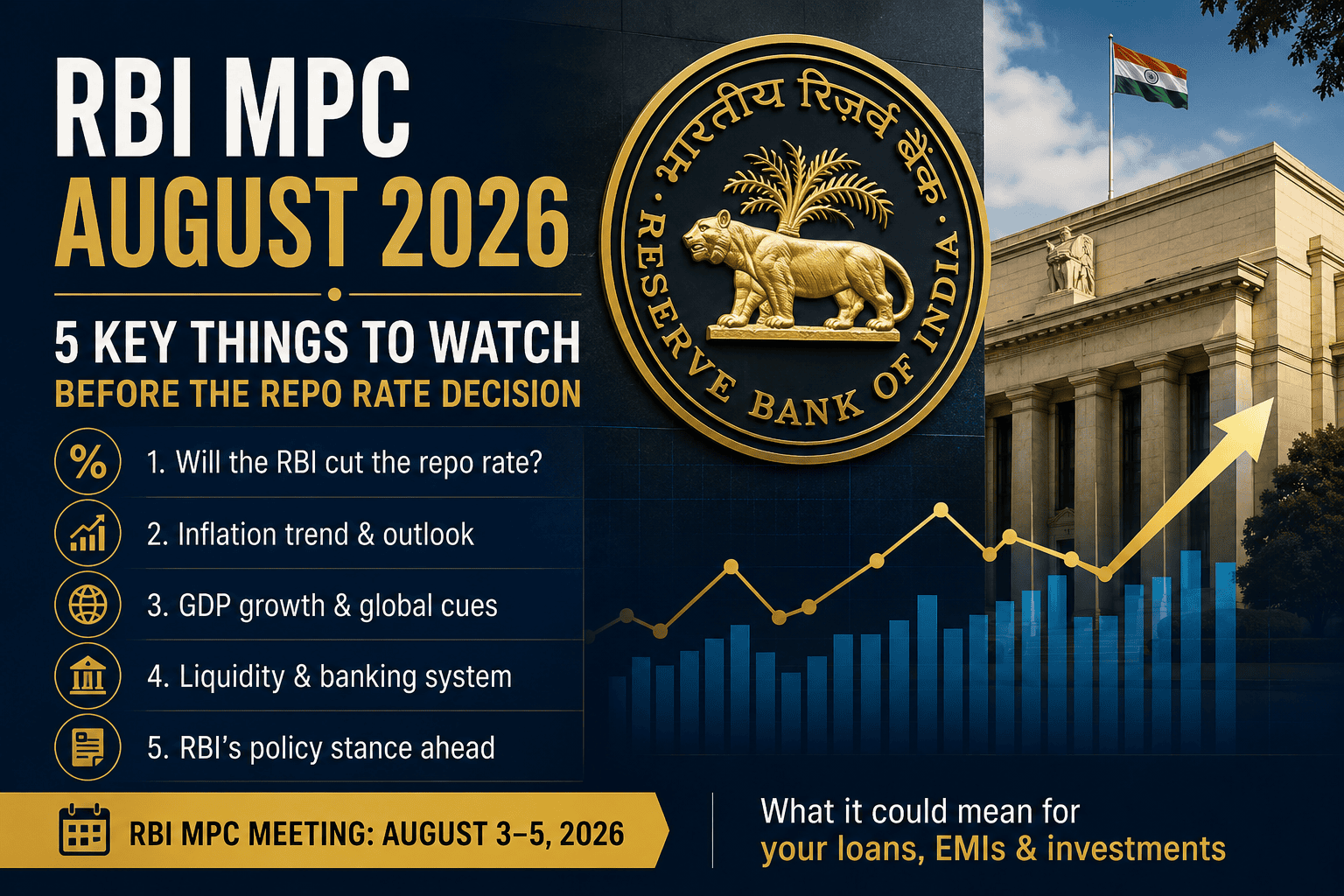

RBI MPC August 2026: 5 Key Things to Watch Before the Repo Rate Decision
RBI MPC August 2026 meeting is scheduled for August 3 to 5, and this time the room feels a little less predictable than the last three sittings. The repo rate has sat still at 5.25% since February, which is the kind of quiet stretch that makes borrowers nervous and FD holders comfortable in equal measure. We track this meeting every two months for Play With Stock readers because the outcome touches almost everything else we write about — home loan EMIs, FD rates, the rupee, and even how Nifty and Sensex trade in the days that follow.
This isn't a policy textbook. We've tried to write this the way we'd explain it to a friend who has a home loan, some money in an FD or a SIP, and fifteen minutes before a meeting to actually understand what's on the table.

Table of Contents
- What Exactly Is the MPC Meeting
- Where the Repo Rate Stands Going Into August
- 5 Things That Will Decide the RBI MPC August 2026 Outcome
- Three Possible Scenarios
- What This Means for Your Money
- How the Stock Market Usually Reacts
- RBI Repo Rate: Last 12 Months at a Glance
- How to Prepare Before August 5
- Frequently Asked Questions
What Exactly Is the MPC Meeting
The Monetary Policy Committee is a six-member panel — three from the RBI and three external economists appointed by the government — that meets roughly every two months to set the repo rate, which is the rate at which the RBI lends short-term money to commercial banks. When this number moves, home loan EMIs, FD rates, and even how freely banks lend to businesses tend to move with it, sometimes within days.
The committee doesn't vote in isolation. Every meeting weighs inflation data from the Ministry of Statistics and Programme Implementation (MoSPI), GDP numbers released through the Press Information Bureau, the health of the rupee, and increasingly, what's happening in the US and global oil markets. You can read the RBI's own explanation of the MPC's mandate on the Reserve Bank of India's official press release page, and the committee's formal minutes are published a fortnight after every meeting on the RBI's Monetary Policy Committee minutes page.
Where the Repo Rate Stands Going Into August
Repo Rate Snapshot — July 2026
| Current Repo Rate | 5.25% |
| Standing Deposit Facility (SDF) | 5.00% |
| Marginal Standing Facility (MSF) / Bank Rate | 5.50% |
| Cash Reserve Ratio (CRR) | 3.00% |
| Policy Stance | Neutral |
| Meeting Dates | August 3–5, 2026 |
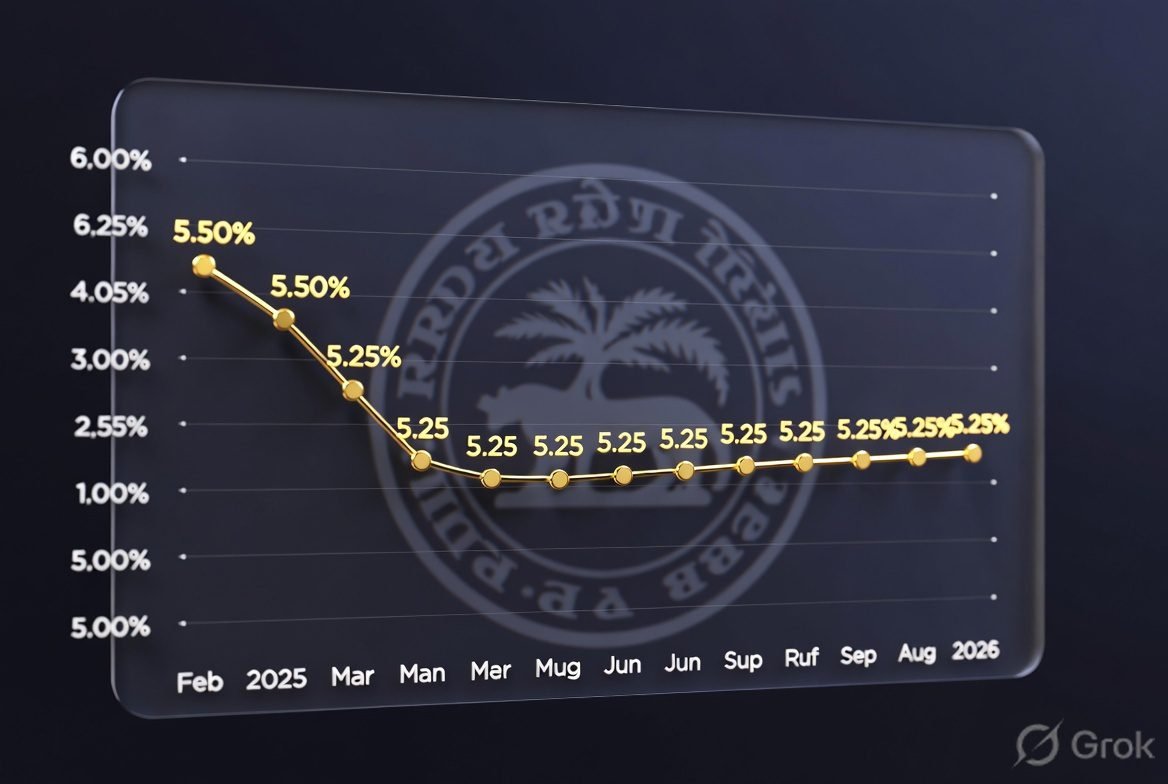
As of June 2026, the RBI repo rate stood at 5.25%, with the Monetary Policy Committee keeping it unchanged while maintaining a neutral policy stance, a figure also tracked independently by Trading Economics' India interest rate database and explained in plain terms by ClearTax's repo rate guide. That's actually the third consecutive hold at its June 5, 2026 meeting, which tells you the committee is comfortable sitting on its hands unless something forces its move. Investopedia's definition of repo rate is a useful primer if you're new to this term.
Inflation is a big part of why. The RBI's own commentary in February pointed to a slight upward revision in the inflation outlook for the first two quarters of FY27, driven largely by rising prices of precious metals — which lines up with what we've already covered in our piece on the gold price hitting all-time highs in India and the follow-up on the gold price correction that followed. You can track the raw CPI inflation series yourself through the RBI's Database on Indian Economy (DBIE), or the monthly release direct from MoSPI's Consumer Price Index page.
5 Things That Will Decide the RBI MPC August 2026 Outcome
1. Inflation Trajectory Heading Into FY27
The RBI's own projection puts CPI inflation for the first quarter of FY27 near 4%, revised up slightly from December's estimate. That's still comfortably inside the RBI's 2-6% target band, but the direction matters more than the absolute number to a committee that just spent over a year bringing inflation down from elevated levels.
2. The Monsoon and Food Prices
A below-normal or erratic monsoon pushes vegetable and pulses prices up almost immediately, and that shows up in the very next CPI print. We wrote about this exact link in our piece on how the 2026 monsoon is shaping India's inflation outlook — it's one of the few genuinely unpredictable inputs the MPC has to work around every year.
3. GDP Growth Momentum
The RBI has projected FY27 GDP growth at 6.6%, assuming a normal monsoon and stable global conditions, after FY26 growth was revised up to 6.8% on the back of strong consumption, investment, GST 2.0, and better credit flow. This is broadly in line with the IMF's India country outlook and the World Bank's India economic overview, both of which have flagged India as one of the faster-growing major economies through 2026. A committee sitting on a neutral stance with growth already this healthy has very little reason to cut just for the sake of stimulus.
4. Global Cues — the Fed, Oil, and Geopolitics
Domestic rate decisions don't happen in a vacuum. What the US Federal Reserve signals at its own meetings directly affects capital flows into Indian markets, and we track that separately in our Fed rate and FOMC watch article. Crude oil is the other wildcard — geopolitical flashpoints around the Strait of Hormuz and broader US-Iran tensions can spike import costs for an oil-dependent economy like India almost overnight, which we also broke down when oil prices swung sharply earlier this year. Global crude benchmarks are tracked live on OilPrice.com's crude charts, while the US Federal Reserve's own rate decisions and statements are published directly on the Federal Reserve's monetary policy page.
5. Rupee Stability and Trade Deal Developments
The rupee's movement against the dollar directly feeds into imported inflation, and it's been a live story all year — see our explainer on the rupee vs dollar in July 2026 and the underlying mechanics in our Dollar Index (DXY) explained piece. Progress on the India-US trade deal and the India-UK CETA agreement both influence how confident the RBI feels about the external environment, and that confidence shows up in the tone of the policy statement even when the rate itself doesn't move. Live rupee-dollar movement can be tracked on Investing.com's USD/INR page, and the government's official trade statistics are published by the Ministry of Commerce and Industry.
Three Possible Scenarios
Most Likely — Hold at 5.25%
Inflation within band, growth steady above 6.5%, no urgent trigger. A fourth straight hold with a neutral stance, and commentary focused on the monsoon and global trade developments rather than any near-term rate signal.
Possible — 25 bps Cut
If July's inflation print comes in soft and global central banks (especially the Fed) turn dovish, a modest cut to 5.00% becomes plausible, aimed at supporting credit growth into the festive season.
Unlikely — Rate Hike
Would require a sharp inflation surprise, a serious rupee slide, or a major oil price shock from an escalation near the Strait of Hormuz. Nothing in current data points strongly this way, but it isn't zero.
What This Means for Your Money
If You Have a Home Loan
A hold means your EMI stays exactly where it is if you're on a repo-linked floating rate. If the RBI does cut by 25 bps, expect your bank to pass it on within one to three months depending on your loan's reset cycle — we've mapped out the actual EMI math in our repo rate cut and home loan EMI guide, and the broader down-payment-to-loan planning framework is in our 20-30-40 rule for home loans article. You can also check live home loan rate comparisons across banks on aggregator sites like BankBazaar and Paisabazaar.
If You Hold Fixed Deposits
A hold is good news for FD holders — rates stay attractive a little longer. If you're comparing where to park money right now, our breakdown of the Amrit Vrishti FD calculator and the Bank of Baroda FD scheme both factor in the current rate environment. The Deposit Insurance and Credit Guarantee Corporation's coverage rules are worth knowing too — see the DICGC's official site for how much of your FD is actually insured.
If You're a SIP or Mutual Fund Investor
A stable rate environment tends to support steady SIP flows — SIP inflows hit record levels in June 2026, and we don't expect a hold decision in August to disrupt that trend. If you're still deciding between fund types, our index funds vs active funds comparison and the SIP compounding calculator are both useful starting points. Monthly SIP inflow data is published by the Association of Mutual Funds in India (AMFI) on the first working day of every month.
We generally suggest running your own numbers through a compounding calculator before assuming any rate decision changes your SIP strategy — a steady 5,000 rupees a month invested consistently tends to matter far more to your long-term outcome than whether the repo rate is 5.00% or 5.25% in any single quarter.
How This Calculator Works →How the Stock Market Usually Reacts
Markets have already been in a strong mood ahead of this meeting, according to reporting from Goodreturns' markets desk. The Nifty 50 climbed over 1% to close at 24,334 while the Sensex advanced 1.25% to settle at 78,151, with the ongoing Q1 FY27 earnings season remaining the biggest trigger for Dalal Street going into the MPC week. Live index levels can always be verified directly on the NSE India and BSE India official sites. That earnings backdrop is worth tracking alongside the policy decision — our Q1 FY27 earnings calendar and results roundups like HDFC, ICICI, Axis and Kotak Bank Q1 results give useful context for how banking stocks specifically might respond to a rate hold.
Interestingly, geopolitical risk has been just as market-moving as domestic data lately, a trend also flagged by Reuters' Asia markets desk. Nifty support has been tested near 24,000 after episodes like Iran's renewed closure of the Strait of Hormuz, even on days when cooler US inflation data and strong US bank earnings should have pushed markets higher, as covered in detail by Univest's research desk. That's a reminder that a rate hold from the RBI doesn't happen in isolation — global headlines can overwhelm a domestic policy announcement within the same trading session.
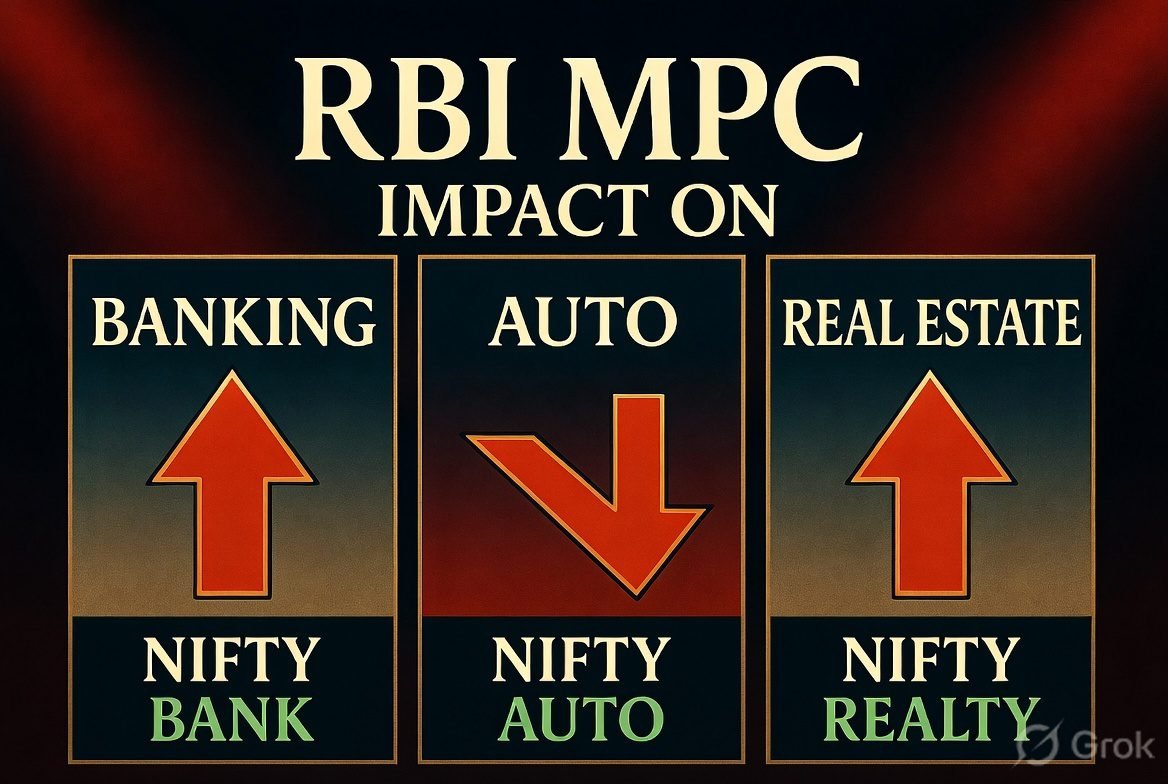
Rate-sensitive sectors — banking, auto, and real estate — typically move the most on MPC day itself. If you want to understand why certain sectors rotate in and out of favour around events like this, our guide on what is sector rotation explains the mechanics, and FII vs DII flows often shift noticeably in the days immediately following a policy announcement — you can check daily FII/DII activity yourself on the SEBI website or via Moneycontrol's FII/DII tracker.
RBI Repo Rate: Last 12 Months at a Glance
| Meeting Month | Repo Rate Decision | Rate After Decision |
|---|---|---|
| August 2025 | Held | 5.50% |
| October 2025 | Held | 5.50% |
| December 2025 | Cut 25 bps | 5.25% |
| February 2026 | Held | 5.25% |
| June 2026 | Held | 5.25% |
| August 2026 | To be announced (Aug 3–5) | — |
This table makes the pattern fairly obvious: one cut in the last six meetings, and a clear preference for stability otherwise. The RBI had already cut the Cash Reserve Ratio by 100 basis points, from 4% to 3%, in four tranches starting September 2025, which itself injected liquidity into the banking system without needing to touch the headline repo rate at all — a detail that's easy to miss if you're only watching the repo number. Full historical repo rate data going back decades is archived on the RBI Bulletin archive, and credit rating agencies like CRISIL and ICRA regularly publish their own rate-outlook notes ahead of each MPC meeting.
How to Prepare Before August 5
You don't need to do anything drastic before an MPC meeting, but a few small checks are worth doing:
If you're planning a large purchase on EMI — a car, a home, an appliance on a personal loan — there's no strong reason to rush before August 5 unless you were already close to signing. A hold changes nothing; a cut works in your favour if you wait a few extra weeks.
If you're deciding where to park a lump sum — an FD locked in now captures today's rate for the full tenure regardless of what happens on August 5, which matters if you expect rates to eventually fall.
If you're tracking your tax planning alongside this — remember the ITR filing deadline for 2026 sits close to this same period, and interest income from FDs and bonds needs to be accounted for regardless of which way the MPC swings.
And if you're a salaried reader also watching the 8th Pay Commission salary calculator or thinking about EPF transfers when changing jobs, none of that timeline is affected by the MPC outcome — these are separate tracks that just happen to be in the news at the same time.
Frequently Asked Questions
When is the RBI MPC August 2026 meeting?
The Monetary Policy Committee meets from August 3 to August 5, 2026, with the rate decision typically announced on the final day, usually around 10 AM.
What is the current repo rate before the August 2026 meeting?
The repo rate stood at 5.25% as of the June 2026 meeting, unchanged for three consecutive policy reviews.
Will the RBI cut rates in August 2026?
Based on current inflation staying within the RBI's target band and GDP growth holding near 6.6-6.8%, a hold looks more likely than a cut, though a modest 25 bps cut isn't off the table if inflation data softens further before the meeting.
How does the repo rate affect my home loan EMI?
If your loan is on a repo-linked floating rate, a repo rate cut typically lowers your EMI within one to three months, while a hold keeps your EMI unchanged. Fixed-rate loans aren't affected until renewal.
Does the repo rate affect FD interest rates?
Yes. Banks generally raise FD rates when the repo rate rises and lower them when it falls, though the pass-through isn't always immediate or one-to-one.
Who decides the repo rate in India?
The six-member Monetary Policy Committee of the RBI, chaired by the RBI Governor, decides the repo rate by majority vote at each bi-monthly meeting.
How often does the RBI review the repo rate?
The MPC meets six times a year, roughly every two months, to review and set the repo rate based on inflation, growth, and liquidity conditions.
What is a neutral policy stance?
A neutral stance means the RBI isn't committing in advance to either raise or cut rates — it signals that future decisions will depend entirely on incoming data, rather than following a pre-set direction.
Our Final Read Going Into August
We track this meeting the same way we track quarterly results — not because every single decision is dramatic, but because the pattern over several meetings tells you far more than any one announcement. Right now, that pattern points to a fourth consecutive hold, with the real story likely being the tone of the commentary around monsoon, inflation, and global trade rather than the rate number itself.
We'll publish the follow-up the moment the decision is announced on August 5, with the actual numbers and what changed from this preview. Until then, if you're comparing how this fits into your broader portfolio decisions, our guides on beginner investing and what is a demat account are good starting points if you're newer to tracking these events at all.

Pranab Barman is a Financial Educator and Personal Finance Researcher with over 10 years of hands-on experience in stock markets, trading, and investing. Currently enrolled in the CFA Program, he is committed to continuous learning and professional excellence in finance.
As the Founder of PlayWithStock, Pranab covers a wide range of topics including Mutual Funds, SIP, Taxation, Stock Market Basics, and Financial Calculators — with a focus on simplifying complex financial concepts for everyday all investors.
Email: support@playwithstock.com
Website: playwithstock.com
Related posts:
 RBI Repo Rate Cut 2026: The Complete Home Loan EMI Guide
 TCS Q1 FY27 Results Preview: Expected Revenue, Profit, Dividend & Key Things to Watch
 SGB Premature Redemption Calculator 2026: Tax Rules, RBI Dates & Exit Guide
 India US Trade Deal 2026: Inside the Tariff Rollercoaster Before July 22
 Fed Rate Hike 2026: Why the July 28-29 FOMC Meeting Could Change Everything
 Infosys Q1 FY27 Results Preview: What to Watch on 23 July
 SBI Mutual Fund IPO Opens Tomorrow: Everything Before You Apply
 SBI Mutual Fund IPO Listing: 7 Essential Facts to Know Before July 21 Debut